
 +1 844-445-5767
 +971 56-848-5757
 +91 921-208-0630
For Business & Service Inquiries
Sales Team
Project quotes, partnerships, implementation

Let's be direct. If your organization handles customer data, processes payments, operates in a regulated industry, or sells to enterprise clients—you are already subject to cybersecurity compliance obligations. The only question is whether you know exactly which ones and whether you're ready to prove it.
The compliance landscape has shifted dramatically. What used to be annual checkbox exercises handled by a single compliance officer have evolved into board-level obligations with real financial consequences. Regulators aren't issuing warnings anymore. European regulators reported over €1.2 billion in GDPR fines in 2025, with an average of 443 breach reports per day—the first time daily breach notifications exceeded 400 since GDPR came into force.
And in the US, the Department of Justice's Civil Cyber-Fraud Initiative is actively pursuing False Claims Act settlements against organizations that misrepresent their cybersecurity compliance posture, with one major defense contractor paying $8.4 million in May 2025 alone.
This blog is your pre-audit action guide. We're covering the core frameworks, what they cost when ignored, how different industries are impacted, and what your compliance program needs to look like before an auditor walks through the door—or a threat actor does.
Cybersecurity compliance is the process of meeting legally mandated, contractually required, or industry-standard security controls designed to protect sensitive data and systems. But here's the distinction that most organizations miss: compliance is not the same as security, and security is not the same as compliance. You need both.
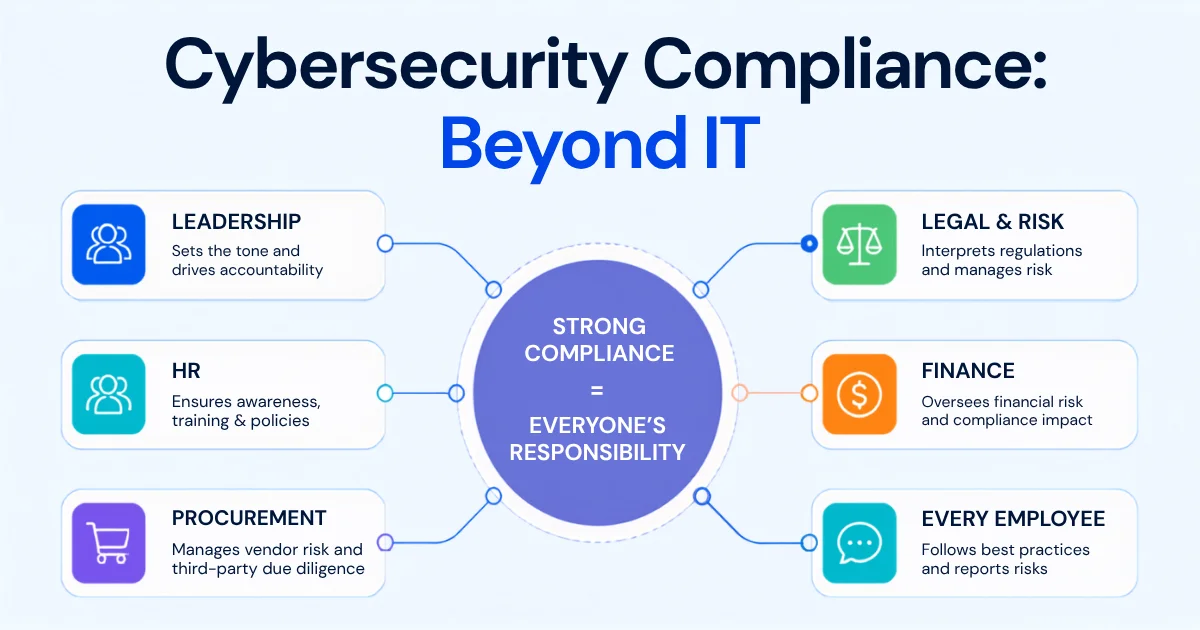
For a B2B enterprise, security and compliance serve three distinct functions: they protect you legally, they signal trustworthiness to clients and partners, and they create internal discipline around data governance that reduces your actual risk exposure.
The challenge in 2026 is the sheer volume of overlapping obligations. A financial services firm headquartered in New York, with EU clients and a SaaS vendor in India, may simultaneously need to satisfy PCI DSS 4.0, GDPR, New York's DFS Cybersecurity Regulation, GLBA, and soon India's DPDP Act. Each framework has different control requirements, different audit evidence standards, and different penalty structures.
This is why working with an experienced cybersecurity services provider has become a strategic decision rather than an operational one. For local organisations, understanding the cybersecurity services Australian businesses need can help align compliance, monitoring, risk management, and incident response under one stronger security strategy.
Understanding which frameworks apply to your organization is the starting point of any real information security and compliance program. Here is a definitive comparison of the major frameworks active globally in 2026.
|
Framework |
Who It Applies To |
Maximum Penalty |
Audit Frequency |
Mandatory? |
|
GDPR |
Any org handling EU personal data |
€20M or 4% of global revenue |
Ongoing/incident triggered |
Yes (EU law) |
|
HIPAA |
US healthcare + business associates |
$1.5M/year per violation category |
Periodic + breach-triggered |
Yes (US law) |
|
PCI DSS 4.0 |
Any org processing card payments |
$5K–$100K/month |
Annual |
Contractual |
|
NIST CSF 2.0 |
US federal contractors + voluntary |
N/A (framework) |
Self-assessed |
Voluntary/mandatory for govt |
|
ISO 27001 |
Global enterprises |
Certification loss |
Annual surveillance audit |
Voluntary (often contractually required) |
|
DORA |
EU financial sector + ICT providers |
2% of global turnover |
Annual TLPT |
Yes (EU law, active Jan 2025) |
|
CMMC 2.0 |
US defence contractors |
Loss of federal contracts |
Triennial |
Yes (DoD contracts) |
|
SOC 2 Type II |
SaaS / cloud service providers |
Business/contractal loss |
Annual |
Contractual |
|
CCPA/CPRA |
Orgs with CA consumer data |
$7,500/intentional violation |
Ongoing |
Yes (CA law) |
|
India DPDP Act |
Orgs processing Indian personal data |
₹250 crore (~$30M) |
As notified |
Yes (2025 onward) |
PCI DSS 4.0 introduces significant new requirements: more frequent phishing training, stricter multi-factor authentication, more robust access logging, and an explicit shift toward continuous IT security compliance rather than point-in-time assessments. If you process card payments and haven't updated your program to 4.0 requirements, you are already behind.
Only about 32% of organizations are fully PCI DSS compliant at any given time. That's two-thirds of payment-processing businesses running exposed.
This is the section your CFO, general counsel, and board need to read. The financials of cybersecurity risk compliance failures are no longer theoretical.
The average cost of compliance is $5.47 million — substantial, but far less than the financial burden of failing to meet legal and regulatory standards. When organizations model this against actual breach and penalty costs, the ROI of proactive compliance becomes undeniable.
|
Framework |
Fine Structure |
Real-World Example |
|
GDPR |
Up to €20M or 4% of global revenue |
LinkedIn fined €310M (Oct 2024); Meta fined €251M (Dec 2024) |
|
HIPAA |
$100–$50,000 per violation; max $1.5M/year |
The average HIPAA fine tied to ransomware hit $1.8M per incident in 2024–2025 |
|
PCI DSS |
$5,000–$100,000/month + card privilege loss |
68% of retailers non-compliant at any given time |
|
CCPA |
$2,500 unintentional / $7,500 intentional per violation |
Thousands of records = millions in fines |
|
DORA |
Up to 2% of global annual turnover |
Active enforcement began January 2025 |
|
CMMC 2.0 |
Loss of DoD contracts |
Only 8% of defence contractors currently certified against a November 2026 deadline |
Beyond the direct fines, non-compliance can add to the average data breach cost, on top of regulatory penalties, reputational damage, remediation expenses, downtime, legal response, and customer loss. For a deeper financial breakdown, read our guide on the cost of a cybersecurity breach in Australia.
Non-compliance costs 2.71 times more than compliance when all factors are totalled. That ratio is the most persuasive number in any board-level conversation about cybersecurity risk compliance investment.
Information security compliance requirements are not uniform. The frameworks that apply to you—and the severity of enforcement—depend heavily on your industry. Here's the breakdown that sector-specific decision-makers need.
Healthcare is the most expensive sector for breach recovery. Healthcare breaches average approximately $11 million per incident, driven by the sensitivity of protected health information (PHI) and the weight of HIPAA regulation.
Nearly half—48%—of healthcare organizations experienced at least one cybersecurity incident in the past year, and financial gain drove attacker motive in 90% of healthcare security breaches.
Required frameworks: HIPAA Security Rule, HITECH Act, SOC 2, and increasingly state privacy laws for telehealth providers. The HHS Office for Civil Rights closed 22 HIPAA investigations with financial penalties in 2024 alone.
What to do: Conduct a full HIPAA Security Risk Assessment, implement encrypted PHI storage and access logging, and ensure all business associates have signed updated BAAs. Proactive engagement with IT risk management professionals is essential here — the HHS audits technical controls, not intentions.
Finance and insurance consistently rank as the second-most targeted sector globally, and in some regions—including the Middle East and Africa—nearly 38% of all incidents targeted financial institutions.
Finance averages approximately $6 million per breach and faces high regulatory exposure from the SEC, GLBA, DORA, and PCI DSS simultaneously.
The SEC's cybersecurity disclosure rules now require publicly traded companies to report material cybersecurity incidents within four business days of determination. DORA, active since January 2025, requires financial entities in the EU to conduct annual threat-led penetration testing and maintain documented ICT risk frameworks.
Required frameworks: GLBA, PCI DSS 4.0, DORA (EU), SEC Cybersecurity Rules, NY DFS Part 500, SOX (for listed entities).
Ransomware appeared in 44% of all confirmed retail breaches in 2025, up from 32% the year before, and the attacks on three major British retailers carried a combined financial impact estimated between £270 million and £440 million.
Retail's primary obligation is PCI DSS—every organization that stores, processes, or transmits cardholder data is in scope. But with the rise of e-commerce, GDPR, CCPA, and increasingly India's DPDP Act are adding layers of information security compliance obligations.
46% of retail ransomware victims blamed unknown security gaps, and 45% cited a lack of in-house expertise — the highest expertise gap recorded in any sector surveyed. This is precisely why outsourcing to managed security services has become the default posture for retail IT teams that cannot sustain an internal SOC.
Manufacturing has been the most-attacked industry globally for four consecutive years, with ransomware targeting legacy OT/ICS systems and weak IT-OT network segmentation being the primary entry points. Nearly 29% of attacks on manufacturing aim specifically at operational disruption and extortion.
The compliance challenge here is unique: manufacturing straddles IT security frameworks (ISO 27001, NIST CSF) and operational technology standards (IEC 62443, NERC CIP for energy-adjacent facilities). For US defense supply chain manufacturers, CMMC 2.0 certification is now a contract requirement—and with the November 2026 enforcement deadline approaching, only 8% of required contractors are currently certified.
SaaS companies face the broadest cybersecurity compliance surface of any sector because they inherit the regulatory obligations of every client vertical they serve. A SaaS platform serving healthcare needs HIPAA BAAs. One serving financial institution needs SOC 2 Type II and potentially PCI DSS. One with EU users needs GDPR.
Total GDPR fines reached approximately €5.65 billion by March 2025, with penalties averaging 18% higher year-over-year. SaaS companies that treat compliance as a sales accelerator—rather than a legal burden—are winning enterprise contracts faster than those that treat it as an afterthought.
Read More: Penetration Testing Guide Australia 2026 | Types, Cost & Process
The regulatory environment has accelerated. Here is what's new and what it means for your obligations right now—and where regulatory compliance services become critical for organizations operating across multiple jurisdictions.
EU AI Act (Active 2025–2026): Organizations deploying high-risk AI systems in areas like credit scoring, employment, healthcare, and critical infrastructure now face mandatory conformity assessments, technical documentation requirements, and ongoing monitoring obligations. Non-compliance carries fines up to €30 million or 6% of global revenue.
DOJ Bulk Data Rule (Active April 2025): The DOJ's Bulk Data Rule introduced a new framework governing how US persons engage in transactions involving bulk personal data with foreign parties, requiring stringent cybersecurity controls to prevent covered persons from accessing relevant data.
State Privacy Laws (Eight new in 2025): Eight new state data privacy laws took effect in 2025 in states including Delaware, Iowa, Nebraska, and Maryland, each with unique requirements around consumer rights, enforcement penalties, and applicability. With 11 new comprehensive privacy laws slated to take effect in 2025 and 2026, approximately half of the US population will be covered by a state comprehensive privacy law by 2026.
India DPDP Act: Now in the enforcement phase, the Digital Personal Data Protection Act applies to any organization processing personal data of Indian residents—including global companies with Indian users. The framework introduces consent requirements, breach notification obligations, and penalties up to ₹250 crore (~$30M USD).
CMMC 2.0 (Enforcement: November 2026): US defense contractors must achieve CMMC Level 2 or Level 3 certification—third-party assessed—to win or retain DoD contracts. The window is closing fast.
Engaging an experienced IT consulting services company with regulatory expertise is no longer optional for organizations navigating multi-jurisdictional obligations. The complexity of simultaneous multi-framework compliance requires dedicated expertise and often purpose-built GRC technology.
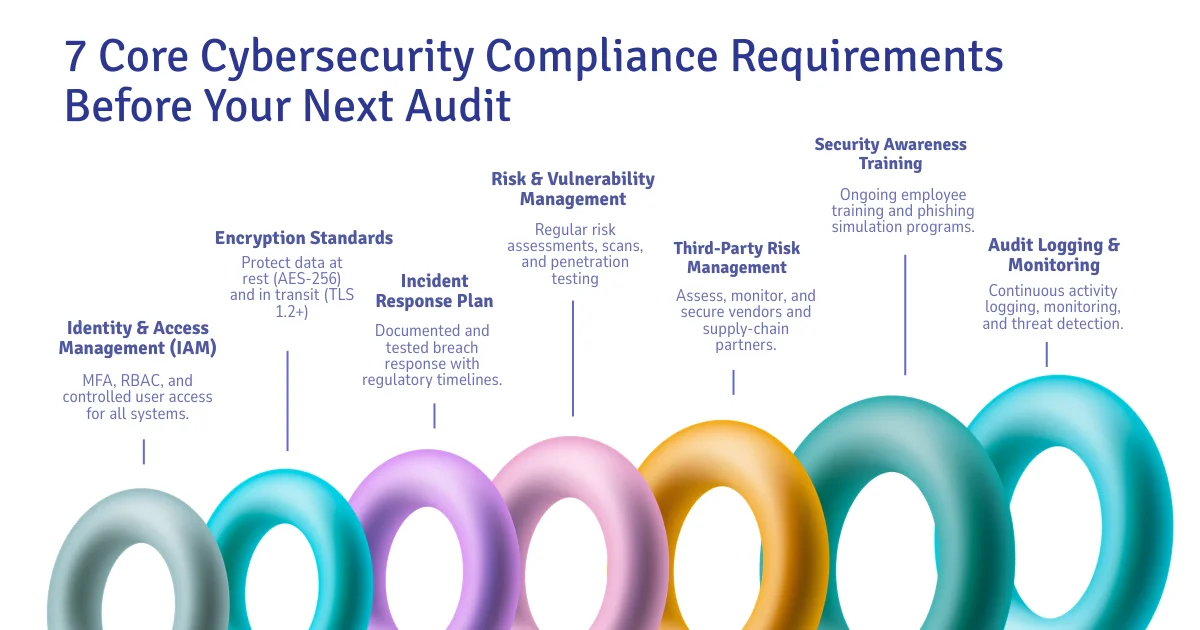
These are the core control areas that every major framework — GDPR, HIPAA, PCI DSS, NIST CSF 2.0, ISO 27001, DORA — assesses in some form. Gaps in any of these will surface in an audit. Getting IT security compliance right across all seven is the baseline for passing any credible assessment.
Moving to the cloud doesn't transfer your compliance obligations — it complicates them. The shared responsibility model means your cloud provider secures the infrastructure, but you own the data security and compliance of everything running on it.
Cloud-specific compliance risks include:
Cloud Security Services designed around compliance workloads—including posture management (CSPM), cloud-native access controls, and automated compliance reporting—are now a foundational requirement for any organization running regulated workloads in AWS, Azure, or GCP.
Cloud Compliance Checklist:
Print this. Share it with your team. Use it 90 days before your next compliance audit.
Governance and Documentation
Technical Controls
Operational Readiness
Audit Evidence
Organisations engaging cybersecurity services Australia should additionally note that the Australian Privacy Act 2024 reforms require mandatory data retention protocols and enhanced breach notification obligations for organizations with annual turnover above AUD $3 million.
Here's the truth that compliance frameworks don't tell you: being compliant in December doesn't mean you're secure in February. Compliance is a point-in-time snapshot. Security is a continuous posture. To stay protected, businesses must also understand the cybersecurity threats Australian businesses face in 2026 and align compliance controls with real attack risks. The organizations winning at both have adopted compliance management services that align the two—treating compliance as an operational discipline, not a quarterly sprint.
The practical approach for B2B enterprises in 2026 is to build compliance into operations rather than treating it as a pre-audit scramble. This means:
Continuous control monitoring over manual evidence collection—automated GRC platforms (like Sprinto, Vanta, Drata, or ServiceNow GRC) continuously collect and map evidence against framework controls, reducing audit prep time by 60–80%.
Common control libraries that satisfy multiple frameworks simultaneously. A single encryption policy, if written correctly, can satisfy GDPR Article 32, HIPAA Security Rule §164.312, PCI DSS Requirement 3, and ISO 27001 Annex A.10 at the same time. Starting with a common control library that maps one set of controls across several frameworks, then automating evidence collection from your cloud, identity, and ticketing tools, is the operational standard for compliance-mature enterprises.
Board-level reporting that translates compliance posture into business risk language. CISOs who present compliance status as "we are 94% control-compliant across GDPR, SOC 2, and PCI DSS" speak to CFOs and boards far more effectively than those presenting technical vulnerability counts.
Enterprises that invest in structured cybersecurity compliance services — rather than patchwork point solutions — consistently report faster audit cycles, fewer findings, and stronger client trust scores across procurement evaluations.
|
Scenario |
Average Cost |
|
Cost of building a compliance programme |
$5.47M (enterprise average) |
|
Average US data breach cost (2025) |
$10.22M |
|
Healthcare breach average |
$11M |
|
Finance breach average |
$6M |
|
GDPR maximum fine |
€20M or 4% of global revenue |
|
Cost savings from security automation |
$1.9M per breach avoided |
|
Non-compliance premium (vs. compliance cost) |
2.71× more expensive |
The math isn't close. The cost of compliance—even at enterprise scale—is consistently less than the combined cost of a single significant breach, regulatory penalty, and the subsequent remediation and reputational recovery.
The B2B enterprises that have shifted how they think about cybersecurity compliance — from burden to business enabler — are the ones closing enterprise contracts faster, passing vendor security questionnaires without friction, and attracting institutional investment with confidence.
Your clients, especially large enterprises and regulated-sector buyers, are increasingly requiring ISO 27001 certification, SOC 2 Type II reports, and documented GDPR compliance as conditions of vendor onboarding. Robust regulatory compliance services are a commercial advantage when deployed proactively. They become a liability when treated reactively.
If your organization is approaching an audit, entering a new regulated market, or simply recognizing that your current posture hasn't kept pace with a rapidly evolving regulatory environment—now is the time to act.



Start Build Your
Next Digital Solution?
Let’s build scalable, future-ready digital solutions tailored to your business goals. Connect with our experienced technology consultants to discuss your vision, strategy, and growth opportunities — with zero obligation and complete transparency.
Get a free consultation and cost estimate for your digital solution
Our expert will contact you within 24 hours. Check your email for confirmation.
Partner with SISGAIN experts to build secure, scalable AI-powered IT Solutions that transform your business operations.












DUQE FREEZONE Quarter Deck, Queen Elizabeth 2, Mina Rashid, Dubai, UAE

100 Consilium Pl Suite 200, Scarborough, ON M1H 3E3, Canada

C-109, Sector 2, Noida, Uttar Pradesh 201301 India
Project quotes, partnerships, implementation
Open roles, referrals, campus hiring