
 +1 844-445-5767
 +971 56-848-5757
 +91 921-208-0630
For Business & Service Inquiries
Sales Team
Project quotes, partnerships, implementation

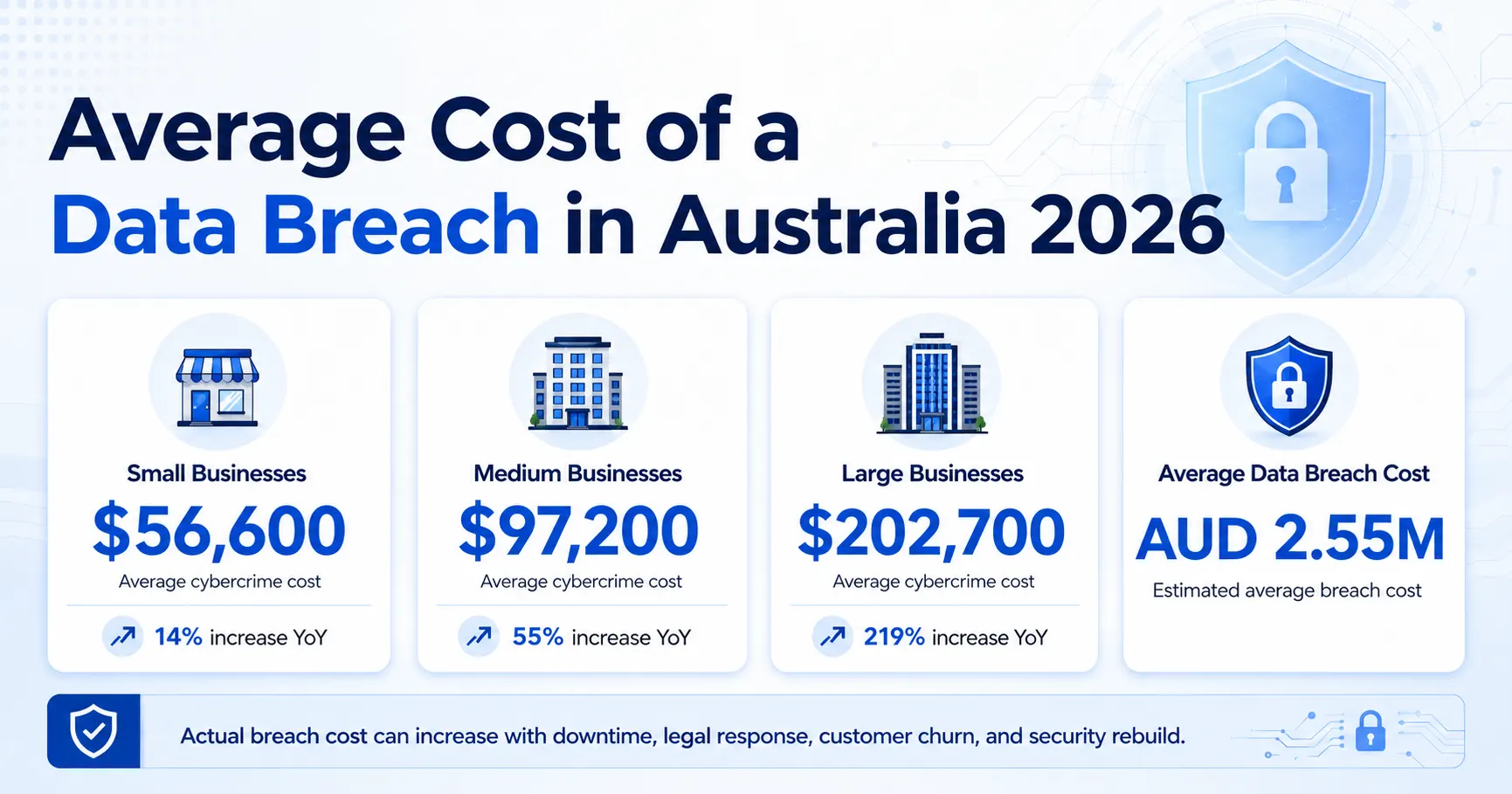
Quick Summary: The average cost of a data breach in Australia is estimated at AUD 2.55 million based on the Cost of a Data Breach Report 2025. However, the final impact varies by industry, business size, exposed records, downtime duration, and regulatory response. For smaller organizations, the Australian Signals Directorate (ASD) reports average cybercrime costs rising to $56,600 for small businesses, $97,200 for medium businesses, and $202,700 for large enterprises. Investing in preventive cybersecurity measures significantly reduces these financial impacts.
Every modern Australian business faces an undeniable reality: cyber attacks are no longer a matter of if, but when. As digital transformation accelerates and cloud adoption becomes the baseline for operational efficiency, the financial stakes associated with securing corporate data have never been higher. Business leaders often view cybersecurity as an IT expense, but a closer look at the actual cost of data breach incidents reveals it is fundamentally a business continuity and risk management issue.
Understanding the cybersecurity breach cost in Australia requires looking far beyond the immediate IT remediation bills. When a cyber incident occurs, organizations face a cascade of financial consequences, ranging from regulatory fines and legal settlements to devastating operational downtime and severe reputation damage. For B2B business owners, founders, and compliance heads, calculating these potential losses is the first step toward building a resilient security posture.
This comprehensive guide breaks down the true cost of cybercrime in Australia for 2026. By examining direct losses, uncovering hidden operational expenses, and comparing the cost of an attack against the return on investment (ROI) of proactive defense, decision-makers can make informed, strategic investments to protect their most valuable assets.
Note: This guide is written for Australian business owners, founders, IT managers, compliance leaders, and decision-makers who need to understand the financial risk of cyber incidents before investing in prevention.
Quick Answer: The average cost of a data breach in Australia is estimated in the millions of dollars, while ASD’s 2024–25 cyber threat data shows self-reported cybercrime costs of around $56,600 for small businesses, $97,200 for medium businesses, and $202,700 for large businesses. Actual breach costs can be much higher when downtime, legal fees, customer churn, regulatory response, and security rebuild expenses are included.
For Australian organizations, the financial toll of a cyber incident continues to climb. According to the Cost of a Data Breach Report 2025, the average cost of a data breach in Australia is currently estimated at AUD 2.55 million. This figure encompasses the entire lifecycle of a breach, including detection, escalation, notification, and post-breach response.
However, averages only tell part of the story. The ASD Cyber Threat Report 2024-2025 highlights a 50% year-over-year increase in overall cybercrime costs for businesses. The report indicates a 14% increase in costs for small businesses, a 55% increase for medium businesses, and a 219% increase for large businesses. These figures demonstrate that the average cost of data breach Australia experiences is highly dependent on organizational size, industry, and the sophistication of the attack.
The cyber attack cost Australia experiences is not increasing in a vacuum. Several converging factors are driving up the financial impact of security incidents, forcing Australian businesses to reassess their threat landscapes. To understand these rising expenses, organizations must review the cybersecurity threats Australian businesses can't ignore and adapt accordingly.
As Australian businesses migrate their operations to cloud environments, investing in professional cloud security services becomes essential because exposed cloud workloads, weak access policies, and compromised credentials can expand the attack surface quickly. When cloud environments are breached, the volume of exposed records is typically higher, driving up the subsequent data breach recovery cost.
Generative AI and advanced automation have allowed cybercriminals to craft highly sophisticated, hyper-personalized phishing campaigns. Business Email Compromise (BEC) attacks bypass traditional spam filters, tricking employees into authorizing fraudulent wire transfers or handing over administrative credentials, which is why strong identity and access management services are critical for controlling privileged access and reducing credential-based breach risk. The financial impact of BEC is immediate and often unrecoverable.
The Australian government has introduced stringent regulatory frameworks to protect consumer privacy and critical infrastructure. Organizations that fail to secure their data face severe penalties under the Privacy Act and the Security of Critical Infrastructure (SOCI) Act. Meeting these cybersecurity compliance requirements for Australian businesses requires dedicated resources, and weak evidence of security controls can increase regulatory scrutiny, legal exposure, and remediation costs after an incident.
Under Australia’s Notifiable Data Breaches scheme, organizations may need to assess eligible data breaches, notify affected individuals, and report serious privacy incidents to the OAIC. This means breach response is not only a technical recovery process; it also becomes a legal, compliance, communication, and governance exercise.
Modern businesses operate on tight supply chains and constant digital availability. When a ransomware attack encrypts critical servers, operations grind to a halt. The business downtime cost compounds every hour systems remain offline, resulting in missed sales, disrupted client services, and contractual penalties for failing to meet Service Level Agreements (SLAs).
When a breach occurs, the immediate financial hemorrhage begins within hours. These direct costs are the highly visible line items that hit the balance sheet immediately following an incident.
| Direct Cost Category | Description of Expense | Why It Increases Breach Cost |
|---|---|---|
| Digital Forensics | Hiring external experts to investigate the breach source and scope. | Specialist response teams are required urgently, increasing professional service costs. |
| Ransom Payments | Capital paid directly to threat actors, which is strongly discouraged by ASD. | Payments do not guarantee recovery and may still be followed by downtime, data leaks, and rebuild costs. |
| Legal Counsel | Retaining privacy lawyers to manage regulatory and customer notification duties. | Legal review is needed to reduce compliance risk, class-action exposure, and reporting mistakes. |
| Customer Notification | Mandated communication to affected customers, partners, and stakeholders. | Large breach volumes increase communication, support, and reputation management costs. |
| Identity Protection | Providing credit monitoring or identity protection support for affected users. | Per-user protection costs can grow quickly when thousands of records are exposed. |
While direct costs are painful, the hidden expenses of a cyber incident often eclipse the initial forensic and legal bills. These long-tail costs can haunt an Australian business for years after the initial breach is contained.
The most devastating hidden expense is operational paralysis. If an organization cannot process orders, access client records, or manufacture goods, revenue drops to zero. Business downtime cost extends beyond immediate sales, often disrupting long-term revenue streams and delaying critical product launches.
Trust is the currency of the B2B marketplace. When client data is compromised, competitors capitalize on the vulnerability. Customer churn accelerates as clients migrate to providers they perceive as more secure. Rebuilding brand equity requires expensive public relations campaigns and significant marketing investment.
Following a breach, cyber insurance providers immediately reassess the organization's risk profile. Businesses can expect their premiums to double or triple upon renewal. In some cases, insurers may refuse coverage entirely until the business implements expensive, enterprise-grade security controls.
During a cyber incident response, regular operations are suspended. Employees are unable to access their workstations, applications, or emails, leading to thousands of hours of paid but unproductive labor. Additionally, IT staff burn out rapidly while working around the clock to restore systems.
Regulatory bodies like the Office of the Australian Information Commissioner (OAIC) will scrutinize the breached organization. The business must fund extensive, mandated security audits to prove compliance. Furthermore, the organization may be subject to ongoing regulatory oversight, adding permanent administrative overhead.
A breach clearly demonstrates that existing security measures were inadequate. The organization is forced to accelerate its IT roadmap, making sudden, unbudgeted capital expenditures on new firewalls, endpoint detection systems, and advanced threat monitoring platforms.
The nature of the cyber attack heavily influences the total financial damage. Understanding these variations helps Australian organizations prioritize their defensive strategies.
|
Attack Vector |
Primary Financial Driver |
Estimated Cost Impact |
|---|---|---|
|
Ransomware |
Extortion payments, massive system downtime, and complete network rebuilds. |
Severe |
|
Business Email Compromise (BEC) |
Direct financial theft via fraudulent wire transfers and invoice manipulation. |
High |
|
Malicious Insider |
Theft of intellectual property, trade secrets, and proprietary databases. |
High |
|
Phishing / Stolen Credentials |
Unauthorized access leading to data exfiltration and compliance fines. |
Medium to High |
|
Cloud Misconfiguration |
Mass exposure of customer data resulting in heavy regulatory penalties. |
Medium |
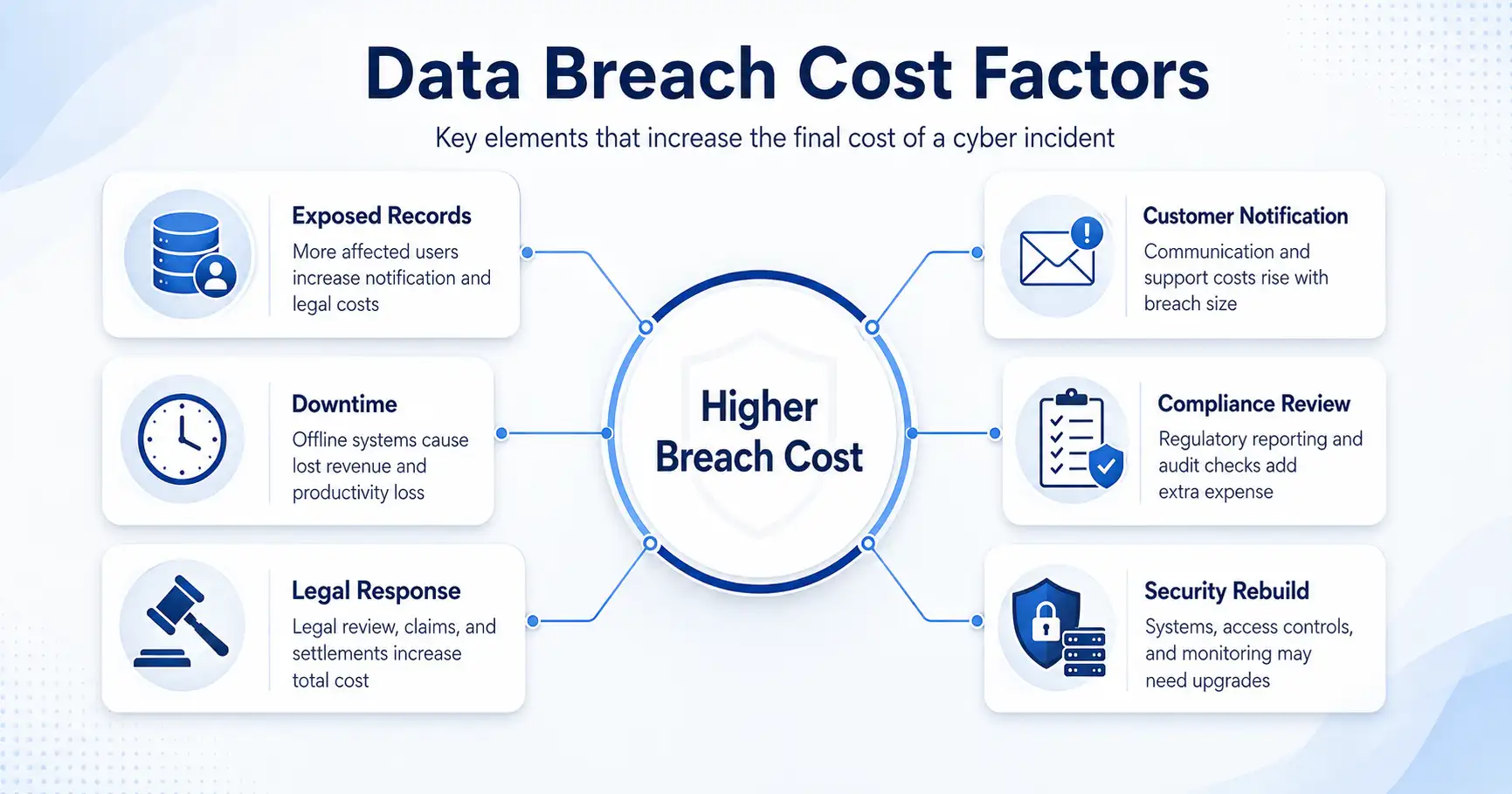
The final cost of a cyber incident depends on more than the attack type. Australian businesses usually face higher breach costs when the incident involves large volumes of customer data, regulated personal information, long detection times, poor backup readiness, weak incident response planning, or third-party vendor exposure.
The cyber attack cost Australia faces scales disproportionately depending on the size of the organization. While enterprises face larger total dollar losses, small and mid-market businesses often suffer higher costs relative to their overall revenue.
|
Business Size |
Key Vulnerability |
Average ASD Cybercrime Cost (2024-2025) |
|---|---|---|
|
Small Businesses |
Lack of dedicated IT staff and reliance on basic, consumer-grade security tools. |
~$56,600 |
|
Mid-Market |
Expanding cloud footprints without scalable, enterprise-grade access controls. |
~$97,200 |
|
Enterprises |
Complex supply chains and vast amounts of highly regulated consumer data. |
~$202,700 |
Small businesses often operate under the false assumption that they are too small to be targeted. Consequently, they underinvest in security. When an incident occurs, the small business cybercrime cost can be catastrophic, often leading to bankruptcy due to an inability to absorb downtime and legal liabilities.
Mid-market organizations present the perfect target for cybercriminals. They possess significant financial assets and valuable data but often lack the sophisticated Security Operations Centers (SOC) of larger enterprises. Their breach costs are driven by complex IT environments that are difficult to secure and expensive to restore.
Enterprises face the highest total cost of cybercrime Australia records. Their breaches involve millions of records, triggering severe regulatory scrutiny, class-action lawsuits, and international media coverage. Enterprises must navigate complex, multi-jurisdictional legal landscapes when responding to an incident.
After a cyber breach, Australian businesses usually move through several urgent stages: detecting the incident, containing affected systems, investigating the root cause, assessing exposed data, notifying stakeholders, restoring operations, and rebuilding security controls. Each stage adds cost, especially when the business does not already have an incident response plan, backup strategy, or managed security partner in place.
Business leaders must reframe cybersecurity from a sunk cost into an investment in risk reduction. The ROI of prevention is clear when comparing the devastating cost of a breach to the predictable, manageable expense of proactive security.
To bridge this gap, organizations must invest in the cybersecurity services Australian businesses need. A robust defense-in-depth strategy costs a fraction of a full-scale cyber incident response. For example, commissioning regular penetration testing for Australian businesses allows organizations to identify and patch vulnerabilities before threat actors exploit them.
For most businesses, prevention is easier to budget than recovery. Security assessments, penetration testing, managed monitoring, employee training, and incident response planning are predictable investments, while breach recovery often arrives as an urgent, unplanned expense with legal, technical, operational, and reputational consequences.
|
Security Posture |
Financial Model |
Business Impact |
|---|---|---|
|
Reactive (Wait for Breach) |
Unpredictable, catastrophic losses averaging AUD 2.55 million. |
High risk of bankruptcy, severe reputation damage, and massive downtime. |
|
Proactive (Prevention ROI) |
Predictable monthly operating expenses for managed security. |
Business continuity secured, compliance achieved, and brand equity protected. |
Building an internal Security Operations Center (SOC) is prohibitively expensive for most organizations. Sourcing elite cybersecurity talent, purchasing enterprise software, and maintaining 24/7 monitoring drains IT budgets rapidly.
Partnering with an MSSP (Managed Security Service Provider) offers a highly effective alternative. When evaluating a managed security services vs in-house security team, the MSSP consistently provides superior threat detection at a lower total cost of ownership. SISGAIN helps Australian businesses reduce breach exposure through managed security monitoring, vulnerability assessment, penetration testing support, compliance-focused security reviews, and incident readiness planning. This gives business owners a practical way to reduce cyber risk without building a costly full-time internal SOC.
Reducing the cybersecurity breach cost Australia experiences requires a strategic, layered approach to defense.
|
Prevention Measure |
Benefit to Organization |
Impact on Breach Cost |
|---|---|---|
|
Implement Zero Trust Architecture |
Restricts lateral movement if a threat actor breaches the perimeter. |
High Reduction |
|
Deploy endpoint security services |
Identifies and isolates ransomware before it encrypts the network. |
High Reduction |
|
Conduct Regular Employee Training |
Lowers the success rate of phishing and social engineering attacks. |
Medium Reduction |
|
Establish an Incident Response Plan |
Ensures a rapid, coordinated reaction to minimize operational downtime. |
High Reduction |
|
Enforce Multi-Factor Authentication (MFA) |
Prevents unauthorized access via stolen or compromised credentials. |
High Reduction |
The optimal time to invest in breach prevention is immediately. Cyber threats evolve daily, and delaying security upgrades leaves the organization exposed to unacceptable levels of risk. If an Australian business is migrating to the cloud, onboarding remote workers, acquiring new companies, or processing sensitive customer data, a comprehensive cybersecurity risk assessment is urgently required. Waiting until an audit fails or a breach occurs guarantees maximum financial damage.
The cost of data breach Australia faces in 2026 proves that cybersecurity is an executive-level priority. At an average cost of AUD 2.55 million, an attack threatens the very survival of an organization. By recognizing the hidden expenses of downtime, reputational damage, and regulatory fines, B2B leaders can justify the critical investments needed to secure their environments. Partnering with expert providers like SISGAIN transforms cybersecurity from a reactive panic into a proactive, strategic business advantage.
A single cyber incident can cost far more than prevention. SISGAIN helps Australian businesses identify security gaps, strengthen compliance readiness, improve incident response planning, and reduce the financial impact of cyber threats.
Book a cybersecurity risk assessment with SISGAIN today and get a practical roadmap to identify gaps, strengthen compliance readiness, and reduce breach risk in 2026.



Start Build Your
Next Digital Solution?
Let’s build scalable, future-ready digital solutions tailored to your business goals. Connect with our experienced technology consultants to discuss your vision, strategy, and growth opportunities — with zero obligation and complete transparency.
Get a free consultation and cost estimate for your digital solution
Our expert will contact you within 24 hours. Check your email for confirmation.
Partner with SISGAIN experts to build secure, scalable AI-powered IT Solutions that transform your business operations.












DUQE FREEZONE Quarter Deck, Queen Elizabeth 2, Mina Rashid, Dubai, UAE

100 Consilium Pl Suite 200, Scarborough, ON M1H 3E3, Canada

C-109, Sector 2, Noida, Uttar Pradesh 201301 India
Project quotes, partnerships, implementation
Open roles, referrals, campus hiring