






























































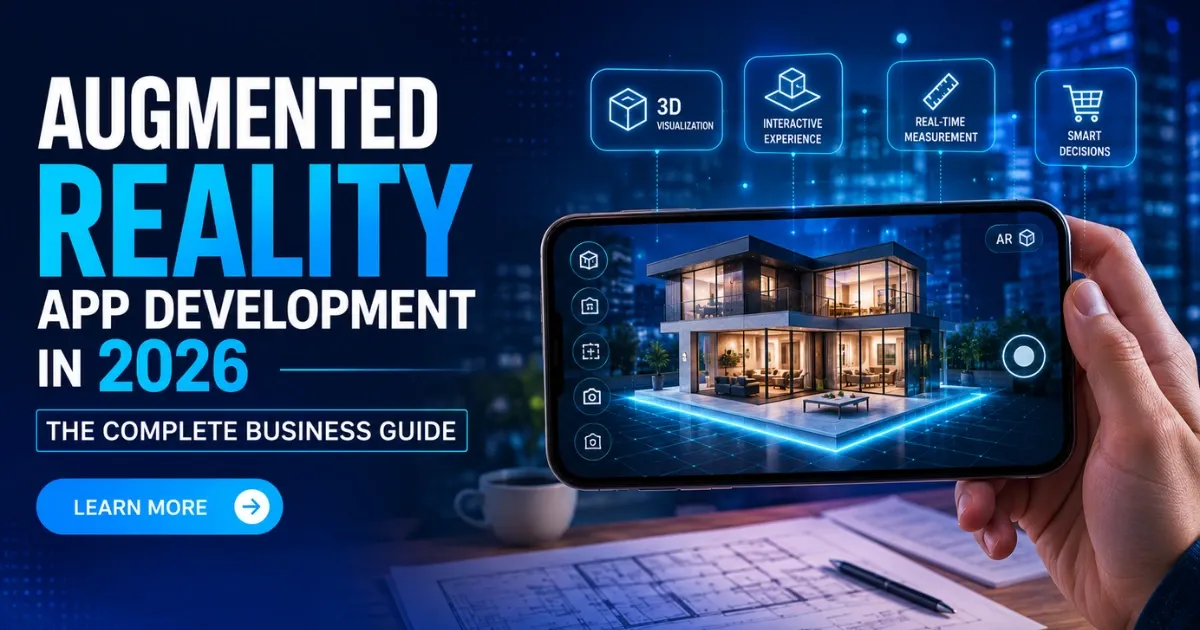
Augmented Reality App Development in 2026: The Complete Business Guide
Executive Summary Augmented reality app development has moved from an experimental novelty to a core enterprise capability — and nowhere is that shift more visible than in Dubai and the wider UAE, where logistics operators, retailers, and government-backed digital transformation programs are racing to deploy spatial computing at scale. This guide breaks down what augmented reality app development actually involves in 2026, how AR apps work under the hood, the development process from discovery to optimization, the tools and technology stack powering modern builds, realistic costs, and the business use cases delivering measurable ROI — with particular attention to logistics, supply chain, and warehouse operations across the region. Whether you're a COO evaluating AR for warehouse navigation or a CTO scoping an AI-powered AR pilot, this guide gives you the operational clarity to move from curiosity to a funded roadmap. Quick Answers Augmented reality app development is the process of designing and building software that overlays digital content — 3D objects, data, navigation cues, or instructions — onto a live view of the real world, typically through a smartphone camera, tablet, or AR headset, enabling real-time interaction between digital and physical environments. AR apps use a device's camera and sensors to detect surfaces and track motion, then apply computer vision and spatial mapping to anchor 3D digital content to the physical environment, rendering it in real time so users can view and interact with it as though it exists in their surroundings. How long does it take to build an AR app? App Type Typical Timeline Simple MVP (marker-based, single platform) 8–12 weeks Business AR app (markerless, cross-platform) 4–6 months Enterprise AR app (AI-enabled, multi-device) 6–10 months Industrial/warehouse AR system 8–14 months Project Tier Estimated Cost Range Simple MVP $20,000 – $45,000 Business App $45,000 – $120,000 Enterprise App $120,000 – $350,000 AI-Enabled / Industrial AR $350,000+ Which industries benefit most from AR? Logistics and supply chain (warehouse navigation, pick-and-pack, fleet maintenance) Retail and e-commerce (virtual try-on, product visualization) Healthcare (surgical support, training, patient education) Manufacturing (quality inspection, remote assistance) Construction and real estate (digital twins, site visualization) Key Takeaways AR has evolved from novelty into a practical business technology, particularly for logistics-heavy economies like the UAE. AI and spatial computing are reshaping how AR experiences are built and deployed. Mobile AR continues to dominate enterprise adoption despite growing wearable interest. Businesses in Dubai are investing in AR for warehouse productivity, workforce training, retail engagement, and customer experience. Successful AR projects prioritize usability and operational impact over visual polish. Choosing the right development tools significantly affects long-term scalability. ROI depends on solving measurable business problems — not showcasing technology for its own sake. What Is Augmented Reality App Development? Augmented reality app development is the discipline of building software that blends digital content with the physical world in real time. Unlike virtual reality, which replaces a user's environment entirely, AR enhances what's already there — a warehouse aisle, a shop floor, a shipping container, a retail shelf — by layering data, 3D models, or interactive instructions directly onto it. Definition At its core, an AR app captures a live camera feed, understands the geometry and lighting of the surrounding space, and renders digital elements that appear anchored to real-world surfaces. The result feels less like using an app and more like interacting with an intelligent extension of your environment. Difference Between AR, VR, and MR Technology Environment Interaction Typical Hardware Augmented Reality (AR) Real world + digital overlay Partial digital interaction Smartphone, tablet, smart glasses Virtual Reality (VR) Fully simulated Full digital immersion VR headset Mixed Reality (MR) Real world + persistent digital objects that interact with physical space Deep bidirectional interaction MR headset (e.g., HoloLens-class devices) Why Businesses Invest in AR Enterprises no longer view AR as a marketing gimmick. Across the UAE, businesses are adopting AR because it directly reduces error rates, shortens training cycles, and improves customer conversion — outcomes that are measurable on a balance sheet, not just a demo reel. Enterprise adoption has accelerated as mobile-first AR frameworks matured, making pilots faster and cheaper to launch. AI-powered AR now allows apps to recognize objects, understand context, and respond intelligently rather than simply displaying static overlays, while spatial computing — the broader category AR belongs to — is becoming a foundational layer for how enterprises visualize operations, from warehouse floors to smart city infrastructure. Takeaway: AR app development in 2026 is no longer about visual novelty — it's about embedding intelligent, spatially aware software into everyday business operations. Why Augmented Reality App Development Matters More Than Ever in 2026 Several converging forces have pushed AR from "nice to have" to strategic priority. The spatial computing revolution. As computing shifts from flat screens to spatially aware interfaces, AR is becoming the connective layer between physical operations and digital systems — particularly relevant for logistics hubs like Jebel Ali, where physical throughput and digital visibility must move in lockstep. AI integration. Modern AR apps combine computer vision with generative AI and large language models, enabling apps that don't just overlay static graphics but reason about what they're looking at — identifying a damaged pallet, flagging a mislabeled SKU, or guiding a technician through a repair. Rising consumer expectations. Shoppers increasingly expect to visualize products before buying, particularly in high-value categories like furniture, fashion, and automotive — categories central to Dubai's retail economy. Enterprise digital transformation. UAE government initiatives around smart logistics, Dubai's positioning as a global trade and logistics hub, and enterprise investment in digital twins are all accelerating AR adoption within supply chain and warehousing operations. For most organizations, AR isn't deployed in isolation — it's rolled out as part of a wider suite of digital IT solutions spanning ERP modernization, IoT, and data analytics. Smartphone and wearable growth. With near-universal high-end smartphone penetration across the UAE and growing enterprise interest in smart glasses for hands-free warehouse work, the hardware barrier to AR adoption has largely disappeared. Market growth. Global AR market estimates place the industry on a trajectory toward tens of billions of dollars in annual value by the late 2020s, with enterprise and industrial AR — including logistics and field service — representing one of the fastest-growing segments. Takeaway: The convergence of AI, spatial computing, and regional digital infrastructure investment has made 2026 the inflection point for enterprise AR adoption in the UAE. How AR Apps Work Understanding the underlying mechanics helps decision-makers ask sharper questions during vendor evaluations. A typical AR app follows this pipeline: Camera → Environment Detection → Plane Detection → Object Recognition → Spatial Mapping → 3D Rendering → User Interaction → Analytics Camera capture — The device continuously captures live video frames. Environment detection — Sensors (camera, gyroscope, accelerometer, LiDAR where available) analyze the surrounding space. Plane detection — The app identifies flat surfaces such as floors, shelves, or walls to anchor content. Object recognition — Computer vision models identify specific objects — a pallet, a product, a barcode, a piece of equipment. Spatial mapping — The app builds a 3D understanding of the environment so digital objects behave realistically (occlusion, scale, depth). 3D rendering — Digital content is rendered and locked to real-world coordinates. User interaction — Users tap, gesture, or issue voice commands to interact with rendered content. Analytics — Usage data, dwell time, and interaction patterns are captured to refine the experience and measure ROI. This pipeline is what allows, for example, a warehouse picker wearing AR glasses to see a highlighted path to the correct shelf location, or a logistics manager to point a tablet at a container and instantly see its manifest data overlaid in real time. Takeaway: Every AR experience — from a retail try-on feature to a warehouse navigation system — runs on the same underlying pipeline of detection, mapping, rendering, and interaction. Evolution of Augmented Reality App Development AR's trajectory has been shaped by hardware, software, and AI maturing in parallel: 2018 — Early ARKit and ARCore releases make mobile AR accessible to mainstream developers for the first time. COVID acceleration — Contactless retail, remote collaboration, and virtual showrooms push enterprises to experiment with AR out of necessity. 2023 AI boom — Generative AI and improved computer vision models dramatically raise the ceiling on what AR apps can understand and generate, from 3D asset creation to real-time object recognition. 2025 spatial computing — Consumer and enterprise spatial computing devices mature, expanding AR beyond phones into headsets and smart glasses. 2026 enterprise-first AR — Enterprise and industrial applications — particularly in logistics, manufacturing, and field service — now outpace consumer novelty apps in investment and deployment volume. Takeaway: AR has matured from a consumer curiosity into an enterprise-first technology, with 2026 marking the year industrial use cases took the lead. Types of Augmented Reality Applications Type How It Works Best Use Case Marker-based Recognizes a predefined image/marker (QR code, logo) to trigger AR content Product packaging, print marketing Markerless Uses SLAM (Simultaneous Localization and Mapping) to detect surfaces without markers Furniture placement, warehouse navigation Location-based Uses GPS and geolocation to trigger content in specific real-world locations Tourism, outdoor wayfinding, logistics yard management Projection AR Projects digital light directly onto physical surfaces Manufacturing floor guides, retail displays Superimposition Fully or partially replaces the view of an object with an augmented view Medical imaging, product customization AI-powered AR Combines computer vision and AI models to recognize, classify, and respond to real-world objects contextually Quality inspection, smart warehouse picking Takeaway: Choosing the right AR type isn't a technical preference — it's a business decision driven by the operating environment, whether that's a retail aisle or a bonded logistics warehouse. Top Augmented Reality App Development Trends in 2026 AI + AR The fusion of AI and AR is the single biggest trend shaping the industry — enabling apps that recognize objects, generate 3D content on the fly, and provide contextual guidance rather than static overlays. This convergence is part of a broader set of AI trends reshaping enterprise software, from predictive analytics to autonomous decision-making, and AR is increasingly the interface through which those capabilities become usable on the ground. Spatial Computing AR is increasingly treated as one component of a broader spatial computing stack that blends real-world data, digital twins, and immersive interfaces. Consumer Smart Glasses Lightweight, all-day-wearable smart glasses are gaining enterprise traction for hands-free warehouse and field service work, reducing reliance on handheld scanners. Mobile AR Despite wearable growth, smartphone-based AR remains the dominant delivery method due to zero additional hardware cost and near-universal device compatibility. Cloud AR Cloud-based rendering and persistent AR content allow lightweight devices to deliver high-fidelity experiences without heavy on-device processing. 5G & Edge Computing Low-latency 5G networks — increasingly robust across UAE logistics corridors — make real-time AR data streaming viable for large-scale warehouse and yard operations. Digital Twins AR is becoming the interface layer for digital twins, allowing operations teams to visualize live facility data overlaid on physical infrastructure. Persistent AR Content that "stays" anchored to a physical location across sessions, enabling shared, collaborative AR experiences in warehouses and job sites. Scene Understanding Advanced computer vision now allows apps to understand entire scenes — not just individual objects — improving accuracy in cluttered, dynamic environments like distribution centers. AI-Generated 3D Assets Generative AI tools can now produce 3D models from text or image prompts, dramatically cutting the cost and time of content creation for AR experiences. Takeaway: The direction of AR app development trends in 2026 is unmistakable — intelligence and context-awareness matter more than visual spectacle. Augmented Reality Use Cases in Business Logistics and Supply Chain This is where AR delivers some of the clearest, most measurable ROI — and it's the category most relevant to Dubai's position as a global logistics and re-export hub. Warehouse navigation — AR-guided picking reduces walk time and picking errors by visually directing staff to exact shelf locations. Fleet and equipment maintenance — Technicians use AR overlays to identify components, access repair instructions, and connect with remote experts without leaving the equipment. Yard and container management — AR apps can overlay manifest, customs, and routing data directly onto containers viewed through a tablet or smart glasses, reducing manual lookup time in high-throughput ports and free zones. Inventory verification — Computer vision-powered AR can cross-check physical stock against system records in real time, reducing shrinkage and reconciliation time. Retail Virtual try-on for fashion, eyewear, and cosmetics Product visualization — placing furniture or décor virtually in a customer's space before purchase Healthcare Surgical support with real-time imaging overlays Medical training simulations Patient education tools that visualize conditions and procedures Manufacturing Remote maintenance guidance Quality inspection with AI-assisted defect detection Education, Automotive, Tourism, Construction, Real Estate AR is also reshaping training simulations, in-car navigation overlays, location-based tourism experiences, construction site visualization against digital twins, and virtual property walkthroughs — all growing categories within the UAE's diversified digital economy. Field Service and Marketing Field technicians use AR for remote-assisted repairs, while marketing teams deploy AR filters and interactive campaigns to boost engagement and dwell time. Takeaway: While AR spans nearly every industry, logistics and supply chain use cases — warehouse navigation, yard management, and equipment maintenance — offer some of the fastest and most quantifiable returns for UAE enterprises. How to Build an Augmented Reality App Step 1: Define the business goal. Every successful AR project starts with a specific operational problem — reducing picking errors, cutting training time, increasing conversion — not a desire to "have an AR app." Step 2: Identify your users. Warehouse staff, field technicians, and retail customers have vastly different needs, device access, and technical comfort levels. Step 3: Select target devices. Smartphone, tablet, or dedicated AR headset — this decision shapes cost, UX, and technical architecture. Step 4: Choose an AR framework. ARKit, ARCore, Unity, or Vuforia, depending on platform and use case (covered in detail below). Step 5: Create the UX. AR interfaces demand different design thinking than flat-screen apps — spatial hierarchy, gesture design, and cognitive load all matter more. Step 6: Build the MVP. Start narrow. A single warehouse zone or single product category is enough to validate value before scaling. Step 7: Test rigorously. Across devices, lighting conditions, and real operational environments — not just in a controlled office demo. Step 8: Deploy. Roll out to a pilot group before a full-scale rollout, with clear success metrics defined upfront. Step 9: Optimize. Use analytics to refine tracking accuracy, interaction design, and performance based on real usage data. Most enterprises find it faster and less risky to run through these nine steps with an experienced augmented reality app development services partner rather than building every capability in-house from scratch. Takeaway: The most successful AR builds start small, prove value quickly, and scale based on evidence — not ambition. Augmented Reality App Development Process A mature AR development partner follows a structured, repeatable process: Discovery → Research → Planning → UI/UX → 3D Assets → Development → Testing → Launch → Analytics → Optimization Discovery: Understand business objectives, operational constraints, and success metrics. Research: Evaluate device ecosystems, existing infrastructure, and competitive benchmarks. Planning: Define scope, architecture, timeline, and budget. UI/UX: Design spatially intuitive interfaces tailored to the environment (warehouse, retail floor, clinical setting). 3D Assets: Create or source 3D models and content, increasingly accelerated using generative AI tools. Development: Build core AR functionality, backend integrations, and data pipelines. Testing: Validate tracking accuracy, performance, and usability under real-world conditions. Launch: Deploy to production with monitoring in place. Analytics: Capture usage and performance data from day one. Optimization: Continuously refine based on real-world feedback and evolving business needs. Takeaway: A disciplined, phase-based augmented reality app development process is what separates AR pilots that scale from those that quietly get shelved. Best Augmented Reality App Development Tools Tool Best For Pros Limitations ARKit iOS-native apps Deep iOS integration, strong tracking accuracy, LiDAR support on compatible devices Limited to Apple ecosystem ARCore Android-native apps Broad Android device support, strong motion tracking Performance varies across device fragmentation Unity Cross-platform AR/3D development Massive asset ecosystem, strong AR Foundation support, widely used by AR studios Steeper learning curve for non-game developers Unreal Engine High-end, photorealistic AR Best-in-class rendering quality Heavier resource requirements, longer build times Vuforia Enterprise and industrial AR Strong marker-based and object recognition tools, enterprise support Licensing costs at scale Niantic Lightship Shared, location-based AR Strong multiplayer/shared AR capabilities More consumer-oriented feature set RealityKit Native Apple ecosystem apps Tight integration with Apple hardware and Vision Pro-class devices Apple-only Blender 3D asset creation Free, powerful modeling toolkit Requires dedicated 3D design skill Takeaway: There is no single "best" AR development tool — the right choice depends on target platform, industry vertical, and whether the priority is visual fidelity or enterprise scalability. Technology Stack for AR App Development A production-grade enterprise AR application typically includes: Frontend: Native iOS/Android or cross-platform frameworks (Unity, React Native with AR bridges) Backend: Node.js, .NET, or Python-based services managing business logic and integrations Cloud: AWS, Azure, or Google Cloud for scalable compute and storage AI: Computer vision models and, increasingly, multimodal AI for object recognition and scene understanding 3D: Asset pipelines built in Blender, Unity, or generative AI 3D tools Analytics: Usage tracking and performance dashboards tied to business KPIs APIs: Integration layers connecting AR apps to WMS, ERP, and inventory management systems — critical for logistics deployments Storage: Cloud and edge storage for 3D assets and spatial maps Security: Encryption, access controls, and compliance safeguards, especially important for enterprises handling sensitive supply chain data Device Support: Cross-device compatibility layers for phones, tablets, and headsets Takeaway: For logistics and enterprise deployments, the technology stack matters less for visual output and more for how cleanly it integrates with existing WMS, ERP, and inventory systems. Augmented Reality Mobile App Development Mobile remains the dominant delivery channel for enterprise AR, and for good reason — it requires no additional hardware investment and reaches the widest possible user base. Android development typically leverages ARCore, with attention paid to device fragmentation across the many Android hardware variants used in UAE logistics and retail environments. iOS development benefits from ARKit's tightly controlled hardware ecosystem, delivering more consistent tracking performance out of the box. Cross-platform frameworks like Unity's AR Foundation allow teams to build once and deploy across both ecosystems, reducing long-term maintenance overhead — a common choice for enterprises deploying across mixed device fleets in warehouses. Performance optimization is critical: AR is computationally intensive, and poorly optimized apps drain battery and overheat devices quickly, which is a real operational concern for staff using AR apps for full shift durations in warehouses. Device compatibility planning should account for the mixed-device reality of most enterprise environments, where staff may be using anything from flagship phones to ruggedized industrial tablets. Offline capabilities matter enormously in logistics settings — warehouses, ports, and remote yards often have inconsistent connectivity, so AR apps must gracefully cache and sync data rather than requiring constant cloud access. Takeaway: Augmented reality mobile app development succeeds in logistics environments when it's engineered for offline resilience and device diversity, not just visual polish. Common Challenges in AR App Development Challenge Solution Device fragmentation Standardize on a defined device list for enterprise rollouts; use cross-platform frameworks Battery usage Optimize rendering pipelines; limit continuous camera/sensor use where possible Privacy Implement clear data governance and minimize unnecessary camera data retention Security Encrypt spatial and business data; enforce strict API access controls Performance Profile early and often; optimize 3D asset complexity for target hardware Tracking accuracy Use LiDAR-enabled devices where budget allows; combine multiple tracking methods Lighting conditions Test extensively in real operational lighting, not just controlled studios UX complexity Involve end users (warehouse staff, technicians) early in design testing Development cost Start with a focused MVP rather than a full feature set Skilled talent shortage Partner with an experienced AR development team rather than building from scratch in-house Takeaway: Most AR project failures trace back to underestimating real-world operating conditions — poor lighting, inconsistent connectivity, and device fragmentation — not the underlying technology itself. AR App Development Cost in 2026 Project Tier Cost Range Typical Scope Simple MVP $20,000 – $45,000 Single platform, marker-based, limited feature set Business App $45,000 – $120,000 Cross-platform, markerless, moderate integrations Enterprise App $120,000 – $350,000 Multi-device, WMS/ERP integration, advanced UX AI-Enabled / Industrial AR $350,000+ Custom computer vision models, real-time analytics, large-scale deployment Factors Affecting Cost Features — Object recognition and AI capabilities add significant development complexity Devices — Supporting multiple device types multiplies testing and optimization effort AI — Custom-trained computer vision models cost more than off-the-shelf recognition Cloud — Cloud rendering and persistent AR content require ongoing infrastructure investment APIs — Integration with existing enterprise systems (WMS, ERP, CRM) adds development time Testing — Real-world, multi-environment testing is essential and often underestimated in initial budgets ROI Discussion For logistics operators, ROI typically comes from three levers: reduced error rates (fewer mis-picks and mis-shipments), reduced training time for new warehouse staff, and improved throughput from faster navigation and task completion. Enterprises that scope AR pilots around one measurable KPI — rather than a broad, unfocused rollout — consistently see faster, clearer payback periods. Takeaway: AR app development cost scales with integration complexity and AI sophistication far more than with visual design — budget accordingly. Best Practices for AR App Development Design user-first — build around real workflows, not technology showcases Optimize performance relentlessly — every dropped frame erodes trust in the experience Reduce cognitive overload — show only the information users need, when they need it Keep interactions natural — favor intuitive gestures over complex menu navigation Test across devices — validate under real lighting and connectivity conditions, not just lab settings Secure camera permissions properly — be transparent about data use, especially in enterprise and logistics settings handling sensitive shipment data Use analytics from day one — you can't optimize what you don't measure Start with an MVP — prove value in one use case before scaling company-wide Build scalable architecture — design integrations (WMS, ERP) to support future expansion Plan for regular updates — AR frameworks and device capabilities evolve quickly; budget for ongoing maintenance Takeaway: The best-performing AR apps are engineered around discipline and restraint — solving one clear problem exceptionally well before expanding scope. Future of Augmented Reality Beyond 2026 Looking ahead, several forces will continue to shape the category: AI-native AR — apps built with AI reasoning at their core, not bolted on afterward Spatial AI — systems that understand and predict how physical environments change over time Smart glasses — increasingly viable as primary hands-free interfaces for warehouse and field service work Enterprise metaverse — persistent shared digital environments layered onto physical facilities Digital twins — real-time synchronized virtual replicas of physical operations, with AR as the primary viewing interface Context-aware assistants — AR-delivered AI assistants that understand task context and proactively guide users Human-computer interaction — a continued shift away from screens toward spatial, gesture- and voice-driven interfaces Ambient computing — technology that recedes into the environment rather than demanding direct attention Takeaway: The next phase of AR won't be defined by flashier graphics — it will be defined by ambient intelligence that anticipates what operators and customers need before they ask. Conclusion Augmented reality app development has crossed a threshold in 2026: it's no longer a technology enterprises experiment with — it's one they build operational strategy around. For logistics, supply chain, and enterprise leaders across Dubai and the UAE, the opportunity is particularly clear. Warehouse navigation, inventory verification, fleet maintenance, and yard management are all use cases where AR delivers measurable reductions in error rates, training time, and operational friction — not someday, but within a single fiscal year of a well-scoped pilot. The businesses that succeed with AR won't be the ones chasing the flashiest demo. They'll be the ones that start with a focused use case, choose the right tools and technology stack for their environment, and partner with a team that understands both the engineering and the operational realities of logistics-heavy businesses. As AI, spatial computing, and 5G infrastructure continue to converge, the gap between early movers and late adopters will only widen. If your organization is ready to move from exploring AR to deploying it, our team's augmented reality app development services can help you scope a focused, ROI-driven pilot built around your specific operational goals. Explore how AR fits into your broader roadmap alongside our latest AI trends coverage, or see how it connects to our full range of digital IT solutions designed for logistics and enterprise transformation across the UAE. table { width: 100%; max-width: 100%; border-collapse: collapse; margin: 24px 0; font-size: 15px; line-height: 1.6; background: #ffffff; border: 1px solid #d9e2ec; display: block; overflow-x: auto; overflow-y: hidden; white-space: nowrap; -webkit-overflow-scrolling: touch; border-radius: 10px; } table tbody { display: table; width: 100%; } table th { background: #0b2a4a; color: #ffffff; font-weight: 700; text-align: left; padding: 14px 16px; border: 1px solid #0b2a4a; } table td { padding: 13px 16px; border: 1px solid #d9e2ec; color: #1f2937; vertical-align: top; } table tr:nth-child(even) td { background: #f8fbff; } table tr:hover td { background: #eef6ff; } table p { margin: 0; } /* Mobile Optimization */ @media (max-width: 768px) { table { font-size: 14px; } table th, table td { padding: 12px; } }









 +1 844-445-5767
 +971 56-848-5757
 +91 921-208-0630