
 +1 844-445-5767
 +971 56-848-5757
 +91 921-208-0630
For Business & Service Inquiries
Sales Team
Project quotes, partnerships, implementation

TL;DR: Machine learning helps food and restaurant businesses forecast demand, cut waste, optimize inventory, personalize customer experiences, and grow revenue. In 2026, the most impactful use cases include demand forecasting, AI-powered inventory management, food waste reduction, and dynamic pricing—each turning everyday data into smarter, faster decisions.
Food and restaurant businesses lose margin every day through inaccurate demand forecasting, overstocked inventory, food waste, delivery delays, and disconnected POS data. Machine learning helps operators predict demand, automate inventory decisions, reduce waste, and improve profitability with real-time data.
Machine learning changes that math. By learning from your sales, inventory, and customer data, it predicts what's coming and tells you what to do about it. The AI in food and beverages market is forecast to grow from $13.39 billion in 2025 to $18.34 billion in 2026, according to Mordor Intelligence—a clear signal that food businesses are moving from curiosity to commitment.
This guide breaks down the most practical use cases of machine learning in food and restaurants, from AI-powered inventory management and predictive analytics for restaurants to delivery optimization, personalization, and food quality monitoring. Whether you run a single café, a QSR chain, a food delivery startup, or a fast-growing cloud kitchen, these applications can help you turn everyday operational data into measurable business growth.
This guide is written for food and restaurant decision-makers who want to reduce waste, improve forecasting, automate operations, and increase profitability with AI and machine learning.
Machine learning is a type of AI that learns patterns from data and makes predictions without being explicitly programmed for each task.
In a restaurant, that means feeding the system your historical sales, inventory counts, weather, and customer behavior. The model finds patterns humans miss—like the fact that rainy Tuesdays spike soup orders by 30%—and uses them to forecast, recommend, and automate.
Unlike traditional software that follows fixed rules, machine learning for restaurants improves over time. The more data it sees, the sharper its predictions get.
AI and machine learning are often used together, but they are not exactly the same. In restaurant operations, AI is the broader system that automates decisions, while machine learning is the part that learns from data and improves predictions over time.
|
Term |
Meaning in Restaurants |
|---|---|
|
Artificial Intelligence |
Technology that automates decisions, recommendations, customer support, forecasting, and restaurant operations. |
|
Machine Learning |
A branch of AI that learns from sales, inventory, customer, and operational data to make better predictions. |
|
Predictive Analytics |
Uses machine learning models to forecast demand, sales, staffing needs, inventory usage, and customer behavior. |
Food businesses are investing in machine learning because the benefits are directly connected to cost control, revenue growth, customer experience, and operational efficiency.
Adoption is accelerating. Around 33% of restaurants globally now use AI for inventory management, per Railwaymen, and that share is climbing fast.
The difference comes down to one word: prediction.
|
Feature |
Traditional Software |
Machine Learning |
|---|---|---|
|
Decision logic |
Fixed rules |
Learns from data |
|
Forecasting |
Manual or historical averages |
Predictive and adaptive |
|
Improvement over time |
Static |
Gets smarter with more data |
|
Inventory |
Tracks what you have |
Predicts what you'll need |
|
Personalization |
One-size-fits-all |
Tailored per customer |
|
Anomaly detection |
Limited |
Flags fraud, waste, errors |
Traditional software records the past. Machine learning predicts the future. That's the shift.
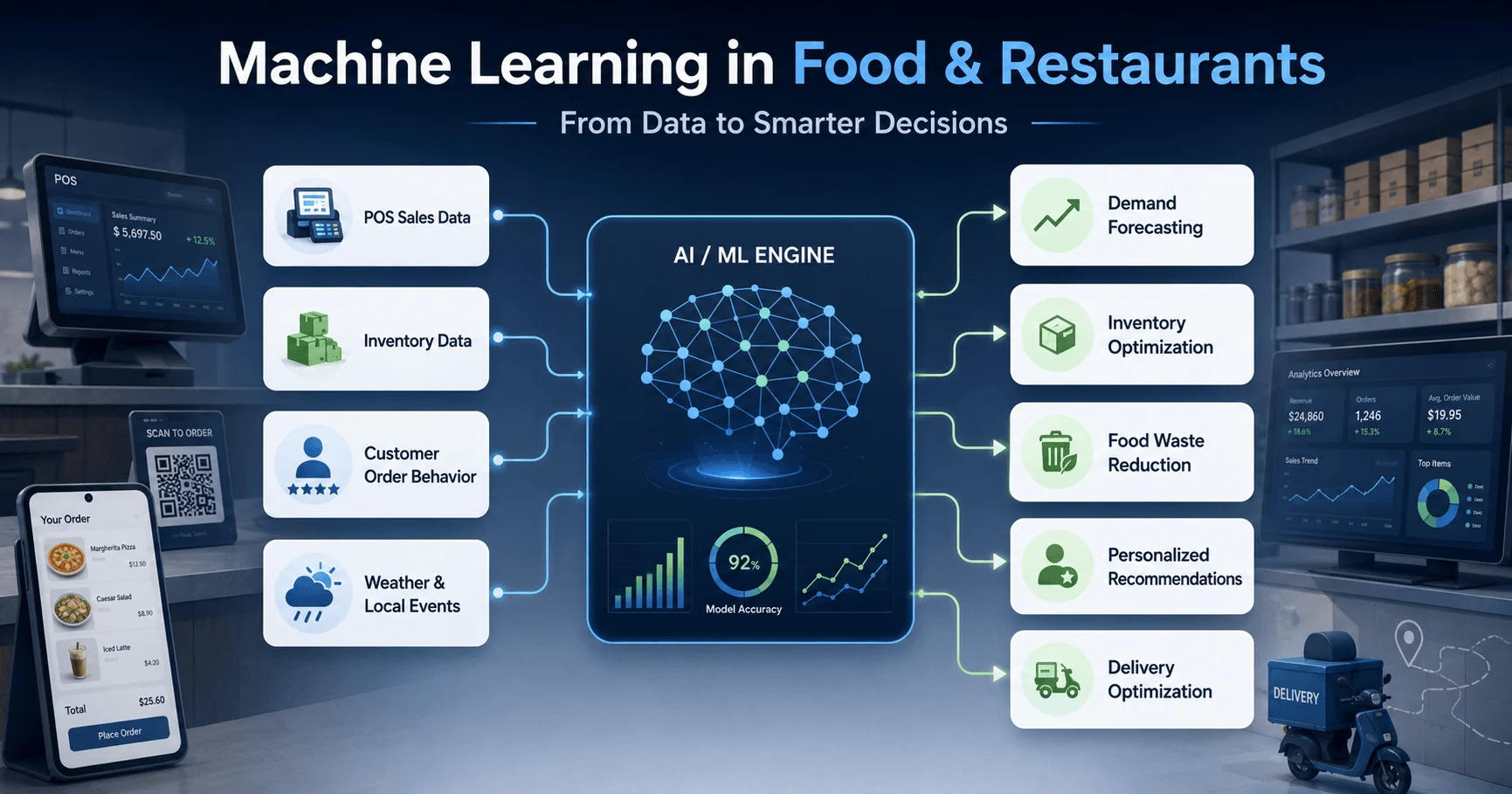
The best machine learning use case depends on the business problem you want to solve first. For most food businesses, the highest ROI comes from forecasting, inventory optimization, waste reduction, and customer retention.
|
Business Goal |
Best Machine Learning Use Case |
|---|---|
|
Reduce food waste |
Demand forecasting and inventory optimization |
|
Lower food cost |
AI-powered inventory management |
|
Improve delivery speed |
Route and ETA optimization |
|
Increase repeat orders |
Personalized recommendations and churn prediction |
|
Improve staffing |
Workforce demand forecasting |
|
Protect revenue |
Fraud detection and anomaly monitoring |
|
Improve reviews |
Sentiment analysis and reputation monitoring |
|
Scale locations |
Multi-location sales forecasting |
Guesswork costs money. Over-prep and you waste food; under-prep and you lose sales.
Restaurant demand forecasting uses machine learning to predict orders by hour, day, location, and season. It factors in weather, holidays, local events, and past trends. One large restaurant chain study published in ScienceDirect found machine learning and deep learning models meaningfully improved forecast accuracy over traditional methods.
The result: tighter prep, less waste, and staff scheduled to match real demand.
Business impact: Better demand forecasting helps reduce over-preparation, prevent lost sales, improve staff planning, and increase daily profitability.
Inventory is where money quietly leaks out.
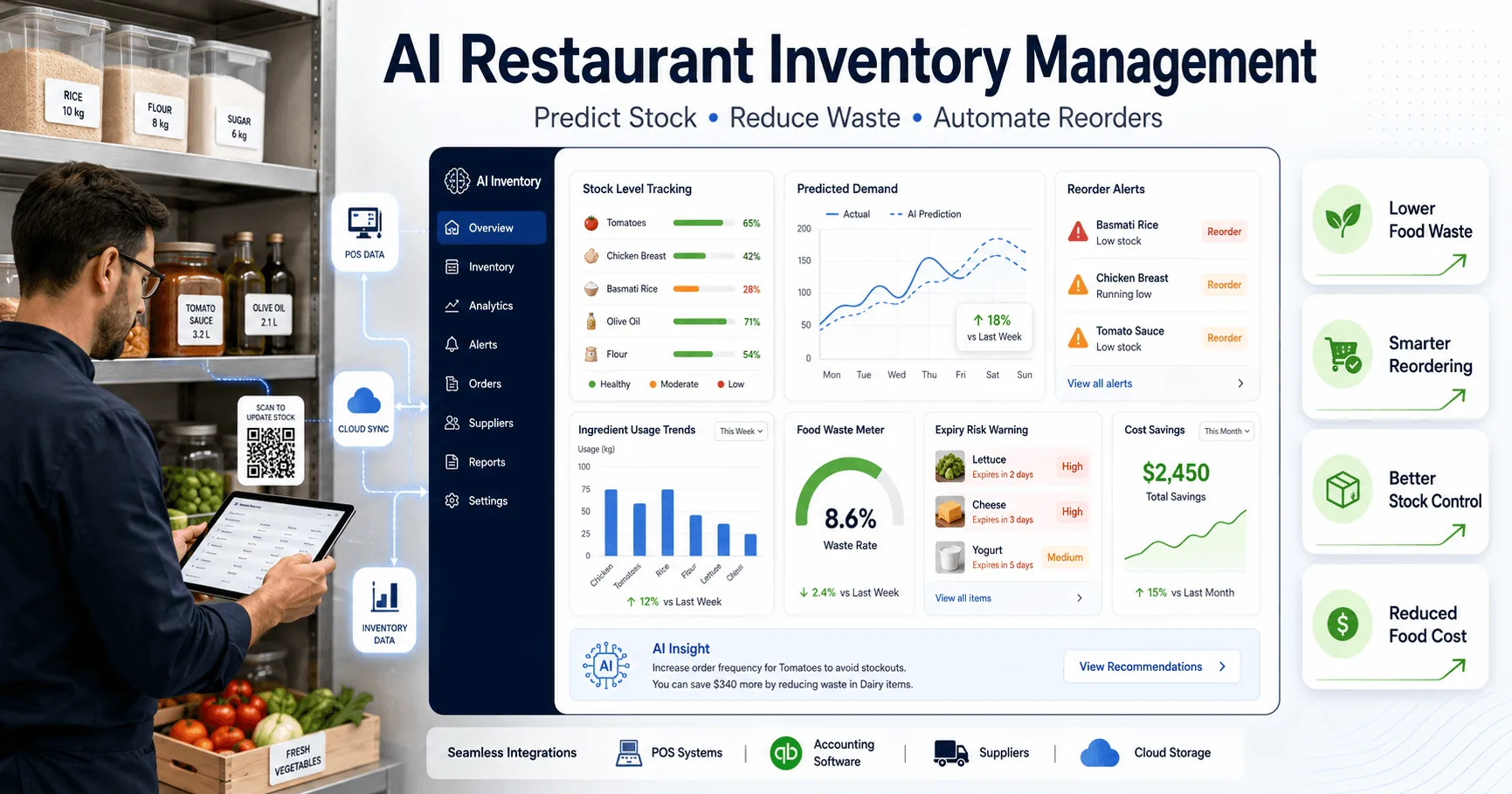
AI-powered inventory management tracks stock in real time, predicts usage, and flags when to reorder. Machine learning in restaurant inventory connects sales data to purchasing, so you stop over-ordering perishables. Studies cited by Loman AI suggest restaurants can save up to 5% of total revenue through AI inventory optimization.
For multi-location operators, restaurant inventory optimization keeps every site stocked correctly without manual counts.
Business impact: AI in restaurant inventory management helps lower food costs, reduce stockouts, prevent over-ordering, and improve purchasing decisions across one or multiple locations.
Roughly a third of food produced globally is wasted. Restaurants carry a big share of that bill.
AI food waste reduction works by predicting demand accurately, then matching prep and purchasing to it. The system spots waste patterns before they happen—an over-ordered ingredient, a slow-moving dish, a recurring end-of-night dump.
ReFED reports AI solutions delivered a 14.8% average reduction in food waste per store. Less waste means lower costs and a smaller environmental footprint.
Business impact: Food waste reduction improves margins, supports sustainability goals, and helps restaurants make purchasing and prep decisions based on real demand.
Generic menus convert poorly. Personalized ones don't.
Restaurant personalization AI studies each customer's order history and preferences, then recommends dishes they're likely to want. Think of how streaming services suggest shows—the same machine learning technology powers both experiences. If you're interested in how recommendation engines transform digital platforms, explore our guide on Machine Learning in Entertainment & Media. The same principle is now applied to restaurant menus to increase engagement and average order value. This lifts average order value and brings guests back more often. Similar recommendation engines also drive online retail success through personalized shopping experiences, demand forecasting, and customer retention, as covered in our guide on Machine Learning in Ecommerce.
Business impact: Personalized recommendations can increase average order value, repeat purchases, customer loyalty, and campaign performance.
Static prices leave money on the table.
Machine learning enables dynamic pricing—adjusting prices based on demand, time of day, inventory, and local events. The same predictive pricing strategies are widely used in hotels and airlines, making our guide on Machine Learning in Travel & Hospitality a useful resource for understanding cross-industry AI applications. It also targets promotions to the right customers at the right moment, instead of blanket discounts that erode margin. Happy hour, but smarter.
Business impact: Dynamic pricing and smart promotions help restaurants protect margins, fill slow periods, and avoid unnecessary blanket discounts.
Every menu has stars and duds. Most owners can't tell which is which.
Machine learning analyzes sales, margins, and ordering patterns to rank each dish by popularity and profitability. It tells you what to promote, reprice, redesign, or cut. The outcome is a leaner, more profitable menu built on data instead of intuition.
Business impact: Menu optimization helps identify high-margin dishes, remove underperforming items, and design menus around profit and demand.
Want to reduce food waste, forecast demand, and automate restaurant inventory with machine learning?
SISGAIN builds custom AI and ML solutions for restaurants, cloud kitchens, food delivery startups, and multi-location food businesses.
Build My Restaurant AI Roadmap
Losing a regular costs more than acquiring a new guest.
Machine learning spots the warning signs—fewer visits, smaller orders, lower engagement—before a customer disappears. It flags at-risk guests so you can win them back with a targeted offer. Retention becomes proactive instead of reactive.
Business impact: Churn prediction helps restaurants retain regular customers before they stop ordering, reducing customer acquisition costs.
Your POS holds a goldmine. Most of it goes unused.
Machine learning restaurant POS analytics turns raw transaction data into clear insights—peak hours, top combos, slow periods, and upsell opportunities. Restaurant predictive analytics built on POS data help you decide what to stock, when to staff, and how to sell. Pairing this with custom POS software development unlocks the full value of that data.
Business impact: Restaurant POS data analytics turns transaction data into decisions for inventory, staffing, upselling, promotions, and sales forecasting.
Slow tickets kill the guest experience.
Machine learning predicts how long each order will take based on kitchen load, dish complexity, and staffing. It helps sequence tickets, set accurate wait times, and smooth out bottlenecks during rushes. Faster kitchens, happier customers.
Business impact: Order time prediction improves kitchen speed, wait-time accuracy, customer satisfaction, and delivery reliability.
Overstaff and you burn payroll. Understaff and service suffers.
AI restaurant automation aligns schedules with forecasted demand. The model predicts busy and slow periods, then suggests the right number of staff for each shift. You cut labor costs without sacrificing service quality.
Business impact: Smarter staff scheduling reduces unnecessary labor cost while keeping enough team members available during peak demand.
Late deliveries lose customers. Inefficient routes lose money.
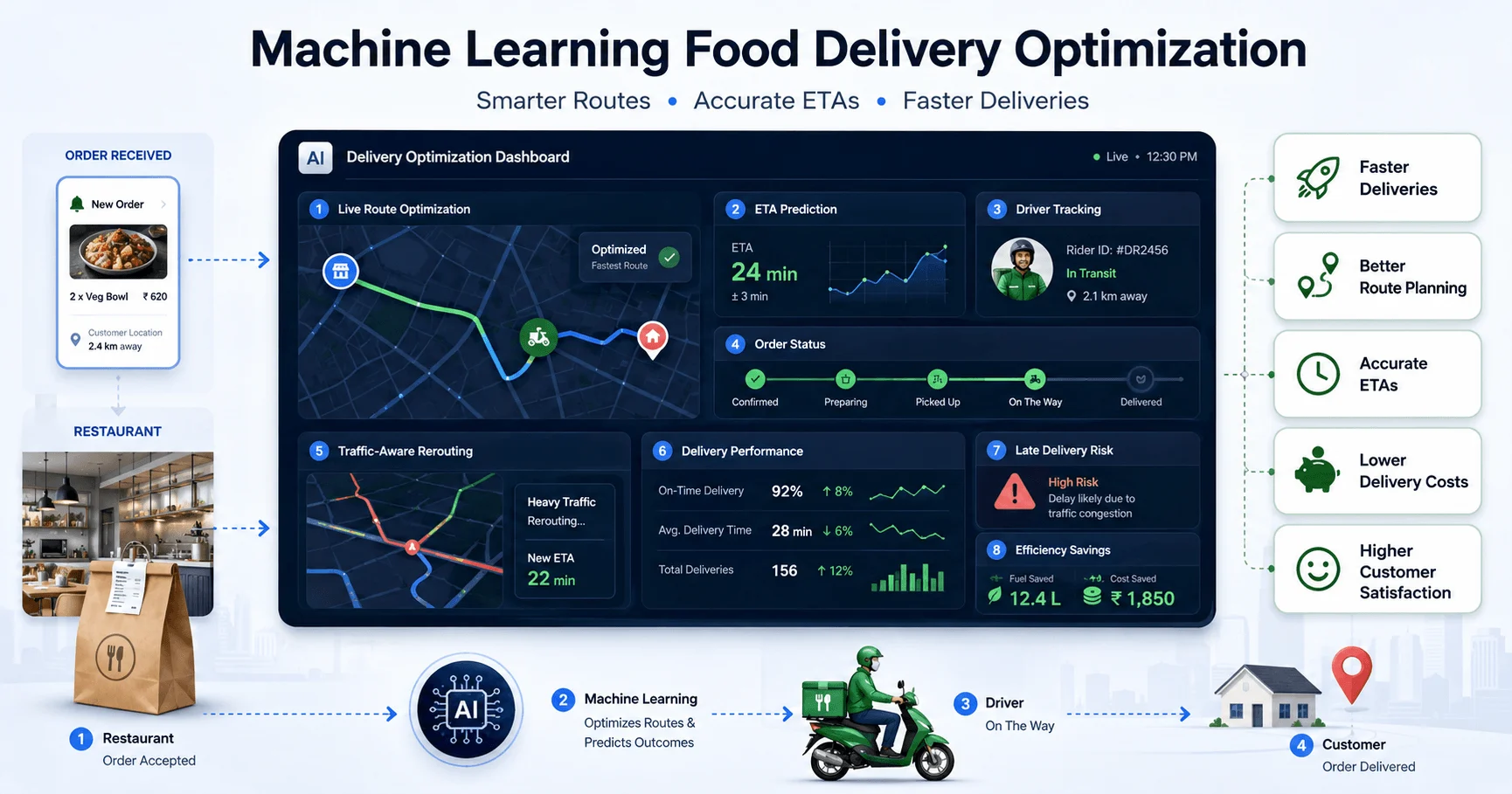
Machine learning food delivery systems calculate the fastest routes in real time, factoring in traffic, distance, and driver location. They predict accurate delivery times and re-route on the fly when conditions change. For delivery-first brands, this is the core of strong food delivery app development solutions.
Business impact: Delivery optimization reduces late orders, improves driver efficiency, lowers fuel and delivery costs, and improves customer satisfaction.
Fraud eats into already-thin margins.
Machine learning flags suspicious activity—fake orders, refund abuse, stolen payment cards—by spotting patterns that don't fit normal behavior. These fraud detection models use the same core techniques applied in banking and financial services, as explained in our guide on Machine Learning for BFSI. It catches problems in real time, before they cost you. For high-volume delivery operations, this protection pays for itself.
Business impact: Fraud detection protects revenue by identifying fake orders, refund abuse, payment fraud, and suspicious customer behavior in real time.
You can't read every review. Machine learning can.
Sentiment analysis scans reviews and social posts, then sorts them as positive, negative, or neutral. It surfaces recurring complaints—slow service, cold food, a problem location—so you fix issues before they spread. Your reputation stays ahead of the conversation.
Business impact: Sentiment analysis helps restaurants detect recurring complaints, protect brand reputation, and improve service quality across locations.
A single safety lapse can sink a brand.
Machine learning monitors temperature, freshness, and storage conditions, then flags risks before they become violations. Computer vision can even inspect food for quality and consistency. The result is safer food and fewer compliance headaches.
Business impact: AI food quality monitoring helps reduce safety risks, improve consistency, support compliance, and protect customer trust.
Scaling multiplies complexity. Each location behaves differently.
Machine learning forecasts sales per location, accounting for local demand, demographics, and trends. Chains get a unified view of performance and location-specific predictions for inventory, staffing, and marketing. One model, every site.
Business impact: Multi-location forecasting gives chains better control over inventory, staffing, marketing, purchasing, and location-level performance.
AI voice ordering allows restaurants, QSRs, and drive-thru brands to take customer orders faster with natural language systems. The system understands menu items, modifiers, combos, and customer preferences, then sends accurate orders directly to the POS or kitchen display system.
For high-volume restaurants, AI voice ordering reduces wait times, improves order accuracy, and allows staff to focus on food preparation and customer service.
Business impact: Faster ordering, shorter queues, better order accuracy, and lower pressure on front-line staff.
Kitchen equipment failures can disrupt operations, delay orders, and increase repair costs. Machine learning models can monitor equipment usage, temperature, performance, and maintenance history to predict when ovens, fryers, refrigerators, or prep machines may fail.
This allows restaurants and cloud kitchens to schedule maintenance before breakdowns happen.
Business impact: Less downtime, fewer emergency repairs, better food safety, and smoother kitchen operations.
Food businesses often deal with changing supplier prices, inconsistent availability, and manual purchasing decisions. Machine learning can compare supplier pricing, ingredient quality, delivery reliability, and demand forecasts to recommend smarter purchasing decisions.
For multi-location operators, AI procurement can help standardize buying, reduce cost leakage, and improve supply chain visibility.
Business impact: Better supplier decisions, lower purchasing costs, improved availability, and stronger control over food margins.
Customers want answers now, not during business hours.
AI chatbots handle reservations, orders, and FAQs around the clock. They understand natural language, take orders accurately, and escalate to humans when needed. Support gets faster and cheaper at the same time.
The payoff is measurable.
Every food business has different pain points. Machine learning meets each one.
|
Business Type |
Top Machine Learning Use Case |
|---|---|
|
QSR chains |
Demand forecasting and drive-thru speed |
|
Cloud kitchens |
Inventory and delivery optimization |
|
Cafés and bakeries |
Waste reduction and menu engineering |
|
Fine dining |
Personalization and reservations |
|
Food delivery startups |
Route optimization and fraud detection |
|
Food manufacturers |
Quality control and demand planning |
Cloud kitchens, in particular, benefit from purpose-built cloud kitchen software solutions that tie forecasting, inventory, and delivery into one system.
Good models need good data. Here's what fuels them:
The cleaner and more complete your data, the better your predictions. Start collecting now, even before you build.
It's not plug-and-play. Know the hurdles upfront.
None of these are dealbreakers. Each has a clear fix—usually the right partner and a phased rollout.
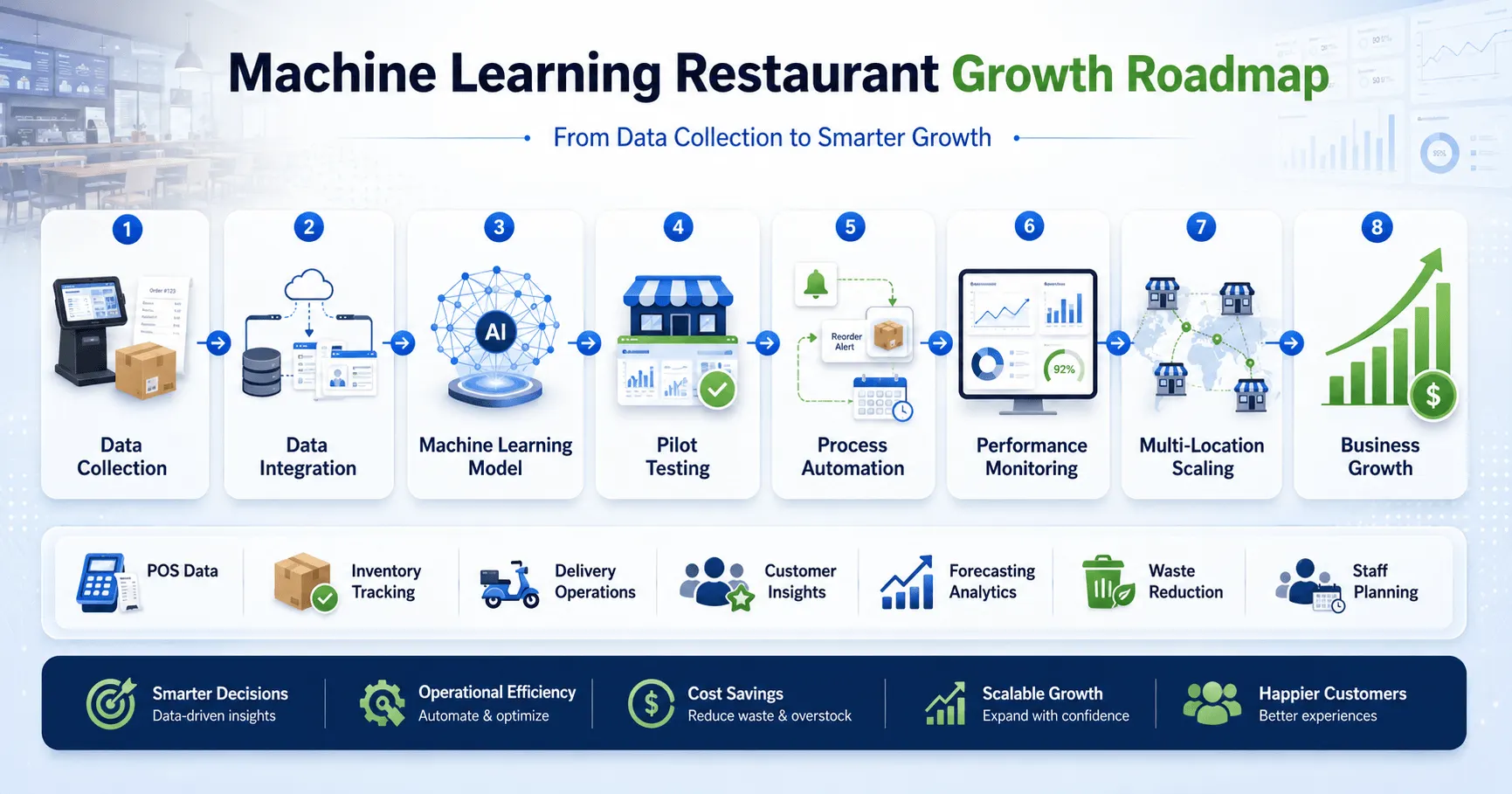
Start small. Prove value. Then scale.
Stage 1: Identify the problem. Pick one painful, measurable issue—waste, forecasting, or scheduling.
Stage 2: Gather your data. Pull sales, inventory, and customer records into one place.
Stage 3: Choose build or buy. Decide between a ready-made tool and a custom solution (more on this below).
Stage 4: Run a pilot. Test the model on one location or one use case. This phased implementation approach is common across industries, including digital learning platforms, where organizations deploy AI incrementally to improve outcomes. Learn more in our guide on Machine Learning in Education & eLearning.
Stage 5: Measure results. Track waste, sales, or labor against your baseline.
Stage 6: Scale. Roll out what works across more locations and use cases.
This is where machine learning development services earn their keep—handling the technical build, data integration, model development, and deployment while you focus on operations.
Need a machine learning roadmap for your restaurant, cloud kitchen, or food delivery business?
Our team can help you identify the highest-ROI use case, connect your data sources, and build a practical AI implementation plan.
The right choice depends on your needs and scale.
|
Factor |
Ready-Made Tools |
Custom ML Software |
|---|---|---|
|
Setup speed |
Fast |
Slower |
|
Cost |
Lower upfront |
Higher upfront |
|
Customization |
Limited |
Full control |
|
Scalability |
Varies |
Built for your scale |
|
Best for |
Small operators, single sites |
Chains, complex operations |
Choose ready-made tools if you need quick wins on a budget. Choose custom restaurant software development services if you run multiple locations, have unique workflows, or want a system that grows with you.
AI is moving from pilot to practice. According to IFT, AI is rapidly transforming how food systems operate—enabling smarter decisions, automation, and new business models.
Here's what's next:
The businesses building these capabilities now will lead the market tomorrow.
The same techniques drive results across industries. If you operate in more than one space, explore how machine learning applies elsewhere:
The underlying principle holds everywhere: data in, smarter decisions out.
Most food businesses know they need machine learning. Few have the in-house team to build it. That's the gap SISGAIN fills.
SISGAIN builds custom machine learning software for food and restaurant businesses, end to end. Services include:
Whether you need a single solution or a full transformation, SISGAIN delivers software built for the way food businesses actually run.
Reviewed by SISGAIN AI & Software Development Team
This guide is based on practical experience in AI software development, machine learning solutions, restaurant software development, POS integration, food delivery app development, predictive analytics, and business automation for operational use cases.
The shift is already underway. Machine learning in food restaurants has moved from nice-to-have to competitive necessity.
The wins are clear: less waste, sharper forecasts, leaner inventory, happier customers, and stronger margins. Start with one use case, prove the value, then scale across your operation.
The food businesses investing in machine learning now will have a clear advantage in 2026 and beyond. The right solution can help you forecast demand, reduce waste, optimize restaurant inventory, improve delivery speed, personalize customer experiences, and scale operations with confidence.
Ready to turn your restaurant data into measurable growth? Book a free consultation with SISGAIN and build a practical machine learning roadmap for your food business.
Sources & References
This guide uses industry research and market data from trusted food technology, AI, and restaurant industry sources. Recommended references to cite include:



Start Build Your
Next Digital Solution?
Let’s build scalable, future-ready digital solutions tailored to your business goals. Connect with our experienced technology consultants to discuss your vision, strategy, and growth opportunities — with zero obligation and complete transparency.
Get a free consultation and cost estimate for your digital solution
Our expert will contact you within 24 hours. Check your email for confirmation.
Partner with SISGAIN experts to build secure, scalable AI-powered IT Solutions that transform your business operations.












DUQE FREEZONE Quarter Deck, Queen Elizabeth 2, Mina Rashid, Dubai, UAE

100 Consilium Pl Suite 200, Scarborough, ON M1H 3E3, Canada

C-109, Sector 2, Noida, Uttar Pradesh 201301 India
Project quotes, partnerships, implementation
Open roles, referrals, campus hiring