How AI in Travel Industry Revolutionizing Tourism and Bookings

/ Blogs / How AI in Travel Industry Revolutionizing Tourism and Bookings

Table of Contents
    How AI in Travel Industry Revolutionizing Tourism and Bookings
    Ethan Carter | Jun 03, 2026 | AI Development

    Picture a traveler planning an international vacation without browsing dozens of websites, comparing hundreds of hotel listings, or spending hours researching destinations. Today, artificial intelligence makes that possible.

    From personalized travel recommendations and AI-powered itinerary creation to intelligent customer support and autonomous booking assistants, AI in the travel industry is rapidly changing how people explore the world and how travel companies operate.

    As customer expectations grow and competition intensifies, travel businesses are investing in AI to improve experiences, streamline operations, and unlock new revenue. This guide walks you through how artificial intelligence in tourism works, the practical use cases driving results, real business benefits, implementation steps, common challenges, and what the future holds.

    Key Takeaways

    • AI is transforming every stage of the traveler journey, from trip planning to post-travel engagement.
    • Travel businesses use AI to improve personalization, automate customer service, optimize pricing, and increase revenue.
    • Generative AI, multimodal AI, and AI agents are becoming competitive advantages for travel companies worldwide.
    • Companies investing in AI today gain operational efficiency, higher customer satisfaction, and stronger market positioning.
    • The future of travel will be driven by intelligent, predictive, and hyper-personalized AI experiences.

    What Is Artificial Intelligence in Travel?

    Defining AI in the Travel Industry

    Artificial intelligence in travel covers a family of technologies that help companies understand travelers, automate decisions, and deliver smarter experiences. Here's what powers it:

    • AI in tourism broadly: software that learns from data to plan, predict, and personalize travel experiences.
    • Machine learning in travel: algorithms that improve over time by analyzing booking patterns, search behavior, and customer preferences.
    • Natural language processing: technology that lets travel chatbots understand and respond to human language across channels.
    • Predictive analytics: models that forecast demand, pricing shifts, and traveler behavior.
    • Computer vision: image recognition used for destination search, identity verification, and smart check-in.
    • Generative AI applications: systems that produce itineraries, travel guides, and conversational responses on demand.
    • Autonomous AI agents: tools that plan and book trips with minimal human input.

    Why AI Matters for Modern Travel Businesses

    The travel market rewards speed, relevance, and convenience. AI helps deliver all three.

    • Rising customer expectations: travelers want instant, tailored answers, not generic results.
    • Growing digital competition: OTAs, startups, and global platforms compete on experience.
    • Need for personalization: one-size-fits-all marketing no longer converts.
    • Operational efficiency requirements: automation cuts costs and frees staff for higher-value work.
    • Data-driven decision making: AI turns scattered booking data into clear strategy.

    What is artificial intelligence in travel?
    Artificial intelligence in travel refers to the use of machine learning, predictive analytics, natural language processing, and automation technologies to improve travel planning, booking, customer service, pricing, and operational efficiency.

    Why AI Is Becoming Essential in the Travel Industry

    The Digital Transformation of Tourism

    Travel has shifted decisively toward digital channels, and AI sits at the center of that shift.

    • Digital-first travelers now research, compare, and book primarily online.
    • Self-service booking has become the norm, raising the bar for fast, accurate tools.
    • Mobile-first travel planning means experiences must work seamlessly on small screens.
    • Intelligent travel platforms use AI to anticipate needs before travelers even ask.

    For travel brands, the message is clear: meeting customers where they are now requires intelligent automation.
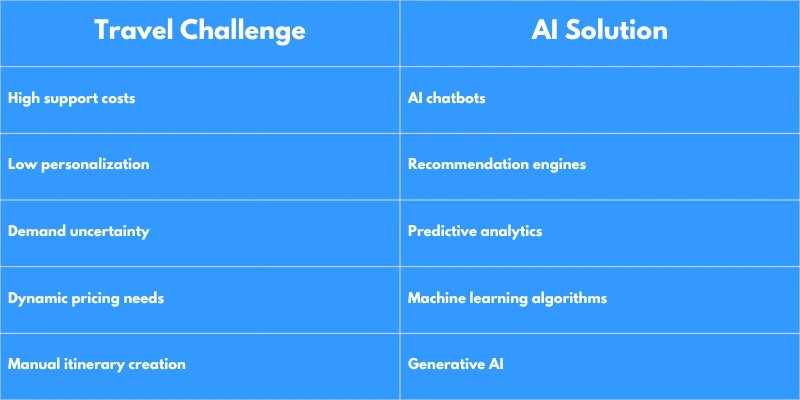
    Key Industry Challenges AI Solves

    Each of these solutions delivers measurable returns, which we'll break down next.

    Top Use Cases of AI in Travel Industry

    AI-Powered Travel Planning and Itinerary Generation

    AI removes the friction from trip planning by building complete, personalized journeys in seconds.

    • Personalized itineraries based on interests, budget, and travel style.
    • Destination recommendations matched to past behavior and seasonality.
    • Activity suggestions tailored to each day of the trip.
    • Budget optimization that balances cost and experience.

    Many companies now build AI-powered itinerary systems with an AI Software Development Company to deliver these experiences at scale.

    Intelligent Travel Chatbots and Virtual Assistants

    Travel chatbots and virtual assistants handle high volumes of routine requests without slowing down.

    What they cover:

    • 24/7 support across time zones
    • Booking assistance and modifications
    • Travel FAQs and policy questions
    • Multi-language communication

    The business benefits are immediate:

    • Faster support that reduces wait times
    • Lower operational costs through automation
    • Improved customer satisfaction with consistent, instant answers

    A common mistake to avoid: deploying a chatbot without clear escalation paths to human agents. The best systems blend automation with easy human handoff.

    AI-Based Dynamic Pricing Systems

    Dynamic pricing is one of the highest-ROI applications of AI in tourism. It applies across:

    • Airlines
    • Hotels
    • Vacation rentals
    • Cruise companies

    So what does this mean for your business? Smarter pricing protects margins during low demand and captures more revenue during peak periods, without manual guesswork.

    Personalized Recommendations and Customer Experiences

    Recommendation engines learn what each traveler likes and surface the right options at the right moment.

    • Hotel recommendations matched to preferences and past stays
    • Attraction recommendations based on location and interests
    • Restaurant suggestions aligned with cuisine and budget
    • Personalized offers that boost conversions and loyalty

    Personalization is no longer a bonus. It directly drives bookings and repeat business.

    Predictive Analytics for Travel Demand Forecasting

    Predictive analytics helps travel companies plan ahead with confidence.

    • Capacity planning to match supply with expected demand
    • Revenue forecasting for sharper financial planning
    • Destination popularity prediction to guide marketing spend
    • Workforce management to staff efficiently during peaks

    AI-Powered Fraud Detection and Security

    Fraud and chargebacks cost the travel industry billions each year. AI strengthens defenses by analyzing patterns in real time.
    • Booking fraud detection that flags suspicious activity
    • Payment security with anomaly detection
    • Risk assessment that protects both customers and revenue

    Generative AI in Travel: The New Era of Customer Engagement

    What Is Generative AI in Travel?

    Generative AI in travel uses large language models to create original content and conversations rather than just retrieving stored answers.

    • LLMs that understand context and generate natural responses
    • Travel assistants that converse like a knowledgeable agent
    • AI content generation for guides, descriptions, and offers
    • Conversational booking systems that complete reservations through chat

    How Generative AI Is Improving Traveler Experiences

    The applications are practical and already in market:

    • Instant itinerary creation built around a traveler's request
    • Personalized travel guides generated for each destination
    • Travel content generation at scale for marketing teams
    • Customer communication that feels human and responsive

    Real Business Benefits

    • Higher engagement across digital channels
    • Increased conversions from tailored recommendations
    • Reduced support workload through automation
    • Better traveler satisfaction and loyalty

    Many travel brands now explore Generative AI in Travel Solutions to turn these benefits into competitive advantage.

    How Multimodal AI Is Transforming Travel Experiences

    What Is Multimodal AI?

    Multimodal AI in travel combines several types of input and output into one seamless experience:

    • Text
    • Images
    • Voice
    • Video
    • Maps

    This lets travelers interact naturally, whether they type, speak, or share a photo.

    Travel Use Cases

    • Image-based destination search: snap a photo and find similar places to visit.
    • Voice travel assistants: plan and book hands-free.
    • Real-time translation: break language barriers instantly.
    • Smart travel companions: combine maps, recommendations, and chat in one tool.

    Companies building these experiences often rely on Multimodal AI Development Services to integrate multiple data types reliably.

    AI Applications Across Different Travel Segments

    AI delivers value across every part of the travel ecosystem. Here's how it plays out by segment.
    Airlines

    • Revenue management through dynamic pricing
    • Route optimization for efficiency and profitability
    • Predictive maintenance to reduce delays and downtime

    Hotels

    • Smart check-in that speeds up arrivals
    • Personalized guest experiences tailored to preferences
    • AI concierge services available around the clock

    Online Travel Agencies

    • Recommendation engines that lift conversions
    • AI search that understands intent
    • Booking optimization for higher completion rates

    Tour Operators

    • Dynamic itinerary creation for flexible trips
    • Customer personalization across touchpoints
    • Marketing automation that scales outreach

    Travel Startups

    • AI-first business models built for speed
    • Travel marketplaces powered by intelligent matching
    • Virtual travel assistants as core products

    Cost of Implementing AI in Travel Industry

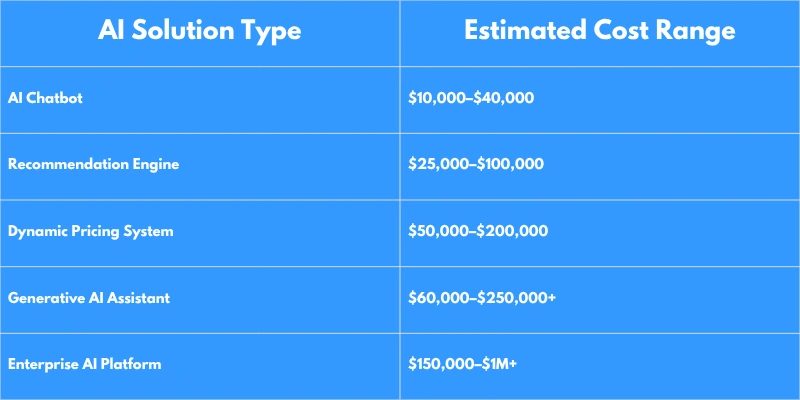
    Budgets vary widely depending on scope and complexity. Use the ranges below as planning benchmarks.

    Factors Affecting Cost

    • Data availability: clean, accessible data lowers cost and risk.
    • AI complexity: advanced models require more development and tuning.
    • Integration requirements: connecting to legacy systems adds effort.
    • Scalability needs: higher volumes demand more robust infrastructure.
    • Security compliance: regulated data raises the bar for governance.

    How to Successfully Implement AI in Travel Business

    A structured rollout reduces risk and speeds up returns. Follow these six steps.

    Step 1: Identify Business Objectives

    Define what success looks like, whether that's lower support costs, higher conversions, or better pricing.

    Step 2: Audit Existing Data Infrastructure

    Assess data quality, sources, and accessibility before building anything.

    Step 3: Prioritize High-ROI AI Use Cases

    Start with use cases that deliver clear, measurable value quickly.

    Step 4: Select the Right Technology Partner

    Choose a partner with proven travel and AI expertise. Explore Travel Application Development Solutions by Top IT Companies to find the right fit.

    Step 5: Launch Pilot Projects

    Test on a small scale, gather data, and validate results before expanding.

    Step 6: Measure and Optimize Performance

    Track KPIs, refine models, and scale what works.

    Challenges of AI Adoption in Travel Industry

    Adopting AI comes with real hurdles. Knowing them early helps you plan around them.

    Data Privacy and Compliance

    Travel data is sensitive. Companies must meet GDPR, CCPA, and regional rules while keeping customer trust intact.

    Legacy System Integration

    Older booking and reservation systems can resist modern AI tools. API modernization usually bridges the gap.

    AI Bias and Accuracy

    Poorly trained models can produce biased or inaccurate results. Regular testing and diverse data sets reduce this risk.

    User Trust and Transparency

    Travelers want to know when they're interacting with AI. Clear communication builds confidence.

    Talent and Skill Gaps

    Skilled AI talent is in short supply. Many companies close the gap with experienced consulting partners.

    Challenge

    Solution

    Data Quality

    Data governance

    Legacy Systems

    API modernization

    Privacy Concerns

    Compliance frameworks

    Skill Shortage

    AI consulting partners

    Future Trends of AI in Travel and Tourism (2026–2030)

    The next wave of innovation will make travel more autonomous, predictive, and personal than ever.

    Autonomous AI Travel Agents

    AI travel agents will plan, book, and adjust entire trips with minimal human input.

    Hyper-Personalized Travel Experiences

    AI will tailor every detail, from flights to dining, to individual preferences.

    Real-Time Predictive Travel Assistance

    Systems will anticipate delays, suggest alternatives, and solve problems before travelers notice them.

    AI-Powered Sustainable Tourism

    AI will help reduce environmental impact through smarter routing, capacity management, and eco-friendly recommendations.

    Conversational Booking Platforms

    Natural conversation will replace forms and filters as the main way to book travel.

    AI CRM Development Trends in Tourism

    Smarter customer relationship tools will deepen loyalty and retention. Explore emerging AI CRM Development Trends shaping tourism.

    Digital Travel Companions

    Always-on assistants will guide travelers through every stage of their journey.

    Smart Airports and Connected Travel Ecosystems

    AI will link airports, transit, and accommodation into seamless, connected experiences.

    Why Travel Companies Should Invest in AI Today

    The case for acting now is strong and practical.

    • Competitive advantage: early adopters set the standard customers expect.
    • Customer retention: personalization and fast service build loyalty.
    • Revenue growth: smarter pricing and recommendations lift the bottom line.
    • Operational efficiency: automation cuts costs across departments.
    • Future readiness: AI investment today prepares you for tomorrow's market.

    Conclusion

    AI is becoming the foundation of modern travel experiences. Businesses that adopt it gain efficiency, personalization, and growth advantages that compound over time. The future belongs to travel companies that use AI strategically and responsibly.

    Whether you're planning an AI-powered booking platform, an intelligent travel assistant, or a predictive analytics solution, investing in AI today can position your business for long-term success in a fast-evolving landscape.
    Frequently Asked Questions (FAQs)

    AI is used for itinerary planning, personalized recommendations, customer service automation, dynamic pricing, fraud detection, demand forecasting, and travel assistance.
    Benefits include improved customer experiences, higher operational efficiency, increased revenue, better personalization, and reduced costs.
    Generative AI creates itineraries, travel content, recommendations, customer support responses, and conversational booking experiences.
    The future includes autonomous booking agents, predictive travel assistants, multimodal AI experiences, smart tourism ecosystems, and AI-powered personalization.
    AI is not replacing travel professionals entirely. Instead, it enhances productivity by automating repetitive tasks while letting agents focus on personalized service and complex travel planning.

    Start Build Your
    Next Digital Solution?

    Let’s build scalable, future-ready digital solutions tailored to your business goals. Connect with our experienced technology consultants to discuss your vision, strategy, and growth opportunities — with zero obligation and complete transparency.

    • Free 60-minute digital transformation consultation
    • Detailed project roadmap & cost estimate within 48 hours
    • NDA signed before any business discussion begins
    • Direct access to senior strategists & developers
    • Flexible engagement models tailored to your business
    • Post-launch support & long-term technology partnership

    Start Your Project

    Get a free consultation and cost estimate for your digital solution

    Connect with our team