

 +1 844-445-5767
 +971 56-848-5757
 +91 921-208-0630
For Business & Service Inquiries
Sales Team
Project quotes, partnerships, implementation
Connected devices are no longer a niche category in the United States. They sit in hospitals, factories, vehicles, homes, and city infrastructure, quietly collecting data and making decisions that affect real people. That growth has created a parallel problem: every new sensor, gateway, or embedded controller is also a potential entry point for an attacker.
For manufacturers, this is no longer just an engineering concern. Insecure devices trigger recalls, lawsuits, regulatory penalties, and reputational damage that can outlast the product itself. IoT security has to be treated as a business function, not an afterthought bolted on before shipping.
Compliance adds another layer of urgency. Federal guidance from NIST, sector rules from the FDA and FCC, and a growing patchwork of state privacy laws mean manufacturers can no longer choose one region's rules and call it done. A device sold nationally has to satisfy overlapping requirements simultaneously.
This guide walks through what connected device manufacturers, OEMs, and technology leaders need to know: the current threat landscape, core security principles, US compliance obligations, the NIST IoT Security Framework, risk management practices, and the best practices that separate resilient products from the ones that end up in a breach disclosure. By the end, you'll have a practical reference for building, certifying, and maintaining secure connected products in the US market.
The number of connected devices in US homes, hospitals, and industrial sites has grown far faster than the security practices meant to protect them. Many manufacturers are still shipping products designed for convenience and cost, not resilience.
That gap is exactly what attackers look for.
Connected devices are attractive targets because they often run lightweight software, rarely get patched, and stay in service for years after the manufacturer stops actively supporting them. Attackers exploit that combination.
Botnets built from compromised cameras and routers, ransomware aimed at industrial controllers, and credential-stuffing attacks against poorly secured cloud APIs are now routine occurrences rather than rare events. Strong IoT cybersecurity has to account for the fact that a device may be attacked long after its original engineering team has moved on to other projects.
A security failure in a connected product rarely stays contained to one device. It becomes a business event.
Key takeaway: Weak IoT device security is not just a technical liability. It is a direct threat to revenue, contracts, and brand equity.
Before fixing anything, manufacturers need an honest picture of where connected devices actually fail. Most incidents trace back to a small, recurring set of weaknesses.
| Industry | Primary Risk Driver | Typical Consequence |
|---|---|---|
| Healthcare | Life-safety devices, PHI exposure | Patient harm, HIPAA-adjacent liability |
| Industrial IoT | Legacy protocols, long device lifespans | Production downtime, safety incidents |
| Automotive | Connected and autonomous features | Vehicle takeover risk, recalls |
| Smart Cities | Shared, distributed infrastructure | Public service disruption |
| Consumer Electronics | High volume, low margin, weak update culture | Botnet recruitment, privacy breaches |
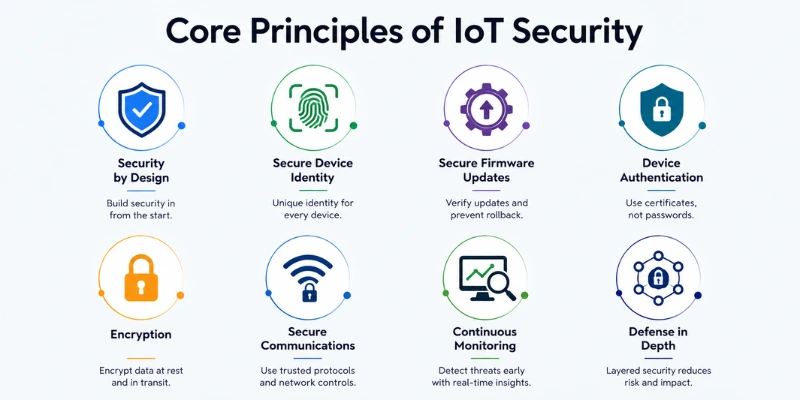
Strong IoT device security is built on a small number of foundational principles. Get these right and most downstream problems become far easier to manage.
Security by Design Security decisions made at the architecture stage — not after launch — determine whether a device can be patched, monitored, and trusted for its entire lifecycle.
Secure Device Identity Every device should have a unique, cryptographically verifiable identity, typically established during manufacturing and tied to a hardware root of trust.
Secure Firmware Updates Update mechanisms must verify signatures, support rollback protection, and work reliably over unstable networks.
Device Authentication Devices should authenticate to networks, gateways, and cloud services using certificates rather than shared secrets or static passwords.
Encryption Data should be encrypted both at rest and in transit, using algorithms appropriate to device compute constraints.
Secure Communications Protocols such as TLS/DTLS, mutual authentication, and network segmentation limit the blast radius of a compromised device.
Continuous Monitoring Ongoing telemetry and anomaly detection let manufacturers catch compromised devices before they cause wider damage.
These principles form the backbone of most IoT security best practices frameworks used across US regulated industries.
Security and privacy are related but distinct disciplines. A device can be technically secure and still mishandle personal data in ways that violate user trust and state law.
Connected devices collect data continuously, often without users fully understanding what's gathered or how it's used. That makes IoT privacy a frontline concern for manufacturers selling into the US market, where state-level privacy law is expanding rapidly.
Manufacturers should collect only what a device genuinely needs to function — a principle often called data minimization. Beyond that:
Together, these practices support both IoT data privacy obligations and the broader trust relationship a manufacturer needs with its customers.
IoT compliance in the US isn't governed by a single federal law. Instead, manufacturers face a layered mix of federal guidance, sector-specific rules, and state privacy statutes.
Healthcare, automotive, critical infrastructure, and financial services each layer additional sector requirements on top of these general obligations. Manufacturers selling across multiple states and sectors should treat compliance as a continuously updated program, not a one-time certification.
Definition: IoT compliance refers to a manufacturer's ongoing conformance with applicable federal guidance, sector regulations, and state privacy laws governing how connected devices are designed, secured, and how they handle personal data.
The NIST IoT security framework gives manufacturers a structured way to approach security across a device's lifecycle, from design through decommissioning.
Quick answer for search: The NIST IoT Security Framework provides guidance on device identification, configuration, patching, and monitoring so manufacturers can secure connected products throughout their entire lifecycle, from design to retirement.
Effective IoT risk management starts well before a product ships and continues throughout its operational life.
Manufacturers should map out attack surfaces early — hardware interfaces, communication protocols, cloud APIs, and update mechanisms — and rank risks by likelihood and impact. Threat modeling exercises done during design catch issues that are far more expensive to fix post-launch.
Most connected devices rely on third-party chipsets, modules, and software libraries. Each one introduces risk that the manufacturer inherits.
Firmware should be signed, version-controlled, and traceable back to a specific build. Manufacturing environments themselves need controls to prevent key material or unsigned firmware from leaking during production.
The following list covers the practices that consistently separate resilient connected products from vulnerable ones.
Best practice callout: Treat these IoT security best practices as a lifecycle checklist, not a one-time launch requirement. Revisit them at every major firmware release.
Selecting the right IoT security solutions depends on device type, deployment scale, and regulatory exposure. Most manufacturers need a combination of the following:
| Solution Category | Primary Function | Best Suited For |
|---|---|---|
| PKI / Device Identity | Unique device authentication | Large fleets, regulated industries |
| Endpoint Protection | On-device threat prevention | Resource-constrained devices |
| Firmware Security Tools | Signing and integrity verification | All connected products |
| Cloud Connectivity Security | Encrypted device-to-cloud channels | Cloud-connected fleets |
| AI-Powered Monitoring | Behavioral anomaly detection | High-volume deployments |
Security priorities shift depending on where a device operates and what's at stake if it fails.
Healthcare Connected medical devices carry life-safety implications alongside sensitive patient data, making rigorous vulnerability management and FDA-aligned documentation essential.
Industrial IoT Legacy protocols and long equipment lifespans make patching harder, which is why predictive, monitoring-driven maintenance strategies matter as much as traditional patch cycles — a theme explored in this industrial IoT predictive maintenance guide.
Smart Manufacturing Factory floors increasingly blend OT and IT networks, so segmentation and secure remote access become critical control points. Many facilities are also layering in immersive tools for training and remote assistance, and any connected headset or overlay system built with AR/VR development services needs the same device-identity and encryption safeguards as other floor-level IoT endpoints.
Automotive Connected and autonomous vehicle features expand the attack surface into safety-critical systems, demanding secure over-the-air update pipelines and rigorous penetration testing.
Smart Cities Shared municipal infrastructure spans thousands of distributed sensors and controllers, and understanding how these environments are architected helps clarify where security controls need to sit — a topic covered in depth in this smart cities IoT architecture overview.
Consumer Electronics High production volumes and thin margins often push security down the priority list, even though these devices are among the most frequently recruited into botnets.
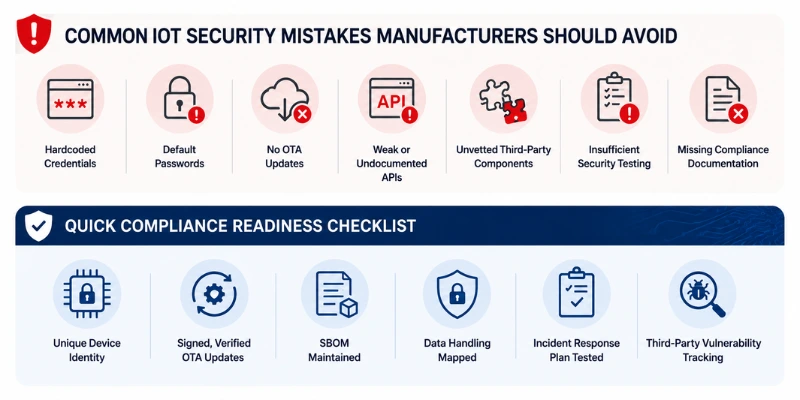
Many breaches trace back to preventable engineering and process shortcuts:
The next wave of connected device security is being shaped by both new threats and new regulatory expectations.
Building and maintaining secure connected products requires expertise that spans hardware, firmware, cloud, and compliance. SISGAIN works with manufacturers across healthcare, industrial, automotive, and consumer IoT to close that gap, offering:
Manufacturers exploring broader connected product strategies can also review SISGAIN's Internet of Things development services for an end-to-end view of how security integrates with product engineering, and teams working on component traceability may find SISGAIN's blockchain development services relevant for building tamper-evident supply chain records.
Ready to strengthen your connected products? SISGAIN helps manufacturers build IoT security and compliance into every stage of the product lifecycle — from initial architecture through post-launch monitoring. Talk to SISGAIN's team to assess your current security posture and close the gaps before they become incidents.
IoT security is no longer a technical checkbox — it's a business necessity that determines whether connected products survive contact with real-world threats and regulatory scrutiny. Manufacturers that treat compliance as a design-stage consideration, rather than a pre-launch scramble, consistently ship more resilient products.
Adopting the core IoT security best practices outlined here, aligning with the NIST IoT security framework, and building a genuine IoT risk management program are no longer optional differentiators. They are baseline expectations from regulators, enterprise buyers, and increasingly, from consumers themselves.
Investing in the right IoT security solutions and proactive risk management today is far less costly than managing a breach, a recall, or a regulatory penalty tomorrow.









Start Build Your
Next Digital Solution?
Let’s build scalable, future-ready digital solutions tailored to your business goals. Connect with our experienced technology consultants to discuss your vision, strategy, and growth opportunities — with zero obligation and complete transparency.
Get a free consultation and cost estimate for your digital solution
Our expert will contact you within 24 hours. Check your email for confirmation.
Partner with SISGAIN experts to build secure, scalable AI-powered IT Solutions that transform your business operations.









DUQE FREEZONE Quarter Deck, Queen Elizabeth 2, Mina Rashid, Dubai, UAE

100 Consilium Pl Suite 200, Scarborough, ON M1H 3E3, Canada

C-109, Sector 2, Noida, Uttar Pradesh 201301 India
Project quotes, partnerships, implementation
Open roles, referrals, campus hiring