
 +1 844-445-5767
 +971 56-848-5757
 +91 921-208-0630
For Business & Service Inquiries
Sales Team
Project quotes, partnerships, implementation
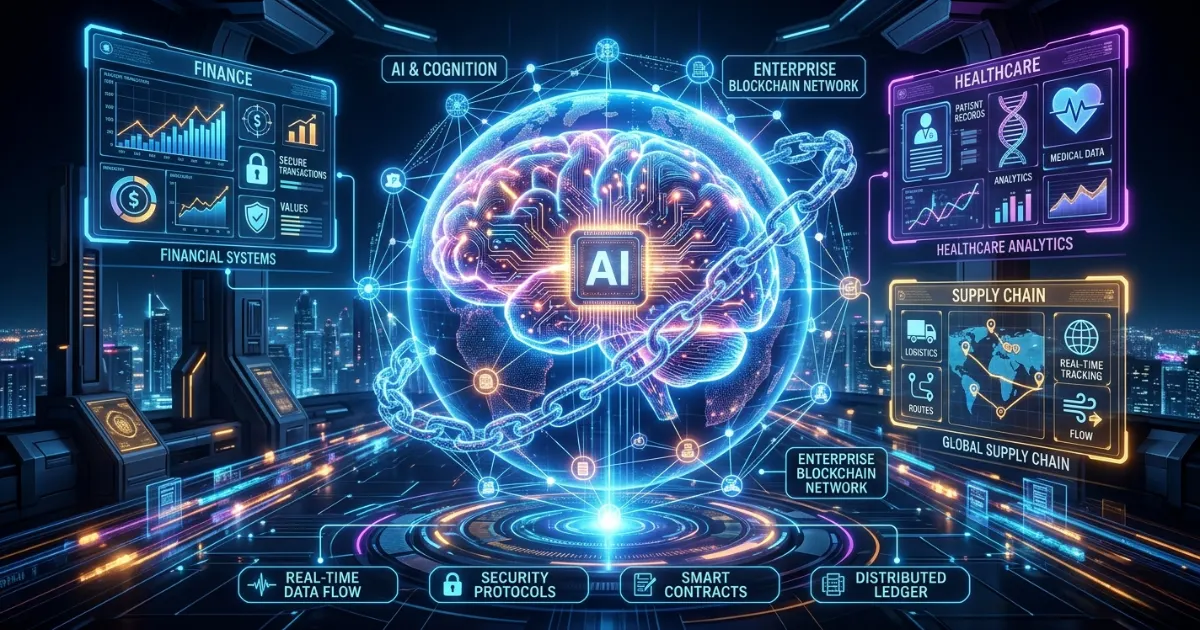
The global Blockchain AI market stands at USD 1.56 billion in 2026 and is projected to reach USD 11.7 billion by 2032, expanding at a CAGR of 39.77%. This explosive growth signals more than a technology trend—it marks a fundamental shift in how enterprises build secure, intelligent systems.
Enterprises today face a dual challenge: AI delivers unprecedented predictive power and automation, yet it demands trustworthy data sources. Blockchain delivers immutable, transparent records that AI can rely upon. Together, they create AI-powered blockchain solutions that eliminate single points of failure, enable verifiable decision-making, and unlock new levels of operational efficiency.
Demand for secure, intelligent enterprise applications has never been higher. CTOs and CIOs report that traditional centralized AI systems expose organizations to data tampering risks, while standalone blockchain platforms lack the intelligence to act on the data they store. The integration of these technologies addresses both gaps simultaneously.
The result? Faster, more trustworthy decision-making, reduced fraud, automated compliance, and seamless multi-party collaboration across global supply chains, financial networks, and healthcare ecosystems. By 2030, organizations that master AI and blockchain integration will gain decisive competitive advantages in transparency, resilience, and innovation.
This 2026 guide explores the technologies, real-world use cases, implementation roadmap, and strategic benefits—equipping enterprise leaders with the knowledge to drive successful enterprise blockchain development initiatives.
Artificial intelligence transforms enterprise software through several core capabilities:
In enterprise environments, AI now powers everything from supply chain optimization to customer experience personalization and financial forecasting. The technology excels at pattern recognition and probabilistic reasoning—but it remains only as reliable as the data it receives.
Blockchain provides the foundational trust layer for modern enterprises through:
Enterprise-grade blockchain platforms prioritize permissioned networks, scalability, and regulatory compliance, making them suitable for mission-critical applications where public blockchains fall short.
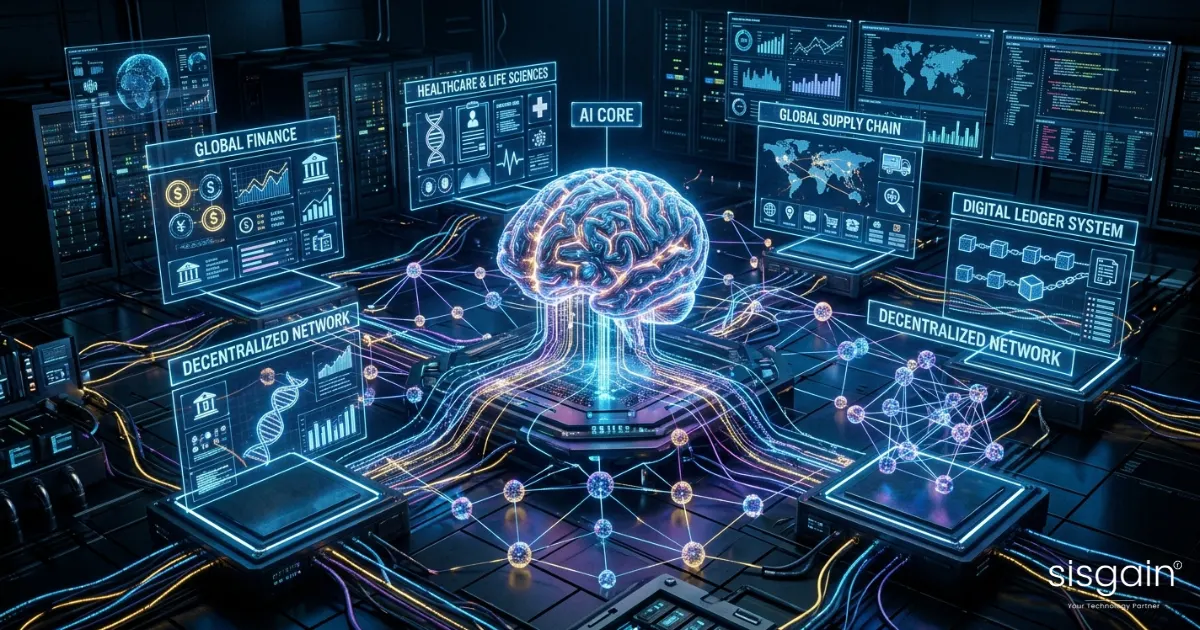
AI requires high-quality, verifiable data to produce trustworthy outputs. Blockchain ensures data authenticity from the point of origin through every subsequent process.
This synergy creates secure intelligent systems where:
The combination delivers explainable AI, provable compliance, and autonomous yet trustworthy operations—capabilities impossible with either technology alone.
Forward-thinking organizations integrate AI blockchain enterprise applications for five compelling reasons:
Secure data sharing — Enterprises can collaborate across organizational boundaries while maintaining strict data sovereignty. Blockchain provides the shared truth layer; AI extracts insights without exposing raw data.
Transparent AI decision models — Every prediction, recommendation, or automated action is logged on-chain with its full data lineage, satisfying auditors and regulators while building stakeholder trust.
Fraud prevention — Immutable records combined with real-time AI anomaly detection catch sophisticated threats that siloed systems miss.
Automated business processes — Smart contracts triggered by AI insights execute complex workflows instantly—approving invoices, rerouting shipments, or adjusting insurance claims without manual intervention.
Trusted multi-party collaboration — Supply chain partners, financial institutions, and healthcare providers operate on a single source of truth while retaining control over their proprietary AI models.
Real-world momentum is clear. Leading enterprises have moved beyond pilots: global retailers achieve near-instant traceability, banks reduce fraud losses dramatically, and healthcare networks enable secure, AI-enhanced patient data exchange.
Secure medical records meet AI-powered diagnostics in one seamless system. Patient data stored on permissioned blockchain ensures privacy and immutability. AI models analyze this verified data to assist in early disease detection, personalized treatment plans, and drug interaction predictions. Smart contracts automatically trigger insurance claims or consent management when new test results arrive.
Blockchain healthcare supply chains alone are projected to reach an $815 million market in 2026, driven by counterfeit drug prevention and cold-chain monitoring.
Blockchain traceability combined with AI demand forecasting creates cognitive supply networks. Every product movement is recorded immutably. AI analyzes this data in real time to predict disruptions, optimize routes, and automate reordering via smart contracts.
Walmart’s Food Trust platform (built on Hyperledger Fabric) reduced produce traceability from seven days to 2.2 seconds. When integrated with AI, the same system delivers up to 30% reduction in administrative costs, 5–10% lower warehousing expenses, and 25% reduction in inventory holding costs.
Fraud detection reaches new levels when AI monitors transaction patterns against blockchain’s immutable history. Smart contract automation handles complex processes such as cross-border payments, trade finance, and real-time settlement.
AI identifies suspicious patterns; blockchain provides the verifiable audit trail; smart contracts execute compliant actions instantly—cutting processing times from days to seconds while reducing fraud losses.
Blockchain identity verification creates tamper-proof digital identities. AI continuously monitors network behavior for anomalies. When threats appear, smart contracts automatically isolate compromised nodes or trigger multi-factor verification protocols.
The result is proactive, self-healing security systems far superior to traditional perimeter defenses.
Autonomous infrastructure systems rely on secure IoT networks. Sensors feed data to blockchain for immutable logging. AI processes this data to optimize traffic flow, energy distribution, and emergency response. Smart contracts execute municipal decisions—adjusting street lighting or rerouting public transport without human delay.
These use cases demonstrate how AI blockchain use cases deliver measurable ROI across industries.
Organizations implementing AI and blockchain integration consistently report:
These benefits compound over time, transforming cost centers into strategic advantages.
A robust architecture includes six interconnected layers:
These layers operate as a closed-loop system: data flows into blockchain → AI analyzes it → insights trigger smart contracts → outcomes feed back into the system. The architecture ensures every decision is traceable, every action verifiable, and every outcome auditable.
Implementing AI and blockchain integration in an enterprise environment is a structured journey rather than a single leap. The following roadmap draws from real-world enterprise projects in supply chain, finance, healthcare, and beyond. It emphasizes risk management, quick value delivery, and scalability.
Follow these eight practical phases to move from concept to production-grade system:
1. Identify core business problems Start by pinpointing specific pain points where current processes suffer from lack of trust, poor transparency, data silos, manual delays, or compliance risks. Common examples include:
Conduct workshops with business units, compliance, and IT to create a prioritized list of high-impact opportunities. Focus on problems where both trust (blockchain’s strength) and intelligence (AI’s strength) are missing.
2. Define clear, high-ROI use cases Narrow down to 1–2 focused scenarios with measurable success criteria. Avoid boiling the ocean. Examples of strong metrics:
Document the current-state cost (time, money, risk), the target future-state improvement, and how success will be tracked. This business case secures stakeholder buy-in and guides every later decision.
3. Select the right blockchain platform Choose based on your privacy, scalability, and ecosystem needs:
Evaluate governance model, node operation, integration maturity with your existing cloud provider (AWS, Azure, etc.), and long-term support.
4. Design and prepare AI models Build or adapt machine learning models using clean, verifiable data—ideally historical records already on-chain or soon to be. Key practices:
Train initially on offline data, then connect to live blockchain feeds for continuous improvement.
5. Develop and secure smart contracts Write self-executing business logic in languages like Solidity (Ethereum/Polygon) or Chaincode (Hyperledger). These contracts should:
Always:
6. Integrate everything securely Bridge blockchain with your existing enterprise systems (ERP, CRM, WMS, etc.) using:
This layer is often the biggest technical challenge—plan for incremental integration and robust error handling.
7. Test rigorously and deploy in phases Adopt a multi-stage testing approach:
Monitor closely during pilot: collect performance data, user feedback, and unexpected edge cases. Only scale after proving stability and value.
8. Monitor, optimize, and evolve continuously Post-deployment:
Treat the system as a living platform—continuous improvement is essential.
Realistic timelines (2026 benchmarks)
Most organizations see positive ROI within 12–24 months through cost savings, risk reduction, and efficiency gains—provided they start with well-defined, high-value use cases.
This roadmap minimizes common pitfalls: over-ambitious scope, poor platform choice, inadequate testing, and disconnected business–technology alignment. When executed methodically, it transforms AI-powered blockchain solutions from experimental to mission-critical infrastructure.
Leading enterprises rely on proven technology stacks:
These tools enable rapid development of production-grade AI powered blockchain solutions while maintaining enterprise security and compliance standards.
Despite compelling benefits, enterprises encounter several challenges:
Best practices include beginning with narrow, well-defined use cases, forming industry consortia for shared infrastructure, and establishing cross-functional governance teams early.
Looking toward 2030, the fusion of AI and blockchain is set to redefine how enterprises operate, moving beyond basic automation toward truly intelligent, trust-native digital systems. Four major transformative trends are already gaining momentum and will likely dominate enterprise strategies in the coming years:
Decentralized AI networks — Instead of relying on centralized cloud providers that control massive datasets, future AI models will train collaboratively across thousands of distributed blockchain nodes. This approach keeps sensitive enterprise data private, avoids single points of failure, and democratizes access to high-quality compute power. Enterprises can participate in or build these networks to gain verifiable, tamper-resistant intelligence without handing over proprietary information to big tech platforms.
Autonomous enterprise platforms — Picture self-managing business systems where AI agents—autonomous software entities—work alongside smart contracts to handle complete end-to-end processes. From procurement and inventory management to customer onboarding, compliance checks, and financial reconciliation, these platforms will make real-time decisions, execute actions, and self-correct with minimal human oversight. Early agentic AI systems are already appearing in 2026; by 2030, they will form the backbone of resilient, always-on enterprises.
AI-powered smart contracts — Traditional smart contracts follow fixed "if-then" rules written in code. The next generation will be dynamic and adaptive: embedded with machine learning, they analyze live market data, external oracles, historical patterns, and even renegotiate terms automatically. For example, a supply-chain contract could adjust pricing or delivery schedules in response to real-time disruptions, weather forecasts, or demand signals—all while remaining fully auditable on the blockchain.
Web3 enterprise ecosystems — Interoperable, standards-based networks will connect suppliers, partners, customers, regulators, and even competitors on shared, permissioned platforms. Blockchain ensures verifiable identity, provenance, and transaction history, while AI layers deliver predictive insights, automated governance, and personalized interactions. These ecosystems will replace siloed legacy systems with fluid, trust-minimized digital value chains.
Market momentum strongly supports this direction. Recent industry analyses project explosive growth in related sectors: the broader blockchain technology market is forecasted to expand dramatically (with CAGRs in the 58–90% range in various reports from 2025–2030), while AI continues its trajectory toward multi-trillion-dollar impact. The convergence of these technologies—often called Blockchain AI or decentralized intelligence—is transitioning rapidly from experimental pilots to core infrastructure. What began as a competitive differentiator is becoming table stakes for organizations that want to maintain trust, agility, and resilience in a data-driven world.
Enterprises that invest strategically now—in talent, pilot architectures, consortium participation, and governance frameworks—will capture first-mover advantages. They will lead the shift toward transparent, autonomous, and hyper-efficient operations. Those that wait risk being outmaneuvered by faster, more adaptive competitors already building the intelligent, decentralized enterprises of tomorrow.
Navigating AI and blockchain integration requires specialized expertise few internal teams possess. A professional blockchain development company accelerates success while minimizing risk.
Expert partners deliver:
Working with experienced developers ensures you avoid common pitfalls, leverage best-in-class technologies, and achieve faster ROI. Whether you need a pilot project or full-scale deployment, the right partner transforms complexity into competitive advantage.
AI and blockchain integration represents the future of enterprise innovation. The combination delivers secure data foundations, transparent intelligence, automated execution, and trusted collaboration at scale.
Organizations that act decisively in 2026 will capture the greatest value—lower costs, faster operations, stronger compliance, and deeper partner trust. Those that delay risk falling behind competitors already building cognitive, verifiable digital ecosystems.
The technology is ready. The market momentum is undeniable. The only remaining question is whether your enterprise will lead or follow.





Start Build Your
Next Digital Solution?
Let’s build scalable, future-ready digital solutions tailored to your business goals. Connect with our experienced technology consultants to discuss your vision, strategy, and growth opportunities — with zero obligation and complete transparency.
Get a free consultation and cost estimate for your digital solution
Our expert will contact you within 24 hours. Check your email for confirmation.
Partner with SISGAIN experts to build secure, scalable AI-powered IT Solutions that transform your business operations.









DUQE FREEZONE Quarter Deck, Queen Elizabeth 2, Mina Rashid, Dubai, UAE

100 Consilium Pl Suite 200, Scarborough, ON M1H 3E3, Canada

C-109, Sector 2, Noida, Uttar Pradesh 201301 India
Project quotes, partnerships, implementation
Open roles, referrals, campus hiring