
 +1 844-445-5767
 +971 56-848-5757
 +91 921-208-0630
For Business & Service Inquiries
Sales Team
Project quotes, partnerships, implementation
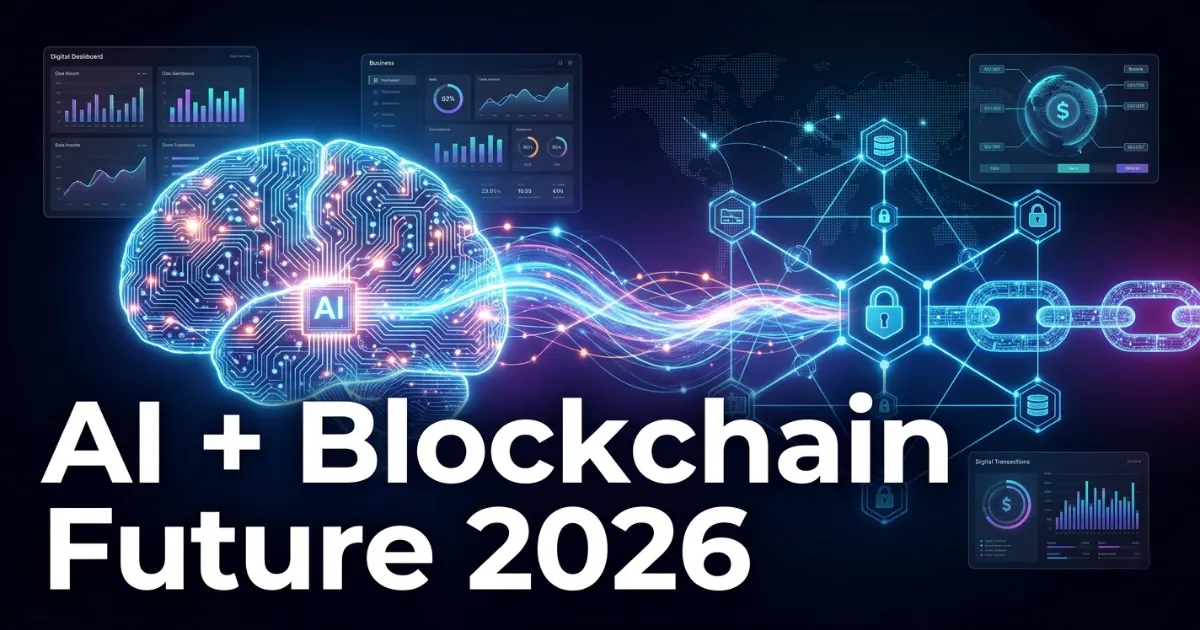
AI and blockchain integration is no longer experimental it is the strategic imperative for enterprises that want verifiable intelligence, unbreakable trust, and defensible competitive advantage in 2026.
Imagine this: Your AI predicts supply-chain disruptions with 95% accuracy, but the underlying data is immutable, auditable in real time, and immune to tampering. Smart contracts automatically execute payments, insurance claims, or compliance reports the instant conditions are met. Decentralized AI agents negotiate deals across borders without intermediaries. This is not science fiction it is the reality AI blockchain integration is delivering to forward-thinking organizations right now.
Global AI spending is projected to hit $2.53 trillion in 2026, while the specialized Blockchain AI market is exploding from approximately $700–843 million in 2025–2026 to over $3.4–4 billion by 2030–2033 at a CAGR of 27–27.8%.
Businesses that treat AI and blockchain for business as a combined stack will capture new markets; those that silo the technologies will fall behind. This 2026 enterprise guide cuts through the hype and shows exactly how CXOs and founders are turning decentralized AI and blockchain into measurable business value.
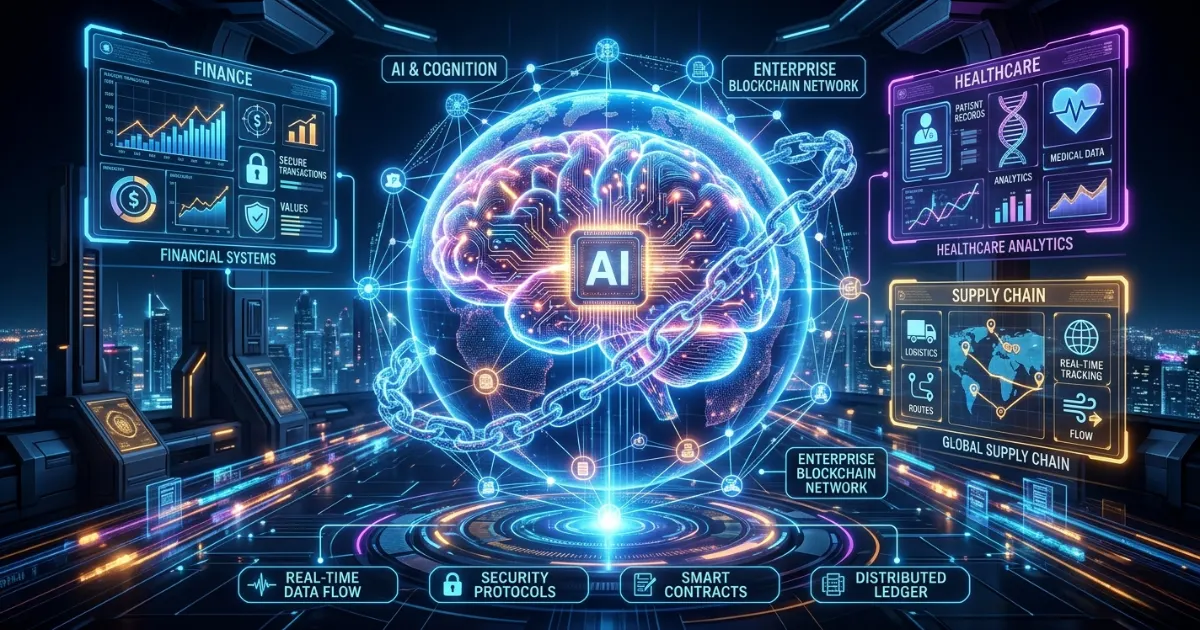
AI and blockchain integration (often called AI blockchain integration) merges two powerful technologies to create systems that are both intelligent and trustworthy.
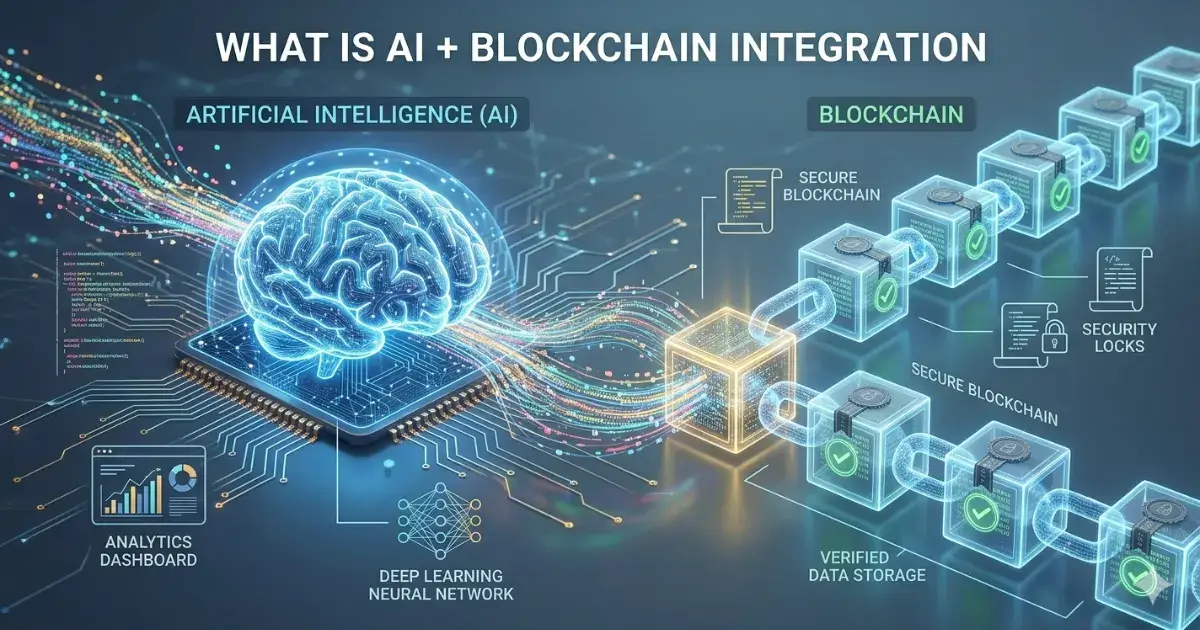
Artificial Intelligence excels at learning from vast amounts of data, spotting hidden patterns, making accurate predictions, optimizing complex processes, and enabling autonomous decisions. Blockchain, by contrast, delivers a secure, shared digital ledger that is immutable (cannot be altered once recorded), decentralized (no single controlling entity), and fully transparent to authorized participants. It includes powerful features like smart contracts self-executing code that automatically enforces rules and verifiable data origins through cryptographic proofs.
When these technologies are combined, each solves the other's core weaknesses. AI frequently struggles with unreliable or biased input data, opaque decision-making processes (the "black-box" issue), and vulnerability to tampering or manipulation after the fact. Blockchain counters these problems by providing unbreakable trust, permanent audit trails, and tamper-proof records. At the same time, blockchain while excellent for ensuring integrity and finality is rigid, computationally limited for advanced analysis, and lacks native intelligence to interpret or act on its data dynamically. AI fills this gap by adding pattern recognition, predictive power, real-time optimization, and autonomous execution.
The result is decentralized AI: intelligent systems where data sources, model training, inference, and decisions are distributed across a network rather than locked in a single company's servers or cloud. This allows AI to operate on verified, high-integrity information that cannot be retroactively changed, while blockchain gains "smart" capabilities through AI-driven automation, fraud detection, vulnerability monitoring, and adaptive smart-contract logic.
Enterprises are increasingly adopting a structured 4-layer architecture to deploy this integration at scale:
To explore this practical 4-layer AI + blockchain architecture model in detail including how it powers verifiable, autonomous systems for the emerging $10T digital economy read: The 4-Layer AI + Blockchain Architecture Model.
In short, AI blockchain integration delivers enterprise AI solutions built on verifiable trust rather than centralized assumptions. It enables businesses to deploy powerful intelligence with the transparency, security, and auditability that regulators, partners, customers, and boards increasingly require in 2026 and beyond.
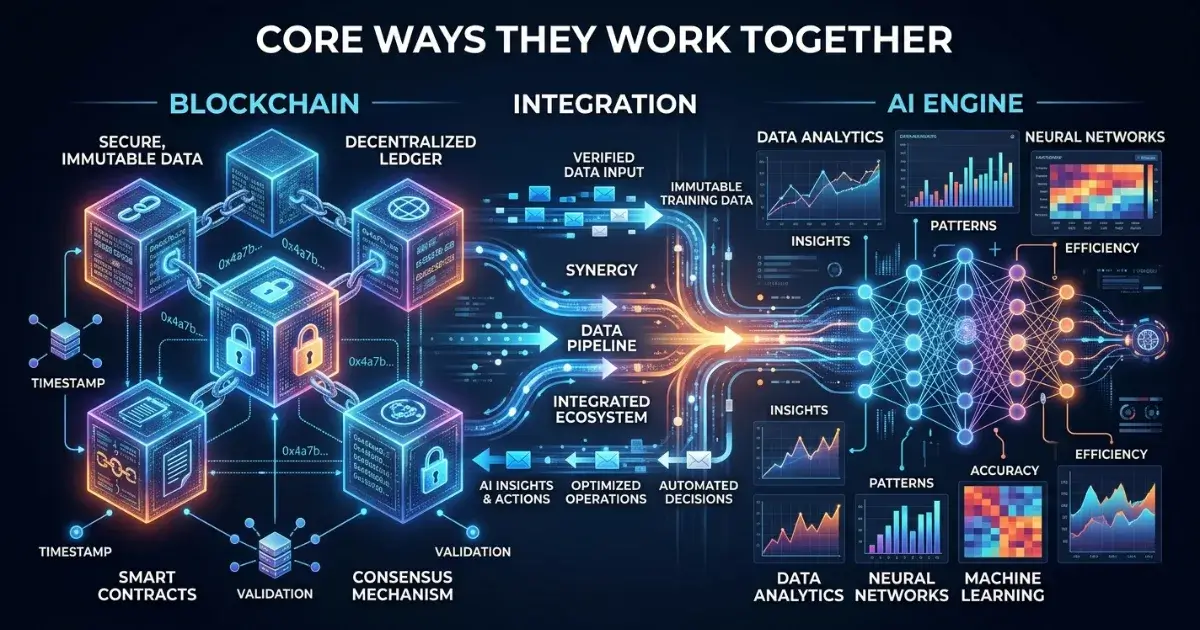
Enterprises adopt practical, hybrid designs that balance performance, cost, and trust:
In short, AI blockchain integration delivers enterprise AI solutions grounded in verifiable trust rather than centralized promises. It enables businesses to deploy powerful intelligence with built-in transparency, security, and auditability exactly what regulators, partners, and customers demand in 2026.
Right now, almost every serious company is using AI in some way. Tools like ChatGPT-style models, predictive analytics, recommendation engines, and automation are already inside marketing, customer service, operations, and product development teams. Adoption numbers look impressive surveys in late 2025 showed that roughly 8–9 out of 10 large organizations have AI running in at least one department.
But here’s the hard truth most boards and CEOs are quietly dealing with: the actual money impact is still disappointing for the majority. When people measure real enterprise-level results things like noticeable profit growth, major cost cuts that show up in financial statements, or clear productivity jumps across the whole company most report very little change. A lot of AI projects stay small, get stuck in pilot mode, or quietly underperform because the predictions aren’t trusted, the data feeding the models is messy or biased, decisions are impossible to explain, and nobody can prove the system wasn’t tampered with after the fact.
Blockchain alone fixes some of these problems very well. It creates records that nobody can secretly change later. It lets multiple parties share the same single version of truth without needing to trust each other blindly. It can automatically run payments, approvals, or penalties the moment conditions are met through smart contracts. But blockchain by itself is not smart it doesn’t look at patterns, forecast what’s coming, spot fraud before it happens, or decide the best next action in complex situations.
That’s where putting AI and blockchain together changes everything.
In 2026, three big realities are forcing companies to seriously consider this combination:
1. Regulators and auditors are no longer accepting “trust us” answers New laws (EU AI Act, updated data protection rules, sector-specific guidelines in finance, healthcare, and energy) demand that companies can clearly show:
That nothing was changed or hidden afterward Blockchain gives an automatic, permanent, cryptographically protected audit trail for every step. AI finally becomes explainable and defensible in front of regulators, investors, partners, and customers.
2. Data can no longer be blindly trusted especially at scale Deepfakes, synthetic training data, hacked datasets, supply-chain document fraud, and intentional manipulation are real and growing problems. When an AI model is built on corrupted or questionable data, the whole output becomes unreliable no matter how advanced the model is. By recording data origins, timestamps, and hashes on blockchain, companies create a tamper-proof foundation. The AI then works only on verified, high-quality inputs. This massively reduces risk and builds real confidence in the results.
3. Autonomous AI agents are about to move real money and they need trustworthy rails We’re quickly moving toward a world where AI agents (software “employees” that think, negotiate, buy, sell, pay, and settle deals on their own) will handle huge numbers of micro-transactions every day: machine-to-machine payments, automated B2B orders, dynamic insurance claims, instant cross-border settlements. These agents can’t operate safely in a purely centralized system too much single-point risk, too easy to hack or dispute. Blockchain gives them secure digital identity, wallets, instant final settlement, and smart-contract enforcement. Without blockchain, the agent economy stays stuck in theory.
Real-world examples already show what happens when companies combine both technologies:
In short: Standalone AI gives you speed and intelligence but fragile trust. Standalone blockchain gives you rock-solid trust but no intelligence.
Together in 2026 they deliver intelligence you can actually trust and that’s becoming the new competitive standard.
The companies that build this combined capability first will:
Those who wait will find themselves playing catch-up in a world where “verifiable AI” is no longer nice-to-have it’s expected.
AI blockchain integration delivers four high-ROI advantages that standalone technologies cannot match:
Bold insight: Organizations combining the technologies see 1.7× average ROI multipliers far above standalone AI pilots because trust removes the adoption friction that kills most AI projects.
AI blockchain integration is shifting from experimental pilots to real-world production systems in 2026. Enterprises across sectors are deploying these hybrid solutions to solve high-stakes problems involving trust, data integrity, automation, and compliance. Below are practical, measurable examples in key industries, showing how businesses gain tangible value today.
In healthcare, patient data privacy, record portability, counterfeit drugs, and trustworthy AI diagnostics remain critical challenges. Blockchain + AI addresses them by combining immutable records with intelligent analysis.
The outcome: faster, safer diagnoses, reduced fraud in drug distribution, and patient-empowered data control all while satisfying growing regulatory demands for transparency.
Fintech leads in AI blockchain integration because it handles high-volume transactions where speed, security, and trust collide.
These applications deliver faster settlements, stronger fraud protection, and new capital access driving measurable revenue and efficiency gains.
Supply chains suffer from opacity, delays, and waste. Blockchain provides unbreakable traceability; AI adds prediction and optimization.
Businesses achieve dramatic cost savings, faster compliance, and customer trust through verifiable origins.
Retail focuses on authenticity, personalization, and efficient operations where provenance and smart execution shine.
This creates transparent, fraud-resistant experiences that drive repeat business and higher margins.
SaaS providers evolve into platforms for verifiable intelligence and automated billing.
These models unlock new recurring revenue, reduce overhead, and position SaaS as infrastructure for the agent economy.
These blockchain AI use cases have matured by 2026 moving beyond proofs-of-concept into production deployments that deliver real ROI through trust, efficiency, risk reduction, and innovation. Enterprises adopting now capture competitive advantages before the shift becomes industry standard.
The real power of AI and blockchain integration goes far beyond fixing day-to-day operations like faster tracing or automated payments. For CXOs, founders, and enterprise leaders, it fundamentally reshapes how the entire organization works, thinks, and creates value. This combination turns traditional weaknesses silos, distrust in data, manual bottlenecks, and untapped assets into strategic strengths that show up in resilience, culture, finances, and long-term competitiveness.
Here are the three core dimensions where the biggest enterprise-level transformation happens in 2026:
Every department and external partner finally operates from the same single source of truth. Blockchain creates an immutable, shared ledger where every data point, transaction, or decision input is timestamped, hashed, and verifiable by anyone with permission no more endless email chains, conflicting spreadsheets, or "he said/she said" disputes over what really happened in a supply chain or contract.
This eliminates massive hidden costs: dispute resolution teams shrink, reconciliation work disappears, audit preparations speed up dramatically, and cross-border or multi-party collaborations become frictionless. When AI sits on top of this trusted foundation, it can predict issues, optimize flows, and automate responses with real confidence because the underlying data can't be quietly altered. The result is a more antifragile operation that withstands shocks like supplier failures, regulatory audits, or cyber incidents far better than before.
Leaders and teams stop blindly saying "trust the AI model" and start demanding "show me the provenance." Blockchain makes every piece of data feeding an AI model traceable back to its origin when it was created, by whom, whether it was altered, and how it moved through the system.
This builds a data-literate culture across the organization. Executives, managers, and even frontline teams learn to question inputs, verify trails, and understand why a prediction or recommendation was made. Decisions become evidence-based rather than gut-based or black-box dependent. Over time, this shifts the mindset from "AI is magic" to "AI is verifiable intelligence we control." It reduces risk aversion around AI adoption, speeds up internal buy-in for new initiatives, and creates a more accountable, transparent environment exactly what boards and regulators want to see in high-stakes industries.
AI + blockchain unlocks entirely new categories of balance-sheet assets that were previously hard to value, trade, or monetize. Enterprises can now tokenize intellectual property (patents, software algorithms, proprietary datasets), trained AI models, high-quality data assets, or even future revenue streams from content or IP.
These tokenized assets become real, liquid entries on the balance sheet verifiable on-chain, fractionally ownable, tradable in decentralized marketplaces, and capable of generating automated royalties or licensing fees via smart contracts. This creates recurring, passive revenue streams that improve cash flow predictability and boost overall enterprise valuation multiples (investors love assets that produce ongoing value with low marginal cost).
On top of that, automation reduces working capital needs (faster settlements, lower disputes), cuts operational expenses (less manual oversight), and opens new revenue models (e.g., selling access to verified AI insights or tokenized data products).
Forward-thinking CXOs already combining these technologies consistently report meaningful gains: 20–40% productivity improvements across targeted processes (from task-level efficiencies cascading into broader operations) and significantly faster time-to-market for AI-powered products and services. When blockchain underpins the AI stack, pilots move to production quicker, scale more reliably, and deliver measurable ROI because trust removes the biggest adoption killer: doubt about data integrity and decision explainability.
In 2026, this isn't incremental improvement it's structural transformation. Organizations that master AI and blockchain for business don't just run better; they become fundamentally more valuable, more adaptable, and harder to disrupt. The gap between leaders and laggards widens as verifiable intelligence becomes a core competitive moat.
No technology stack is perfect, and AI blockchain integration is no exception. For enterprise leaders evaluating this convergence in 2026, an honest look at the real barriers is essential because overlooking them can turn promising pilots into expensive failures. These challenges are well-documented across industry reports, deployments, and analyst insights, but they are solvable with the right architecture, partnerships, and phased approach.
Here are the main limitations businesses face today, explained clearly with why they matter and practical ways forward:
Public blockchains (like Ethereum mainnet) still handle only a limited number of transactions per second often 15–30 TPS for base layers far below what high-frequency enterprise AI inference or real-time analytics might demand. Running heavy AI computations directly on-chain is slow and expensive due to gas fees and network congestion.
Why it matters: Supply-chain monitoring, fraud detection, or agentic commerce can generate thousands of events per minute. Bottlenecks here kill user experience and ROI.
Current reality in 2026: Most enterprises avoid this by using hybrid architectures heavy AI processing happens off-chain (on fast cloud/edge servers), while only critical results, proofs, or hashes land on blockchain. Layer-2 solutions (Polygon, Optimism, Arbitrum) and permissioned networks (Hyperledger Fabric, Corda) deliver much higher throughput with enterprise-grade performance.
Blockchain's core strength permanent, transparent records clashes with regulations like GDPR's "right to be forgotten," HIPAA patient data rules, or CCPA deletion rights. Once data is on-chain, erasing it is impossible without breaking the chain's integrity.
Why it matters: Regulated industries (healthcare, finance, HR) risk massive fines or blocked adoption if they can't comply with privacy mandates.
Practical solutions in 2026:
The blockchain landscape remains fragmented hundreds of chains, protocols, and standards. AI frameworks add another layer: different models, tooling, and data formats don't always talk to each other seamlessly.
Why it matters: Enterprises rarely use one chain or one AI vendor. Without smooth connections, value gets locked in silos, integrations become custom and costly, and cross-partner workflows (e.g., supply-chain ecosystems) break.
Progress in 2026: Cross-chain bridges, interoperability protocols (like Polkadot, Cosmos, or Chainlink CCIP), and emerging standards for AI-blockchain middleware are closing the gap. Many enterprises start with permissioned, consortium-style networks that control interoperability from the design phase.
Few professionals are deeply skilled in both AI (model training, MLOps, ethics) and blockchain (smart contracts, consensus, cryptography, tokenomics). Governance who owns data, who audits models, how to handle disputes is even harder when combining decentralized systems with corporate hierarchies.
Why it matters: Without expertise, projects drag, security risks rise, and internal alignment fails. Boards demand clear responsible-AI and blockchain policies before approving big budgets.
How leaders address it: Build cross-functional teams early (AI engineers + blockchain architects + legal/compliance). Partner with specialized vendors or consultancies. Establish governance frameworks from day one: data ownership rules, audit protocols, ethical AI guidelines, and escalation paths.
Proof-of-work chains remain power-hungry, and layering AI (which is compute-intensive) can push energy use 30–40% higher than traditional systems. Even proof-of-stake chains have costs for Layer-2 fees, oracle data, and ZKP computations.
Why it matters: Sustainability goals, ESG reporting, and rising energy prices make high costs a board-level concern.
Mitigation: Shift entirely to proof-of-stake or energy-efficient Layer-2s. Optimize by keeping most AI off-chain. Many enterprises now prioritize green, low-cost networks for production.
To turn these challenges from blockers into manageable steps:
In 2026, these aren't reasons to avoid AI blockchain integration they're known hurdles that successful adopters have already navigated. The enterprises winning today treat these limitations as design constraints, not excuses, and build accordingly. The result is systems that are not just innovative, but reliably enterprise-ready.
Looking ahead from 2026 into the late 2020s and early 2030s, the convergence of AI and blockchain accelerates into something far more profound than today's integrations. What starts as trusted data feeds and automated smart contracts evolves into fully autonomous, verifiable intelligence ecosystems. Enterprises that position themselves now will own not just tools or ledgers, but entire networks of intelligent, trust-native operations that competitors struggle to replicate.
Here are the most impactful trends emerging beyond 2026, grounded in current trajectories and expert forecasts:
By the late 2020s, autonomous AI agents intelligent software that independently researches, negotiates, decides, and executes become major economic actors. These agents handle complex workflows like dynamic procurement, personalized shopping, or B2B deal-making without constant human oversight.
Blockchain provides the essential infrastructure: secure digital identities, wallets for holding value, instant micropayments via stablecoins, and tamper-proof settlement. Emerging standards like x402 (an HTTP-native payment protocol revived by Coinbase and others) enable agents to pay per use for APIs, data, or services no accounts, no API keys, just seamless stablecoin transfers triggered by HTTP 402 responses.
Projections show explosive growth: AI agents could influence 20–50%+ of online orders and e-commerce transactions by 2027–2028, with global agentic commerce opportunity reaching $3–5 trillion by 2030. In blockchain-native environments, agents execute a significant portion of on-chain activity, turning blockchains into quiet backbones for machine-to-machine economies. Enterprises win by building agent-ready rails or risk being bypassed entirely.
Traditional scientific research faces funding bottlenecks, slow peer review, data silos, and gatekeeping. DeSci flips this using blockchain for transparent funding (via DAOs and tokens), immutable data sharing, tokenized IP, and community-governed projects.
Enterprises tap into this by monetizing proprietary AI models, datasets, or research outputs on open, decentralized marketplaces successors to platforms like SingularityNET or Fetch.ai. Researchers and companies earn tokens for contributions; AI models train on verifiable, consented data pools; breakthroughs accelerate through global, pseudonymous collaboration.
By the early 2030s, DeSci becomes foundational infrastructure much like arXiv or PubMed today but with economic incentives and AI-powered insights. Forward-thinking firms create recurring revenue from tokenized research assets while accessing high-quality, auditable data for their own models.
Blockchains evolve from general-purpose networks to specialized, composable stacks. Modular architectures separate execution, data availability, consensus, and settlement letting enterprises deploy custom chains tailored for AI tasks (e.g., high-throughput inference, privacy-preserving computation, or agent coordination).
Zero-knowledge proofs (ZK) scale this further: they enable verifiable off-chain AI computations with on-chain proofs, keeping sensitive data private while ensuring results are trustworthy. This supports privacy-heavy use cases like federated learning or confidential AI agents.
By 2030, modular + ZK setups become the default for AI-intensive applications powering everything from decentralized compute marketplaces to agent swarms with Ethereum (and competitors) serving as secure settlement anchors.
Quantum computers threaten to break traditional cryptography (e.g., via Shor's algorithm cracking ECC/RSA keys used in most blockchains and AI signing). Regulated industries face existential risks if unprepared.
Blockchain platforms integrate post-quantum cryptography (PQC) standards from NIST like CRYSTALS-Kyber, Dilithium, and Falcon to future-proof signatures, wallets, and consensus. AI systems gain quantum-resistant protections for model weights, training data, and inference proofs.
Enterprises in finance, healthcare, and critical infrastructure prioritize this migration in the late 2020s to avoid "harvest-now-decrypt-later" attacks and maintain trust in verifiable AI outputs.
Real-world assets (RWAs) real estate, bonds, treasuries, commodities, private credit move on-chain at massive scale. Current tokenized RWA markets sit around $20–36 billion (2025–2026), but forecasts range from $2–30 trillion by 2030 (with bullish estimates at $16–30T).
AI agents supercharge this: they dynamically value, price, trade, and manage tokenized assets in real time using on-chain data for predictions, negotiating deals, and executing via smart contracts. This creates liquid, 24/7 markets for illiquid assets and unlocks new valuation models (e.g., AI-optimized fractional ownership or predictive yield farming).
The winners own verifiable intelligence ecosystems: networks where AI agents operate on trusted blockchain rails, provenance is unbreakable, computations are provable, and value flows autonomously. It's no longer about owning models or ledgers it's about commanding ecosystems of intelligent, trust-native agents that generate and capture economic value at unprecedented scale.
These trends converge into one clear message for CXOs: the post-2026 era rewards those who build verifiable, autonomous intelligence today. Start with high-ROI pilots in agentic flows or tokenized assets the compounding advantages will define industry leadership for the next decade.
Adopting AI and blockchain integration in a large organization isn't about rushing into new tech it's a deliberate, low-risk journey that starts with business value and builds toward scalable, production-ready systems. In 2026, successful enterprises follow a structured, phased approach that minimizes disruption, proves ROI early, and incorporates governance from the beginning.
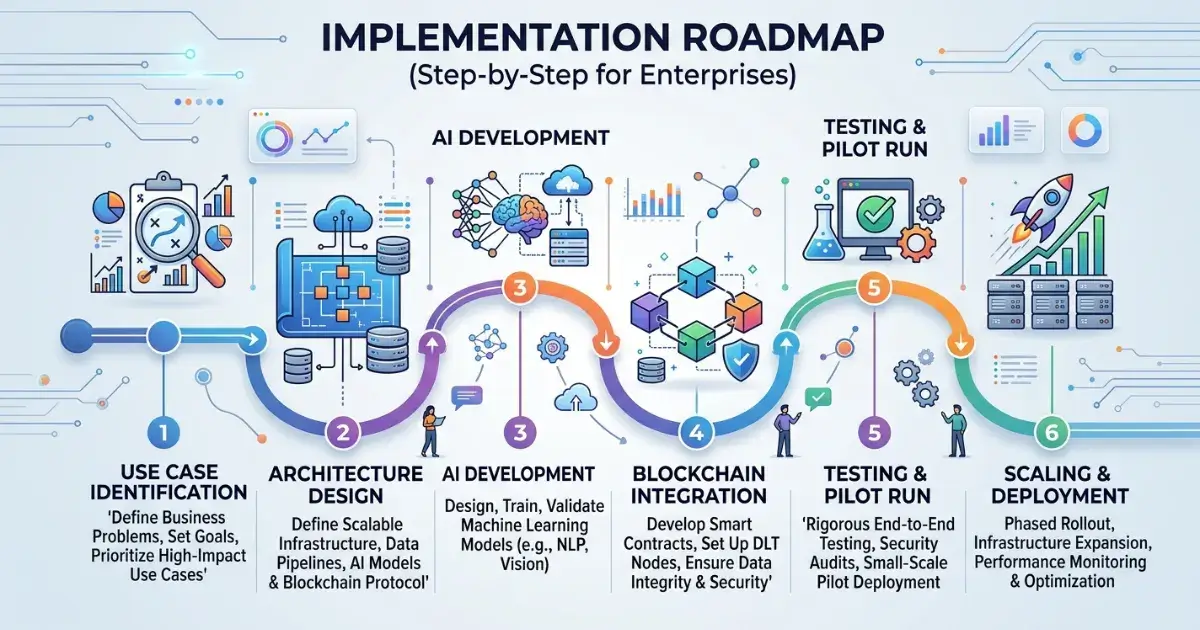
This practical 8-step roadmap draws from real enterprise deployments (in supply chain, fintech, healthcare, and more). It typically delivers a working pilot in 6–9 months and full-scale transformation (with meaningful enterprise-wide impact) in 18–24 months assuming strong executive support and iterative execution.
Start by focusing on real business pain points where trust issues, data silos, manual processes, or compliance risks create the biggest costs or missed opportunities.
This step prevents "tech-first" failures and ensures the project solves actual problems.
Translate the use case into dollars and risk reduction to win C-suite support.
Without this buy-in, projects stall at the pilot stage.
Audit what you already have data quality, sources, silos and choose a blockchain setup that fits your needs.
This avoids building on shaky foundations.
Build a small, focused prototype to test the integration in 8–12 weeks.
Success here builds momentum and real data for Step 2's ROI case.
Select tools that balance enterprise needs (security, scalability, integration) with developer productivity.
Choose based on your team's skills and existing vendor relationships.
Define rules before scaling don't bolt them on later.
This step turns potential blockers into built-in strengths.
Deploy in one department or business unit to gather real-world proof.
This phase turns skeptics into advocates with evidence.
Expand once the pilot proves value integrate deeply and explore revenue opportunities.
Monitor ROI post-scale and adjust.
This roadmap is proven in 2026 deployments: start narrow, prove fast, govern tightly, scale smart. Enterprises that follow it avoid common pitfalls (scope creep, compliance surprises, integration hell) and position AI blockchain integration as a core capability not a side project.
If you're ready to map this to your organization, our team helps Fortune-level companies design customized roadmaps and run secure PoCs book a strategy session to see how this applies to your priorities.
In March 2026, the landscape for AI and blockchain integration has shifted dramatically. The major barriers that held back widespread enterprise adoption uncertainty around regulations, high costs, and lack of proven results have largely fallen away. This creates a narrow window where forward-thinking companies can gain lasting advantages before the opportunity closes.
Governments are moving from vague warnings to structured (though still evolving) frameworks that demand transparency, auditability, and accountability in AI systems.
AI blockchain integration fits perfectly here. Blockchain provides the immutable audit trails, verifiable data provenance, and tamper-proof logs that make AI decisions defensible to regulators, auditors, and partners. Companies that build this in now avoid last-minute scrambles to retrofit systems when enforcement ramps up.
Layer-2 blockchain solutions (like Polygon, Optimism, Arbitrum, and zk-rollups) have matured significantly by 2026. Transaction fees have plummeted often to near-zero levels for many use cases thanks to upgrades like Ethereum's Pectra (which doubled blob capacity in 2025) and ongoing improvements in batching, proving efficiency, and data availability layers (e.g., Celestia). This makes it practical and affordable to anchor AI results, run agentic payments, or maintain provenance at enterprise scale without the old gas-fee headaches.
What used to be prohibitively expensive is now economically viable even for high-volume applications like supply-chain tracking, fraud monitoring, or autonomous agent transactions.
Enterprise pilots in 2026 are no longer theoretical. Major companies (in retail, finance, logistics, healthcare) have moved beyond demos to production systems showing concrete wins:
These successes remove the "it works in a lab but not for us" excuse. The technology is battle-tested at scale.
Competitors who adopt AI blockchain integration in 2026 are quietly building unbreakable advantages:
Delaying means watching rivals pull ahead in trust, efficiency, and innovation. When customers and regulators start expecting "verifiable AI" as standard (which is already happening in Europe and key US sectors), companies without it will face higher scrutiny, lost deals, and retrofitting costs.
In short: the barriers are gone, the proof is in, and the first-mover window is open but closing fast. Businesses that act decisively in 2026 don't just keep up they redefine what's possible in their industry. Waiting risks ceding ground to competitors who already make AI decisions with unbreakable, on-chain confidence.
If this resonates with your 2026 priorities, our enterprise team can help map a quick, high-ROI starting point whether it's a targeted pilot or a full strategic assessment. Reach out for a confidential discussion.
AI and blockchain for business is the defining technology convergence of the decade. It turns opaque predictions into verifiable actions, manual processes into autonomous execution, and data liabilities into tokenized assets.
The enterprises that act in 2026 will lead their industries for the next decade.
Ready to build your AI-blockchain advantage? Our enterprise team has delivered production-grade AI blockchain integration solutions for Fortune 500 companies in healthcare, fintech, and supply chain. Book a 30-minute strategy call today to map your high-ROI use case and receive a customized 2026 roadmap no obligation, full confidentiality.






Start Build Your
Next Digital Solution?
Let’s build scalable, future-ready digital solutions tailored to your business goals. Connect with our experienced technology consultants to discuss your vision, strategy, and growth opportunities — with zero obligation and complete transparency.
Get a free consultation and cost estimate for your digital solution
Our expert will contact you within 24 hours. Check your email for confirmation.
Partner with SISGAIN experts to build secure, scalable AI-powered IT Solutions that transform your business operations.









DUQE FREEZONE Quarter Deck, Queen Elizabeth 2, Mina Rashid, Dubai, UAE

100 Consilium Pl Suite 200, Scarborough, ON M1H 3E3, Canada

C-109, Sector 2, Noida, Uttar Pradesh 201301 India
Project quotes, partnerships, implementation
Open roles, referrals, campus hiring