
 +1 844-445-5767
 +971 56-848-5757
 +91 921-208-0630
For Business & Service Inquiries
Sales Team
Project quotes, partnerships, implementation
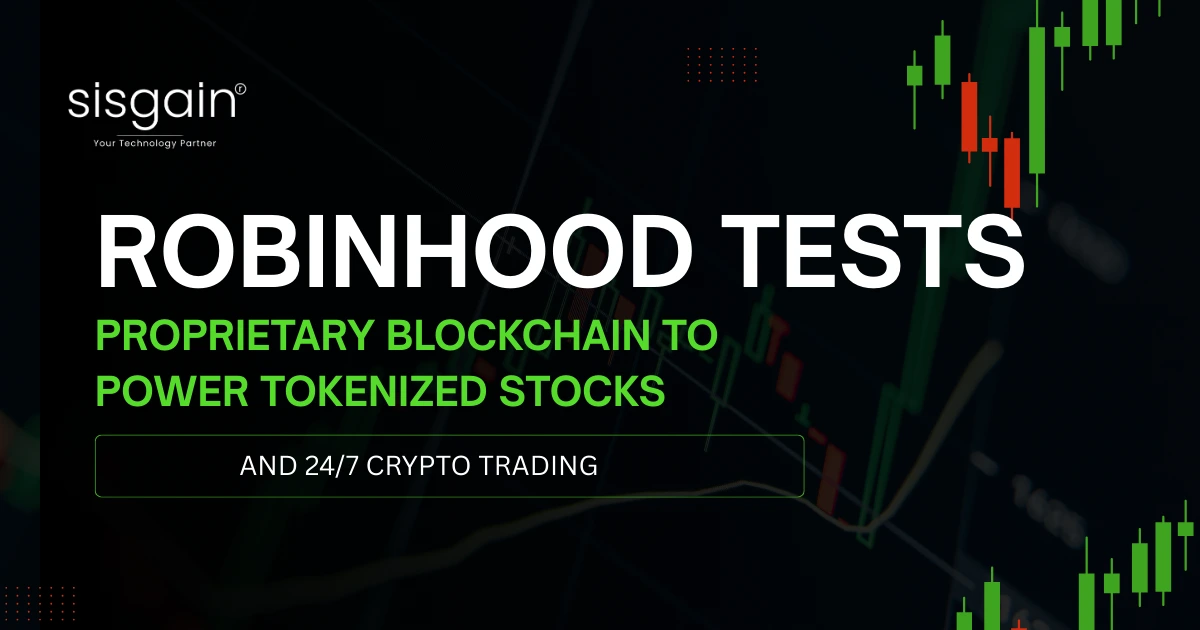
Hong Kong — Robinhood has taken a decisive step deeper into onchain finance, unveiling a public testnet for its own Ethereum-based blockchain designed to support tokenized equities, round-the-clock trading and decentralized finance integrations.
The new network, dubbed Robinhood Chain, is built on Arbitrum — one of Ethereum’s most prominent layer-2 frameworks — and marks the brokerage firm’s most ambitious infrastructure move yet as digital assets and real-world tokenization accelerate across global markets.
Announced during CoinDesk’s Consensus Hong Kong conference, the testnet follows six months of private experimentation and will open the door for developers to build publicly ahead of a planned mainnet launch later this year.
Robinhood’s latest initiative reflects a broader shift sweeping financial services, where traditional trading platforms are evolving into blockchain-native ecosystems. These developments are rapidly becoming central to wider fintech trends in 2026, as firms seek faster settlement, global accessibility and programmable compliance.
According to Johann Kerbrat, Robinhood’s Senior Vice President and General Manager of Crypto, the decision to build its own chain was less about chasing transaction speed and more about anchoring itself in Ethereum’s deep liquidity and developer community.
“What we wanted was the security of Ethereum, the liquidity that is available on EVM chains and the Ethereum ecosystem,” Kerbrat said, while emphasizing the importance of tailoring infrastructure for regulated assets like stocks and ETFs.
Unlike many high-performance rollups optimized for speculative trading, Robinhood Chain is being architected specifically for tokenized traditional securities. The network aims to allow users to self-custody digital representations of equities, exchange-traded funds and other financial instruments through Robinhood’s crypto wallet, while seamlessly bridging to Ethereum-based DeFi applications.
The platform also plans to enable 24/7 trading — a sharp contrast to legacy market hours — signaling how tokenization could redraw the boundaries of global capital markets.
This move builds on Robinhood’s earlier foray into digital securities. Last year, the company introduced tokenized U.S. stocks and ETFs for European customers, complete with dividend payouts and extended trading windows. Those assets were initially issued on Arbitrum, though their overall value still trails behind rival token issuers such as xStocks and Ondo Global Markets.
Robinhood’s timing is notable. Ethereum’s roadmap has recently shifted renewed attention to strengthening its base layer, with upgrades aimed at lowering fees and easing congestion — developments that challenge the long-standing argument that layer-2 networks exist solely to scale the main chain.
Kerbrat suggested Robinhood had already anticipated this evolution.
“For us, it was never really about scaling Ethereum or doing faster transactions,” he said. “We wanted to customize the chain and make it optimized for traditional assets being tokenized.”
That philosophy aligns with a growing industry narrative: layer-2 networks as specialized environments rather than generic throughput engines. Increasingly, firms — including large financial institutions working alongside blockchain development companies — are crafting application-specific chains that bake in regulatory controls, identity layers and compliance tooling.
Because tokenized securities must adhere to different legal frameworks across jurisdictions, Robinhood Chain is being structured with regulatory flexibility in mind. Kerbrat noted that future blockchain ecosystems are likely to fragment into purpose-built networks — some focused on payments, others on institutional finance, and still others on consumer crypto services.
This approach echoes recent debates sparked by Ethereum co-founder Vitalik Buterin, who has argued that rollups dealing with real-world assets may need to accept different decentralization trade-offs to satisfy regulators.
Robinhood, Kerbrat said, has long assumed such compromises would be unavoidable.
“We’ve always been building with the idea that there are different compliance requirements based on the jurisdiction, and all these things can be embedded into the chain.”
With the testnet now live, developers can access tooling, documentation and standard Ethereum frameworks to begin experimenting on the network. Robinhood plans to gradually expand functionality ahead of mainnet, including test-only stock tokens and deeper wallet integrations.
The rollout underscores how major financial platforms are no longer content merely offering crypto trading — they are becoming infrastructure providers themselves. As institutional interest in tokenization rises and demand grows for sophisticated digital-asset platforms — from equity rails to bitcoin application development — Robinhood’s blockchain gamble could position the firm at the heart of the next generation of market plumbing.
Whether Robinhood Chain ultimately becomes a cornerstone for regulated onchain finance remains to be seen. But its debut signals one thing clearly: the race to tokenize Wall Street has entered a new, more infrastructural phase.






Start Build Your
Next Digital Solution?
Let’s build scalable, future-ready digital solutions tailored to your business goals. Connect with our experienced technology consultants to discuss your vision, strategy, and growth opportunities — with zero obligation and complete transparency.
Get a free consultation and cost estimate for your digital solution
Our expert will contact you within 24 hours. Check your email for confirmation.
Partner with SISGAIN experts to build secure, scalable AI-powered IT Solutions that transform your business operations.









DUQE FREEZONE Quarter Deck, Queen Elizabeth 2, Mina Rashid, Dubai, UAE

100 Consilium Pl Suite 200, Scarborough, ON M1H 3E3, Canada

C-109, Sector 2, Noida, Uttar Pradesh 201301 India
Project quotes, partnerships, implementation
Open roles, referrals, campus hiring