
 +1 844-445-5767
 +971 56-848-5757
 +91 921-208-0630
For Business & Service Inquiries
Sales Team
Project quotes, partnerships, implementation
The next decade of economic expansion in the United States will not be driven by apps or platforms—it will be driven by infrastructure. And at the center of that infrastructure shift sits the convergence of ai and blockchain.
Individually, artificial intelligence has transformed automation, data processing, and decision-making at scale. Blockchain, on the other hand, has redefined digital ownership, trust, and decentralized value exchange. Together, blockchain and artificial intelligence are forming the backbone of what many analysts describe as the transition from Web2’s centralized platforms to an AI-native Web3 economy.
Web2 was built on data extraction. Web3 is being built on programmable trust. Now, AI is injecting intelligence into that programmable trust layer.
This is not hype. It is infrastructure evolution.
In the Web2 era, enterprises relied on centralized databases and opaque algorithms. In the emerging AI-native Web3 model, logic can execute autonomously, data can be verified cryptographically, and value can move without intermediaries. The combination of ai and blockchain is reshaping digital trust, enabling autonomous automation, and redefining how assets—both financial and informational—are created and exchanged.
For US enterprises, this convergence represents a structural shift. It impacts regulatory compliance, cybersecurity resilience, financial transparency, and competitive advantage. Companies that understand how artificial intelligence in blockchain ecosystems enhances auditability, automation, and data integrity will lead the next digital growth cycle.
The question is no longer whether these technologies will converge. It is how strategically organizations deploy them.
Artificial intelligence is powerful—but it is not inherently trustworthy.
Modern AI systems are trained on vast datasets that are often opaque in origin, inconsistently governed, and difficult to audit. This creates four structural weaknesses:
Enterprises frequently cannot verify where training data originated or whether it was lawfully obtained. This exposes organizations to compliance and reputational risks.
Without transparent datasets, AI models can unintentionally amplify bias, creating regulatory and ethical liabilities.
As AI becomes more autonomous, organizations struggle to maintain oversight and accountability over model decisions.
With generative AI producing code, content, and designs, ownership questions have intensified across industries.
This is where blockchain for AI becomes strategically critical.
By anchoring AI training datasets and model updates onto immutable ledgers, organizations can create verifiable data provenance. Every data input can be timestamped, hashed, and auditable. This enables true transparency—something traditional centralized AI pipelines cannot offer.
Deploying ai on the blockchain also introduces immutable audit trails. Every inference, model adjustment, or prompt interaction can be logged securely, strengthening governance and compliance readiness.
Additionally, decentralized governance mechanisms allow stakeholders to vote on model updates or protocol changes, reducing centralized control risks. This approach elevates ai with blockchain from a technical experiment to a governance solution.
Perhaps most transformative is the emergence of tokenized data marketplaces. Blockchain enables individuals and institutions to securely monetize proprietary datasets, fueling better model training while preserving ownership rights.
Building verifiable data provenance systems often requires custom blockchain development to ensure scalability, interoperability, and enterprise-grade security.
In short, artificial intelligence needs blockchain not for speed—but for trust, transparency, and sustainable scale.
While blockchain introduced decentralized trust, it was never designed to be intelligent.
Traditional blockchain systems operate on deterministic logic: predefined rules execute when specific conditions are met. This works well for simple transfers or contractual triggers—but modern digital economies demand adaptive intelligence.
Several limitations have emerged:
Smart Contract Vulnerabilities
Coding flaws can expose networks to exploits, leading to financial losses.
Fraud Detection Gaps
Blockchains record transactions immutably—but they do not inherently detect suspicious behavior in real time.
Static Automation
Smart contracts execute predefined instructions but cannot adapt dynamically to changing environments.
Limited Intelligence Layer
Blockchain validates transactions but does not interpret intent, risk probability, or predictive outcomes.
This is where ai for blockchain becomes transformative.
AI-powered auditing tools can continuously scan smart contracts to identify vulnerabilities before deployment. Machine learning models can analyze historical exploit patterns, reducing systemic risk across decentralized ecosystems.
Integrating blockchain ai systems also enhances on-chain fraud detection. AI can monitor wallet behavior, transaction velocity, and anomaly patterns to flag suspicious activity in real time—far beyond static rule-based systems.
More importantly, the fusion of blockchain and ai introduces predictive transaction monitoring. Instead of merely recording what has happened, systems can anticipate risk exposure before it materializes.
The most advanced evolution is the rise of autonomous agents operating across decentralized networks. These AI agents can evaluate data, make probabilistic decisions, and execute transactions without human intervention—bringing intelligence directly into programmable trust systems. This is where ai and the blockchain shift from coexistence to true integration.
Blockchain provides trust.
AI provides intelligence.
Together, they create adaptive, autonomous, and secure digital infrastructure ready for enterprise-scale deployment in the US market.
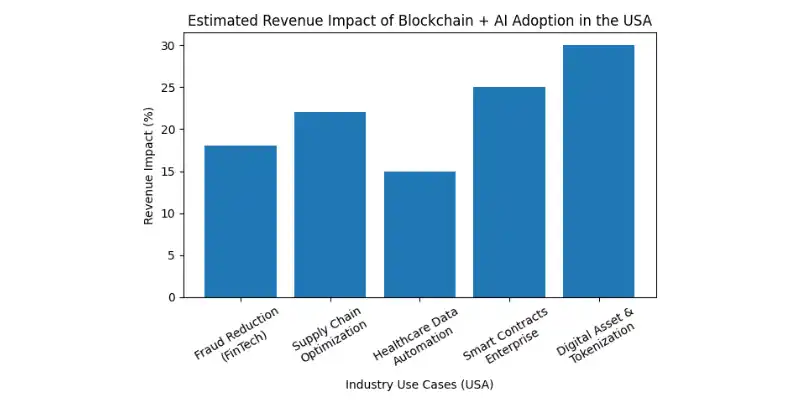
The convergence of blockchain and artificial intelligence is no longer theoretical. Across the United States, enterprises are moving from experimentation to production deployment.
US financial institutions operate under intense regulatory scrutiny, particularly from the U.S. Securities and Exchange Commission. As decentralized finance (DeFi) platforms expand, compliance complexity increases.
AI-enhanced DeFi compliance systems now monitor transactions in real time, identifying suspicious patterns before they escalate into violations. When deployed across blockchain networks, AI models can analyze wallet behaviors, cross-reference sanctions databases, and flag anomalies that static rule engines often miss.
The combination of ai and blockchain enables immutable reporting trails. Every flagged transaction, compliance review, and remediation step can be cryptographically recorded. This not only reduces regulatory exposure but also strengthens audit defensibility during SEC investigations.
Counterfeit goods and supply chain fraud cost US businesses billions annually. Blockchain ensures product traceability, while AI enhances interpretation.
By integrating AI with blockchain tracking systems, enterprises can verify authenticity at every stage—from raw material sourcing to final delivery. AI-driven predictive demand modeling analyzes historical data to anticipate inventory shortages or disruptions.
This fusion of blockchain and artificial intelligence moves supply chains from reactive to predictive systems. Instead of merely recording product journeys, companies gain forward-looking intelligence that optimizes logistics, reduces waste, and improves margin performance.
Healthcare remains one of the most sensitive data environments in the US. Blockchain secures patient records through decentralized encryption, reducing breach risk. Layering AI on top enables advanced diagnostics without compromising privacy.
AI models can analyze encrypted health data stored on blockchain-backed systems, enabling early disease detection and risk scoring. The integration of ai and blockchain ensures that every data access, update, or diagnostic inference is logged immutably—critical for HIPAA-aligned governance.
Generative AI has intensified ownership disputes. Blockchain provides timestamped proof of content creation and licensing agreements. AI systems embedded into blockchain layers can automatically enforce licensing terms and royalty payments.
For creators and enterprises alike, this model introduces programmable intellectual property management—bringing transparency and enforceability to a rapidly evolving AI content economy.
To move beyond experimentation, Enterprises seeking tailored predictive engines often collaborate with a Custom AI software development company to design models aligned with proprietary data and industry-specific compliance requirements.
This foundational layer establishes verifiable integrity.
It includes:
The Trust Layer ensures that data, transactions, and operational rules cannot be altered retroactively. It provides the security backbone upon which AI systems can safely operate.
Without this layer, AI models rely on centralized databases vulnerable to manipulation and compliance risk.
Above the trust infrastructure sits the Intelligence Layer.
This includes:
Here, ai and blockchain intersect operationally. AI consumes verified blockchain data, analyzes patterns, predicts outcomes, and generates insights. Because the data originates from immutable ledgers, model outputs are grounded in verifiable truth rather than opaque datasets.
The Automation Layer introduces autonomous execution.
AI agents can:
This transforms static blockchain systems into adaptive ecosystems. Instead of pre-coded triggers, AI agents evaluate conditions probabilistically and act accordingly. The result is dynamic automation aligned with real-time data.
The final layer introduces economic alignment.
Tokenized mechanisms enable:
This layer ensures sustainable participation. Enterprises, developers, and users are rewarded for contributing value—creating a self-reinforcing ecosystem.
Together, these four layers convert blockchain and artificial intelligence from isolated technologies into a unified digital infrastructure stack.
For US enterprises, regulatory alignment determines scalability.
The U.S. Securities and Exchange Commission continues to expand oversight across digital assets and decentralized finance platforms. At the same time, AI governance frameworks are gaining national attention, particularly those outlined by the National Institute of Standards and Technology, which emphasize transparency, risk management, and accountability in AI deployment.
Organizations deploying ai and blockchain solutions must address both regulatory dimensions simultaneously.
Blockchain enhances compliance by providing immutable transaction histories, transparent audit logs, and tamper-proof reporting structures. AI strengthens regulatory monitoring by identifying anomalies, detecting fraud patterns, and automating risk scoring in real time.
Emerging compliance models increasingly favor verifiable systems. Regulators are prioritizing explainability, traceability, and governance controls. By combining blockchain’s transparency with AI’s analytical intelligence, enterprises can proactively meet these expectations rather than react to enforcement actions.
In this context, blockchain and artificial intelligence are not regulatory liabilities—they are compliance enablers. Properly architected systems reduce ambiguity, increase audit readiness, and strengthen institutional trust.
For US enterprises seeking long-term growth, regulatory-aligned infrastructure is no longer optional. It is strategic necessity.
As adoption accelerates, misconceptions around ai and blockchain continue to distort strategic decision-making. Enterprise leaders must separate technical constraints from outdated assumptions.
“AI on blockchain is too slow.”
Public blockchains are not designed to process heavy AI computations directly on-chain. But that misses the architecture reality. Modern deployments use hybrid models: AI inference and training occur off-chain for efficiency, while verification proofs, model hashes, and transaction logs are anchored on-chain. The result is scalable intelligence combined with immutable validation. Performance is an engineering challenge—not a structural limitation.
“Blockchain AI is only for crypto.”
This is perhaps the most persistent myth. While early adoption emerged in digital assets, today blockchain and artificial intelligence are transforming healthcare compliance, supply chain traceability, digital identity, and intellectual property management. The infrastructure value extends far beyond cryptocurrency.
“Regulation will kill innovation.”
In reality, regulation accelerates institutional adoption. US enterprises require clarity before deploying capital at scale. Regulatory frameworks from agencies such as the U.S. Securities and Exchange Commission provide operational boundaries that reduce uncertainty. Mature governance attracts institutional investors.
“Decentralized AI is unrealistic.”
Fully decentralized AI remains early-stage, but hybrid decentralized governance models are already viable. Blockchain enables transparent model oversight and data monetization, even when computation remains distributed across cloud infrastructure.
The real strategic misstep is waiting. Enterprises that delay experimentation risk ceding competitive ground to early movers who are building compliant, intelligent infrastructure today.
The economic signals are clear. The World Economic Forum projects that emerging technologies—including AI and blockchain—will define the next phase of digital economic expansion.
Artificial intelligence alone is expected to contribute trillions to global GDP over the next decade. Simultaneously, Web3 infrastructure investment continues to expand as enterprises explore decentralized identity, tokenization, and programmable finance.
Institutional capital is no longer speculative. Major investment funds are allocating capital toward AI infrastructure, decentralized data marketplaces, and enterprise blockchain networks. Venture funding in blockchain-based AI protocols has increased as organizations seek verifiable, transparent model governance.
The convergence of ai with blockchain creates a multiplier effect. Blockchain ensures trust, provenance, and secure data exchange. AI transforms that verified data into predictive intelligence and automation.
Enterprises building blockchain for AI ecosystems are not simply adopting new tools—they are positioning themselves within the next generation of digital infrastructure. The capital flow reflects this reality.
The opportunity is not incremental efficiency. It is structural market repositioning.
Monitoring evolving AI trends is essential for enterprises looking to align long-term infrastructure investments with emerging decentralized intelligence models

For US enterprises, successful adoption of blockchain and artificial intelligence requires disciplined execution. The following roadmap minimizes risk while maximizing strategic value.
Start where transparency and automation generate measurable ROI. Examples include compliance reporting, fraud monitoring, intellectual property tracking, or supply chain validation. Focus on workflows where data integrity and predictive intelligence directly impact revenue or regulatory exposure.
Introduce AI models to analyze existing operational data. Machine learning systems can identify anomalies, optimize performance, and generate predictive insights. At this stage, AI enhances visibility without restructuring core infrastructure.
Once intelligence insights are validated, anchor critical data outputs onto blockchain infrastructure. Immutable logging ensures auditability and strengthens governance. This creates a verifiable record of AI-driven decisions, enhancing compliance defensibility.
As automation maturity increases, enterprises should study broader patterns of AI Agent Adoption in Tech Companies to understand how autonomous systems are transforming decision execution, compliance workflows, and operational scalability.
Establish oversight protocols aligned with guidance from bodies such as the National Institute of Standards and Technology. Implement explainability standards, role-based access controls, and regular model audits.
This phased approach reduces disruption while enabling scalable innovation. Enterprises that integrate ai and blockchain strategically—rather than reactively—will build resilient digital infrastructure capable of sustaining long-term growth in the US market. Partnering with experienced AI Software Development Companies can accelerate deployment while ensuring regulatory alignment and scalable architecture design.
In every major technological shift, early infrastructure adopters capture disproportionate value. The convergence of ai and blockchain is no different.
First, there is a clear valuation premium. Public markets and private equity increasingly reward companies that demonstrate scalable automation, verifiable governance, and resilient digital infrastructure. When enterprises integrate blockchain and artificial intelligence into core operations—not just innovation labs—they signal operational maturity and long-term defensibility. That narrative directly influences valuation multiples.
Second, early adoption creates powerful investor signaling. Institutional investors seek businesses that anticipate regulatory shifts rather than react to them. Demonstrating immutable audit trails, AI-driven compliance systems, and transparent governance frameworks positions companies as forward-thinking and risk-aware.
Third, proactive regulatory positioning reduces future friction. By embedding explainability, traceability, and oversight into infrastructure today, enterprises align with evolving expectations from agencies such as the U.S. Securities and Exchange Commission. Compliance becomes a competitive advantage rather than a constraint.
Finally, the automation gains are measurable. AI-powered monitoring, autonomous smart contract execution, and predictive analytics reduce manual oversight costs and operational inefficiencies. Over time, these efficiencies compound—freeing capital for innovation rather than remediation.
Early movers do not simply adopt new tools. They reshape their competitive cost structures and strategic positioning for the decade ahead.
The convergence of ai and blockchain marks a turning point in digital enterprise architecture.
This is not a passing trend driven by hype cycles. It is the next stage of infrastructure evolution—where intelligence operates on top of programmable trust, and automation is governed by verifiable transparency. The integration of blockchain and artificial intelligence transforms compliance, operational efficiency, asset ownership, and institutional credibility.
For US enterprises, the implications are strategic. Organizations that embed AI into secure blockchain-backed systems gain resilience, auditability, and scalable automation. Those that delay risk structural disadvantage—operating with opaque data pipelines and reactive governance models while competitors build adaptive, compliant ecosystems.
Infrastructure transitions do not wait for consensus. They reward conviction.
The companies that treat ai and blockchain as foundational—not experimental—will define the next era of digital leadership.




Start Build Your
Next Digital Solution?
Let’s build scalable, future-ready digital solutions tailored to your business goals. Connect with our experienced technology consultants to discuss your vision, strategy, and growth opportunities — with zero obligation and complete transparency.
Get a free consultation and cost estimate for your digital solution
Our expert will contact you within 24 hours. Check your email for confirmation.
Partner with SISGAIN experts to build secure, scalable AI-powered IT Solutions that transform your business operations.









DUQE FREEZONE Quarter Deck, Queen Elizabeth 2, Mina Rashid, Dubai, UAE

100 Consilium Pl Suite 200, Scarborough, ON M1H 3E3, Canada

C-109, Sector 2, Noida, Uttar Pradesh 201301 India
Project quotes, partnerships, implementation
Open roles, referrals, campus hiring