
 +1 844-445-5767
 +971 56-848-5757
 +91 921-208-0630
For Business & Service Inquiries
Sales Team
Project quotes, partnerships, implementation
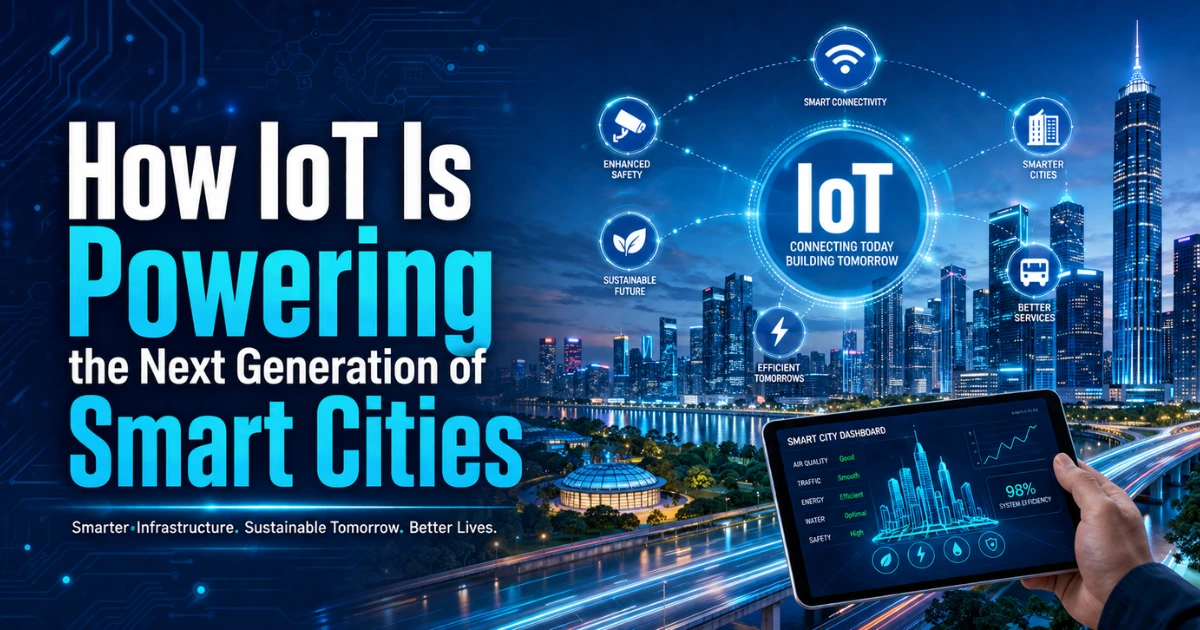
TL;DR: IoT for smart cities connects physical infrastructure—sensors, cameras, traffic systems, and utilities—to centralized data platforms that enable real-time monitoring, automated decision-making, and data-driven governance. Cities deploying smart city IoT solutions report measurable reductions in traffic congestion, energy waste, and operational costs, while improving public safety and citizen services.
Urban infrastructure is under pressure. By 2050, the United Nations projects that 68% of the world's population will live in cities—up from 56% today. That kind of growth doesn't just strain roads and water systems. It strains the underlying technology and governance frameworks that keep cities functioning. Fixed schedules, manual inspections, and reactive maintenance simply cannot scale to meet the demands of modern urban life.
This is the environment that makes IoT for smart cities not just compelling, but essential.
The global smart city market was valued at USD 785 billion in 2023 and is projected to exceed USD 2.5 trillion by 2030, according to Grand View Research. That growth is fueled by falling sensor costs, expanding 5G connectivity, and the maturation of cloud platforms capable of processing data from thousands of connected devices simultaneously.
This post explores how smart city IoT works in practice, where it delivers the clearest value, and what municipalities, infrastructure companies, and urban planners need to know before committing to a deployment strategy. It also covers the real-world architecture behind these systems, the connectivity technologies that make them possible, and the challenges that cause projects to stall—along with how experienced IoT development partners help organizations avoid them.
Municipal budgets are finite. Populations are growing. Climate targets are tightening. And citizens—used to instant information on their phones—increasingly expect the same responsiveness from public services.
Traditional infrastructure management was built for a different era. Potholes are reported by residents, not detected by sensors. Water main failures are discovered when streets flood, not when pressure readings shift. Traffic signals run on fixed schedules regardless of actual vehicle flow. These reactive patterns cost cities enormous sums—not just in repair bills, but in the cascading economic impact of congestion, service disruption, and wasted resources.
McKinsey Global Institute research suggests that smart city applications could reduce crime rates by 30–40%, cut emergency response times by 20–35%, and reduce water consumption by 15–20%. These aren't marginal improvements. For a city of one million people, they translate into billions of dollars in economic value and measurable improvements in quality of life.
The case for IoT-powered smart city infrastructure is no longer theoretical. It's operational.
Quick answer: A smart city uses digital technology, connected devices, and data analytics to optimize the delivery of public services, improve infrastructure efficiency, and enhance the quality of life for residents. Smart city systems collect real-time data from physical environments and use that data to automate decisions, allocate resources, and inform policy.
A smart city is not a single product or platform. It's an ecosystem—one that integrates transportation, energy, water, public safety, health services, and civic engagement into a unified data environment. Different cities prioritize different domains depending on their population density, fiscal constraints, and strategic goals.
What distinguishes a truly smart city from one that has simply deployed technology is integration. Isolated sensors generate data; connected systems generate insight. The application of IoT in smart cities closes that gap.
Quick answer: IoT provides the sensing and communication layer that makes smart city data collection possible at scale. IoT devices—sensors, cameras, meters, actuators, and connected infrastructure—capture real-time information from the physical environment and transmit it to centralized platforms where it can be analyzed, visualized, and acted upon.
Without IoT, a smart city is just a planning concept. IoT solutions for smart cities are the mechanism through which physical environments become digitally legible.
Consider a traffic intersection. Without IoT: signals run on pre-set timers, congestion builds unpredictably, and emergency vehicles get stuck in gridlock. With smart city IoT: embedded sensors detect real-time vehicle density, adaptive signal control adjusts timing dynamically, and priority corridors open automatically when an ambulance is detected in the network.
The same logic applies across every public infrastructure domain—from leak detection in water distribution networks to occupancy sensing in public buildings to air quality monitoring in parks.
Quick answer: IoT improves public infrastructure by replacing scheduled, reactive maintenance cycles with continuous, data-driven monitoring. Connected sensors detect anomalies before they become failures, giving operations teams lead time to intervene. This shifts infrastructure management from reactive firefighting to proactive stewardship—reducing costs, extending asset life, and improving service reliability.
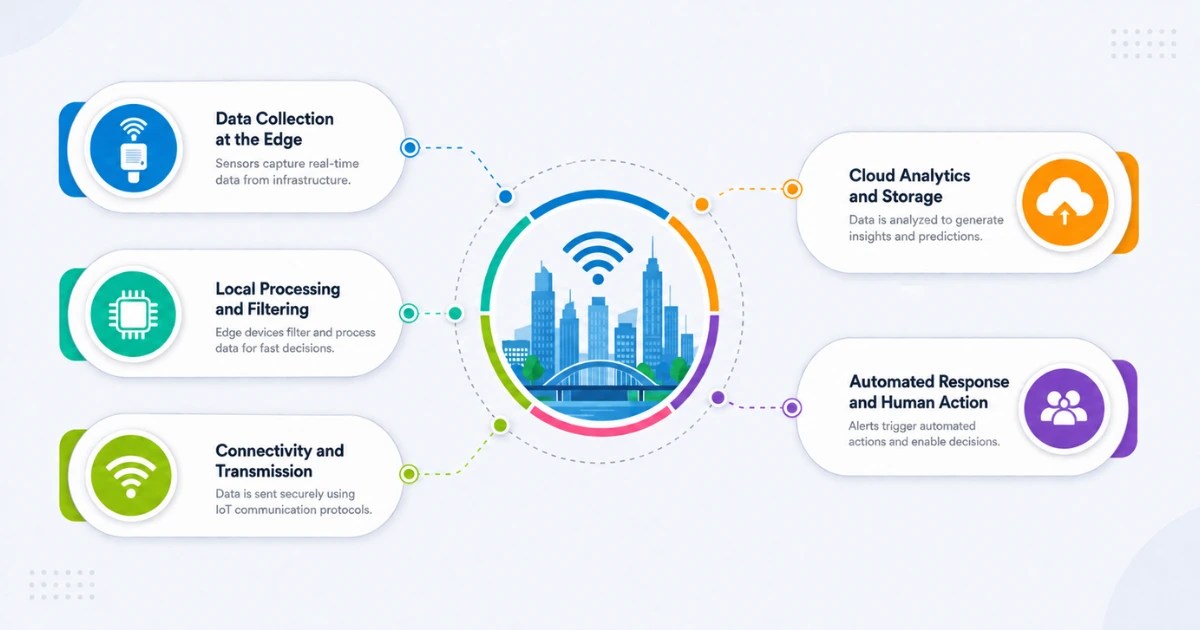
The mechanism is consistent across domains. Sensors collect data. That data travels through a connectivity layer to an edge or cloud platform. Analytics engines process the data, detect patterns, and trigger alerts or automated responses. Human operators receive actionable information, not raw noise.
At scale, this architecture supports the kind of Industrial IoT & Predictive Maintenance approaches that manufacturers have been deploying for years—applied now to roads, utilities, buildings, and transit systems.

The smart city IoT stack follows a layered workflow. Understanding each layer is essential for organizations evaluating deployments or planning procurement.
Everything begins with physical sensors embedded in infrastructure: road surface sensors, smart meters, environmental monitors, CCTV cameras with computer vision, flood detection nodes, and structural health monitors in bridges and buildings. These devices continuously capture operational data—temperature, pressure, flow rate, light levels, acoustic signatures, and more.
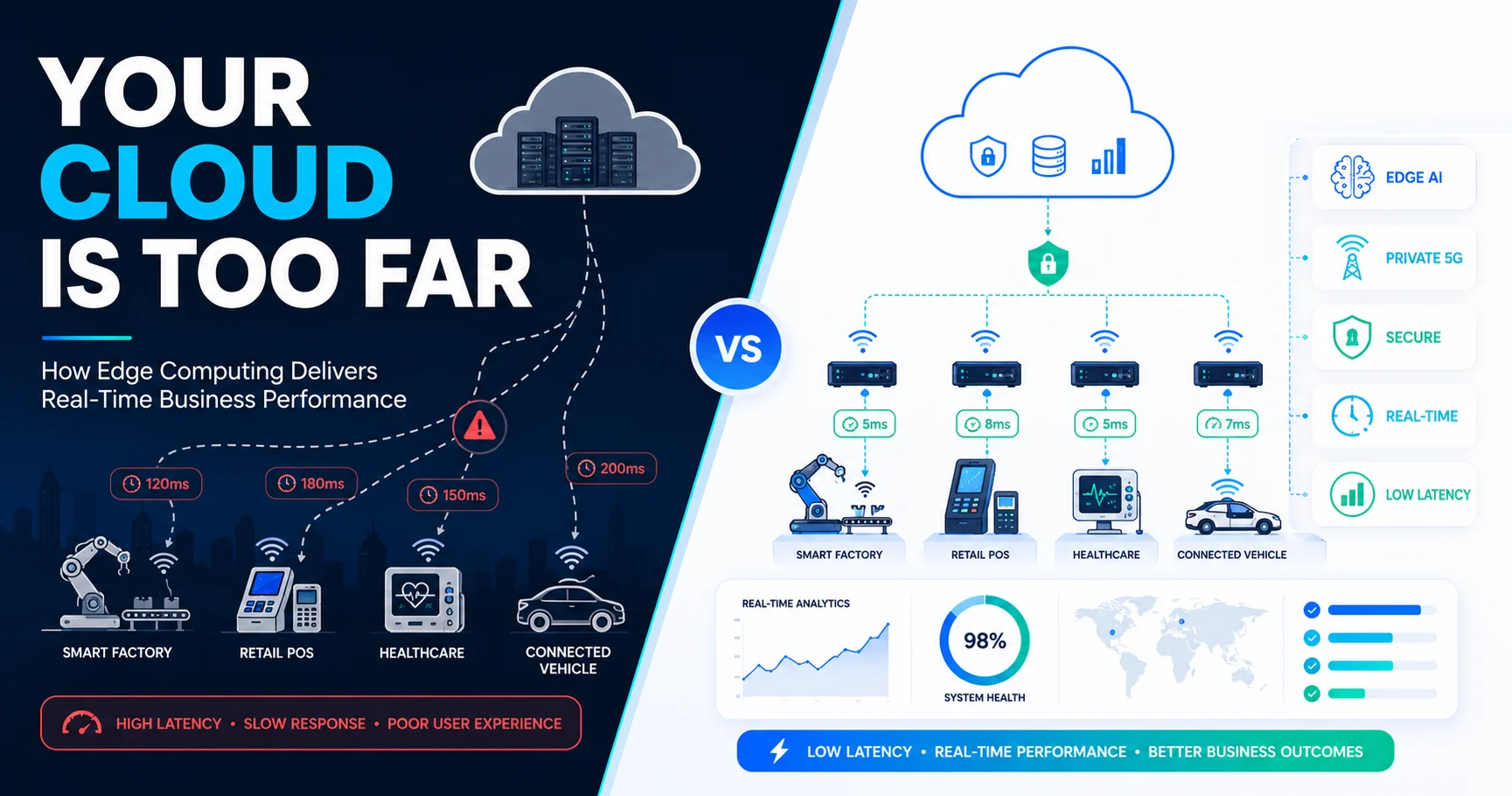
Not all data needs to travel to a centralized cloud. Edge computing nodes—deployed at the device level or at local gateways—filter, compress, and pre-process raw sensor readings. Time-sensitive decisions, such as traffic signal adjustments or flood gate activations, happen locally in milliseconds. Only relevant summaries and alerts are transmitted upstream.
Processed data travels through wireless communication protocols—LoRaWAN for low-power wide-area applications, 5G for high-bandwidth use cases, NB-IoT for deep-coverage sensors, Zigbee for short-range mesh networks—to centralized IoT platforms.
Cloud platforms ingest, store, and analyze data from thousands of connected devices. Machine learning models identify anomalies, forecast demand, and surface operational insights through dashboards accessible to city operators, planners, and administrators.
When conditions breach defined thresholds or AI models detect risk patterns, the system triggers alerts, automated responses, or workflow assignments. A pressure drop in a water main generates a maintenance ticket. A surge in pedestrian density reroutes transit resources. An air quality spike triggers a public health notification.
Adaptive traffic signal control systems use sensor data from road loops, cameras, and radar to adjust signal timing in real time based on vehicle density. The results are significant: a 2022 pilot in Pittsburgh using Surtrac adaptive signal technology reduced travel time by 26% and vehicle emissions by 21%.
Emergency vehicle preemption—automatically clearing corridors for ambulances, fire trucks, and police—is another high-value application that directly affects public safety outcomes.
Smart lighting systems adjust illumination levels based on pedestrian presence, weather conditions, and time of day. A city of 100,000 street lights operating on fixed schedules wastes enormous amounts of energy. The same infrastructure equipped with occupancy sensors and centralized control can reduce electricity consumption by 40–60%, according to the International Energy Agency.
Smart grid IoT enables utilities to monitor real-time energy demand, detect outages faster, and integrate renewable energy sources more effectively.
IoT sensors embedded in pipe networks continuously monitor pressure, flow rates, and chemical composition. Anomalies that suggest leaks, contamination, or infrastructure stress are flagged before they escalate. The American Society of Civil Engineers estimates that water loss from leakage costs US cities approximately $2.6 billion annually. Smart water IoT directly addresses this.
Connected fill-level sensors in waste bins enable dynamic collection route planning. Rather than running fixed collection schedules regardless of bin status, municipalities dispatch vehicles only when and where they're needed. Cities like Barcelona and Seoul have reduced collection costs by over 20% using this approach.
Dense sensor networks measuring air quality, noise levels, temperature, humidity, and particulate matter give cities real-time visibility into environmental conditions. This data informs public health advisories, traffic routing decisions, and zoning policy.
IoT-enabled building management systems optimize HVAC, lighting, access control, and occupancy monitoring in government buildings, schools, and public facilities. Energy savings of 20–30% are routinely reported in deployments at this scale.
AI-powered camera networks, gunshot detection systems, and connected emergency call boxes create a more responsive public safety infrastructure. These systems generate data that can shorten emergency response times and provide forensic evidence for investigations.
Quick answer: IoT for public infrastructure delivers measurable improvements in operational efficiency, cost reduction, service reliability, and sustainability. The benefits compound over time as data volumes grow and AI models improve.
|
Sector |
Primary IoT Benefit |
Reported Outcome |
|---|---|---|
|
Transportation |
Adaptive traffic management |
20–30% reduction in travel time |
|
Energy |
Smart grid and lighting control |
30–50% reduction in energy costs |
|
Water |
Leak detection and pressure monitoring |
15–25% reduction in water loss |
|
Waste |
Dynamic collection routing |
20–30% reduction in collection costs |
|
Public Safety |
Connected emergency response |
15–35% faster response times |
|
Buildings |
Occupancy-based automation |
20–30% reduction in energy consumption |
Beyond cost savings, smart city IoT supports sustainability goals by reducing energy consumption, lowering emissions, and enabling data-driven resource allocation. For municipalities under carbon reduction commitments, connected infrastructure is both a policy lever and a reporting mechanism.
Selecting the right connectivity protocol is one of the most consequential decisions in any smart city IoT deployment. No single technology serves every use case.
|
Technology |
Range |
Power Consumption |
Best Use Case |
|---|---|---|---|
|
LoRaWAN |
Wide (15+ km rural) |
Very low |
Smart meters, environmental sensors |
|
NB-IoT |
Wide, deep penetration |
Very low |
Underground sensors, asset tracking |
|
5G |
Variable |
Higher |
High-bandwidth video, real-time control |
|
Zigbee |
Short-range mesh |
Low |
Smart buildings, indoor sensors |
|
Wi-Fi 6 |
Medium |
Medium |
High-density public spaces |
Edge nodes process time-sensitive data locally, reducing latency for applications that cannot wait for a cloud round trip. Traffic signal control, flood gate activation, and emergency response systems all benefit from edge processing. SISGAIN's IoT Development Services architecture prioritizes edge-first design for latency-critical applications.
Pattern recognition, anomaly detection, and predictive modeling convert raw sensor data into actionable intelligence. AI is what separates a monitoring system from a decision-support system.
Virtual replicas of physical infrastructure—roads, utility networks, buildings—allow city planners to simulate changes before implementing them. A digital twin of a traffic network can test the impact of a new bus route before a single sign is erected.
In applications where data provenance matters—air quality reporting, energy credits, citizen identity management—blockchain provides tamper-evident records. SISGAIN's Blockchain Development Company capabilities extend to smart city data governance applications where audit trails are legally or operationally required.
A production-ready smart city IoT architecture follows a five-layer model:
Layer 1 — Device and Sensor Layer
Physical sensors, actuators, cameras, meters, and embedded edge devices. The source of all operational data. Devices must be ruggedized for outdoor environments, designed for long battery life, and capable of functioning with intermittent connectivity.
Layer 2 — Connectivity Layer
Communication protocols and network infrastructure that move data from devices to platforms. Protocol selection depends on coverage requirements, power constraints, bandwidth needs, and cost.
Layer 3 — Edge Processing Layer
Local compute resources that handle time-sensitive logic, data filtering, and offline operation. Critical for applications where latency, bandwidth costs, or connectivity reliability make cloud-only processing impractical.
Layer 4 — Cloud Platform Layer
Scalable infrastructure for device management, telemetry ingestion, data storage, and analytics. This layer supports long-term trend analysis, cross-domain integration, and AI model training.
Layer 5 — Application and Insight Layer
Dashboards, public-facing portals, administrative tools, APIs, and alert systems that surface insights to the people who need them—from city operators and maintenance crews to elected officials and citizens.
Most cities operate infrastructure that was not designed for digital connectivity. Legacy traffic controllers, aging utility SCADA systems, and proprietary building management platforms create integration complexity. Successful deployments require open standards adoption, protocol translation middleware, and phased migration strategies.
A connected city is an expanded attack surface. Sensors embedded in critical infrastructure represent potential entry points for adversaries. Cybersecurity must be treated as a design requirement, not a post-deployment audit. This includes device authentication, encrypted communications, network segmentation, and continuous vulnerability monitoring.
Cities collect enormous amounts of data about citizen behavior and movement. Clear data governance frameworks—defining what is collected, how long it is retained, who can access it, and how it is protected—are essential for maintaining public trust and regulatory compliance.
Smart city projects often span multiple municipal departments: transportation, utilities, public safety, planning, and IT. Successful deployments require cross-departmental governance structures and clear ownership of shared data platforms.
Cities face procurement rules designed for physical infrastructure, not software-defined systems. Contract structures, interoperability requirements, and long-term support obligations need careful design to avoid vendor lock-in.
Operating a smart city IoT platform requires expertise across data engineering, cloud infrastructure, cybersecurity, and domain-specific operational technology. Many municipalities lack these capabilities internally, making experienced implementation partners essential.
1. Define measurable outcomes before selecting technology. Start with the problem—congestion, energy waste, maintenance costs—and work backward to the solution. Technology selection should follow outcome definition, not precede it.
2. Adopt open standards from the start. Proprietary protocols and closed platforms create lock-in that makes future expansion expensive. Prioritize open APIs, standard connectivity protocols, and interoperable data formats.
3. Design for security at the architecture level. Device authentication, encrypted communications, and network segmentation should be built into initial designs, not retrofitted after deployment.
4. Start with a well-scoped pilot. Validate technology, data quality, and operational workflows in a controlled deployment before committing to city-wide rollout. A pilot on a single district or infrastructure type surfaces integration challenges before they scale.
5. Build cross-departmental governance structures. Smart city IoT cuts across organizational boundaries. Establish clear data ownership, decision rights, and funding models before deployment begins.
6. Plan for the full data lifecycle. Define data retention policies, privacy protections, and access controls before sensors go live. Retroactive governance is significantly harder to implement than proactive governance.
7. Invest in change management. The technology is often the simpler part of a smart city deployment. Training operations staff, aligning incentives, and building internal champions for data-driven decision-making are equally important.
8. Integrate AR/VR for operator training and planning visualization. SISGAIN's AR/VR Development Services enable municipalities to train maintenance crews in simulated infrastructure environments and visualize sensor network deployments before physical installation.
Singapore — Smart Nation Initiative
Singapore's Smart Nation program has deployed over 100,000 sensors across the island, monitoring everything from dengue mosquito breeding to parking availability. The Intelligent Transport System integrates real-time traffic data from cameras, loop detectors, and GPS-equipped vehicles to manage signal timing across the entire road network. The program has contributed to Singapore consistently ranking among the top five cities globally for traffic flow efficiency.
Amsterdam — Smart City Partnership
Amsterdam's sensor network monitors air quality, noise levels, crowd density, and energy consumption across the city. The data feeds a publicly accessible open data platform, enabling third-party developers to build services on top of city infrastructure. The city has used sensor data to redesign cycling infrastructure and reduce noise pollution in residential areas.
Kansas City, USA — Smart Streetlight Network
Kansas City deployed 240 smart streetlight nodes along its streetcar corridor, integrating LED lighting, environmental sensors, pedestrian counters, and public Wi-Fi. The deployment reduced lighting costs by 50% and generated data that informed transit scheduling and event planning.
Barcelona — Smart Water Management
Barcelona's smart water network, covering approximately 19,000 sensors, monitors pressure and flow across the distribution system. The system identifies leaks within hours rather than days, reducing non-revenue water loss by approximately 25% and saving an estimated 45,000 cubic meters of water annually.
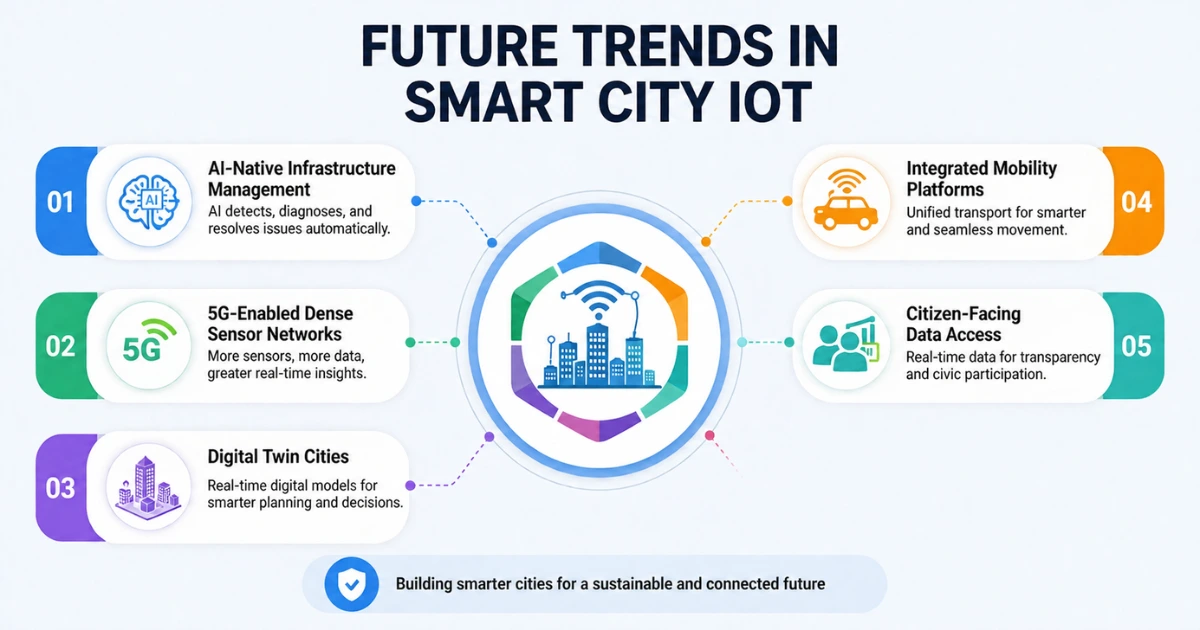
AI-Native Infrastructure Management
Autonomous systems that detect, diagnose, and resolve infrastructure issues without human intervention are moving from pilots to production. Smart city platforms will increasingly embed AI at the edge, enabling real-time decision-making without centralized cloud dependency.
5G-Enabled Dense Sensor Networks
5G's combination of high bandwidth, ultra-low latency, and network slicing capabilities will enable sensor densities that were previously cost-prohibitive. Cities will be able to deploy thousands of devices per square kilometer, creating granular environmental and behavioral data that supports highly localized service delivery.
Digital Twin Cities
Full-fidelity digital replicas of urban environments—integrating real-time IoT data with 3D spatial models—will become standard planning tools. City planners will simulate the impact of new development, infrastructure changes, and extreme weather events before making investment decisions.
Integrated Mobility Platforms
Smart city IoT will increasingly connect transportation modes—autonomous vehicles, shared electric scooters, public transit, and pedestrian infrastructure—into unified mobility management platforms that optimize movement across the entire urban system.
Citizen-Facing Data Access
Progressive cities are moving toward giving residents real-time access to the data collected about their neighborhoods—air quality, noise levels, traffic conditions, and service status. This transparency builds public trust and enables civic participation in infrastructure decisions.
Organizations undertaking a smart city IoT deployment benefit from a structured implementation approach:
Phase 1: Discovery and Assessment (Weeks 1–4)
Map existing infrastructure assets, identify priority use cases, assess connectivity coverage, and define measurable success criteria. Evaluate data governance requirements and cybersecurity constraints.
Phase 2: Architecture Design (Weeks 4–8)
Design device, connectivity, edge, cloud, and application layers. Select protocols, platforms, and data models. Define integration points with existing municipal systems. Develop security architecture.
Phase 3: Pilot Development and Deployment (Weeks 8–16)
Deploy a controlled pilot covering one infrastructure domain or geographic area. Validate device performance, connectivity reliability, data quality, and platform integration. Engage operational stakeholders in workflow design.
Phase 4: Evaluation and Iteration (Weeks 16–20)
Measure pilot outcomes against defined success criteria. Identify integration issues, performance gaps, and process improvements. Refine architecture before scaling.
Phase 5: Phased Rollout (Months 6–18)
Expand deployment in structured phases, integrating additional infrastructure domains and data sources. Maintain continuous performance monitoring and security review throughout.
Phase 6: Ongoing Optimization
Continuously refine AI models, expand analytics capabilities, and integrate new data sources as the platform matures. Most smart city IoT platforms deliver increasing value as data volumes accumulate.
Delivering a smart city IoT solution requires far more than deploying sensors. It demands expertise across embedded systems, connectivity architecture, cloud platform engineering, data analytics, cybersecurity, and domain-specific operational knowledge. Most municipal IT teams and infrastructure companies lack the full breadth of these capabilities internally.
SISGAIN's IoT Development Services practice is built around end-to-end smart city IoT delivery—from device selection and firmware development through cloud platform architecture, analytics dashboards, and long-term operational support.
What distinguishes SISGAIN's approach:
SISGAIN also brings complementary capabilities that matter in complex smart city projects: AR/VR Development Services for operator training and infrastructure visualization, and Blockchain Development Company expertise for applications requiring tamper-evident data records and decentralized governance.
Engagements begin with a no-cost discovery session. SISGAIN shares detailed project scoping and cost estimates within 48 hours, with an NDA signed before any business discussion begins.

The transformation of urban infrastructure through IoT for smart cities is no longer a future ambition—it's a present-tense operational discipline. The cities leading this shift are not necessarily the wealthiest or the largest. They're the ones that started with a clear problem, chose the right technology architecture, and invested in partners with the depth to deliver.
For municipalities, government agencies, infrastructure companies, and urban planners, the strategic imperative is clear: connected, data-driven infrastructure is becoming the baseline expectation for efficient, sustainable urban governance. The question is not whether to invest, but where to start and how to build an architecture that scales.
IoT solutions for smart cities deliver the most value when they are designed as platforms, not projects—built for continuous data accumulation, iterative improvement, and integration across infrastructure domains.
SISGAIN's IoT development practice is available to support organizations at any stage of this journey: from initial feasibility assessment through full-scale deployment and long-term managed operations. Contact the SISGAIN team to schedule a discovery session and define the right starting point for your smart infrastructure program.








Start Build Your
Next Digital Solution?
Let’s build scalable, future-ready digital solutions tailored to your business goals. Connect with our experienced technology consultants to discuss your vision, strategy, and growth opportunities — with zero obligation and complete transparency.
Get a free consultation and cost estimate for your digital solution
Our expert will contact you within 24 hours. Check your email for confirmation.
Partner with SISGAIN experts to build secure, scalable AI-powered IT Solutions that transform your business operations.









DUQE FREEZONE Quarter Deck, Queen Elizabeth 2, Mina Rashid, Dubai, UAE

100 Consilium Pl Suite 200, Scarborough, ON M1H 3E3, Canada

C-109, Sector 2, Noida, Uttar Pradesh 201301 India
Project quotes, partnerships, implementation
Open roles, referrals, campus hiring