
 +1 844-445-5767
 +971 56-848-5757
 +91 921-208-0630
For Business & Service Inquiries
Sales Team
Project quotes, partnerships, implementation

Enterprises deploying connected devices at scale face a recurring challenge: the platform they choose today determines how easily they can integrate new systems, manage thousands of devices, and push firmware updates five years from now. A poorly chosen IoT platform creates technical debt that compounds with every new sensor, gateway, or edge node added to the network.
This guide walks through what an IoT platform actually is, how device integration and device management work in practice, why OTA firmware update management is a core operational requirement rather than an afterthought, and how security and emerging technologies factor into a long-term platform decision. It is written for CIOs, CTOs, IT leaders, product managers, and operations teams evaluating platforms for industrial, smart city, healthcare, logistics, or AI-driven deployments.
What is an IoT Platform? An IoT platform is the software layer that connects, manages, and processes data from physical devices, turning raw sensor input into actionable business intelligence while handling connectivity, security, and lifecycle management at scale.
An enterprise-grade IoT platform is not a single product. It is a layered architecture where each layer performs a distinct function, and the strength of the platform depends on how well those layers work together.
Device layer. This is the physical hardware — sensors, actuators, controllers, and gateways — that generates telemetry and executes commands. Device diversity is one of the biggest architectural challenges enterprises face, since a single deployment may include equipment from a dozen vendors, each with different firmware, protocols, and hardware constraints.
Connectivity layer. This layer moves data between devices and the platform using protocols such as MQTT, CoAP, HTTP, LoRaWAN, Zigbee, or cellular (4G/5G, NB-IoT). Enterprises operating across facilities, regions, or outdoor environments typically need multi-protocol support rather than a single connectivity standard.
Data layer. Once data arrives, it must be ingested, normalized, stored, and made queryable. This includes time-series databases for telemetry, data lakes for unstructured inputs, and stream-processing pipelines for real-time analytics.
Application layer. This is where business logic lives — dashboards, alerting rules, automation workflows, and integrations with enterprise systems like ERP and CRM. This layer is what turns device data into operational decisions.
Cloud and edge computing. Modern platforms distribute processing between the cloud and the edge. Cloud computing offers centralized storage, analytics, and cross-site visibility. Edge computing processes data closer to the device, reducing latency for time-sensitive decisions and cutting bandwidth costs where connectivity is limited.
Enterprise scalability. A platform designed for a pilot of 50 devices does not automatically scale to 50,000. Scalability requirements include horizontal scaling of ingestion pipelines, multi-tenant architecture for different business units, and the ability to onboard new device types without re-architecting the system.
Security foundations. Security cannot be bolted on after deployment. It must be embedded into device provisioning, data transport, and firmware distribution from day one — a theme this guide returns to throughout.
Callout: The platform decision is a 5–10 year commitment. Migrating an IoT platform after thousands of devices are already deployed is significantly more expensive and disruptive than migrating a typical software application, because it involves physical hardware, field technicians, and operational downtime.
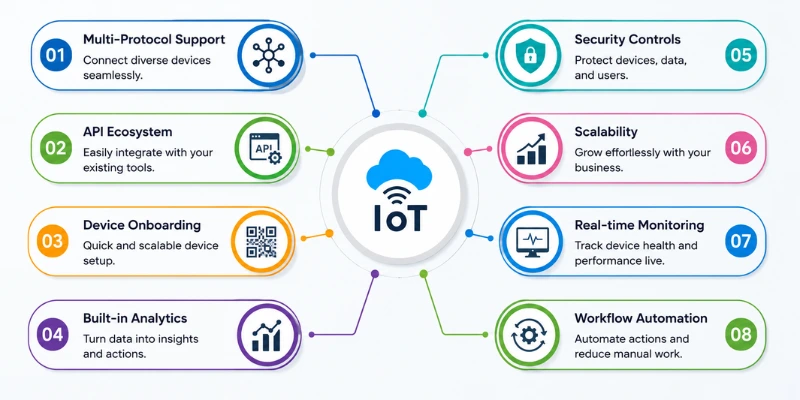
What are the most important IoT Platform Features and Benefits? The core features enterprises should evaluate are multi-protocol connectivity, a robust API ecosystem, streamlined device onboarding, built-in analytics, granular security controls, horizontal scalability, real-time monitoring, and workflow automation.
Each of these features and benefits translates directly into operational and financial outcomes:
| Capability | Entry-Level Platform | Enterprise-Grade Platform |
|---|---|---|
| Protocol support | Single or limited protocols | Multi-protocol (MQTT, CoAP, LoRaWAN, cellular) |
| Device onboarding | Manual, one-by-one | Automated, bulk, zero-touch provisioning |
| API ecosystem | Basic REST endpoints | Full REST/GraphQL, webhooks, SDKs |
| Security | Basic authentication | Zero Trust, certificate-based identity, encryption at rest and in transit |
| OTA updates | Manual or unavailable | Staged rollouts, rollback, delta updates |
| Analytics | Basic dashboards | Predictive analytics, AI/ML integration |
| Scalability | Hundreds of devices | Tens of thousands to millions of devices |
| Multi-tenancy | Not supported | Supported for business units or customers |
What is the IoT Device Integration Process? The IoT device integration process is the sequence of steps — onboarding, authentication, API integration, middleware configuration, and enterprise system connectivity — required to bring a new device or data source securely into an operational IoT environment.
Integration is often where IoT projects stall. A platform can have excellent features on paper, but if the integration process is fragile, every new device type or business system becomes a custom engineering project.
Device onboarding is the first step: registering a device's identity, assigning it to the correct account or tenant, and establishing initial trust. Authentication follows immediately, using certificates, tokens, or mutual TLS to confirm the device is legitimate before it can transmit data.
API integration connects the platform to external systems. This is where middleware plays a critical role — translating protocols, normalizing data formats, and buffering communication between devices and business applications so that neither side needs to understand the other's native format.
ERP integration allows device data — such as machine utilization or inventory sensor readings — to feed directly into financial and operational planning systems. CRM integration allows field service and customer-facing teams to see device health data tied to specific accounts, improving service response times.
Data normalization is essential because different devices report the same metric (temperature, pressure, location) in different units, formats, or intervals. Without normalization, downstream analytics become unreliable. Edge processing handles time-sensitive normalization and filtering locally, before data reaches the cloud, which is particularly important for edge computing and connectivity architectures in environments with intermittent network access.
Common integration challenges include:
Best practices for a smoother integration process include standardizing on open protocols where possible, using middleware to abstract vendor differences, running integration tests in a staging environment before production rollout, and documenting API contracts clearly for internal and partner teams.
How Does IoT Device Management Work? IoT device management works through a lifecycle of registration, authentication, provisioning, ongoing monitoring, diagnostics, remote configuration, maintenance, and eventual retirement — all coordinated centrally so operations teams can manage thousands of devices without manual, device-by-device intervention.
Registration: Every device is assigned a unique identity in the platform's device registry, typically tied to a hardware-based identifier or certificate.
Authentication: Before a device can send or receive data, it must authenticate using credentials issued during registration — commonly X.509 certificates, API keys, or token-based authentication.
Provisioning: The device receives its initial configuration — network settings, security policies, and application-level parameters — either manually or through zero-touch provisioning workflows.
Monitoring: Once live, the platform continuously tracks device status: connectivity, battery level, signal strength, and application-level metrics. Monitoring dashboards typically flag devices that go offline unexpectedly or report anomalous readings.
Diagnostics: When issues arise, remote diagnostics allow IT teams to inspect device logs, run health checks, and identify root causes without dispatching a technician.
Remote configuration: Settings can be updated centrally and pushed to individual devices, groups, or the entire fleet — critical for enforcing new security policies or adjusting operational parameters without a truck roll.
Maintenance: This includes scheduled firmware updates, certificate renewals, and proactive replacement of devices showing signs of degradation, often informed by predictive analytics.
Retirement: At end-of-life, devices must be securely decommissioned — credentials revoked, data wiped, and the device removed from the registry — to prevent orphaned devices from becoming security liabilities.
Callout: Orphaned devices are a hidden risk. Devices that are physically decommissioned but not formally retired in the platform can retain valid credentials indefinitely, creating an unmonitored attack surface.
What is OTA Firmware Update Management? OTA (over-the-air) firmware update management is the process of remotely distributing, verifying, and installing firmware updates on connected devices without physical access, ensuring devices remain secure, compliant, and functionally current throughout their operational life.
Architecture: A typical OTA system includes a firmware repository, a distribution service, a device-side update agent, and a verification mechanism to confirm successful installation.
Firmware lifecycle: Firmware moves through development, testing, staged rollout, full deployment, and eventual deprecation. Enterprise platforms track which firmware version is running on every device at all times.
Security patching: OTA is often the only practical way to patch vulnerabilities across a distributed fleet, especially for devices in remote or physically inaccessible locations.
Feature releases: Beyond security, OTA allows enterprises to roll out new functionality or performance improvements without recalling hardware.
Version control: Maintaining a clear record of firmware versions per device, per fleet, and per region is essential for troubleshooting, compliance audits, and staged rollouts.
Rollback mechanisms: If an update causes instability, the platform must be able to revert devices to a known-good firmware version automatically, minimizing downtime.
Compliance requirements: Regulated industries (healthcare, industrial, automotive) often require documented proof of firmware version history and update validation as part of audit trails.
Security is not a feature to evaluate alongside others — it is a prerequisite that determines whether the rest of the platform can be trusted at all. This is especially relevant given the growing regulatory attention on connected device security, as outlined in broader IoT security and compliance guidance.
Zero Trust: Every device, user, and service should be authenticated and authorized continuously, rather than trusted by default once inside the network perimeter.
Encryption: Data should be encrypted both in transit (TLS/DTLS) and at rest, protecting telemetry and credentials from interception or extraction.
Secure boot: Devices should verify the cryptographic signature of their firmware at every boot, preventing unauthorized or tampered code from executing.
Certificate management: Enterprise-scale deployments require automated certificate issuance, rotation, and revocation — manual certificate management does not scale past a few hundred devices.
Access controls: Role-based access control ensures that operators, administrators, and third-party integrators only have the permissions necessary for their function.
Firmware integrity: Combined with OTA update management, firmware integrity checks confirm that installed firmware matches the expected cryptographic hash before execution.
Compliance requirements: Depending on industry and geography, platforms may need to meet standards such as NIST IoT guidelines, ISO 27001, HIPAA (healthcare), or regional data residency laws.
Risk mitigation: A layered security approach — combining network segmentation, device identity, encrypted communication, and continuous monitoring — reduces the blast radius of any single compromised device.
Underestimating integration complexity. Organizations frequently select a platform based on device connectivity alone, only to discover during implementation that ERP or CRM integration requires extensive custom middleware development, delaying go-live by months.
Ignoring OTA capabilities until scale becomes painful. Some teams treat firmware updates as a manual, low-frequency task during pilot phases, then find themselves unable to patch a critical vulnerability across thousands of already-deployed devices.
Choosing based on cost alone. A lower-cost platform that lacks multi-tenancy or robust API support often results in higher long-term costs through custom development and workarounds.
Neglecting security until after deployment. Retrofitting Zero Trust architecture or certificate-based authentication onto an already-deployed fleet is significantly more disruptive than designing it in from the start.
Failing to plan for device diversity. Enterprises that assume all future devices will come from a single vendor often find themselves locked out of multi-protocol support when new sensor types are introduced.
Overlooking scalability limits. Platforms that perform well in a proof-of-concept with 100 devices sometimes fail to scale cost-effectively or technically to 10,000 or 100,000 devices.
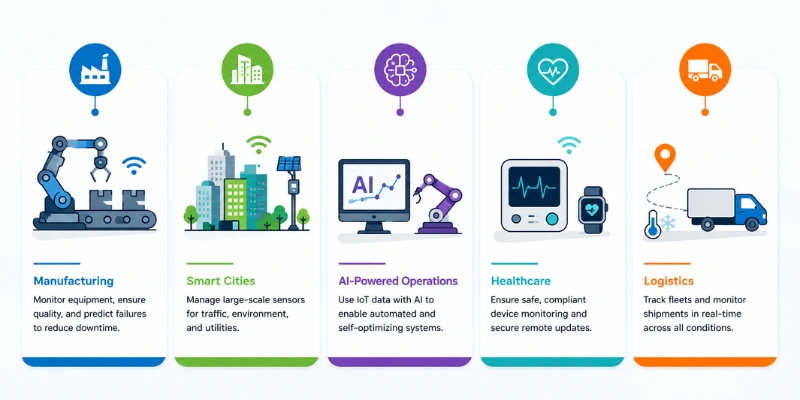
Manufacturing: Connected sensors on production equipment enable condition monitoring, quality control, and predictive maintenance that reduces unplanned downtime. Enterprises using platforms with strong device management capabilities can identify equipment degradation before failure occurs, a practice explored in depth in this guide to industrial IoT and predictive maintenance.
Smart Cities: Municipal deployments spanning traffic sensors, environmental monitoring, and public utilities require platforms capable of managing extremely large, geographically distributed device fleets, as covered in this overview of IoT for smart cities applications, benefits, and architecture.
AI-Powered Operations: Enterprises increasingly combine IoT telemetry with AI models to enable autonomous decision-making — from automated quality inspection to self-optimizing logistics networks — a trend detailed in this piece on AI and IoT for autonomous operations.
Healthcare: Connected medical devices and remote patient monitoring require platforms with strict compliance support, encrypted data handling, and reliable OTA update mechanisms to maintain device safety without requiring hospital visits.
Logistics: Fleet tracking, cold chain monitoring, and warehouse automation depend on platforms that can process high-frequency location and sensor data across constrained connectivity environments, often switching between cellular and satellite links mid-route.
Artificial Intelligence and Machine Learning: AI and ML models increasingly run directly on IoT platforms, analyzing telemetry patterns to detect anomalies, forecast maintenance needs, and optimize operational parameters in real time.
Edge AI: Running inference models directly on edge devices reduces latency and bandwidth requirements, enabling real-time decisions in environments where round-trips to the cloud are impractical.
Blockchain: Distributed ledger technology is being explored for device identity verification and tamper-proof audit trails, particularly in supply chain and multi-party industrial environments where trust between organizations matters as much as trust between devices. Enterprises exploring this space often work with a dedicated blockchain development partner to integrate ledger-based verification into existing IoT data pipelines.
Digital Twins: Virtual replicas of physical assets, continuously updated with live sensor data, allow enterprises to simulate scenarios, test firmware changes virtually, and predict failure modes before they occur in the physical system.
AR/VR: Augmented and virtual reality are increasingly layered onto IoT data for field technician support — overlaying real-time device diagnostics onto a technician's field of view — an integration made possible through dedicated AR/VR development services that connect immersive interfaces to live device telemetry.
Predictive Analytics: Beyond basic monitoring, predictive models forecast equipment failure, optimal maintenance windows, and resource allocation needs based on historical and real-time data patterns.
Generative AI: Generative AI is beginning to assist with natural-language querying of device fleets, automated incident summarization, and even drafting firmware release notes based on code and testing changes.
| Evaluation Criteria | Key Questions to Ask | Priority |
|---|---|---|
| Connectivity | Does it support the protocols our current and future devices require? | High |
| Scalability | Can it handle 10x our current device count without re-architecture? | High |
| Security | Does it support Zero Trust, encryption, and certificate-based identity? | Critical |
| OTA capability | Does it support staged rollouts, delta updates, and rollback? | Critical |
| Integration | Does it offer robust APIs for ERP, CRM, and custom systems? | High |
| Device management | Does it cover the full lifecycle from provisioning to retirement? | High |
| Analytics | Does it include built-in analytics or support third-party BI tools? | Medium |
| Compliance | Does it meet the regulatory requirements of our industry and region? | Critical |
| Vendor stability | Does the vendor have a track record of long-term platform support? | Medium |
| Total cost of ownership | Have we accounted for licensing, integration, and scaling costs? | High |
Choosing an IoT platform is ultimately a decision about how well an organization can integrate new systems, manage a growing device fleet, and keep that fleet secure and current over years of operation. Integration determines how quickly device data becomes business value. Device management determines whether operations teams can scale without proportionally scaling headcount. OTA update management determines whether the organization can respond to security threats and feature demands without physical intervention. Security considerations underpin all of it, since a platform that cannot protect device identity and firmware integrity puts the entire deployment at risk.
Enterprises that evaluate platforms against these dimensions — rather than connectivity or cost alone — position themselves for long-term scalability and a stronger return on investment. As AI, edge computing, digital twins, and generative AI capabilities continue to mature, the platforms that will deliver the most enterprise value are the ones built with integration, device management, and update infrastructure as first-class architectural priorities, not afterthoughts. Organizations planning their next phase of IoT investment should treat platform selection as a strategic decision with implications reaching well beyond the initial deployment.



Start Build Your
Next Digital Solution?
Let’s build scalable, future-ready digital solutions tailored to your business goals. Connect with our experienced technology consultants to discuss your vision, strategy, and growth opportunities — with zero obligation and complete transparency.
Get a free consultation and cost estimate for your digital solution
Our expert will contact you within 24 hours. Check your email for confirmation.
Partner with SISGAIN experts to build secure, scalable AI-powered IT Solutions that transform your business operations.









DUQE FREEZONE Quarter Deck, Queen Elizabeth 2, Mina Rashid, Dubai, UAE

100 Consilium Pl Suite 200, Scarborough, ON M1H 3E3, Canada

C-109, Sector 2, Noida, Uttar Pradesh 201301 India
Project quotes, partnerships, implementation
Open roles, referrals, campus hiring