
 +1 844-445-5767
 +971 56-848-5757
 +91 921-208-0630
For Business & Service Inquiries
Sales Team
Project quotes, partnerships, implementation

TL;DR: Disaster recovery and business continuity (BCDR) are the twin disciplines that determine whether an organization survives a disruption — or doesn't. This guide covers every component of a mature BCDR strategy: from defining RTOs and RPOs, to cloud DR architectures, common threats, implementation steps, and emerging trends like AI-driven autonomous recovery. Use it to build, audit, or strengthen your organization's resilience posture.
Every organization eventually faces a disruption. A ransomware attack that encrypts production systems overnight. A misconfigured cloud resource that triggers a cascading outage. A data center flood that renders on-site infrastructure unreachable. The question is never whether a disruptive event will happen — it is whether your organization is ready to recover when it does.
The numbers make the stakes clear. According to the Cockroach Labs 2025 State of Resilience Report, 100% of surveyed senior technology executives reported financial losses from IT outages in the previous year. The ITIC 2024 Hourly Cost of Downtime Survey found that 90% of mid-sized and large enterprises lose more than $300,000 per hour when systems go down — with 41% facing hourly losses between $1 million and $5 million. For smaller organizations, the 2025 Calyptix/ITIC SMB Security Survey found hourly downtime costs frequently exceeding $25,000.
Despite this, the Disaster Recovery Journal's 2026 report found that 22% of organizations still have no formal disaster recovery program in place. And among those that do, only 28% of ransomware victims fully recover all affected data, according to a 2026 Veeam industry survey of more than 900 security leaders.
This guide covers everything your team needs to understand, build, and continuously improve a resilient IT business continuity and disaster recovery plan — including frameworks, implementation steps, cloud architectures, DR tools, metrics, and what the future of BCDR looks like.
The terms are often used interchangeably, but they address different dimensions of organizational resilience. Understanding the distinction is foundational before attempting to build any BCDR program.
Business continuity is the discipline of ensuring that critical business functions can continue operating during and after a disruption. It is broader than IT recovery — it encompasses people, processes, supply chains, facilities, and communications. A business continuity plan (BCP) defines how a hospital keeps patient care running if its EHR system goes offline, or how a bank continues processing transactions if its primary data center becomes inaccessible.
Business continuity planning is forward-looking. It maps which functions are essential, what dependencies exist, and how the organization would operate at reduced capacity if necessary.
Disaster recovery (DR) is the subset of business continuity that focuses specifically on restoring IT systems, data, and infrastructure after a disruptive event. A disaster recovery plan defines how technology teams detect failures, execute recovery procedures, restore data from backups, failover to secondary environments, and return systems to normal operation within defined time windows.
Think of business continuity as the strategy and disaster recovery as the execution playbook.
|
Dimension |
Business Continuity |
Disaster Recovery |
|---|---|---|
|
Scope |
Whole organization |
IT systems and data |
|
Focus |
Operational continuity |
Technical restoration |
|
Owners |
C-suite, operations, IT |
IT, infrastructure, DevOps |
|
Output |
Business Continuity Plan (BCP) |
Disaster Recovery Plan (DRP) |
|
Key metrics |
Business impact, operational capacity |
RTO, RPO, MTTR |
|
Activation |
Immediately during a disruption |
When IT systems fail or are compromised |
Together, they form BCDR — a unified framework that covers both organizational continuity and technical recovery.
The case for a mature BCDR program rarely needs to be made twice after a major incident. But leadership teams often deprioritize it during periods of stability, treating it as an insurance policy they hope never to use. That framing underestimates the risk.
Consider the exposure across common scenarios:
Ransomware: Sophos' 2025 State of Ransomware Report found that 50% of surveyed organizations had data encrypted in a ransomware attack in the previous year. Recovery costs averaged $1.53 million per attack — excluding ransom payments. Eighteen percent took more than a month to recover. And 89% of those attacks, per a 2025 Veeam Ransomware Trends Report, attempted to infect backup systems as well.
Data breaches: IBM's 2025 Cost of a Data Breach Report found the average breach cost in the United States reached $10.22 million. Forty-two percent of breaches occurred in cloud-based systems.
Human error: ITIC's 2024 data identified human error as the second most common cause of downtime, affecting 69% of organizations. Accidental deletion, misconfiguration, and device mismanagement are everyday risks that even mature IT teams encounter.
Operational scale: The Cockroach Labs survey found organizations experienced an average of 86 outages per year. Fifty-five percent reported weekly outages.
The business risk extends beyond the immediate incident. FEMA has cited that approximately 25% of businesses that close following a major disaster never reopen. According to Inc., 60% of small and midsize businesses that experience a significant cyberattack go out of business within six months.
A well-built IT business continuity and disaster recovery plan does not just reduce downtime. It protects revenue, preserves customer trust, satisfies regulatory requirements, and gives leadership the operational confidence to make decisions under pressure.
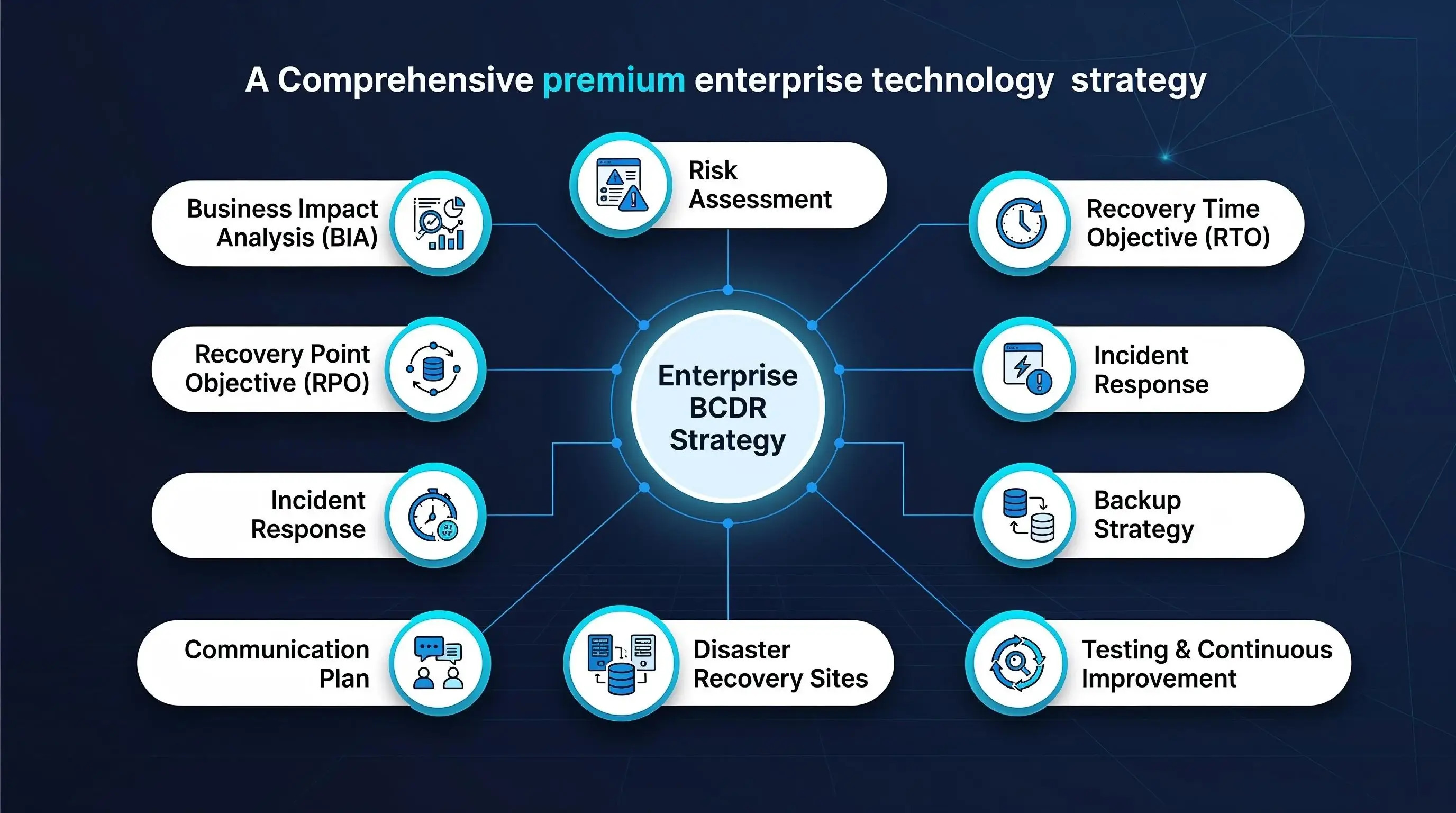
A mature BCDR strategy is built from several interlocking components. Weakness in any one of them compromises the whole.
Business Impact Analysis (BIA): Identifies which systems, processes, and data are critical to operations. Quantifies the financial, operational, and reputational impact of different downtime scenarios. The BIA anchors every subsequent recovery decision.
Risk Assessment: Catalogs the threats most likely to cause disruption — ransomware, hardware failure, natural disaster, insider threat, supply chain outage — and evaluates their probability and potential impact. This guides investment prioritization.
Recovery Time Objective (RTO): The maximum acceptable time to restore a system or process after a failure. An RTO of four hours for a core banking platform means systems must be operational within four hours of a declared incident.
Recovery Point Objective (RPO): The maximum acceptable amount of data loss measured in time. An RPO of 15 minutes means no more than 15 minutes of data can be lost in any recovery scenario.
Incident Response: The structured process for detecting, classifying, containing, and escalating incidents before formal DR procedures begin. Effective incident response compresses the gap between failure and recovery initiation.
Backup Strategy: Defines backup frequency, retention policies, storage locations, and verification procedures. The 3-2-1-1 rule — three copies, two different media types, one offsite, one immutable — is the widely adopted standard for enterprise environments.
Disaster Recovery Sites: Hot sites (fully operational, always-on), warm sites (partially configured, requiring activation), and cold sites (hardware available, requiring full configuration). Cloud environments, backed by well-run infrastructure management services, have largely replaced traditional hot and warm sites for most workloads.
Communication Plan: Defines who is notified when, through what channels, and with what information. This covers internal stakeholders, vendors, regulators, customers, and media.
Testing and Continuous Improvement: Plans that are never tested are assumptions. Regular tabletop exercises, failover tests, and live recovery rehearsals are what separate theoretical readiness from demonstrated capability.
A BCDR policy is the governing document that establishes organizational commitments, responsibilities, and standards for business continuity and disaster recovery. It is distinct from a plan — the policy defines what the organization will do; the plan defines how.
A complete BCDR policy covers:
In regulated industries — financial services, healthcare, critical infrastructure — a documented BCDR policy is not optional. It is a compliance requirement with audit evidence attached.
The most durable BCDR frameworks are built around five phases:
Prevention: Proactive measures that reduce the probability of disruption. Patch management, vulnerability scanning, access controls, redundant infrastructure, and disaster-resistant architecture all belong here.
Preparedness: Building the capabilities to respond effectively — documented plans, trained personnel, tested runbooks, and verified backups. Many organizations invest in prevention but underinvest in preparedness.
Response: The immediate actions taken when a disruption occurs. Detection, classification, escalation, containment, and communication. Speed and clarity at this stage directly determine how fast recovery begins.
Recovery: Restoring systems, data, and operations according to defined RTOs and RPOs. This includes failover execution, data restoration, and validation that recovered systems are clean and functional.
Continuous Improvement: Post-incident reviews, regular testing cycles, and systematic updates to plans based on lessons learned. Resilience degrades over time without this phase.
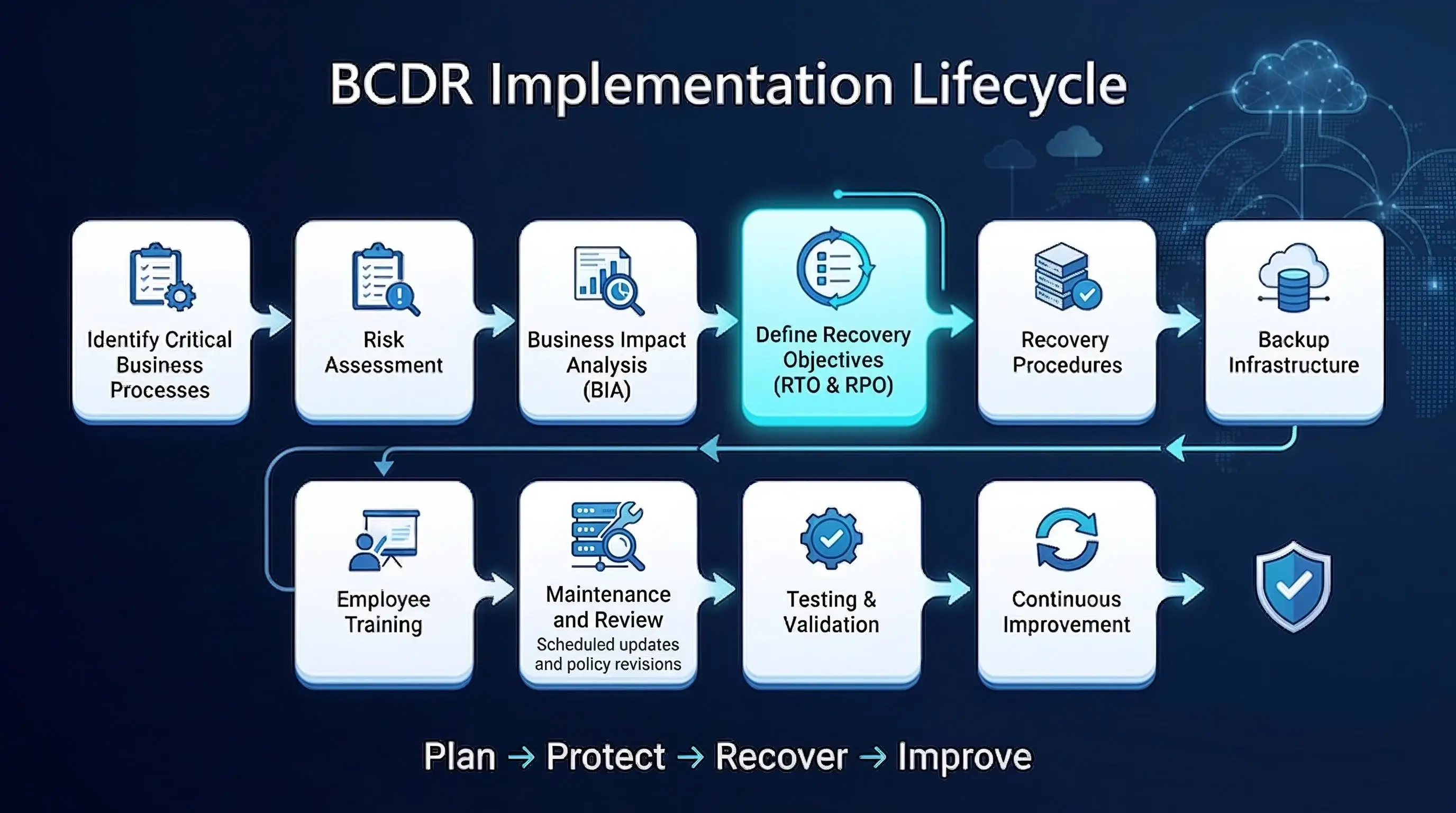
Start by mapping every business function and its technology dependencies. A manufacturing company might identify production scheduling, supply chain systems, and ERP as tier-one critical. A SaaS company might prioritize its customer-facing application, authentication infrastructure, and payment processing. Every organization's map will look different.
For each critical process, identify plausible threats. Score each threat by likelihood and potential impact. Ransomware will rank high for most organizations. Hardware failure is a consistent risk for on-premises environments. Natural disaster risk varies by geography. The output is a prioritized threat register that guides investment.
Quantify what happens if each critical system is unavailable for one hour, four hours, 24 hours, and one week. Include direct financial impact, customer impact, regulatory exposure, and operational degradation. This BIA output is what justifies your RTO and RPO targets to leadership.
Use the BIA to set tiered RTOs and RPOs for each system. Mission-critical systems — transaction processing in banking, patient records in healthcare — may require RTOs measured in minutes. Tier-two systems may tolerate hours. Non-essential systems may tolerate days.
|
System Tier |
Example |
Target RTO |
Target RPO |
|---|---|---|---|
|
Tier 1 – Mission Critical |
Core banking, EHR, payment processing |
< 15 minutes |
< 5 minutes |
|
Tier 2 – Business Critical |
CRM, ERP, collaboration tools |
< 4 hours |
< 1 hour |
|
Tier 3 – Important |
Reporting systems, dev environments |
< 24 hours |
< 4 hours |
|
Tier 4 – Non-Critical |
Archival systems, legacy tools |
< 72 hours |
< 24 hours |
Document step-by-step runbooks for each critical system. These should be specific enough that an on-call engineer unfamiliar with the system can execute them under pressure at 2 a.m. Vague procedures fail during real incidents.
Implement backup solutions aligned to your RPO targets. For sub-hour RPOs, continuous data protection or synchronous replication may be required. Deploy immutable backups to prevent ransomware encryption of backup repositories — Veeam's 2025 Ransomware Trends Report found 89% of attacks attempt to infect backup systems. Use cross-region replication for geographic redundancy.
Human error was identified as the second most common cause of downtime in ITIC's 2024 data, affecting 69% of organizations. Training covers incident identification, escalation procedures, communications protocols, and each team member's specific role during a recovery.
Testing is the single most underperformed element of BCDR. A 2026 Disaster Recovery Journal report noted that 22% of organizations have no formal DR program — and among those that do, many test infrequently. Run tabletop exercises quarterly. Conduct live failover tests at least twice a year. Validate backup restoration, not just backup creation.
Infrastructure changes, personnel changes, new regulatory requirements, and post-incident findings all create drift between the plan and reality. Build a structured review cycle — minimally annual, ideally following any significant change.
Backup and Restore: The baseline approach — data is backed up at defined intervals and restored to hardware after a failure. Simple and cost-effective, but RTOs can be long depending on data volumes and restoration speed.
Disaster Recovery as a Service (DRaaS): Cloud-based DR where a provider replicates workloads and orchestrates recovery on demand. Organizations pay for the capability without maintaining a secondary data center. Well-suited for SMEs and mid-market enterprises.
Cloud Disaster Recovery: Leverages cloud platforms — AWS, Azure, GCP — as recovery targets for on-premises or hybrid workloads. Scales on demand, eliminates capital expenditure for standby infrastructure, and depends on disciplined cloud infrastructure management practices to stay reliable.
Multi-Cloud Recovery: Distributes recovery workloads across multiple cloud providers to eliminate single-provider dependency. Relevant for enterprises with strict availability SLAs and regulatory requirements around data sovereignty.
Hot Site: A fully operational secondary environment that can assume production traffic immediately. The highest cost option — appropriate for systems where any downtime is unacceptable.
Warm Site: A partially configured environment that requires some activation steps before assuming production load. Balances cost and recovery speed.
Cold Site: Hardware is available but requires full configuration before use. Appropriate for non-critical systems with tolerant RTOs.
Ransomware: Encrypts data and demands payment for decryption keys. Fifty percent of organizations had data encrypted in a 2025 Sophos survey. Modern ransomware targets backup systems deliberately.
Other Cyberattacks: DDoS attacks, credential compromise, supply chain infiltration, and data exfiltration all create operational disruption requiring DR activation.
Hardware Failures: ITIC's 2024 data found 28% of organizations experienced server downtime due to hardware failure. Drive failures, NIC failures, and power supply failures are predictable risks in any data center environment.
Human Error: Accidental deletion, misconfiguration, and unauthorized changes remain leading causes of operational disruption. Granular backup snapshots are the primary defense.
Natural Disasters: Floods, fires, earthquakes, and severe weather can destroy on-site infrastructure entirely. Geographic distribution of recovery infrastructure is the mitigation strategy.
Power Failures: Unplanned power loss affects on-premises environments without adequate UPS and generator infrastructure. Cloud environments largely abstract this risk.
Cloud Outages: IBM's 2025 data found 42% of breaches involved cloud environments. Major cloud providers have experienced regional outages. Multi-cloud and hybrid architectures reduce single-provider dependency.
Insider Threats: Verizon's 2025 Data Breach Investigations Report found 18% of breaches involved internal actors. Following IT infrastructure security best practices — including access controls, activity monitoring, and immutable backups — limits the blast radius.
Cloud platforms have fundamentally changed DR economics. Secondary data centers once required significant capital investment and ongoing maintenance. Today, organizations can design resilient cloud architecture and infrastructure that replicates workloads to cloud regions and pays only for active storage and compute — activating full recovery capacity on demand.
AWS offers services including AWS Backup, AWS Elastic Disaster Recovery (DRS), and multi-region architectures. AWS DRS enables continuous replication of on-premises and cloud workloads with sub-second RPOs and RTO targets measured in minutes.
Azure provides Azure Site Recovery (ASR) for orchestrated failover across on-premises, Azure, and multi-cloud environments. ASR integrates with Azure Monitor and Azure Policy for automated compliance and observability.
Google Cloud offers Google Cloud Backup and DR, regional failover using Cloud Spanner, and integration with Actifio for application-consistent backup.
Hybrid Cloud environments require unified DR orchestration across on-premises and cloud tiers. Key considerations include data synchronization latency, network connectivity during failover, and consistent identity and access management across environments.
Multi-Cloud DR provides provider independence and geographic distribution. The architectural complexity increases, but for enterprises with strict availability SLAs and data sovereignty requirements, the operational resilience justifies the investment.
Backup Software: Enterprise backup platforms — Veeam, Commvault, Rubrik, Cohesity — manage backup scheduling, verification, retention, and restoration across heterogeneous environments. Modern platforms include immutability, ransomware detection, and automated recovery testing.
Replication: Synchronous replication maintains real-time copies of data at secondary sites, enabling near-zero RPOs. Asynchronous replication introduces a lag that must be weighed against network bandwidth costs.
Snapshot Technology: Point-in-time copies of data at the storage or hypervisor layer. Snapshots enable rapid granular restoration — individual files, folders, or VMs — from a specific moment before a failure or corruption event.
Infrastructure Monitoring: Continuous visibility into system health, performance, and availability enables faster incident detection and reduces mean time to respond.
Automation: Automated recovery orchestration — triggered failovers, pre-validated runbook execution, automated rollback — reduces recovery time and eliminates manual steps that introduce delay and error.
Infrastructure as Code (IaC): Codified infrastructure definitions enable consistent, repeatable environment provisioning. During a DR event, IaC tools like Terraform can rebuild entire environments from version-controlled templates in minutes rather than days.
AI-powered Recovery: A 2025 Cockroach Labs survey found 49% of organizations are investing in AI and automation to improve disaster recovery capabilities. As enterprises scale AI workloads with a multi-cloud GPU strategy for enterprise LLMs, AI-driven anomaly detection, predictive failure identification, and autonomous recovery orchestration are moving from experimentation to production deployment.
|
Metric |
Definition |
Target Range |
|---|---|---|
|
RTO |
Time from failure declaration to system restoration |
Defined per system tier |
|
RPO |
Maximum data loss tolerated, measured in time |
Defined per system tier |
|
MTTR |
Mean Time to Recovery — average time to restore after failure |
Minimize continuously |
|
Recovery Success Rate |
Percentage of recovery tests that achieve defined RTO/RPO |
> 99% |
|
Backup Success Rate |
Percentage of scheduled backups that complete successfully |
> 99% |
|
Downtime Cost |
Financial impact per hour of downtime for critical systems |
Track and report quarterly |
|
Recovery Testing Frequency |
Number of DR tests conducted per year |
Minimum annually; biannually for critical systems |
A 2026 Veeam survey found that 57% of organizations track restore and recovery testing frequency, 56% track MTTR, and only 23% track the percentage of recovery processes that are fully automated. That last metric represents a meaningful gap for most organizations.
Assuming backups are working without verifying them. A 2021 Veeam study found that 58% of data backups fail during recovery. Automated backup verification — not just backup creation logging — is mandatory.
Setting RTOs without validating them. A 2026 Veeam survey found 90% of security leaders were confident in their recovery capabilities, but only 28% of ransomware victims fully recovered their data. An RTO on a slide is not the same as an RTO demonstrated under real conditions.
Protecting on-premises infrastructure but neglecting cloud and SaaS data. IBM's 2025 data found 42% of breaches involved cloud environments. Microsoft 365 and Google Workspace data requires dedicated backup — native retention is not a substitute for backup.
Building DR plans that only exist in key personnel's heads. Organizational knowledge walks out the door with resignations, illness, and unplanned absence. Runbooks must be documented, tested, and owned by the team — not an individual.
Never testing with realistic failure scenarios. Tabletop exercises that only involve IT teams, or tests that are announced in advance, do not reveal real weaknesses. Unannounced tests and cross-functional exercises expose the gaps that planned tests miss.
Treating BCDR as a one-time project. Infrastructure changes, personnel changes, and new threats continuously erode the relevance of static plans. BCDR is an operational discipline, not a project with a completion date.
AI-driven Recovery: Machine learning models that analyze historical incident data to predict failures before they occur, automatically trigger recovery playbooks, and optimize recovery sequencing. Forty-nine percent of organizations are already investing in AI and automation for DR (Cockroach Labs, 2025).
Predictive Analytics: Using infrastructure telemetry to identify hardware degradation, capacity constraints, and anomalous behavior patterns before they cause outages.
Autonomous Recovery: Self-healing infrastructure that detects failures, routes around them, and initiates recovery without human intervention. Relevant for microservices architectures where failure domains are granular and service dependencies are complex.
Immutable Backups: Backups enforced as immutable at the storage system level — not just through policy — that ransomware cannot overwrite or delete. A 2026 Veeam survey found organizations with immutable storage were far more likely to achieve full data recovery after ransomware attacks (40% vs. 16% among those without budget for immutable infrastructure).
Zero Trust Security: Applying zero-trust principles to DR infrastructure — no implicit trust, continuous verification, least-privilege access — ensures that backup and recovery systems are not treated as trusted environments that bypass normal security controls.
Cyber Recovery Vaults: Air-gapped or logically isolated recovery environments that cannot be reached from the production network. Designed specifically to ensure a clean, verified copy of data and systems survives even a sophisticated, network-wide attack.
Cloud-native Resilience: Multi-AZ, multi-region, and multi-cloud architectures that build resilience into the application layer rather than treating DR as a bolt-on process. Serverless and containerized workloads increasingly support automated recovery as a native capability.
Edge Disaster Recovery: As compute moves to edge locations — retail stores, manufacturing floors, hospitals — DR must extend to protect distributed edge infrastructure with local recovery capabilities and centralized management.
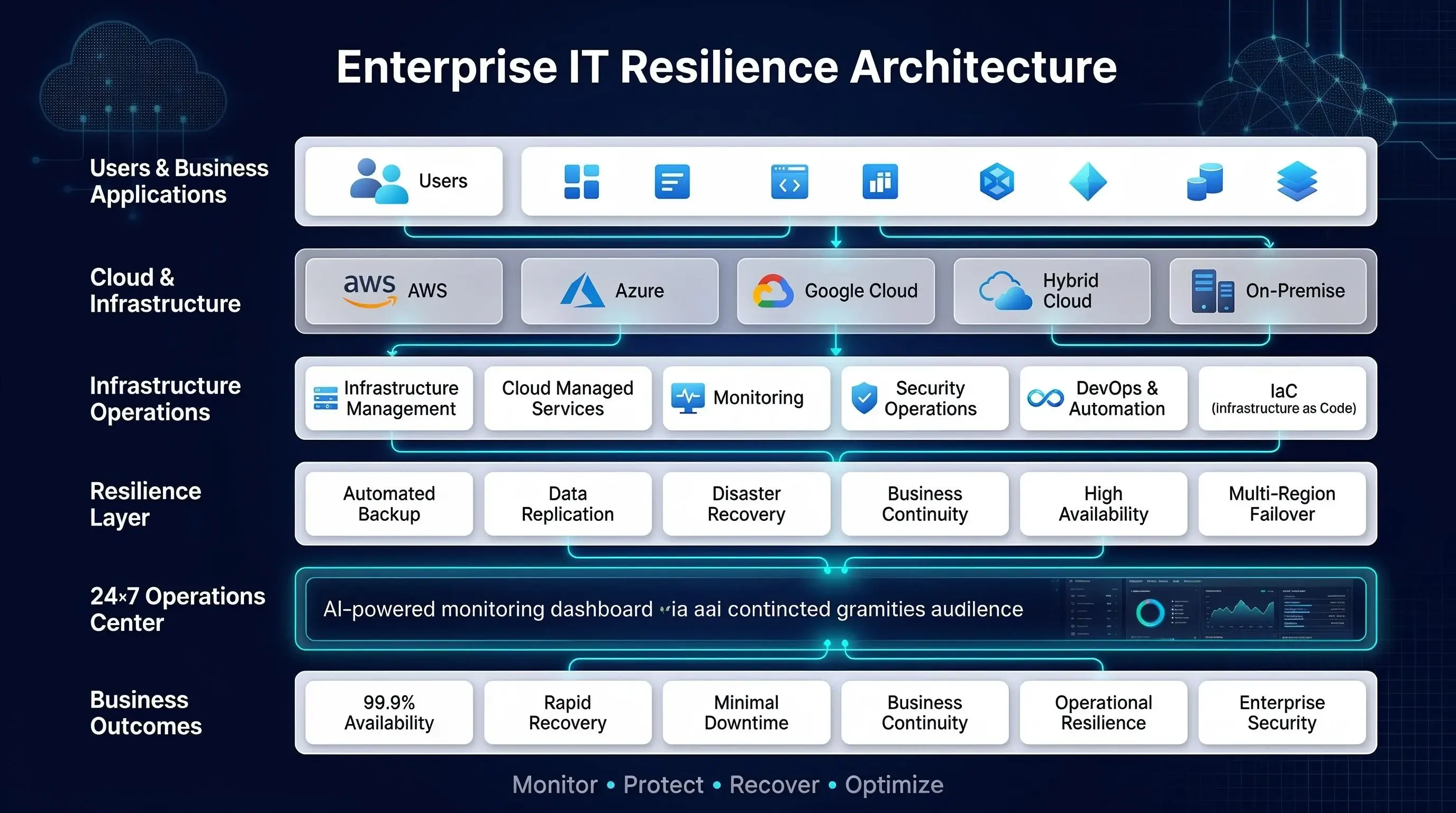
Building and sustaining a mature IT business continuity and disaster recovery program requires deep expertise across cloud infrastructure, security operations, observability, and automation. Most enterprise IT teams are already managing significant operational workloads — adding BCDR program development and continuous maintenance on top frequently results in gaps, deferred testing, and undocumented runbooks.
SISGAIN's cloud managed services practice delivers enterprise-grade infrastructure management across AWS, Azure, and GCP — with disaster recovery and business continuity baked into every engagement.
Backup Management and Disaster Recovery: SISGAIN manages backup operations with defined RTO and RPO targets, automated recovery testing, cross-region replication, and documented DR runbooks. Quarterly game-day simulations validate that recovery procedures work under realistic failure conditions — not just on paper.
24/7 Cloud Infrastructure Monitoring and Management: SISGAIN's NOC team monitors compute, storage, networking, and application layers continuously — with sub-5-minute alert response times and pre-authorized automated remediation for common incident categories. For P1 incidents, SISGAIN's Enterprise tier guarantees a 15-minute response time, 24 hours a day, 365 days a year.
Cloud Security Operations (SecOps): SISGAIN's managed security operations include Cloud Security Posture Management (CSPM), SIEM integration, vulnerability management, identity governance, and compliance monitoring — continuously enforcing security posture across cloud environments. This directly reduces the probability of incidents that trigger DR activation.
Patch Management and Compliance Automation: Automated OS and application patch management with pre-tested rollout windows, rollback capabilities, and compliance reporting aligned to SOC 2, PCI DSS, HIPAA, and ISO 27001 requirements.
Cloud Observability and AIOps: Unified observability across metrics, logs, and traces — with AIOps-powered anomaly detection, predictive alerting, and automated root cause analysis. Identifying failure precursors before they cause outages is the highest-value form of DR.
Hybrid Cloud Management: SISGAIN manages hybrid architectures that span on-premises infrastructure and cloud environments — ensuring consistent recovery capabilities, unified observability, and governance across both tiers.
SISGAIN serves 100+ enterprise clients across 40+ countries, including organizations in financial services, healthcare, and technology — maintaining a 99.9% uptime SLA with an average mean time to resolution of 4.2 minutes and a mean time to resolution under 15 minutes for managed service clients. The average cloud cost savings for managed clients is 35% within the first 90 days of engagement.
Ready to strengthen your organization's disaster recovery and business continuity posture? Schedule a free cloud assessment with SISGAIN's infrastructure team. No commitment required. Senior engineers only. Response within 24 hours.
A disaster recovery and business continuity strategy is only as strong as its weakest untested assumption. The organizations that recover quickly from disruptions ransomware, hardware failure, cloud outages share a common characteristic: they have invested in proving their recovery capability, not just documenting it.
The data from 2025 and 2026 points to a consistent pattern. Organizations that deploy immutable backups, conduct regular live recovery tests, align DR ownership across IT and business leadership, and invest in automation consistently outperform those that rely on legacy backup tools and static plans that haven't been opened since last year's audit.
BCDR is no longer purely a risk mitigation function. It is a competitive capability. Organizations that can recover faster, protect data more reliably, and demonstrate resilience to customers and regulators carry a meaningful operational advantage over those that can only hope their plan works when the time comes.
Start with an honest assessment of where your current BCDR program stands.



Start Build Your
Next Digital Solution?
Let’s build scalable, future-ready digital solutions tailored to your business goals. Connect with our experienced technology consultants to discuss your vision, strategy, and growth opportunities — with zero obligation and complete transparency.
Get a free consultation and cost estimate for your digital solution
Our expert will contact you within 24 hours. Check your email for confirmation.
Partner with SISGAIN experts to build secure, scalable AI-powered IT Solutions that transform your business operations.












DUQE FREEZONE Quarter Deck, Queen Elizabeth 2, Mina Rashid, Dubai, UAE

100 Consilium Pl Suite 200, Scarborough, ON M1H 3E3, Canada

C-109, Sector 2, Noida, Uttar Pradesh 201301 India
Project quotes, partnerships, implementation
Open roles, referrals, campus hiring