
 +1 844-445-5767
 +971 56-848-5757
 +91 921-208-0630
For Business & Service Inquiries
Sales Team
Project quotes, partnerships, implementation
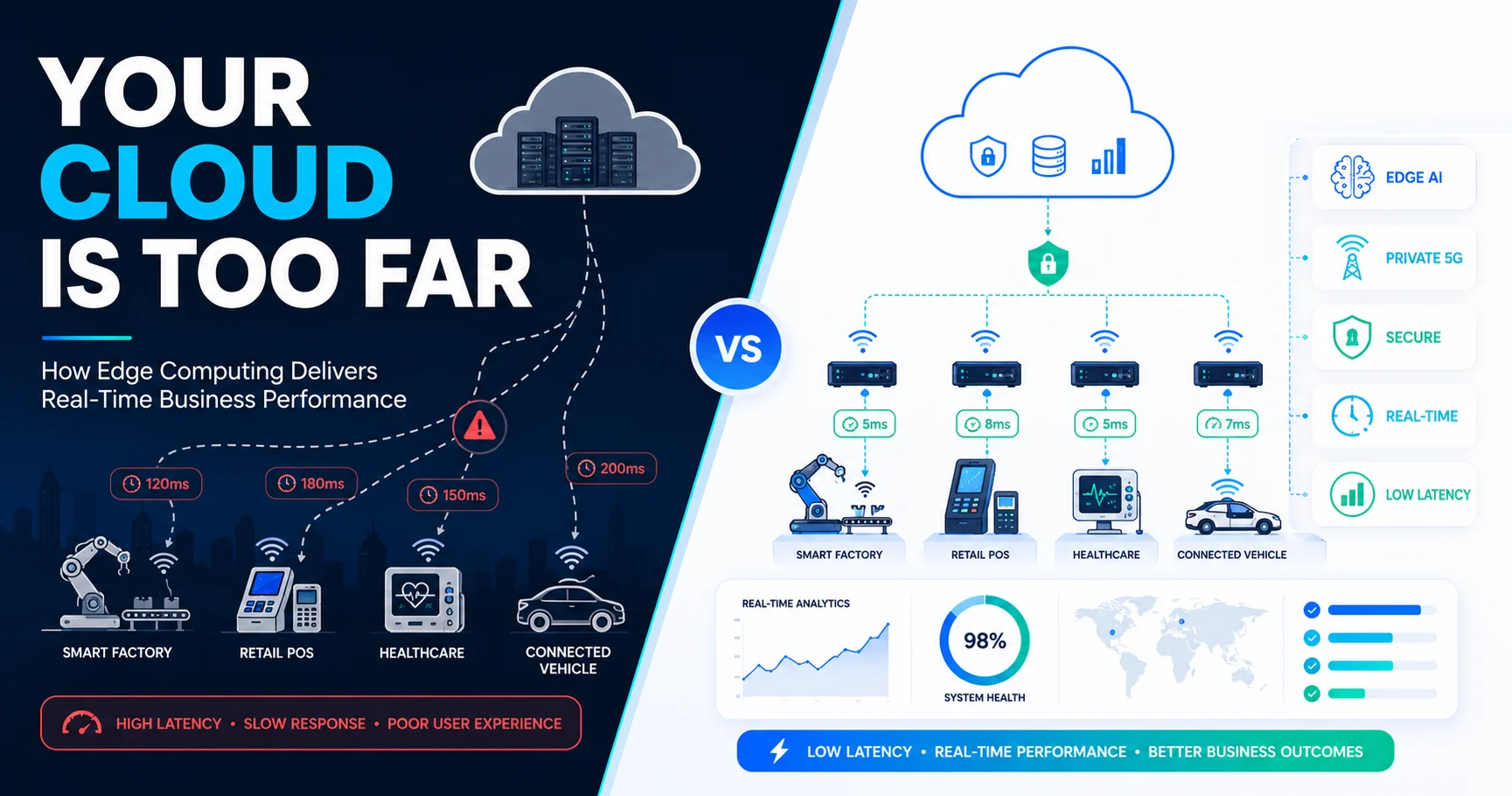
TL;DR: Edge computing infrastructure processes data near its source rather than routing it to centralized cloud servers. This approach cuts latency from 50–200ms to as low as 1–10ms, reduces bandwidth costs, and enables real-time decision-making. Enterprises across manufacturing, healthcare, retail, and logistics are adopting edge computing to gain speed, resilience, and competitive advantage.
Cloud computing transformed enterprise IT. But as IoT devices multiply, customer expectations for real-time experiences rise, and operational data volumes explode, routing every byte of data to a distant data center has become a bottleneck rather than a strength.
Consider this: a production line processing 60 parts per second cannot afford a 200ms round trip to the cloud for a quality check. An autonomous vehicle cannot wait 100ms for a navigation update. A hospital monitoring patient vitals cannot tolerate network-dependent delays. These are not edge cases — they represent the operational reality of modern enterprise.
Edge computing addresses this directly. Rather than centralizing all computation, edge computing infrastructure distributes processing power to locations close to where data originates. The result is faster response times, lower bandwidth consumption, reduced cloud costs, and greater resilience when network connectivity is disrupted.
According to Gartner Research, 75% of enterprise data will be processed at the edge in the coming years, up from just 10% historically. The global edge computing market reflects this momentum — valued at $28.5 billion in 2026 and projected to grow to $263.8 billion by 2034 (Global Market Insights).
This guide covers everything enterprise leaders and technology teams need to understand: how edge computing infrastructure works, what business problems it solves, where it is being deployed, and how to build a strategy that delivers lasting value.
Edge computing infrastructure is a distributed computing model that moves data processing, storage, and application logic closer to the physical source of that data — whether that is a factory sensor, a retail POS terminal, a hospital monitoring device, or a connected vehicle.
Unlike traditional cloud computing, which consolidates workloads in centralized data centers, edge computing places compute resources at or near the network's boundary — the "edge." This proximity dramatically shortens the distance data must travel before it is processed, which in turn reduces latency, decreases bandwidth consumption, and enables real-time decision-making without dependency on cloud connectivity.
Edge computing does not replace the cloud. It extends it. Most enterprise deployments follow a hybrid model: time-sensitive workloads are processed at the edge, while aggregated results, long-term analytics, and non-critical data flow to the central cloud for storage and analysis.
The relationship between edge computing and the Internet of Things (IoT) is particularly important. IoT devices generate enormous volumes of data continuously. Sending all of that raw data to the cloud is expensive and slow. Edge computing allows organizations to filter, analyze, and act on relevant data locally, transmitting only meaningful insights to centralized systems.
For enterprises looking to understand how infrastructure management ties into this broader picture, our overview of infrastructure management services provides a strong foundation.
The business case for edge computing infrastructure comes down to speed, cost, resilience, and competitive differentiation.
Speed and responsiveness. Edge computing cuts latency to 1–10ms, compared to 50–200ms or more for cloud-only architectures (Firecell, 2026). For industries where milliseconds determine safety, quality, or customer experience, this difference is critical.
Reduced bandwidth costs. Processing data locally means only relevant summaries and alerts are transmitted to the cloud. Organizations with high-volume IoT deployments report substantial savings in network and cloud egress costs when edge processing filters data before it leaves the site.
Business continuity. Edge nodes operate independently of cloud connectivity. If a network link fails, local operations continue without interruption. This autonomy is especially valuable for manufacturing plants, remote energy sites, and retail locations with unreliable connectivity.
Competitive advantage. Real-time analytics, personalized customer experiences, and AI-powered automation all depend on fast data processing. Enterprises that deploy edge computing infrastructure gain the ability to act on insights faster than competitors relying solely on cloud processing.
Regulatory compliance. Data sovereignty laws in sectors such as healthcare, finance, and government often require sensitive data to remain within specific geographic boundaries. Processing that data locally at the edge simplifies compliance and reduces the risk of regulatory violations.
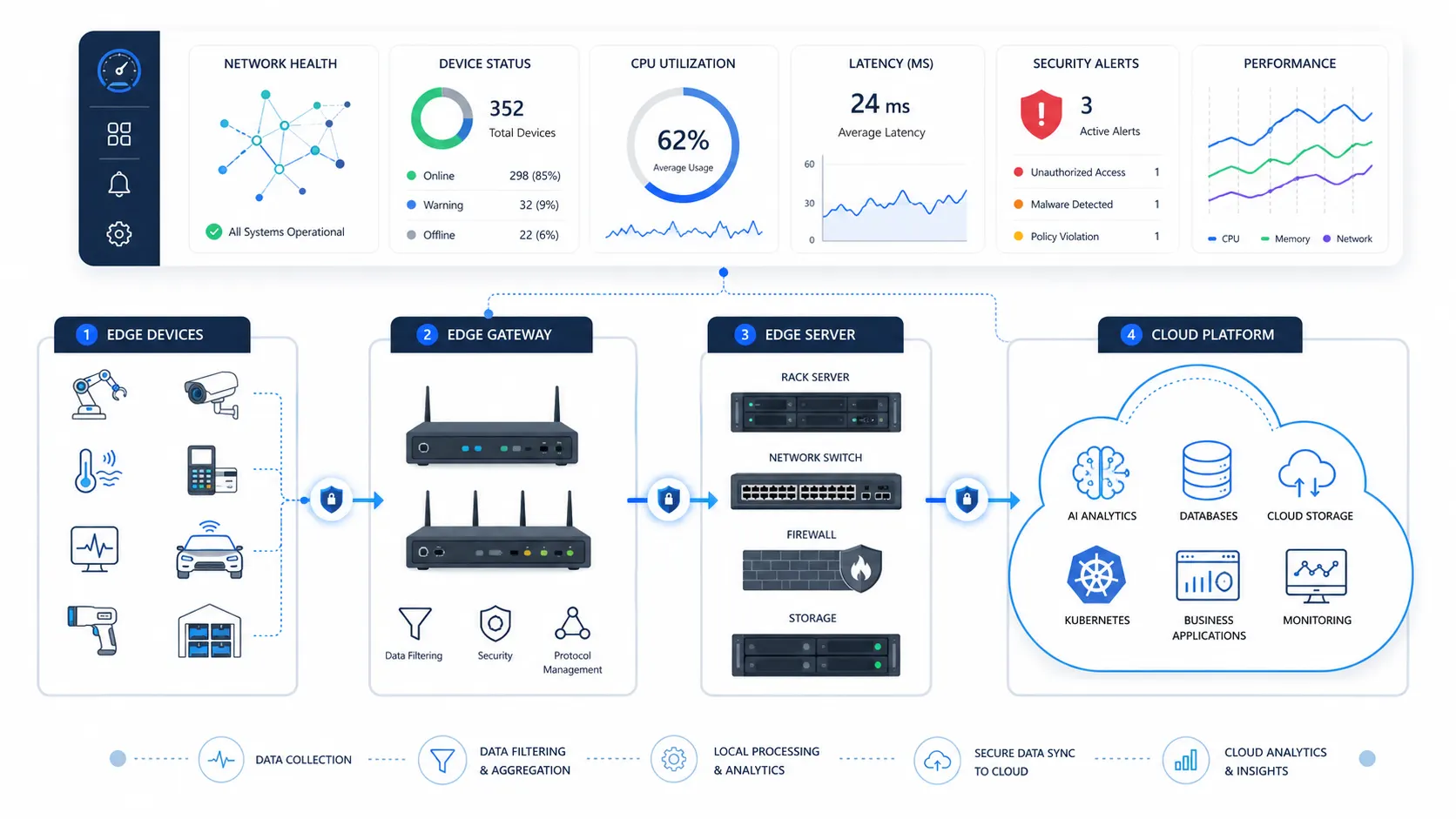
Understanding the building blocks of an edge computing deployment helps enterprise architects make informed design decisions.
Edge devices are the data generators — IoT sensors, industrial cameras, medical monitors, point-of-sale terminals, and connected machinery. These devices collect raw data from the physical environment and initiate the edge computing workflow.
Edge gateways aggregate data from multiple edge devices and perform initial filtering, protocol conversion, and local processing. They act as the bridge between field devices and edge servers, reducing the data volume that needs to travel further in the network stack.
Edge servers are the compute workhorses of the architecture. These ruggedized or micro-data-center-grade machines run applications, AI inference models, and analytics workloads locally. They handle the heavy processing that cannot wait for a cloud round trip.
This layer manages the secure transmission of processed data, logs, and aggregated insights from edge locations to the central cloud. It also pushes software updates, configuration changes, and AI model refreshes from the cloud down to edge nodes. Our guide on cloud infrastructure management covers this integration layer in detail.
Edge deployments depend on reliable, low-latency network connectivity — whether via private 5G, Wi-Fi 6, fiber, or MPLS. Network design significantly affects edge performance and resilience.
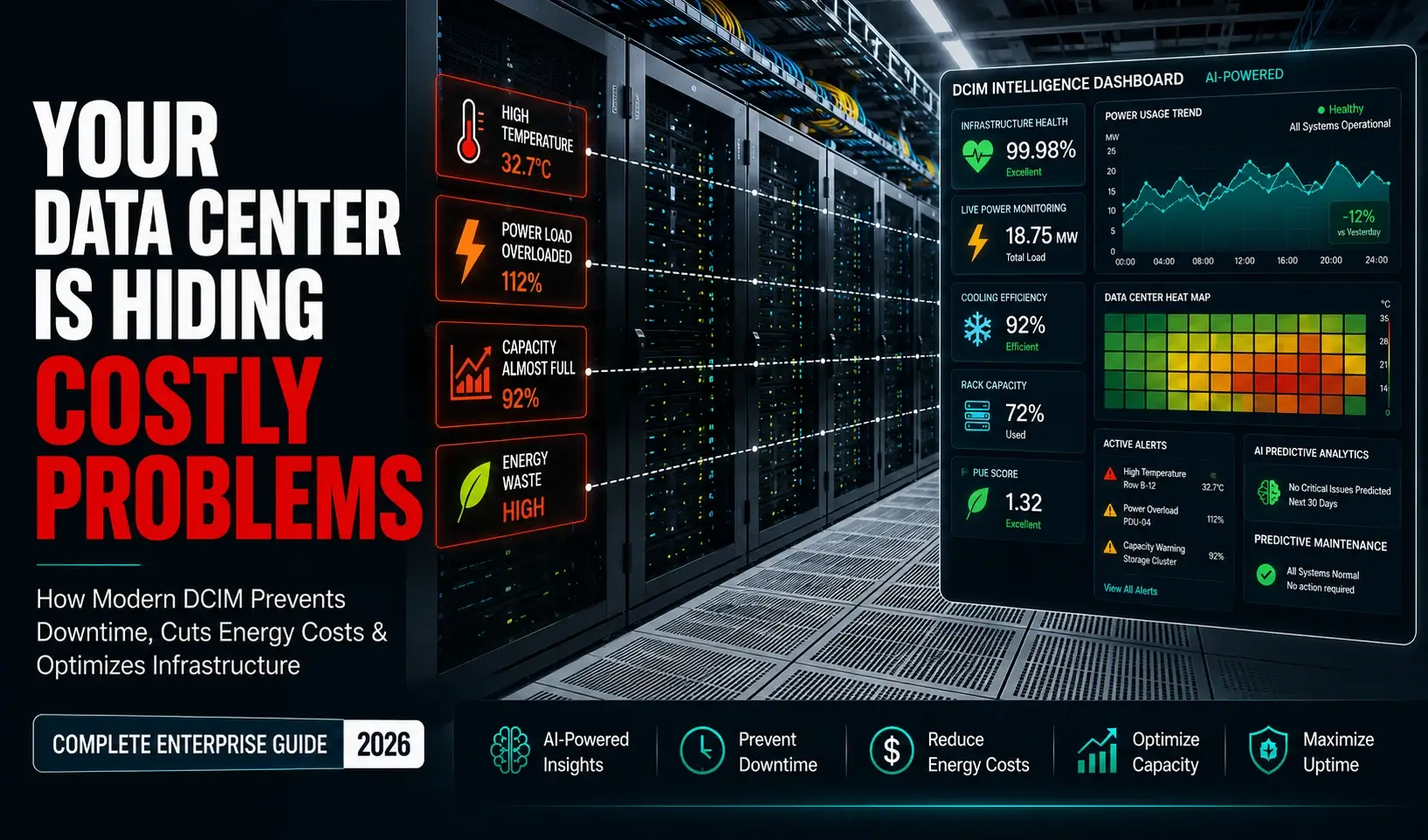
Distributed edge nodes require centralized visibility. Monitoring platforms track device health, performance metrics, security events, and connectivity status across all edge locations. Learn more about how infrastructure monitoring supports edge environments.
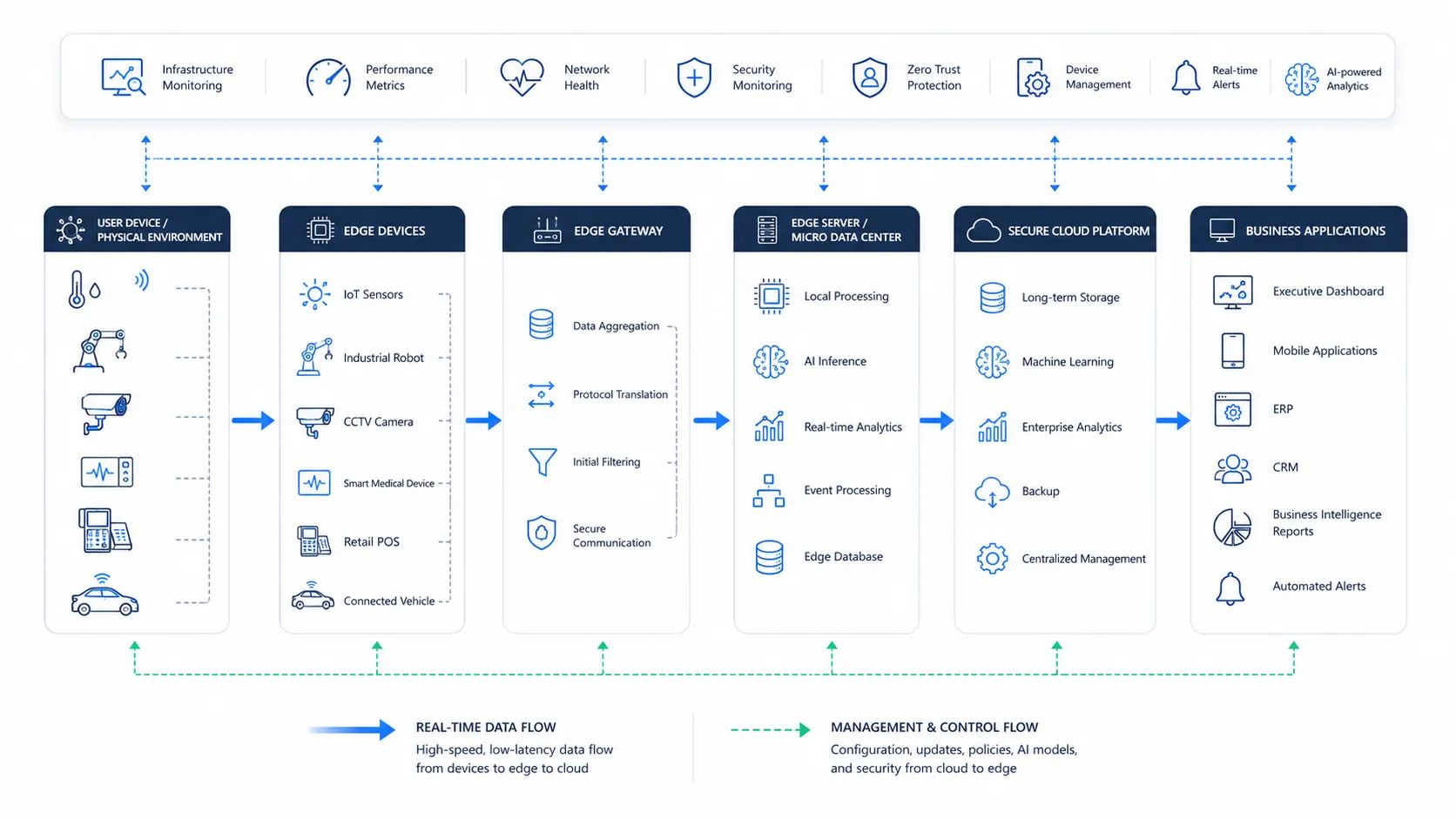
A complete edge computing architecture follows a layered data flow that moves from the physical world to business applications:
User Device / Physical Environment → Edge Device (IoT Sensor / Camera) → Edge Gateway (Aggregation & Filtering) → Edge Server (Local Processing & AI Inference) → Secure Network Link → Central Cloud (Storage, Long-Term Analytics) → Business Applications (Dashboards, Reports, Alerts)
At each stage, data is filtered and enriched. Raw sensor readings become structured events at the gateway. Structured events become actionable insights at the edge server. Actionable insights flow to the cloud where they inform business strategy and feed machine learning pipelines.
This architecture ensures that time-sensitive decisions happen locally in milliseconds, while strategic analysis happens centrally with full context. Enterprises designing this layered approach benefit from working with specialists in cloud architecture and infrastructure who can optimize data flows across edge and cloud tiers.
Edge computing reduces response times by two to ten times compared to centralized cloud processing (3GPP, cited in Firecell, 2026). For applications such as autonomous robotics, real-time quality inspection, and financial transaction processing, sub-10ms response times are not optional — they are a hard requirement.
Retailers can deliver personalized product recommendations in real time. Media platforms can stream content without buffering. Healthcare providers can surface patient alerts instantly. Edge computing makes all of this possible by eliminating the round-trip delay to distant data centers.
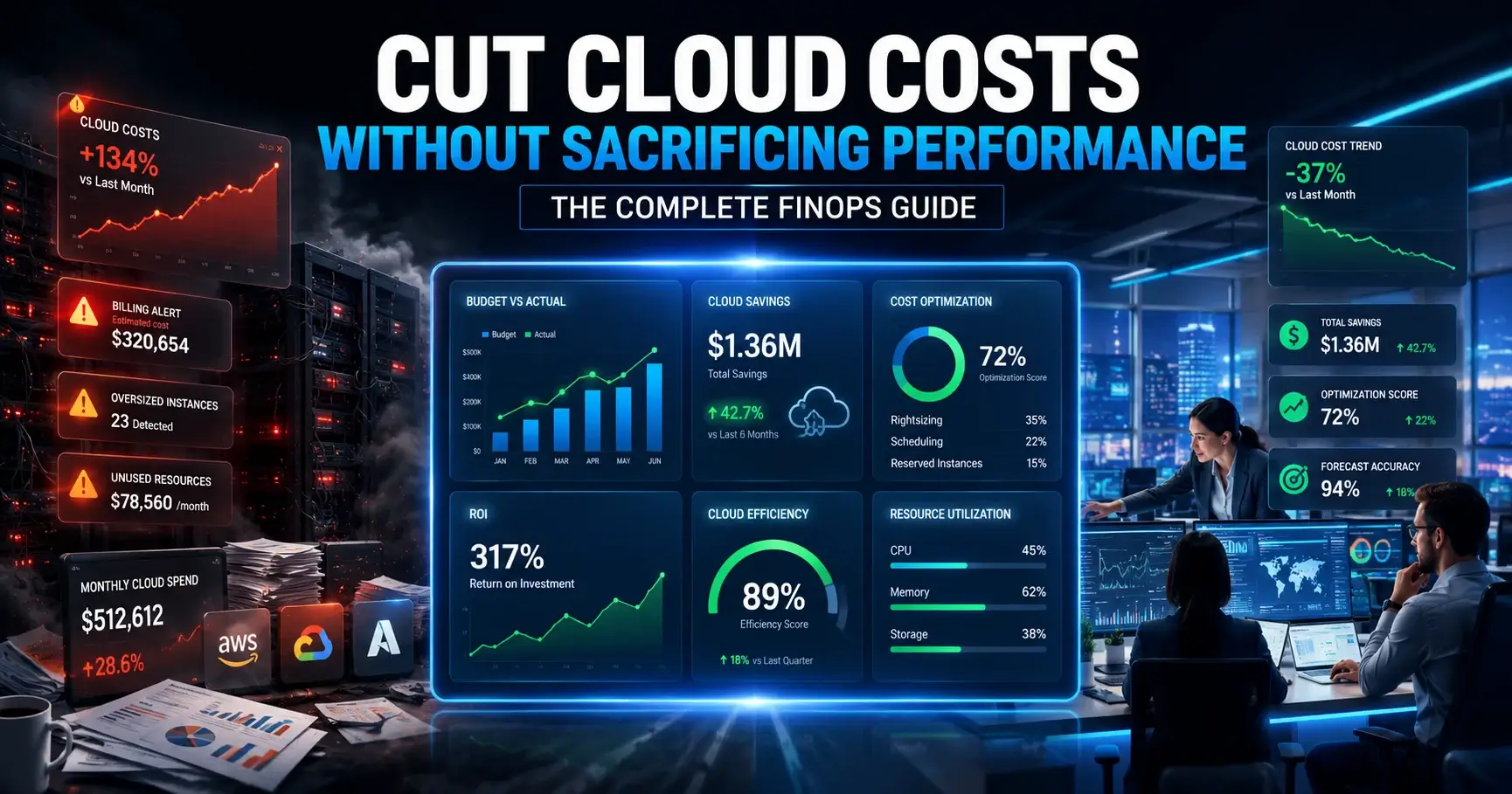
By processing data at the edge and transmitting only essential information to the cloud, enterprises significantly reduce cloud storage, compute, and egress costs. Our FinOps and cloud cost optimization guide outlines strategies that pair well with edge architecture to drive sustained cost efficiency.
Sensitive data — patient records, financial transactions, biometric data — can be processed and stored locally without ever leaving the facility or jurisdiction. This reduces exposure to external threats and simplifies regulatory compliance.
Local edge nodes continue operating during cloud or WAN outages. Critical processes stay online regardless of connectivity disruptions, which is especially important for manufacturing, logistics, and emergency services.
Edge infrastructure scales horizontally. New edge locations can be added to the network without overhauling the central cloud architecture, making edge computing well-suited to geographically distributed enterprise operations.
Edge processing dramatically reduces the volume of raw data transmitted over expensive WAN and cloud links. Enterprises with high-density IoT environments see the most significant bandwidth savings.
For organizations managing multi-cloud and hybrid environments alongside edge infrastructure, our hybrid cloud infrastructure management guide is a practical resource.
Edge computing enables real-time quality control, predictive maintenance, and autonomous robotics on factory floors. Sensors embedded in machinery monitor vibration, temperature, and pressure, with edge nodes detecting anomalies within milliseconds. Maintenance teams receive alerts before equipment fails, reducing costly unplanned downtime.
Hospitals use edge computing to process patient monitoring data locally, enabling real-time alerts for critical changes in vitals. Edge infrastructure also supports robot-assisted surgeries, where any latency in data transmission could compromise patient safety. Additionally, local processing keeps sensitive health data compliant with HIPAA and similar regulations (IBM Think).
Brick-and-mortar retailers deploy edge computing to power real-time inventory management, facial recognition for frictionless checkout, and hyper-personalized in-store experiences. RFID tags and camera feeds are processed locally to trigger restocking alerts and targeted promotions without cloud dependency.
Municipal governments use edge infrastructure to manage traffic flow, monitor public infrastructure, coordinate emergency vehicle routing, and analyze energy grid performance. Processing happens at distributed nodes across the city, reducing the volume of data that needs to reach central systems.
Self-driving vehicles rely on edge computing to process LiDAR, radar, and camera data in real time. Navigation decisions must happen in milliseconds — far too fast for cloud processing. Edge computing enables vehicles to respond to dynamic traffic conditions instantly (IBM Think).
Remote energy sites — offshore platforms, pipeline monitoring stations — use edge computing for real-time asset monitoring and anomaly detection. Local processing reduces the need for expensive satellite bandwidth while ensuring continuous operational visibility.
Financial institutions deploy edge computing at ATMs, branch offices, and trading terminals to accelerate transaction processing, enable real-time fraud detection, and maintain operation during connectivity disruptions.
Warehouses and distribution centers use edge computing to power machine vision systems that verify package integrity, guide autonomous sorting equipment, and optimize routing in real time — all without cloud dependency.
For development teams building cloud-based applications, the best edge computing tech for cloud-based frontend focuses on moving server-side logic and content delivery closer to users through distributed edge networks.
Content Delivery Networks (CDNs) serve static assets from edge nodes geographically close to users, cutting page load times significantly. Modern CDNs have evolved from simple file caches to programmable edge platforms.
Edge Rendering allows server-side rendering (SSR) and static site generation (SSG) to happen at edge nodes rather than centralized origin servers. A user in Tokyo receives content rendered at a Tokyo edge node, not a Virginia data center — dropping latency from 500ms to under 50ms.
Edge Functions and Serverless Edge APIs enable developers to run business logic — authentication, personalization, A/B testing, rate limiting — at edge locations using platforms such as Cloudflare Workers, Vercel Edge Functions, AWS Lambda@Edge, and Deno Deploy. These tools support sub-millisecond cold starts and global deployment by default.
AI Inference at the Edge allows machine learning models to run directly on edge nodes, enabling real-time content personalization, fraud scoring, and recommendation engines without cloud round trips.
Smart Caching with Stale-While-Revalidate strategies ensure users receive fresh content immediately while background processes revalidate the cache, balancing performance with accuracy.
The practical result: a frontend architecture built on edge computing edge computing solutions delivers faster page loads, lower infrastructure costs, and more personalized experiences at global scale.
Choosing the right edge computing hardware depends on the processing requirements, environmental conditions, and management complexity of each deployment.
Industrial PCs and Embedded Computers are ruggedized computing units designed for factory floors, outdoor environments, and harsh industrial conditions. They support continuous operation under extreme temperature, vibration, and humidity.
Micro Data Centers are self-contained, prefabricated compute units that include servers, storage, networking, power conditioning, and cooling in a single enclosure. They are deployed at retail locations, cell towers, and remote sites where traditional data center infrastructure is impractical.
AI Accelerators (GPUs and TPUs) enable edge nodes to run demanding AI inference workloads locally — object detection, predictive maintenance models, natural language processing — without cloud dependency. Selecting the right accelerator is covered in detail in our multi-cloud GPU strategy for enterprise AI guide.
Smart Gateways combine protocol translation, data aggregation, and edge analytics in a single device optimized for IoT environments.
Rugged Edge Servers deliver full server-class processing in form factors designed for space-constrained or environmentally challenging deployments, including oil platforms, military installations, and remote substations.
When selecting hardware, enterprise architects should evaluate power consumption, processing throughput, storage capacity, environmental rating, remote management capabilities, and total cost of ownership over the expected deployment lifecycle.
A structured approach to building an edge computing strategy reduces deployment risk and accelerates business value.
Inventory all applications and data flows. Identify which workloads are latency-sensitive, data-intensive, or compliance-constrained. Not all workloads belong at the edge — strategic assessment prevents unnecessary complexity.
Applications requiring sub-20ms response times are prime edge candidates. These typically include real-time control systems, safety monitoring, customer-facing applications, and AI inference pipelines.
Select deployment locations based on proximity to data sources and end users. Consider network connectivity options, physical security, power availability, and maintenance access at each location.
Edge nodes deployed in distributed, sometimes physically exposed environments require a robust security model. This includes device authentication, encrypted communications, network segmentation, and intrusion detection. Our IT infrastructure security best practices guide outlines the controls essential for edge deployments.
Design clear data pipelines between edge nodes and the central cloud. Define what data is processed locally, what is transmitted upstream, and at what frequency. Ensure bidirectional management — cloud to edge for configuration and updates, edge to cloud for insights and logs.
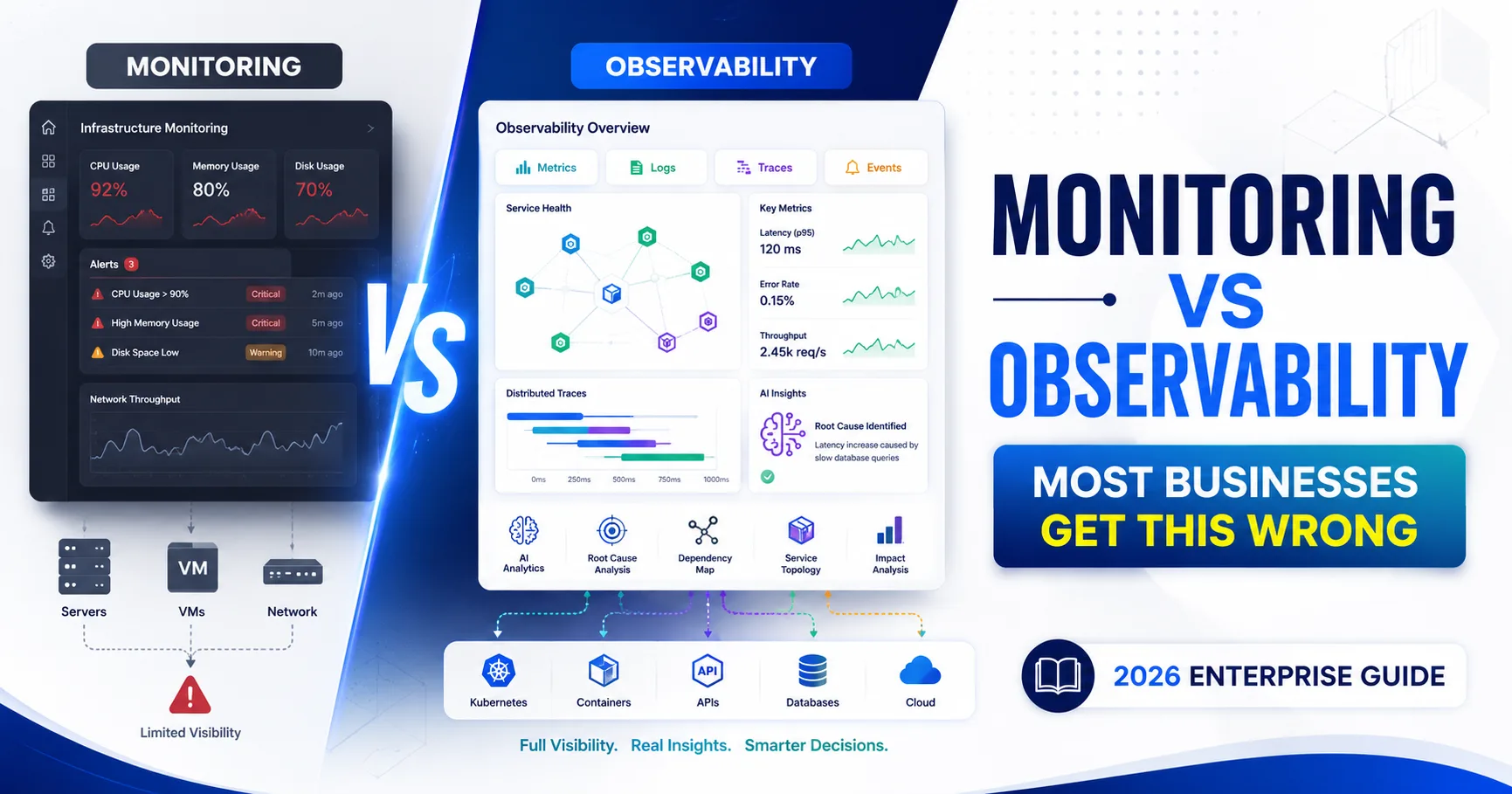
Distributed edge infrastructure demands centralized visibility. Implement monitoring that covers device health, application performance, network status, and security events across all edge locations. Explore the distinction between observability and monitoring to design an effective visibility strategy.
Design edge infrastructure to scale without manual intervention. Containerized workloads, Infrastructure as Code, and automated provisioning enable rapid deployment of new edge nodes as the business expands.
Edge computing delivers significant value, but enterprise deployments face real operational challenges that require deliberate planning.
Security at the Edge. Distributed nodes — often in environments with limited physical security — expand the attack surface. According to an AT&T survey (2022), businesses allocate 11–20% of their edge investment to security. Physical tampering, device authentication failures, and software vulnerabilities are all meaningful risks.
Device Management at Scale. Managing hundreds or thousands of edge nodes — each with its own hardware, operating system, and application stack — is operationally demanding. Automated provisioning, remote management, and over-the-air updates are essential.
Network Reliability. Edge nodes in remote or industrial environments may face unreliable connectivity. Infrastructure must be designed to maintain local operations during outages and synchronize gracefully when connectivity is restored.
Compliance and Data Governance. Multi-jurisdictional deployments must comply with different data residency, privacy, and industry regulations across each location. Governance frameworks must account for this complexity.
Operational Complexity. Managing a hybrid edge-cloud architecture requires new skills, processes, and tooling across networking, security, DevOps, and infrastructure teams.
Vendor Lock-In. Proprietary edge platforms can create long-term dependencies. Enterprises should evaluate open standards, containerized workloads, and multi-vendor strategies to preserve flexibility.
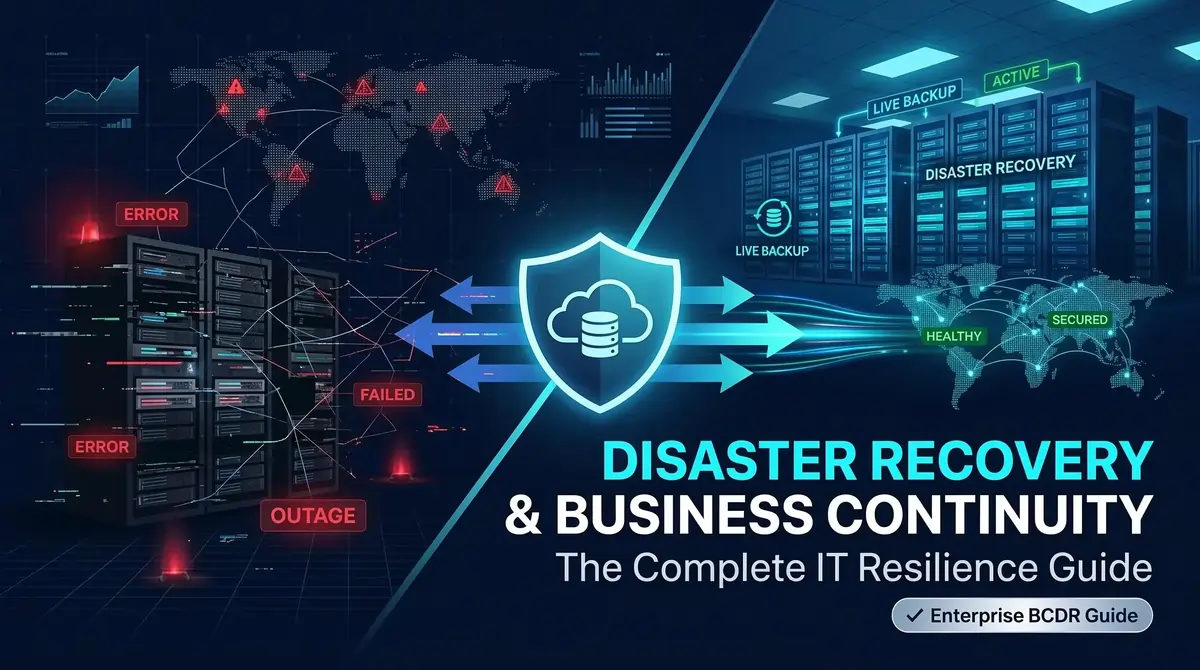
Robust disaster recovery planning is essential for edge environments. Our disaster recovery and business continuity guide addresses strategies for maintaining resilience across distributed infrastructure.
Enterprise edge computing solutions span a range of deployment models tailored to specific business needs:
|
Dimension |
Edge Computing |
Cloud Computing |
|---|---|---|
|
Latency |
1–10 ms |
50–200+ ms |
|
Data Processing Location |
Near the source |
Centralized data centers |
|
Best Use Cases |
Real-time control, AI inference, IoT |
Long-term analytics, storage, SaaS |
|
Resilience |
Operates during connectivity loss |
Dependent on network connectivity |
|
Cost Model |
Higher upfront hardware; lower bandwidth |
Pay-as-you-go; higher egress costs at scale |
|
Scalability |
Horizontal, distributed |
Near-unlimited vertical and horizontal |
|
Security Model |
Distributed, edge-hardened |
Centralized, provider-managed |
|
Deployment Complexity |
Higher — distributed management |
Lower — centralized management |
The choice between edge and cloud is rarely binary. Process control loops require edge latency below 10ms. Long-term analytics and business intelligence thrive in the cloud. Most enterprise deployments combine both — and the growing discipline of hybrid edge-cloud architecture ensures each workload runs where it performs best.
For deeper guidance on cloud-side infrastructure design, our cloud infrastructure management guide is a practical reference.
The following checklist reflects what high-performing enterprise edge deployments have in common:
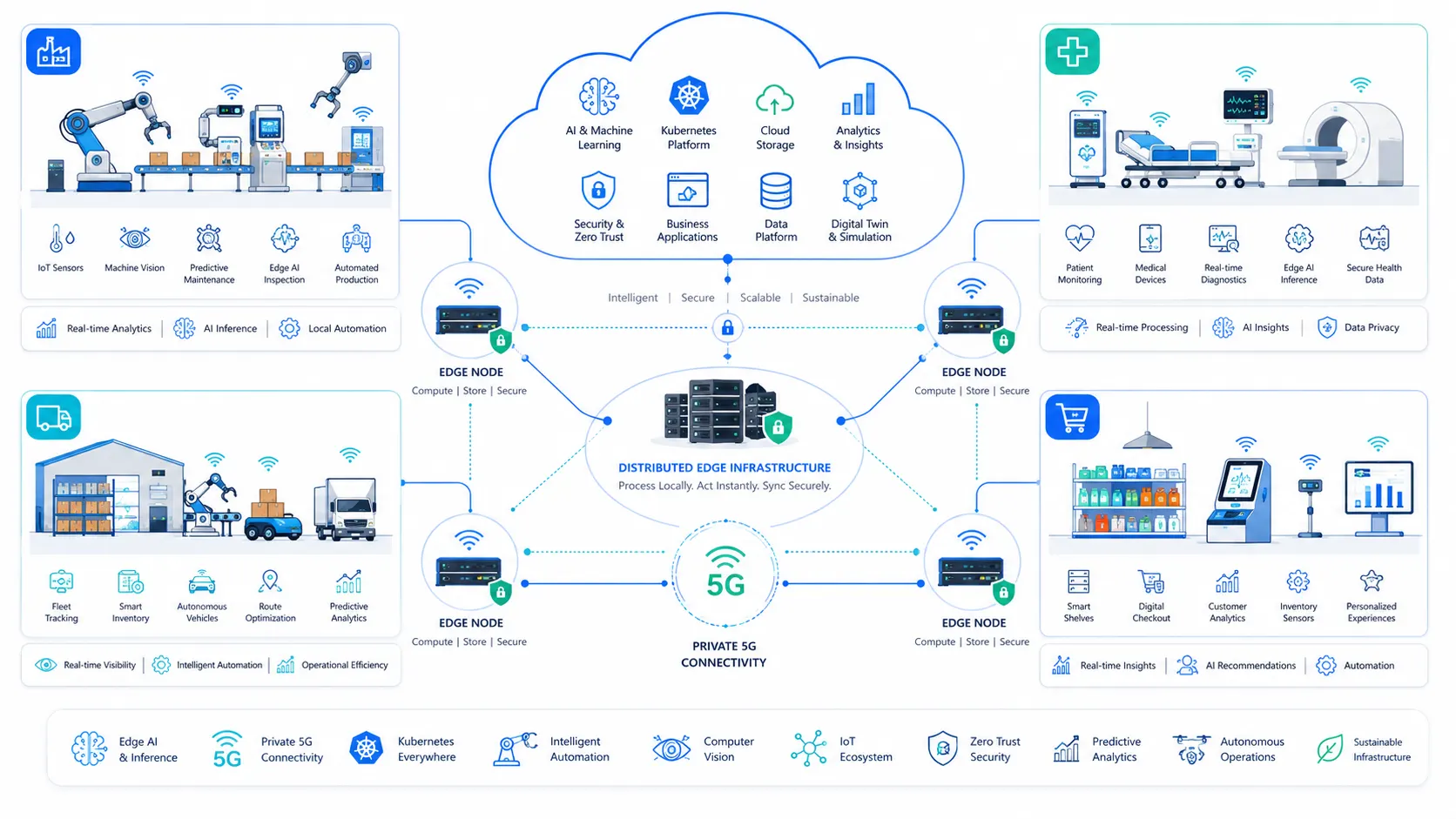
The edge computing landscape is evolving rapidly. These are the developments that enterprise technology leaders should track closely.
Edge AI and On-Device Inference. Machine learning models are increasingly deployed directly on edge hardware, enabling real-time computer vision, anomaly detection, and predictive analytics without cloud dependency. As AI accelerator hardware becomes more affordable and energy-efficient, edge AI capabilities will become standard in industrial and retail deployments.
Private 5G Networks. The convergence of edge computing and private 5G delivers ultra-low latency wireless connectivity within campuses, factories, and large facilities. 5G Ultra-Reliable Low-Latency Communication (URLLC) targets end-to-end latency below 1ms with 99.999% reliability — a significant enabler for autonomous robotics and industrial automation.
Digital Twins. Edge infrastructure feeds real-time operational data into digital twin models — virtual replicas of physical assets and systems. These models enable simulation, predictive maintenance, and optimization at a level of fidelity that cloud-only architectures cannot match.
Edge Kubernetes and Container Orchestration. Kubernetes-based platforms are extending to edge environments, bringing consistent workload management, self-healing capabilities, and CI/CD pipelines to distributed edge nodes. This approach reduces operational complexity significantly — and our Kubernetes and containerization services are built to support this evolution.
Autonomous Edge Infrastructure. AI-driven infrastructure management will enable edge nodes to self-configure, self-heal, and self-optimize — reducing the operational burden of managing large distributed deployments.
Sustainable Edge Data Centers. Energy efficiency is becoming a priority as edge deployments scale. Liquid cooling, renewable energy integration, and intelligent power management are emerging as standard design requirements for enterprise edge infrastructure.
The shift to distributed computing is not a speculative future scenario — it is an operational reality unfolding across industries at scale. With global edge computing hardware markets projected to grow from $14.82 billion in 2026 to nearly $49.38 billion (Fortune Business Insights), and enterprise data processing shifting decisively toward the edge, the question for most organizations is not whether to invest in edge computing infrastructure, but when and how.
The enterprises that move deliberately — assessing their workloads, designing secure and scalable architectures, and integrating edge with their existing cloud environments — will gain sustainable advantages in speed, efficiency, resilience, and customer experience.
Edge computing infrastructure is foundational to the next generation of enterprise technology. It enables real-time AI, autonomous operations, personalized digital experiences, and operational continuity at a scale that cloud-only architectures simply cannot deliver.
Ready to design and deploy enterprise-grade edge computing infrastructure? Explore SISGAIN's infrastructure management services to learn how our team helps enterprises plan, build, and operate distributed infrastructure that drives measurable business value.
Start Build Your
Next Digital Solution?
Let’s build scalable, future-ready digital solutions tailored to your business goals. Connect with our experienced technology consultants to discuss your vision, strategy, and growth opportunities — with zero obligation and complete transparency.
Get a free consultation and cost estimate for your digital solution
Our expert will contact you within 24 hours. Check your email for confirmation.
Partner with SISGAIN experts to build secure, scalable AI-powered IT Solutions that transform your business operations.









DUQE FREEZONE Quarter Deck, Queen Elizabeth 2, Mina Rashid, Dubai, UAE

100 Consilium Pl Suite 200, Scarborough, ON M1H 3E3, Canada

C-109, Sector 2, Noida, Uttar Pradesh 201301 India
Project quotes, partnerships, implementation
Open roles, referrals, campus hiring