
 +1 844-445-5767
 +971 56-848-5757
 +91 921-208-0630
For Business & Service Inquiries
Sales Team
Project quotes, partnerships, implementation
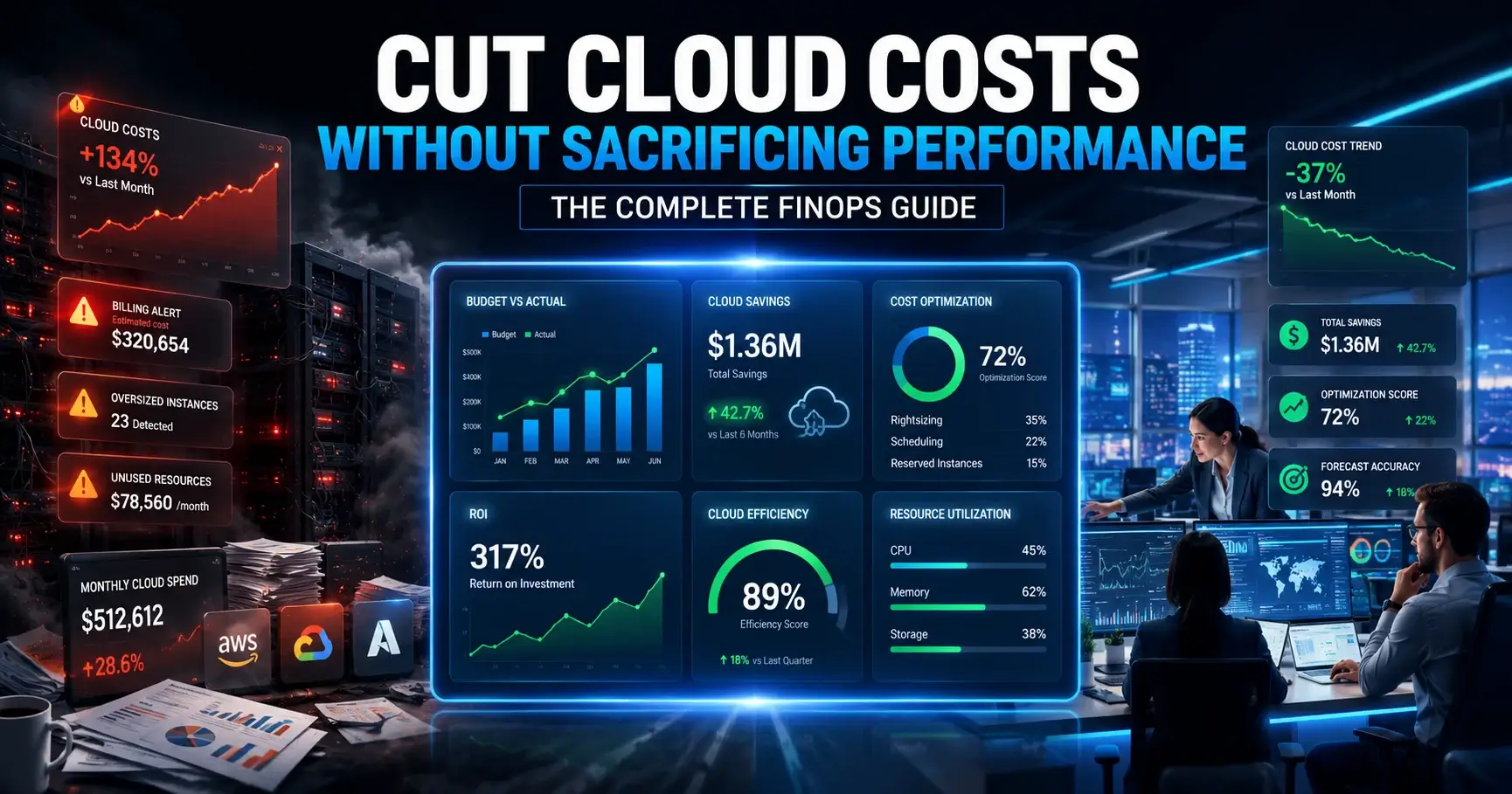
Quick answer: FinOps (short for Financial Operations) is an operational framework and cultural practice that maximizes the business value of technology by enabling timely, data-driven decisions and creating financial accountability through collaboration between engineering, finance, and business teams. It helps organizations control cloud costs without slowing down innovation.
Cloud bills have a way of growing faster than anyone plans for. A team spins up a handful of virtual machines for a project, the project ends, but the machines keep running. Reserved instances get purchased without a clear usage strategy. Infrastructure scales up for peak demand and never scales back down. Before long, finance is asking questions that engineering can't answer, and engineering is making decisions that finance never approved.
This is not an unusual story. According to a 2025 report by Harness, an estimated 21% of enterprise cloud infrastructure spend — equivalent to $44.5 billion globally — is wasted on underutilized resources each year. Meanwhile, Gartner forecasts that global public cloud spending reached over $720 billion in 2025, up from nearly $600 billion in 2024. The financial stakes have never been higher.
The challenge is not that organizations are spending too much on cloud. Often, they are spending in the wrong places, without enough visibility to know the difference. Traditional budgeting approaches were built for predictable, fixed-cost environments. Cloud infrastructure is the opposite — elastic, variable, and billed by the minute. That mismatch is exactly what FinOps was designed to solve.
This guide covers everything decision-makers, engineers, and finance teams need to understand about FinOps: what it is, how the FinOps framework works, what platforms support it, how to implement it, and when to consider engaging expert FinOps services.
Cloud adoption has moved well beyond experimentation. For most organizations, cloud infrastructure now powers core operations — customer-facing applications, data pipelines, machine learning workloads, development environments, and more. That operational dependence brings real financial consequences.
The cost structure of cloud is fundamentally different from on-premises infrastructure. Instead of fixed, depreciated assets, cloud spend is variable, consumption-based, and billed continuously. That flexibility is a genuine advantage — but it also creates serious risks for organizations that lack the visibility and governance to manage it.
Several factors are driving cloud costs upward across enterprises:
The result: according to Flexera's State of the Cloud report, 84% of organizations identify managing cloud spend as their top cloud challenge. Only 3 in 10 have a clear understanding of where their cloud spend is actually going.
Cloud cost optimization, done properly, is not about cutting corners or restricting engineering teams. It is about making intentional, data-driven decisions about where cloud investment delivers the most business value — and eliminating the spend that doesn't.
According to the FinOps Foundation's Technical Advisory Council, updated March 2026:
"FinOps is an operational framework and cultural practice which maximizes the business value of technology, enables timely data-driven decision making, and creates financial accountability through collaboration between engineering, finance, and business teams."
The term itself is a portmanteau of "Finance" and "DevOps" — a nod to the collaborative, iterative, cross-functional nature of the practice. Other names for FinOps include Cloud Financial Management, Cloud Cost Management, Cloud Financial Engineering, and Cloud Optimization. All describe the same underlying discipline.
A common misconception is that FinOps is about saving money. The FinOps Foundation explicitly addresses this: FinOps is about getting the most value out of technology to drive efficient growth, not simply minimizing spend. Sometimes that means cutting costs. Sometimes it means investing more — but doing so deliberately, with clear visibility into the expected return.
FinOps has its roots in managing public cloud costs, but the modern practice has expanded significantly. Today, FinOps principles apply across all technology categories: SaaS subscriptions, software licensing, data center infrastructure, data cloud platforms, AI services, and Kubernetes workloads.
FinOps vs. traditional cloud cost management:
|
Dimension |
Traditional Cloud Cost Management |
FinOps |
|---|---|---|
|
Approach |
Reactive, after-the-fact |
Proactive, continuous |
|
Ownership |
Centralized IT or Finance |
Distributed across Engineering, Finance, Product |
|
Visibility |
Monthly billing reviews |
Real-time cost dashboards |
|
Decision-making |
Top-down budget enforcement |
Data-driven, team-level accountability |
|
Optimization |
Periodic manual reviews |
Automated, continuous sprints |
|
Culture |
Cost as a Finance concern |
Cost as a shared engineering metric |
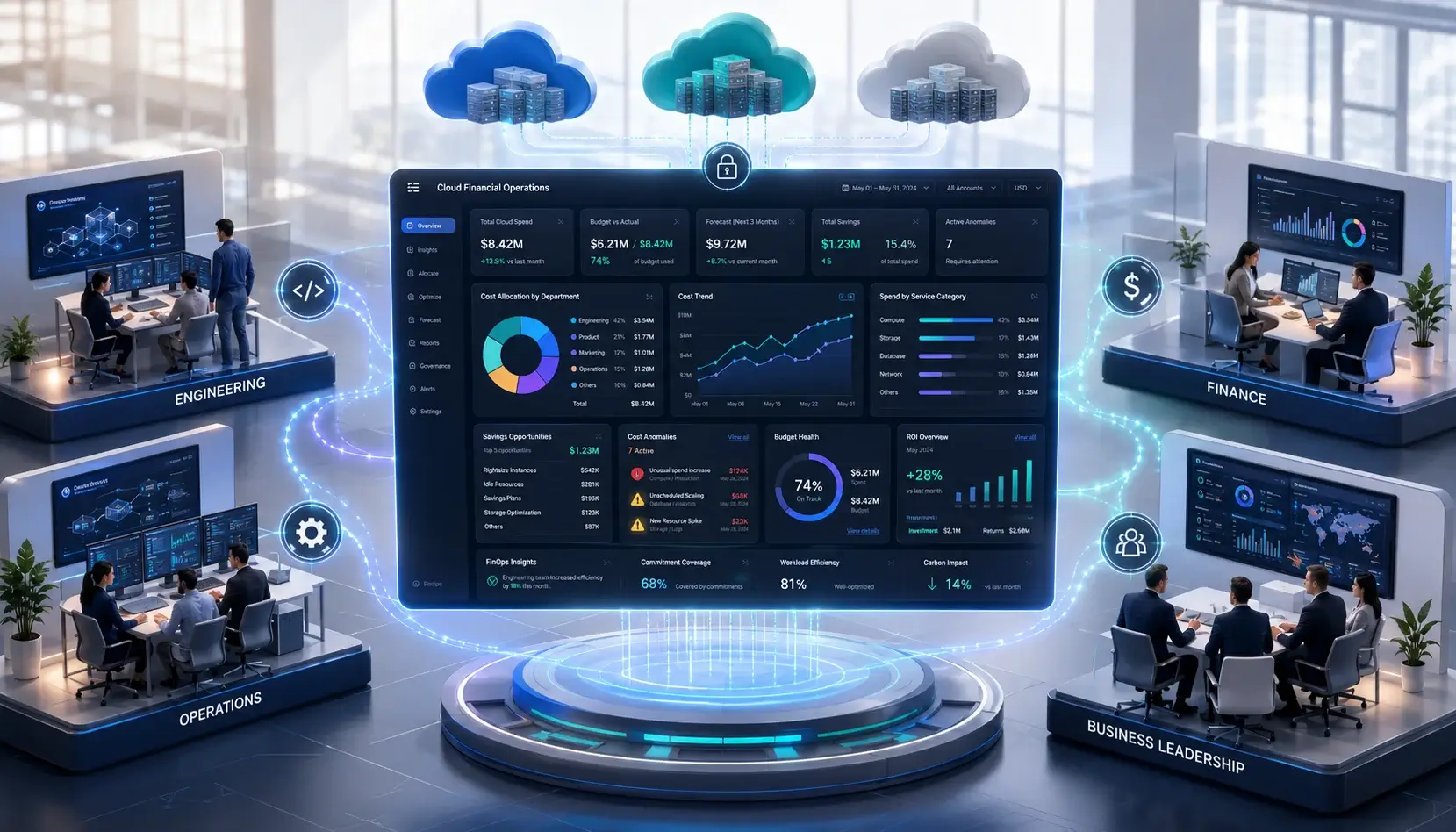
FinOps is, at its core, a cultural change as much as a technical one. It works by breaking down the organizational silos that typically separate cloud spending decisions from the people who understand cloud architecture — and those who control financial planning.
In a mature FinOps practice, engineering teams understand the cost implications of their architectural choices before they deploy resources. Finance teams have real-time visibility into cloud spend rather than waiting for the monthly invoice. Product teams factor cost efficiency into their roadmap priorities. And leadership has the executive reporting needed to make confident investment decisions.
Practically, this looks like:
The cross-functional collaboration that FinOps requires is also what makes it effective. The Harness FinOps in Focus 2025 report found that 55% of developers say cloud infrastructure purchasing commitments are ultimately based on guesswork — primarily because they lack real-time visibility into cost data. FinOps closes that gap by giving the people who make architectural decisions the financial context they need to make better ones.
For organizations managing cloud infrastructure management at scale, this kind of cross-team alignment is foundational to sustainable cost efficiency.
The FinOps Framework, developed and maintained by the FinOps Foundation, is the operating model that defines how organizations establish and evolve a successful FinOps practice. It encompasses principles, personas, phases, maturity models, domains, and capabilities — all structured in a common language that reflects how practitioners drive value from technology investments.
The FinOps Foundation defines six core principles that guide FinOps practice:
These principles are not a checklist — they are a north star. Organizations returning to them regularly will find their FinOps practice stays grounded in business value rather than drifting into pure cost-cutting.
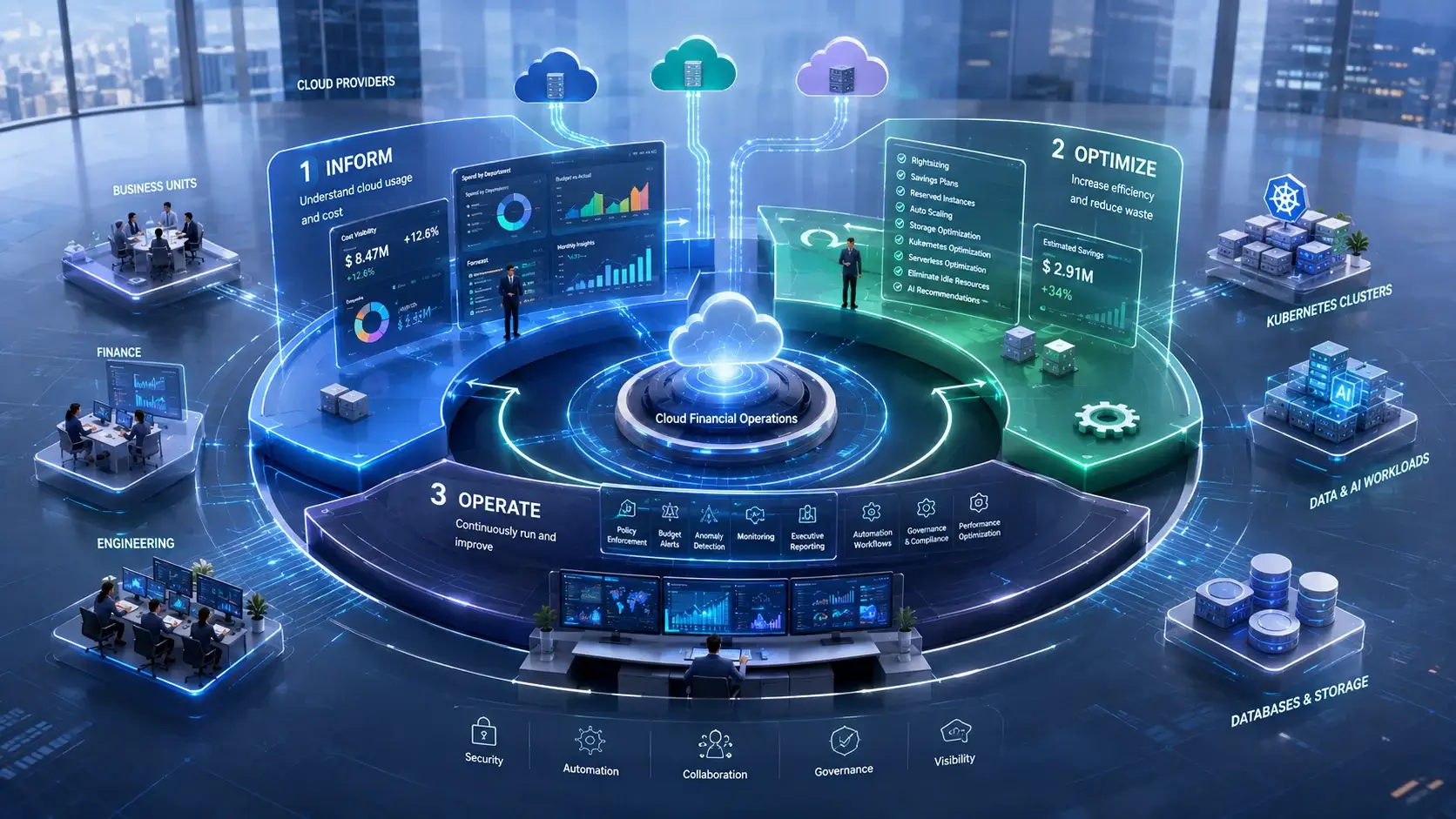
The FinOps journey consists of three iterative phases: Inform, Optimize, and Operate. These phases are not sequential steps to be completed once — they form a continuous cycle that FinOps teams work through repeatedly as their practice matures and their technology environment evolves.
The Inform phase focuses on building accurate visibility into technology cost, usage, and efficiency. Without this foundation, optimization efforts are speculative at best.
Key activities in the Inform phase include:
The on-demand and elastic nature of cloud technology means that the Inform phase is never truly complete. Organizations must continuously revisit it to validate the impact of optimization actions and ensure that decisions are grounded in accurate data.
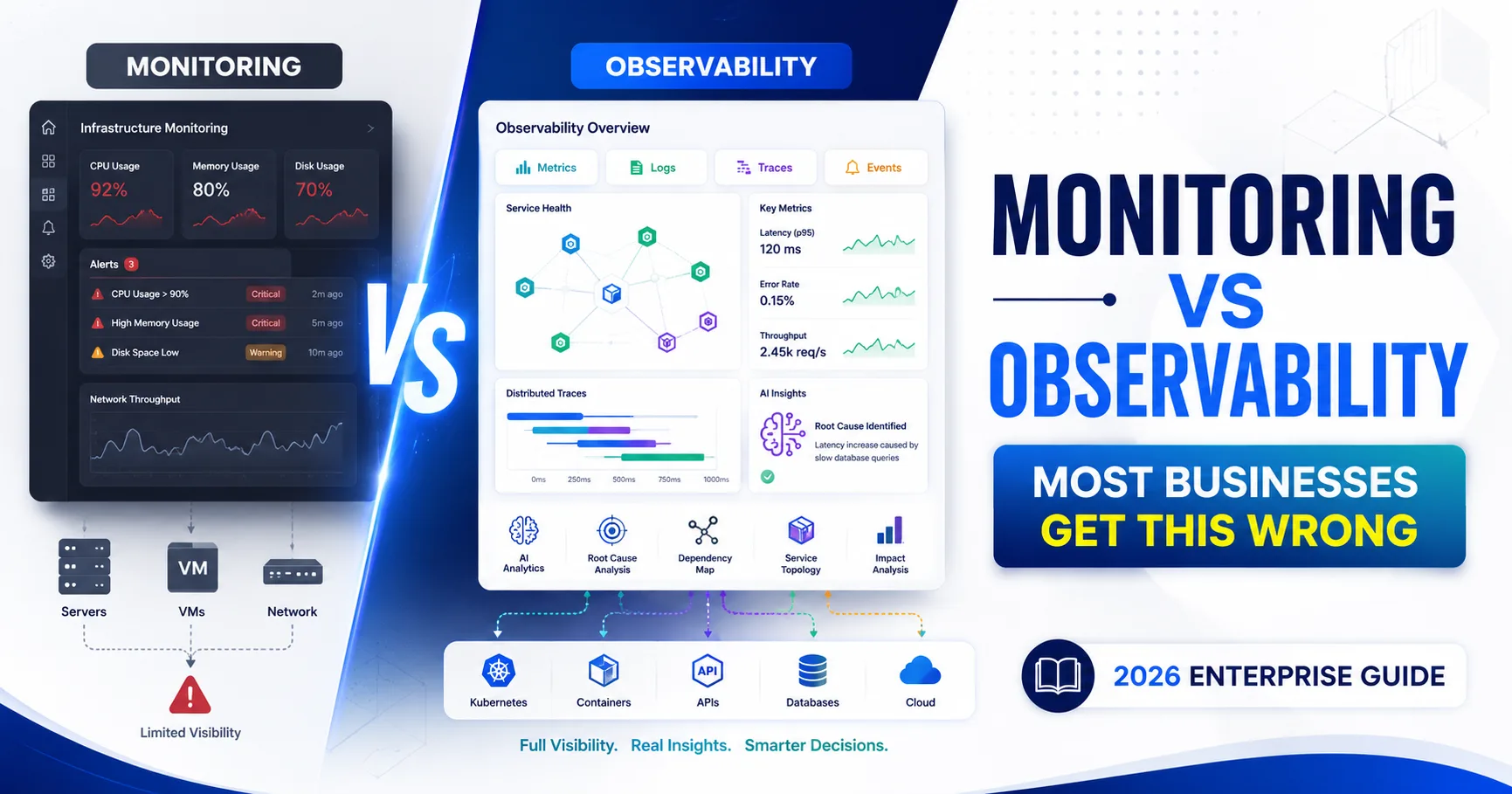
Effective infrastructure monitoring and observability practices are closely related to this phase — comprehensive telemetry and cost data work together to provide the full picture of infrastructure health and efficiency.
With accurate visibility established, the Optimize phase focuses on identifying and documenting opportunities to improve efficiency and value across the technology landscape.
Optimization in FinOps operates across two dimensions:
Usage optimization primarily requires collaboration with engineering teams, who understand workload behavior and can assess the impact of configuration changes. Rate optimization requires procurement and leadership involvement, since it involves financial commitments. A well-functioning FinOps practice coordinates both.
The Optimize phase also involves prioritizing opportunities. Not every optimization delivers equal value, and teams have limited capacity to act on every finding simultaneously. Establishing clear criteria for prioritization — based on savings potential, implementation complexity, and business risk — ensures that FinOps effort delivers maximum impact. This connects directly to infrastructure automation tools that can make optimization more consistent and scalable.
The Operate phase is where identified optimizations become implemented realities. It is also the phase most dependent on organizational culture — because meaningful, sustained cost reduction requires continuous action, not periodic cleanup.
Key activities in the Operate phase include:
The Operate phase loops directly back into Inform and Optimize. As infrastructure changes and new workloads are deployed, the cycle restarts — which is precisely the point. FinOps is not a project with an end date. It is an ongoing operating discipline.
The FinOps lifecycle describes the continuous process through which organizations improve their cloud financial management over time. It is not a linear path from start to finish — it is a feedback loop that becomes faster, more precise, and more valuable as the organization's FinOps maturity grows.
The FinOps Foundation's maturity model frames this progression as "Crawl, Walk, Run":
Most organizations begin their FinOps journey in Crawl — and that is entirely appropriate. The goal is to take action at a scale that is manageable, measure the results, and build momentum. Quick wins in the early stages generate the business case for investing in more mature capabilities.
Progressing through the FinOps lifecycle also depends on how well FinOps practices integrate with adjacent disciplines. Organizations with strong IT infrastructure security practices, well-governed hybrid cloud environments, and mature infrastructure management services tend to reach FinOps maturity faster — because the underlying data quality, governance habits, and cross-team collaboration are already in place.
The FinOps Framework organizes specific functional capabilities under four domains. Each capability represents a discrete area of FinOps activity that organizations can develop progressively:
Understand Usage and Cost
Quantify Business Value
Optimize Usage and Cost
Manage the FinOps Practice
No organization builds all of these capabilities at once. The practical approach is to identify which capabilities would deliver the most immediate value given the current state of cloud spend, and develop them in priority order.
Several platforms support FinOps practices across different cloud environments, team sizes, and maturity levels. The right choice depends on the organization's cloud providers, governance requirements, technical complexity, and budget.
AWS Cost Explorer: AWS's built-in cost management tool provides visualizations of AWS spending, rightsizing recommendations for EC2, Reserved Instance recommendations, and basic anomaly detection. Strong for AWS-only environments; limited for multi-cloud.
Azure Cost Management: Microsoft's native tool for Azure cost visibility, budget management, and anomaly alerts. Includes some support for AWS costs through connector integrations. Best suited for Azure-centric or Microsoft-ecosystem organizations.
Google Cloud Billing: GCP's native billing and cost reporting interface, with budget alerts, cost tables, and BigQuery export for advanced analysis. Works well within GCP environments; lacks multi-cloud breadth.
CloudHealth by VMware: A mature multi-cloud management platform with strong governance features, policy enforcement, chargeback reporting, and optimization recommendations across AWS, Azure, and GCP. Well-suited for large enterprise environments.
Apptio Cloudability: Focused on cloud financial management with strong alignment to business units and cost center reporting. Popular with finance-centric organizations and those already using Apptio for IT financial management.
Flexera One: Combines multi-cloud cost management with software license management and ITAM (IT Asset Management), making it a strong choice for enterprises managing both cloud and on-premises technology costs.
Harness Cloud Cost Management (CCM): Developer-focused FinOps platform with AI-powered recommendations, Kubernetes cost visibility, and tight integration with CI/CD pipelines. Particularly useful for organizations prioritizing developer-level cost ownership.
Kubecost: Open-source Kubernetes cost allocation tool that provides namespace-level cost visibility, rightsizing recommendations, and cluster efficiency reporting. A common choice for organizations running significant containerized workloads.
|
Platform |
Best For |
Multi-Cloud |
Kubernetes |
Governance |
|---|---|---|---|---|
|
AWS Cost Explorer |
AWS-only environments |
✗ |
Limited |
Basic |
|
Azure Cost Management |
Azure-centric orgs |
Partial |
Limited |
Moderate |
|
Google Cloud Billing |
GCP environments |
✗ |
Limited |
Basic |
|
CloudHealth |
Large enterprise, multi-cloud |
✓ |
Limited |
Strong |
|
Apptio Cloudability |
Finance-focused enterprises |
✓ |
Limited |
Strong |
|
Flexera One |
Cloud + license management |
✓ |
Limited |
Strong |
|
Harness CCM |
Developer-centric FinOps |
✓ |
Strong |
Moderate |
|
Kubecost |
Kubernetes-heavy workloads |
Partial |
Strong |
Moderate |
For organizations managing complex multi-cloud environments, combining native tools with a third-party platform — or engaging cloud managed services — often delivers better coverage and more actionable insights than any single tool can provide.

A FinOps report is a structured communication artifact that delivers cloud cost intelligence to specific stakeholders within the organization. Unlike raw billing exports, a well-designed FinOps report translates cost data into business context that informs decisions.
Executive FinOps Report (monthly or quarterly, for C-suite and board):
Team-Level Showback Report (weekly or bi-weekly, for engineering and product teams):
Finance and Budget Report (monthly, for finance teams):
The most effective FinOps reports are automated, delivered on a consistent cadence, and actionable — meaning each stakeholder can clearly see what decisions or actions the data suggests.
The specific optimization techniques available depend on the cloud provider, workload type, and architectural patterns in use. These are the highest-impact approaches across most enterprise environments:
Rightsizing: Adjusting instance types, sizes, and configurations to match actual workload requirements. Rightsizing uses historical utilization data — typically 30 to 90 days — to identify oversized resources. This single technique typically delivers 15–30% cost reduction in compute-heavy environments.
Reserved Instances and Savings Plans: Committing to one- or three-year usage terms in exchange for discounts of 30–60% compared to on-demand pricing. Effective for predictable, stable workloads. Requires careful analysis to avoid commitment waste.
Spot and Preemptible Instances: Using spare cloud provider capacity at deeply discounted rates (up to 90% off on-demand) for fault-tolerant, interruptible workloads such as batch processing, data pipelines, and CI/CD jobs.
Auto-Scaling: Configuring workloads to scale resources up and down dynamically based on demand. Prevents paying for capacity during low-traffic periods. Particularly impactful for web applications with variable traffic patterns.
Idle and Zombie Resource Cleanup: Systematically identifying and terminating unused virtual machines, unattached storage volumes, obsolete snapshots, and forgotten load balancers. Automation is critical here — manual reviews catch a fraction of what automated daily scans find.
Storage Tiering: Moving infrequently accessed data to lower-cost storage tiers (e.g., AWS S3 Glacier, Azure Archive Storage, GCP Coldline). Often overlooked, storage optimization can deliver significant savings in data-intensive environments.
Kubernetes Cost Optimization: Implementing namespace-level cost allocation, pod rightsizing, cluster autoscaler tuning, and Spot/Preemptible node strategies for containerized workloads. Kubernetes environments are particularly prone to overprovisioning because resource limits are set conservatively to ensure application stability. Cloud architecture and infrastructure design plays a significant role in Kubernetes cost efficiency.
Serverless Optimization: Reviewing function memory allocations, execution timeouts, and concurrency limits for serverless workloads. Many organizations set these values at defaults and never revisit them.
Tagging and Allocation Governance: Ensuring all resources are consistently tagged by team, environment, application, and cost center. Untagged resources cannot be allocated accurately — and resources that lack accountability tend to accumulate waste faster. Infrastructure automation tools can enforce tagging standards at the point of provisioning.
Organizations that implement FinOps practices consistently report benefits across financial, operational, and cultural dimensions:
Direct cost reduction: SISGAIN's FinOps engagements typically achieve 30–45% cloud cost reduction within 60–90 days through a combination of rightsizing, commitment optimization, waste elimination, and governance. The specific savings depend on the starting state — organizations with no prior FinOps practice tend to have more low-hanging fruit.
Real-time cost visibility: Finance and engineering teams gain access to up-to-date cost data rather than month-end billing surprises. This visibility alone changes behavior — teams that can see the cost impact of their decisions tend to make more cost-conscious architectural choices.
Budget accuracy and forecasting: With historical utilization data and unit economic models, FinOps teams can forecast cloud spend significantly more accurately than traditional IT budget processes allow. This improves financial planning and reduces budget variance.
Accountability and governance: Showback and chargeback reporting create clear ownership of cloud costs at the team and service level. When teams know their costs are visible, optimization becomes part of their day-to-day operating rhythm.
Better ROI on cloud investment: By eliminating waste and reallocating spend toward high-value workloads, FinOps improves the overall return on cloud investment — not just the bill.
Faster decision-making: Real-time data and cross-team alignment reduce the time required to evaluate cost implications of architectural changes, new service deployments, or capacity commitments.
Stronger executive reporting: Leaders gain the financial intelligence needed to make confident decisions about cloud investment strategy, vendor negotiations, and technology modernization priorities.
For organizations managing complex disaster recovery and business continuity requirements alongside day-to-day operations, FinOps also ensures that redundancy and resilience investments are properly accounted for — rather than appearing as unexplained cost overruns.
FinOps implementation is not without friction. Understanding the most common obstacles — and how to address them — significantly improves the chances of a successful practice.
Cultural resistance: Engineering teams may perceive FinOps as a cost-cutting mandate that constrains their ability to build and innovate. Finance teams may see it as an IT initiative outside their area. Overcoming this requires executive sponsorship, clear communication about the goals of FinOps (maximizing value, not just cutting costs), and early wins that demonstrate tangible benefits to all stakeholders.
Poor tagging and cost allocation: Without consistent resource tagging, it is impossible to attribute costs accurately to teams, applications, or business units. Many organizations discover significant "untagged spend" when they first attempt cost allocation. The solution is a comprehensive tagging taxonomy, enforced through policy-as-code, implemented as early as possible in the cloud journey.
Multi-cloud complexity: Each cloud provider has different billing structures, discount mechanisms, naming conventions, and cost management tools. Generating a unified view across AWS, Azure, and GCP requires either a sophisticated third-party platform or significant engineering effort. This is one of the primary reasons organizations engage dedicated FinOps services rather than building multi-cloud visibility entirely in-house.
Limited visibility into Kubernetes and container costs: Kubernetes workloads are notoriously difficult to cost-allocate because multiple applications share cluster resources. Namespace-level cost attribution requires specialized tooling that many organizations do not deploy until cost concerns force the issue.
Organizational silos: When engineering, finance, and product teams have no shared platform for cost data, they inevitably work from different numbers — which makes collaborative optimization difficult. Building a single source of truth for cloud cost data is foundational.
Skills shortage: Effective FinOps practice requires a combination of cloud architecture knowledge, financial acumen, data analysis skills, and organizational influence. Few individuals naturally possess all of these, and building internal FinOps capability takes time.
Analysis paralysis: The volume of optimization opportunities in a large cloud environment can be overwhelming. Organizations that try to optimize everything simultaneously often make slow progress. The solution is ruthless prioritization — focus on the highest-impact opportunities first, implement them, measure results, and iterate.
Connecting FinOps with broader multi-cloud infrastructure practices and GPU and AI workload strategies helps organizations avoid treating cloud cost management as a separate initiative from their core cloud operations.
Not every organization needs a full-time internal FinOps team or a specialized external engagement from day one. But there are clear indicators that a more structured, expert-led approach is warranted:
Monthly cloud bills exceed $50K: At this scale, even modest optimization percentages translate into meaningful dollar savings. The ROI on FinOps investment becomes clear and compelling.
Cloud spend is growing faster than the business: If cloud costs are increasing significantly faster than revenue, user growth, or feature delivery, something is wrong. FinOps investigation typically surfaces the culprits quickly.
Significant AI or GPU workloads: AI training and inference workloads on GPU instances are among the most expensive in cloud computing. Without FinOps governance, AI infrastructure costs can become unmanageable very quickly.
Kubernetes environments at scale: Container orchestration adds a layer of cost complexity that requires specialized tools and expertise. Organizations running significant Kubernetes workloads need Kubernetes-specific FinOps capabilities.
Multi-cloud operations: Managing costs across two or more cloud providers without a unified FinOps practice creates the visibility and governance gaps that lead to waste and budget overruns.
Enterprise governance requirements: Organizations subject to regulatory compliance, internal audit requirements, or board-level financial oversight need FinOps governance that meets those standards — not ad-hoc cost reviews.
Preparing for cloud modernization or migration: Large-scale migrations or modernization projects often create temporary cost spikes. FinOps planning before and during these projects prevents costs from exceeding projections.
SISGAIN's FinOps practice is built around a FinOps-as-a-Service delivery model that combines cost management tooling, expert advisory, and automated engineering. The approach covers the complete FinOps lifecycle, from initial cost discovery through continuous optimization and governance.
Several factors distinguish SISGAIN's approach in the enterprise FinOps market:
Certified expertise across major cloud platforms: SISGAIN holds FinOps Foundation certification, AWS Cost Optimization Partner status, Azure FinOps certification, and GCP Cost Management expertise. Engagements are staffed by practitioners with hands-on experience across all three major cloud providers.
Speed to value: Most clients receive a detailed savings opportunity report within five business days of onboarding. Quick-win optimizations and initial rightsizing typically deliver measurable savings within the first 30 days. Full optimization — targeting 30–45% cost reduction — generally achieves results within 60–90 days.
Automation over manual effort: SISGAIN implements rightsizing automation, tagging policy enforcement through policy-as-code, automated anomaly detection, and continuous optimization workflows. This means savings are sustained as the environment evolves, rather than eroding as new resources are deployed.
Multi-cloud unified visibility: SISGAIN connects to AWS Cost & Usage Reports, Azure Cost Management APIs, and GCP Billing Export to deliver unified dashboards across all cloud environments — eliminating the data silos that undermine cost governance in multi-cloud operations.
FinOps culture enablement: Beyond tooling and optimization, SISGAIN embeds FinOps practices into client engineering culture through showback reporting, cost awareness training, and the development of internal FinOps champions who sustain savings long after the engagement concludes.
Enterprise-grade governance: Engagements include tagging taxonomy design, policy guardrails, budget alerting, Kubernetes cost optimization, and FinOps maturity assessments aligned to established maturity benchmarks.
SISGAIN's engagement process follows four stages: cloud cost audit and discovery, FinOps strategy and roadmap, implementation and automation, and continuous optimization and governance. This structured approach means clients don't have to figure out where to start — the audit surfaces the opportunities, and the roadmap prioritizes them by expected impact.
Cloud costs are not going down on their own. Workloads grow, new services are deployed, architectures evolve — and without a structured FinOps practice, waste accumulates faster than any team can manually address.
The good news is that the FinOps framework provides a clear, battle-tested model for taking control. Starting with visibility, moving through optimization, and embedding governance into ongoing operations — the Inform, Optimize, Operate cycle is designed to deliver measurable results at every stage of cloud maturity.
The organizations that benefit most from FinOps are those that treat it as an operational discipline rather than a one-time project. Cost efficiency, business value alignment, and financial accountability become permanent features of how engineering and finance teams work together — not periodic events triggered by an oversized invoice.
For businesses ready to move from reactive cost management to proactive cloud financial governance, exploring SISGAIN's FinOps services is a practical starting point. The free cloud cost audit surfaces waste and savings opportunities within five business days — giving engineering and finance leaders the concrete data they need to build the case for a sustained FinOps practice.
Start Build Your
Next Digital Solution?
Let’s build scalable, future-ready digital solutions tailored to your business goals. Connect with our experienced technology consultants to discuss your vision, strategy, and growth opportunities — with zero obligation and complete transparency.
Get a free consultation and cost estimate for your digital solution
Our expert will contact you within 24 hours. Check your email for confirmation.
Partner with SISGAIN experts to build secure, scalable AI-powered IT Solutions that transform your business operations.









DUQE FREEZONE Quarter Deck, Queen Elizabeth 2, Mina Rashid, Dubai, UAE

100 Consilium Pl Suite 200, Scarborough, ON M1H 3E3, Canada

C-109, Sector 2, Noida, Uttar Pradesh 201301 India
Project quotes, partnerships, implementation
Open roles, referrals, campus hiring