
 +1 844-445-5767
 +971 56-848-5757
 +91 921-208-0630
For Business & Service Inquiries
Sales Team
Project quotes, partnerships, implementation

TL;DR: A multi-cloud GPU strategy distributes AI workloads across multiple cloud providers to optimize cost, performance, and availability. For enterprises running large language models, single-cloud deployments create vendor lock-in, capacity risks, and unpredictable costs. Multi-cloud GPU orchestration—managed through Kubernetes and AI workload scheduling tools—solves all three.
GPU scarcity is not a future problem. Enterprises training and serving large language models today routinely encounter capacity constraints, spot instance interruptions, and pricing volatility that single-cloud contracts cannot absorb. When a single provider throttles your GPU allocation mid-training run, you do not get a warning. You get failure.
A multi-cloud GPU strategy changes the equation. By distributing LLM workloads across AWS, Google Cloud, Microsoft Azure, CoreWeave, and specialized GPU cloud providers, enterprise AI teams gain flexibility that a single-vendor contract structurally cannot offer. GPU availability expands. Cost optimization becomes an active discipline rather than a procurement afterthought. Disaster recovery moves from theoretical to operational. Getting this right starts with a deliberate infrastructure management strategy that treats GPU capacity as a managed portfolio rather than a single vendor relationship.
This guide covers what a multi-cloud GPU strategy is, why single-cloud deployments no longer meet enterprise LLM demands, and how to build, orchestrate, and optimize AI infrastructure across multiple GPU clouds. It addresses Kubernetes GPU management, AI workload orchestration, cost and performance trade-offs, common failure patterns, and the industry trends reshaping enterprise AI infrastructure over the next three years.
The audience for this content is technical: CIOs, CTOs, Cloud Architects, Infrastructure Engineers, AI Engineers, DevOps teams, and Platform Engineers who make or influence GPU infrastructure decisions. The recommendations are practical. The conclusions are direct.
A multi-cloud GPU strategy is an architectural approach where AI workloads—model training, fine-tuning, inference, and data processing—run across GPU clusters hosted by two or more cloud providers simultaneously or in a coordinated failover configuration.
It is not the same as multi-region deployment within a single provider. It is not hybrid cloud management, though hybrid configurations can incorporate multi-cloud elements. A true multi-cloud GPU strategy involves active management of GPU resources across distinct provider APIs, pricing models, and availability zones.
The strategy has three operational pillars:
Executing across all three pillars requires multi-cloud GPU orchestration—the software layer that abstracts provider differences and makes intelligent scheduling decisions at runtime.
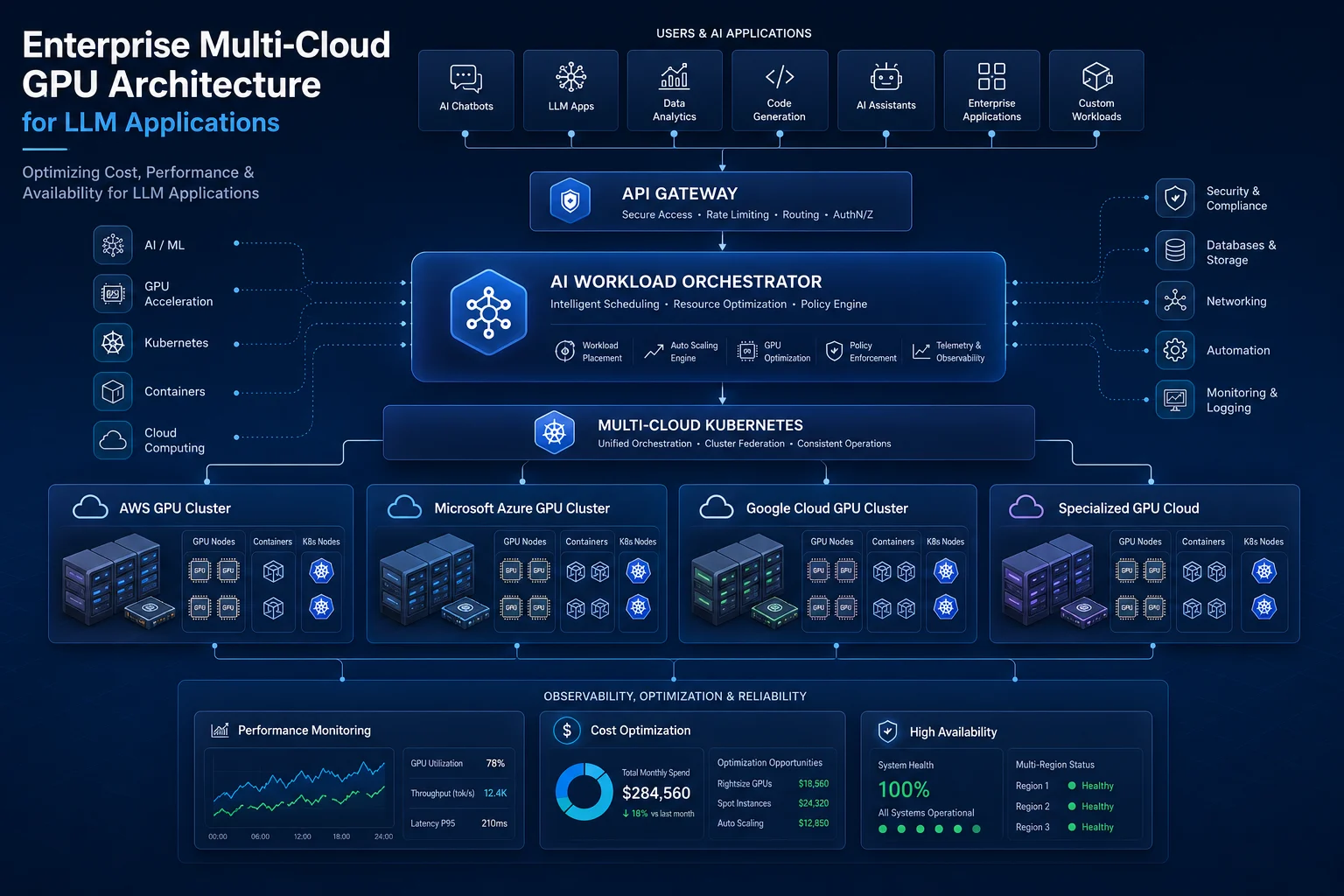
Single-cloud GPU deployments made sense when LLM workloads were experimental. They no longer do.
The fundamental problem is structural. Major hyperscalers—AWS, Azure, and Google Cloud—operate GPU capacity as a constrained resource. NVIDIA H100 and H200 availability fluctuates based on demand from thousands of concurrent enterprise customers. On-demand H100 instances regularly show wait times measured in weeks, not hours. Spot instance preemption rates increase sharply during peak demand windows, interrupting multi-day training runs without recourse.
Beyond availability, single-cloud contracts impose pricing rigidity. Reserved instance commitments lock enterprises into a fixed cost structure for one to three years, regardless of how LLM infrastructure requirements shift. As model architectures evolve—from dense transformers to mixture-of-experts configurations—GPU requirements change. A contract signed for A100 capacity becomes a liability when H100 or Blackwell GPUs become the performance baseline.
Security and compliance create a third constraint. Regulated industries—healthcare, finance, government—increasingly require data residency controls that a single provider cannot always satisfy across all required jurisdictions. Multi-cloud AI infrastructure allows organizations to route sensitive workloads to the provider whose compliance posture and regional footprint match the regulatory requirement, which is why a documented approach to IT infrastructure security has to sit alongside any provider-selection decision.
Single-cloud GPU deployments optimize for simplicity. Enterprise LLM operations require resilience, cost discipline, and compliance coverage. Simplicity is not sufficient.
Reduced GPU cost through competitive routing. Spot GPU pricing varies significantly across providers and regions. A multi-cloud GPU strategy enables dynamic workload routing to the lowest-cost available GPU cluster, reducing AI training and inference costs without reducing throughput.
Elimination of single-provider capacity risk. When one provider exhausts H100 availability, the orchestration layer routes to an alternative source—CoreWeave, Lambda Labs, or a secondary hyperscaler—without manual intervention.
Improved LLM inference latency. Distributing inference endpoints across multiple cloud regions reduces the geographic distance between the model and the end user, directly improving response latency for production applications.
Stronger disaster recovery posture. A provider outage on AWS us-east-1 does not affect a workload already running on Azure or Google Cloud. Multi-cloud AI infrastructure eliminates single points of failure at the provider level.
Regulatory flexibility. Enterprises operating in the EU, APAC, or government sectors can route specific LLM workloads to providers and regions that satisfy local data residency and sovereignty requirements without restructuring the entire AI infrastructure.
Negotiating leverage. Committing to multi-cloud removes single-vendor dependency and creates competitive pressure that typically improves both pricing and support terms.
Multi-cloud GPU orchestration is the control plane that makes a multi-cloud strategy executable at scale. Without it, operating GPU clusters across multiple providers is a manual, error-prone process that creates more operational overhead than it eliminates.
Effective multi-cloud GPU orchestration does four things:
Tools operating in this space include Kubernetes-based orchestration platforms extended with GPU-aware scheduling plugins, as well as purpose-built AI infrastructure orchestration platforms designed for multi-cloud LLM operations.
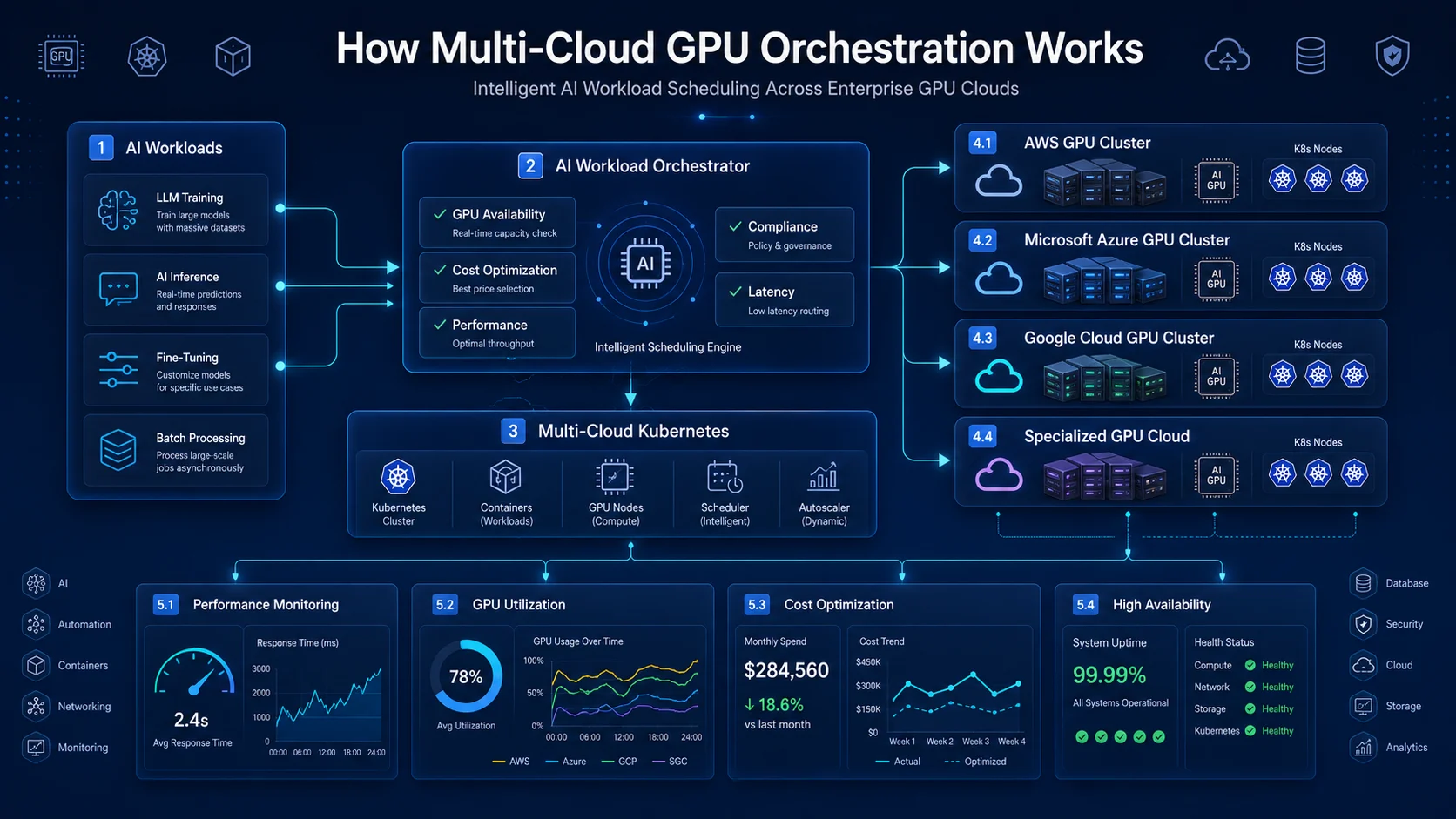
LLM workloads impose requirements on GPU orchestration that general-purpose compute scheduling does not address.
Training a large language model requires high-bandwidth interconnect between GPU nodes—typically NVIDIA NVLink or InfiniBand—to minimize the communication overhead of distributed training across hundreds or thousands of GPUs. An orchestration system unaware of GPU topology will schedule training jobs across nodes with inadequate interconnect, degrading throughput and inflating training time.
Inference workloads have different requirements. Low-latency token generation for production LLM applications requires consistent GPU availability, predictable memory allocation for model weights, and fast autoscaling to handle request volume spikes. An orchestration system optimized for training throughput is not automatically optimized for inference latency.
Effective GPU orchestration for LLM workloads distinguishes between these job types and applies placement policies accordingly:
GPU resource management at this level of specificity requires orchestration tooling with native LLM awareness, not generic workload schedulers retrofitted for AI.
Building multi-cloud AI infrastructure is an architectural decision that spans networking, storage, security, and orchestration, and it benefits from the same discipline organizations already apply to a broader cloud infrastructure management guide. Each layer requires deliberate design.
Networking. Cross-cloud GPU traffic must traverse public internet unless private connectivity options—AWS Direct Connect, Azure ExpressRoute, or Google Cloud Interconnect—are configured. For distributed training across providers, network latency and bandwidth constraints can negate the benefits of GPU availability diversification. Evaluate whether the workload tolerates cross-cloud communication overhead before distributing training jobs across providers.
Storage. LLM training datasets and model checkpoints require high-throughput, low-latency storage. Cloud-native object storage (S3, GCS, Azure Blob) is the standard approach, but cross-cloud data transfer costs accumulate quickly at petabyte scale. A storage strategy that centralizes training data in one provider while running compute on another introduces both latency and egress costs.
Security. Multi-cloud environments expand the attack surface. Each provider uses a distinct identity and access management model. A coherent security posture requires a unified secrets management system, consistent network policy enforcement across clouds, and workload identity federation that works across provider boundaries.
Observability. GPU utilization, job completion rates, autoscaling events, and cost metrics must flow into a unified observability platform. Operating blind across multiple clouds is operationally untenable, which is why a deliberate approach to monitoring GPU infrastructure needs to be built in from day one rather than bolted on later.
Kubernetes is the de facto orchestration platform for containerized AI workloads. Multi-cloud Kubernetes extends that orchestration capability across provider boundaries, and enterprises formalizing this layer often turn to dedicated Kubernetes & Containerization Services to manage cluster lifecycle across providers.
Tools like Cluster API, Crossplane, and Loft enable teams to provision and manage Kubernetes clusters across AWS EKS, Google GKE, and Azure AKS through a unified control plane. Combined with GPU-aware scheduling extensions—NVIDIA's GPU Operator, the Kubernetes Device Plugin for GPUs, and schedulers like Volcano or YARN for batch AI jobs—multi-cloud Kubernetes provides the foundation for portable, schedulable LLM workloads.
Key capabilities that multi-cloud Kubernetes enables for GPU management:
Multi-cloud Kubernetes does not eliminate the complexity of managing GPU infrastructure across providers—it structures that complexity into a manageable, auditable control plane.
AI workload orchestration at the multi-cloud level requires more than a Kubernetes federation. It requires a scheduling intelligence layer that understands LLM job characteristics and makes real-time placement decisions based on cost, performance, and compliance constraints.
The orchestration decision tree for a typical enterprise LLM operation includes:
This decision cycle runs continuously. As spot prices shift, GPU availability changes, and job queues evolve, the orchestration layer adjusts placement in real time. Manual scheduling at this frequency is not feasible for enterprise-scale LLM operations.
1. Define a GPU workload taxonomy before selecting providers.
Classify every LLM workload by type, SLA, data sensitivity, and GPU memory requirement before evaluating provider options. Workload characteristics determine provider fit—not the reverse.
2. Prioritize GPU topology in training job placement.
Distributed LLM training degrades sharply when GPU nodes lack high-bandwidth interconnect. Confirm that the GPU clusters used for large training runs provide NVIDIA NVLink or InfiniBand connectivity.
3. Build checkpoint-first fault tolerance.
Spot GPU instances are preemptible. Every training job must checkpoint model state at regular intervals and resume automatically from the latest checkpoint on preemption. Treat preemption as a standard operational event, not an exception.
4. Implement unified cost visibility before optimizing.
GPU cost optimization requires accurate, real-time data on GPU utilization, idle time, and spot versus on-demand spend across all providers. Establish a unified FinOps dashboard before making routing decisions—many enterprises bring in dedicated FinOps Services to build this visibility rather than assembling it ad hoc.
5. Standardize on containers and Kubernetes-native tooling.
Workload portability across GPU clouds depends on containerization. LLM training and inference jobs packaged as Kubernetes-native workloads are portable; jobs with hard dependencies on provider-specific APIs are not. Defining cluster and provider configuration through Infrastructure as Code (IaC) keeps this portability reproducible across environments rather than dependent on manual setup.
6. Enforce least-privilege access across all provider environments.
Multi-cloud environments multiply IAM complexity. Apply least-privilege access policies consistently across providers using a centralized secrets management system. Audit GPU cluster access regularly.
7. Separate inference and training infrastructure.
Training clusters optimize for throughput and interconnect bandwidth. Inference clusters optimize for latency and autoscaling speed. Running both workload types on shared GPU infrastructure forces trade-offs that degrade performance on both dimensions.
|
Challenge |
Root Cause |
Recommended Solution |
|---|---|---|
|
GPU spot preemption interrupting training runs |
Provider reclaims spot capacity mid-job |
Implement checkpoint-and-resume logic; use mixed instance pools with at least one on-demand node |
|
Inconsistent GPU availability across providers |
NVIDIA H100/H200 supply constraints at hyperscalers |
Add specialized GPU cloud providers (CoreWeave, Lambda Labs) to the provider pool |
|
Cross-cloud data transfer costs |
Egress fees when training data and compute span providers |
Centralize training datasets in one region; replicate only model checkpoints cross-cloud |
|
Fragmented IAM and security policies |
Each provider uses distinct identity models |
Deploy a centralized secrets manager (HashiCorp Vault or AWS Secrets Manager cross-cloud) and federated workload identity |
|
Lack of unified observability |
Metrics siloed in provider-native monitoring tools |
Implement an aggregated observability stack (Prometheus + Grafana or Datadog) with cross-cloud GPU metrics |
|
GPU scheduling inefficiency |
Generic Kubernetes scheduler lacks GPU topology awareness |
Deploy NVIDIA GPU Operator and a GPU-aware batch scheduler (Volcano, YARN, or Kueue) |
|
FinOps complexity at scale |
Multiple billing models, discount programs, and currencies |
Establish a dedicated FinOps function with tooling (CloudHealth, Apptio Cloudability) that consolidates GPU spend across providers |
Healthcare AI requires strict data residency controls under HIPAA in the US and GDPR in the EU. Multi-cloud AI infrastructure enables healthcare organizations to route LLM workloads processing patient data to compliant provider regions while running non-sensitive model development tasks on lower-cost GPU clouds. Clinical NLP models, medical imaging AI, and drug discovery LLMs all benefit from the GPU capacity diversification that multi-cloud provides.
Financial services firms run time-sensitive LLM workloads—fraud detection inference, risk modeling, algorithmic research—where GPU availability and latency directly affect revenue outcomes. A multi-cloud GPU strategy ensures that GPU capacity constraints on one provider do not create inference latency spikes or batch processing delays during peak trading windows. Compliance requirements under SOC 2, PCI-DSS, and regional financial regulations drive provider selection for specific workloads.
Manufacturing AI applications—predictive maintenance, quality inspection, supply chain optimization—increasingly run LLM-scale models on operational data. Multi-cloud GPU infrastructure enables manufacturers to keep operational data within regional cloud environments while accessing GPU capacity from specialized providers for compute-intensive training jobs.
Retail LLM applications—recommendation engines, demand forecasting, personalized search—face sharp demand spikes during peak retail periods. GPU autoscaling across multiple clouds allows retail AI teams to absorb those spikes without maintaining idle reserved capacity year-round. Multi-cloud GPU routing keeps inference costs proportional to actual demand.
Government and defense organizations face the most stringent data sovereignty requirements. Multi-cloud GPU strategy allows these organizations to operate LLM workloads in FedRAMP-authorized or sovereign cloud environments while accessing commercial GPU capacity for non-sensitive research and development workloads. The separation of classified and unclassified AI workloads across distinct provider environments is a structural requirement, not an optimization.
AI-Native Infrastructure
Cloud infrastructure is evolving from general-purpose compute with GPU add-ons to purpose-built AI infrastructure. Providers are deploying GPU supercomputer clusters—NVIDIA DGX Cloud on Azure, AWS Trainium clusters, Google TPU v5 pods—designed specifically for LLM training at scale. Multi-cloud GPU strategies will increasingly incorporate these purpose-built AI infrastructure options alongside traditional GPU instances.
GPU Marketplaces
Spot GPU capacity markets—CoreWeave, RunPod, Vast.ai, and emerging broker platforms—are creating a secondary GPU market that operates outside hyperscaler pricing. GPU marketplace integration into multi-cloud orchestration platforms gives enterprise AI teams access to a wider pool of GPU capacity at competitive prices, reducing dependence on hyperscaler spot instance availability.
Edge AI
LLM inference at the edge—on-premises GPU servers, regional co-location facilities, and edge cloud nodes—is becoming a requirement for latency-sensitive enterprise applications. Multi-cloud GPU strategies will expand to incorporate edge GPU capacity alongside hyperscaler and specialized cloud GPU resources.
Intelligent Scheduling
Current GPU scheduling systems route workloads based on cost, availability, and static constraints. Next-generation intelligent scheduling incorporates ML-driven prediction—forecasting spot price movements, GPU availability windows, and preemption probabilities—to make proactive placement decisions that reduce job interruptions and total GPU spend.
Autonomous Operations
AI-driven infrastructure operations—automated GPU cluster right-sizing, self-healing job recovery, and autonomous cost optimization—are moving from experimental to production-grade tooling. Enterprise AI infrastructure teams will manage GPU operations at a policy level rather than a configuration level.
FinOps for AI
GPU cost management is becoming a dedicated discipline within enterprise FinOps. Frameworks for GPU cost allocation, chargeback, and optimization are maturing rapidly. Organizations that establish FinOps for AI practices now—with tooling, processes, and ownership—will have a measurable cost advantage as LLM infrastructure spend scales.
Serverless GPUs
Serverless GPU platforms—where AI inference runs on GPU infrastructure with no cluster management overhead and billing on a per-token or per-second basis—are gaining traction for variable inference workloads. Multi-cloud GPU strategies will incorporate serverless GPU options for unpredictable or low-volume inference tasks, eliminating idle reserved capacity costs for those workload types.
GPU infrastructure decisions compound. A training cluster optimized for today's LLM architecture becomes a constraint when the next model generation requires different GPU types, higher interconnect bandwidth, or different regional availability. A single-cloud commitment made for simplicity becomes a ceiling on what is operationally possible.
Multi-cloud GPU strategy removes that ceiling. It does not simplify GPU infrastructure—it structures the complexity into manageable layers: orchestration, scheduling, cost management, and security. Each layer operates independently but contributes to the same outcome: GPU capacity that scales with AI ambition rather than constraining it.
The organizations building durable AI infrastructure today are not choosing between providers. They are building the systems that let them use all of them—on their terms, at their cost, with the control that enterprise LLM operations demand, backed by Infrastructure Management Services that can operate that complexity day to day.



Start Build Your
Next Digital Solution?
Let’s build scalable, future-ready digital solutions tailored to your business goals. Connect with our experienced technology consultants to discuss your vision, strategy, and growth opportunities — with zero obligation and complete transparency.
Get a free consultation and cost estimate for your digital solution
Our expert will contact you within 24 hours. Check your email for confirmation.
Partner with SISGAIN experts to build secure, scalable AI-powered IT Solutions that transform your business operations.












DUQE FREEZONE Quarter Deck, Queen Elizabeth 2, Mina Rashid, Dubai, UAE

100 Consilium Pl Suite 200, Scarborough, ON M1H 3E3, Canada

C-109, Sector 2, Noida, Uttar Pradesh 201301 India
Project quotes, partnerships, implementation
Open roles, referrals, campus hiring