Infrastructure Management Trends 2026: AI, Automation, Hybrid Cloud, FinOps, Edge, and Observability

/ Blogs / Infrastructure Management Trends 2026: AI, Automation, Hybrid Cloud, FinOps, Edge, and Observability

Table of Contents
    Infrastructure Management Trends 2026: AI, Automation, Hybrid Cloud, FinOps, Edge, and Observability

    Ten years ago, infrastructure management meant keeping servers running and patching them on schedule. That job still exists, but it's a small fraction of what the role covers now. Today's infrastructure teams are expected to support AI training clusters, keep multi-cloud environments in sync, defend against constant security threats, and do it all without blowing the budget.

    The shift happened fast. A team that used to measure success by uptime percentages is now measured by how quickly it can spin up GPU capacity for a new model, how cleanly it can move workloads between clouds, and how well it controls costs that used to be predictable and are now anything but. Infrastructure isn't the plumbing anymore — it's a competitive lever.

    This guide walks through the trends actually reshaping infrastructure management in 2026: AI and agentic operations, automation and self-healing systems, hybrid cloud, FinOps, edge computing, observability, GPU orchestration, and platform engineering. It closes with a practical modernization roadmap, common pitfalls, and answers to the questions IT leaders ask most.

    Looking to modernize your enterprise infrastructure?

    Discover how intelligent infrastructure management services can improve resilience, security, and operational efficiency for your organization.

    Key Takeaways

    • AI-powered infrastructure operations are moving from pilot projects to standard practice.
    • Hybrid and multi-cloud setups are now the default operating model, not a transition phase.
    • Automation and self-healing systems are cutting both downtime and the manual toil that burns out ops teams.
    • Observability is replacing traditional monitoring because dashboards alone can't explain why something broke.
    • FinOps is turning cloud spend from a monthly surprise into a managed, forecastable line item.
    • Edge computing is pushing infrastructure responsibility past the data center and into factories, stores, and vehicles.
    • Organizations that invest in intelligent infrastructure now will have a real head start once AI workloads become the norm rather than the exception.

    Why Infrastructure Management Has Become a Strategic Business Capability

    Traditional infrastructure management was reactive by design. Something broke, someone got paged, someone fixed it. That model worked when applications were monolithic and ran on hardware you could walk over and touch.

    It doesn't work anymore, for a few concrete reasons.

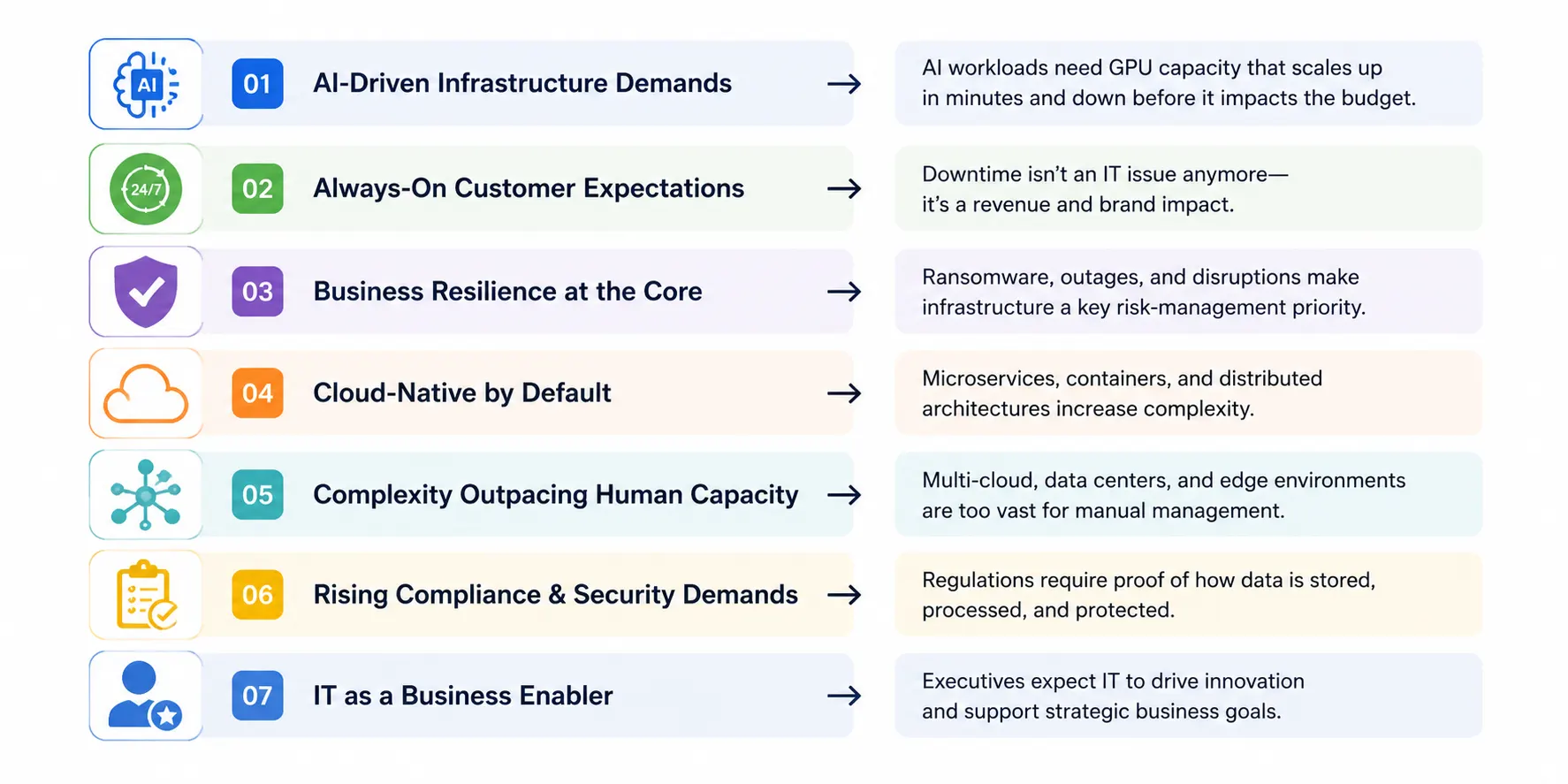
    AI-driven enterprises run on infrastructure that has to think ahead, not just respond. Training and serving machine learning models needs GPU capacity that can scale up in minutes and scale down before it drains the budget. There's no manual process fast enough to manage that curve.

    Customers expect always-on availability, full stop. A retailer's checkout flow going down for twenty minutes during a sale isn't an IT incident anymore — it's a revenue event that shows up in the next earnings call.

    Business resilience has become a board-level topic. Ransomware, regional cloud outages, and supply chain disruptions have all made infrastructure design a risk-management conversation, not just an engineering one.

    Applications are cloud-native by default. Microservices, containers, and distributed architectures replaced monoliths years ago, and that shift multiplied the number of moving parts any single infrastructure team has to track.

    Complexity has genuinely outgrown human capacity. A mid-sized enterprise today might run workloads across three or four clouds, a couple of data centers, and a growing edge footprint. No team can hold that entire picture in their heads and manage it by hand.

    Compliance and cybersecurity requirements keep expanding. Frameworks like GDPR, HIPAA, and various sector-specific mandates now require infrastructure teams to prove — not just claim — that data is stored, processed, and secured correctly.

    Executives expect IT to drive the business forward, not just keep the lights on. CIOs increasingly sit in strategy conversations because infrastructure decisions directly shape what the business can and can't do next.

    Flexera's 2025 State of the Cloud Report found that managing cloud spend remains the top challenge cited by IT leaders for the ninth year running, ahead of security and even ahead of the skills gap. That single statistic captures the whole shift: infrastructure isn't a cost center to be minimized quietly anymore. It's a resource to be actively managed, the same way a CFO manages capital.
    Strategic Infrastructure Management

    Top Infrastructure Management Trends Transforming Enterprises in 2026

    Trend

    Business Impact

    Priority

    AI Infrastructure Operations

    Very High

    Critical

    Infrastructure Automation

    High

    Critical

    Hybrid & Multi-Cloud

    Very High

    Critical

    Observability

    Critical

    Critical

    FinOps

    High

    High

    Edge Computing

    High

    High

    GPU Orchestration

    High

    Rising fast

    Platform Engineering

    Medium-High

    High

    The pattern in this table isn't subtle: nearly everything sitting at "Critical" priority touches AI in some way, directly or indirectly. That's not a coincidence — it's the throughline connecting every trend in this piece.

    AI and Agentic AI Are Transforming Infrastructure Operations

    What Is AI-Driven Infrastructure Management?

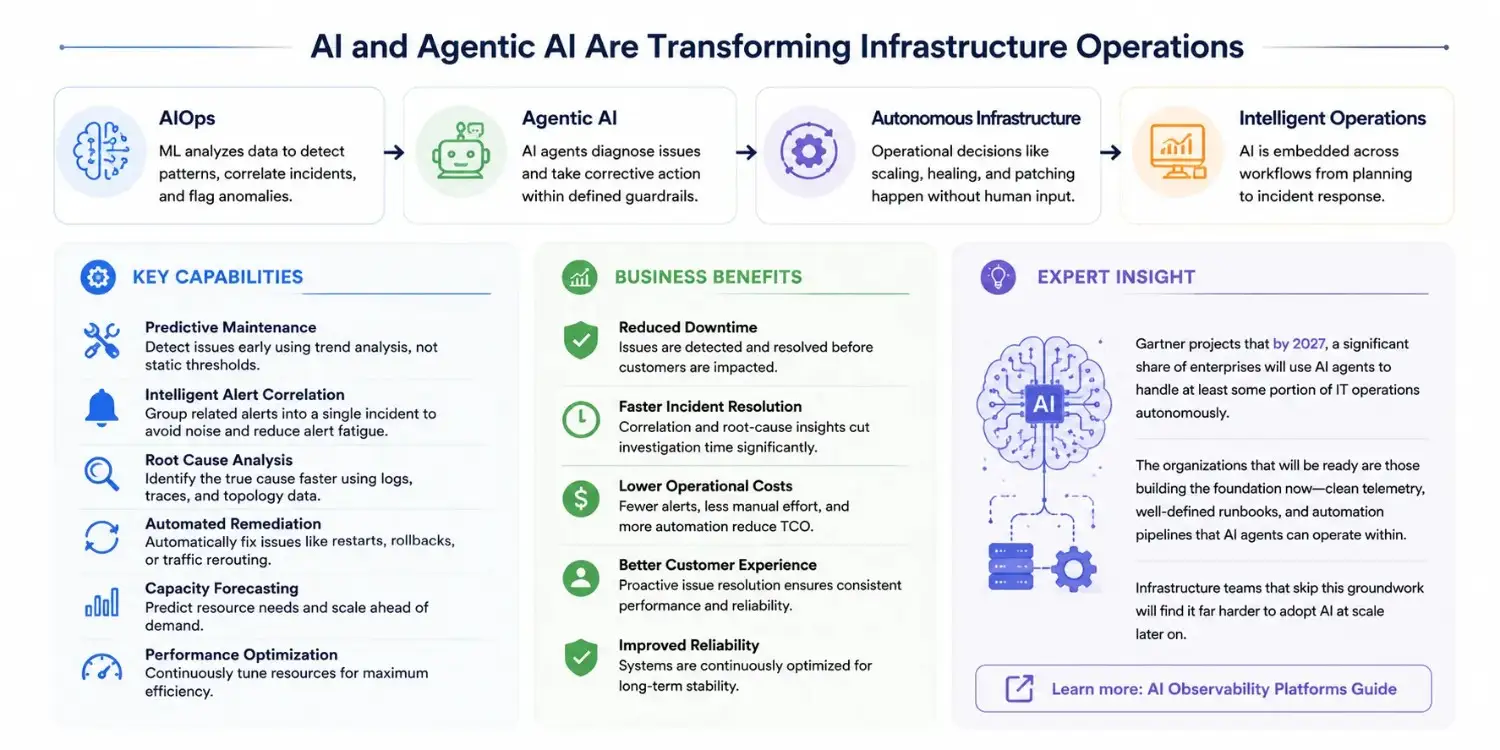
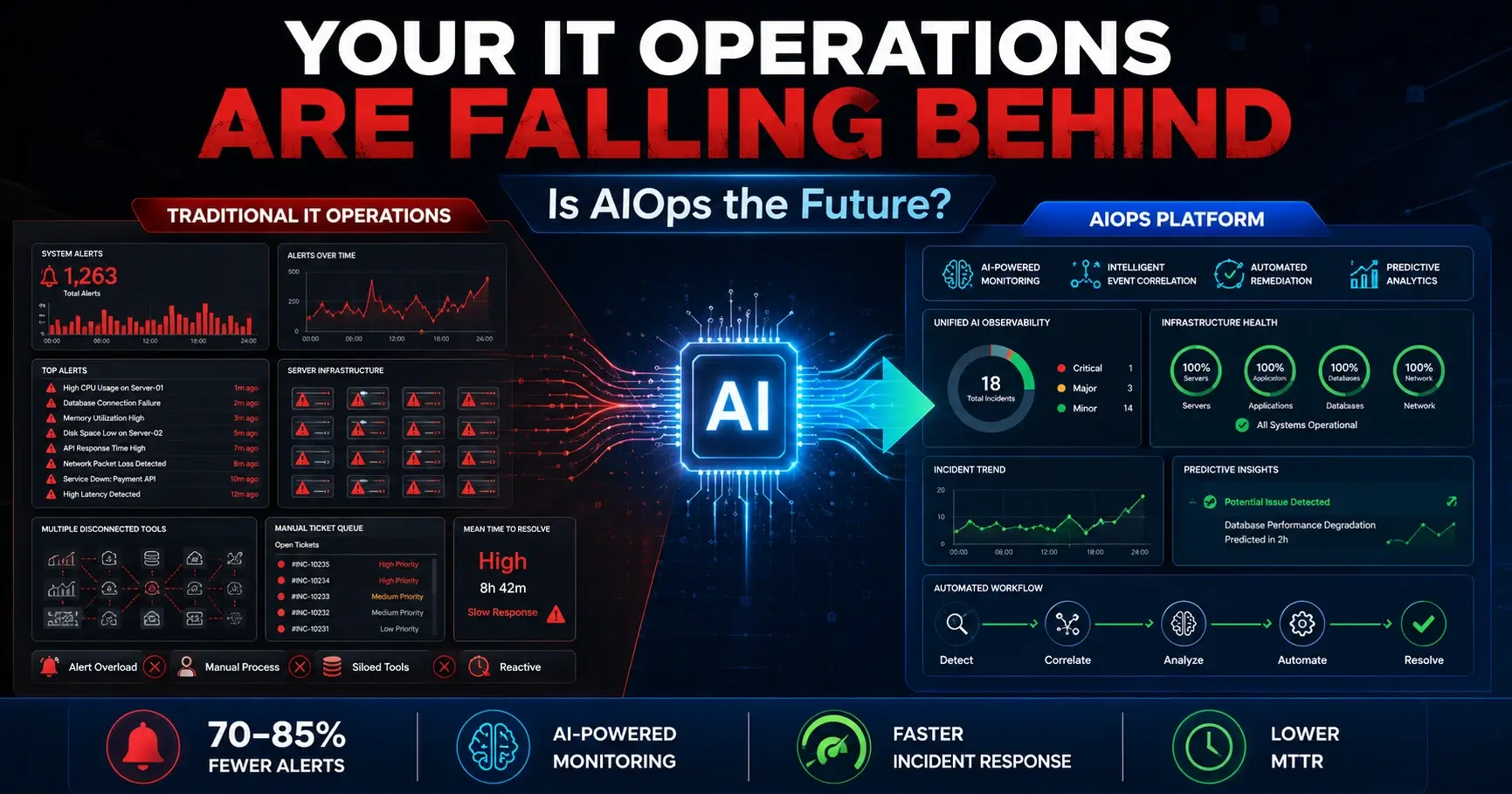
    AI-driven infrastructure management means using machine learning and automated agents to run infrastructure operations that used to require a human watching a dashboard. It covers a handful of related but distinct concepts that get used interchangeably, which causes confusion:

    • AIOps applies machine learning to operational data — logs, metrics, traces, alerts — to detect patterns, correlate incidents, and flag anomalies before they escalate.
    • Agentic AI goes a step further: instead of just flagging a problem, an AI agent can diagnose it and take corrective action on its own, within guardrails a human has defined.
    • Autonomous infrastructure is the end state where a meaningful share of operational decisions — scaling, healing, patching — happen without a person in the loop for each one.
    • Intelligent operations is the umbrella term for infrastructure teams that have layered AI into their day-to-day workflows, from capacity planning to incident response.

    Key Capabilities

    The practical capabilities enterprises are deploying today include:

    • Predictive maintenance — flagging hardware or service degradation before it causes an outage, based on trend analysis rather than static thresholds.
    • Intelligent alert correlation — collapsing hundreds of related alerts from one root cause into a single actionable incident, instead of paging five different teams for the same underlying issue.
    • Root cause analysis — using pattern matching across logs, traces, and topology data to point directly at the failing component rather than making engineers hunt for it.
    • Automated remediation — restarting failed services, rolling back bad deployments, or rerouting traffic without waiting on a human to approve each step.
    • Capacity forecasting — predicting resource needs based on historical and seasonal patterns, so scaling happens ahead of demand instead of in a panic during it.
    • Performance optimization — continuously tuning resource allocation instead of relying on a quarterly review to catch inefficiencies.

    Business Benefits

    None of this matters if it doesn't translate into outcomes leadership actually cares about:

    • Reduced downtime, because problems get caught and often fixed before customers notice.
    • Faster incident resolution, since correlation and root-cause tooling cut the investigation time that used to eat up most of an incident.
    • Lower operational costs, driven by fewer 3 a.m. pages and less time spent on repetitive troubleshooting.
    • A better customer experience, since performance issues get addressed proactively instead of after complaints roll in.
    • Improved reliability overall, as systems get tuned continuously rather than in periodic bursts.

    Expert Insight

    Gartner has projected that by 2027, a significant share of enterprises will use AI agents to handle at least some portion of IT operations autonomously — a sharp jump from the largely manual or semi-automated processes most teams run today. The direction of travel is clear even if exact adoption numbers vary by report and by year.

    What that means practically: infrastructure teams shouldn't wait for a mature, plug-and-play agentic platform to show up before getting started. The organizations that will be ready when autonomous operations hit the mainstream are the ones building the underlying discipline now — clean telemetry, well-defined runbooks, and automation pipelines that an AI agent could eventually operate within. Teams that skip that groundwork will find themselves retrofitting AI onto infrastructure that was never designed to be observed or automated in the first place, which is a much harder problem to solve after the fact.

    For a closer look at how predictive analytics and anomaly detection fit into a modern operations stack, see our guide to AI observability platforms

    AI Infrastructure Operations

    Infrastructure Automation and Self-Healing Systems Become the New Standard

    Why Manual Infrastructure Management No Longer Works

    Manual infrastructure management assumes a level of scale and simplicity that most enterprises left behind years ago. Four factors made the old approach obsolete:

    Scale. An enterprise running thousands of containers across dozens of services can't be managed by someone clicking through a console. The volume alone rules it out.

    Complexity. Modern architectures involve service meshes, multiple databases, event queues, and API gateways all interacting in ways that are hard to reason about manually, let alone troubleshoot under pressure.

    Human error. Manual configuration changes are still one of the leading causes of outages. A single mistyped value in a firewall rule or a missed step in a deployment checklist can take down a production system.

    Multi-cloud environments. Managing infrastructure across AWS, Azure, and Google Cloud by hand means learning three different consoles, three different APIs, and three different sets of quirks — and doing it consistently, every time, without drift.

    Infrastructure as Code (IaC)

    Infrastructure as Code treats servers, networks, and configurations as version-controlled code rather than manual clicks in a console. That shift alone eliminates a huge share of configuration drift and undocumented changes.

    The major tools in this space each solve a slightly different piece of the puzzle:

    • Terraform provisions infrastructure declaratively across almost any cloud provider, and has become close to a default choice for multi-cloud provisioning.
    • Ansible handles configuration management and application deployment, using a simpler, more procedural approach than Terraform's declarative model.
    • Pulumi lets teams define infrastructure using general-purpose programming languages like Python or TypeScript instead of a domain-specific language, which appeals to teams who want infrastructure code to live alongside application code.
    • GitOps takes IaC further by making Git the single source of truth for infrastructure state — changes get proposed as pull requests, reviewed, and automatically synced to the live environment.

    Policy-as-Code

    Policy-as-code applies the same version-controlled, automated approach to governance and compliance rules. Instead of a manual audit checklist, policies get written as code and enforced automatically:

    • Compliance automation checks every infrastructure change against regulatory requirements before it ever gets deployed.
    • Governance rules — naming conventions, tagging standards, approved regions — get enforced at the pipeline level instead of relying on developers to remember them.
    • Security automation blocks non-compliant resources (an unencrypted storage bucket, an overly permissive security group) from being created in the first place, rather than catching them in a quarterly scan.

    Self-Healing Infrastructure

    Self-healing infrastructure takes automation from "provision it correctly" to "keep it running correctly, without a human." Core mechanisms include:

    • Auto remediation — detecting a failed health check and automatically restarting or replacing the affected component.
    • Service recovery — rerouting traffic away from unhealthy instances while replacements spin up.
    • Automated patching — applying security patches on a schedule, tested and rolled out without manual intervention for routine updates.
    • Health validation — continuously verifying that a system is actually healthy, not just technically running.
    • Rollback mechanisms — automatically reverting a deployment the moment error rates spike, before the blast radius grows.

    Teams evaluating where to start should look at infrastructure automation services that can assess current maturity and prioritize the highest-impact areas first, rather than trying to automate everything at once. A well-designed IaC and policy foundation also does double duty for secure IT infrastructure, since consistent, auditable configuration is one of the strongest defenses against misconfiguration-driven breaches.

    Hybrid Cloud Architecture Is Becoming the Default Enterprise Model

    Why Enterprises Prefer Hybrid Cloud

    The all-in, single-cloud strategy that some enterprises pursued in the early 2020s has largely given way to a hybrid approach, driven by a handful of practical needs:

    • Compliance requirements in industries like finance and healthcare often mandate that certain data stay within specific jurisdictions or on-premises entirely.
    • Cost optimization improves when workloads can run wherever pricing and performance line up best, rather than being locked into one provider's rate card.
    • Performance benefits from running latency-sensitive workloads close to users or close to on-prem systems they depend on.
    • Data sovereignty laws in the EU, and a growing list of other regions, require infrastructure decisions that a single global cloud provider can't always satisfy on its own.
    • Business continuity improves when a regional outage at one provider doesn't take down the entire business — a lesson more than one enterprise learned the hard way during major cloud outages in recent years.

    Challenges

    Hybrid cloud solves real problems, but it introduces its own set of headaches:

    • Visibility gets harder when infrastructure spans multiple providers with different monitoring tools and different data formats.
    • Governance policies have to be reimplemented, or at least re-verified, across every environment they touch.
    • Tool sprawl creeps in fast — a team can end up running five different monitoring tools, three different IaC frameworks, and duplicate security tooling across environments.
    • Security posture becomes harder to maintain consistently when identity, access, and network policies don't translate cleanly between providers.
    • Operational complexity compounds because troubleshooting an issue might mean correlating data across systems that were never designed to talk to each other.

    Best Practices

    The enterprises managing hybrid cloud well tend to converge on a few shared practices:

    • Unified management platforms that give a single pane of glass across environments, instead of context-switching between provider consoles.
    • Cloud governance frameworks that define policy once and enforce it everywhere, rather than maintaining separate rulebooks per environment.
    • Standardized operations — the same deployment pipeline, the same incident process, the same tagging convention, regardless of which cloud a workload lands on.
    • Centralized control planes that let teams provision, monitor, and secure resources across providers from one place.

    According to IDC's cloud research, a large majority of enterprises now operate multi-cloud environments by design rather than by accident — a marked shift from a few years ago, when multi-cloud was often the unplanned result of shadow IT and mergers rather than a deliberate architecture decision.

    For organizations navigating this shift, our breakdown of hybrid cloud architecture covers design patterns in more depth, and our piece on managing cloud infrastructure at scale looks at how a Fortune 500 cloud strategy typically evolves from single-cloud to hybrid over a multi-year period.

    FinOps Is Driving Smarter Infrastructure Investments

    What Is FinOps?

    FinOps is the discipline of bringing financial accountability to cloud spending — treating infrastructure cost the way an organization treats any other significant operating expense, with visibility, ownership, and continuous optimization instead of an annual budget review. It rests on a few pillars:

    • Cost visibility — knowing exactly what's being spent, by which team, on which workload, in near real time rather than discovering it on next month's invoice.
    • Accountability — making engineering teams, not just finance, responsible for the cost impact of their architectural decisions.
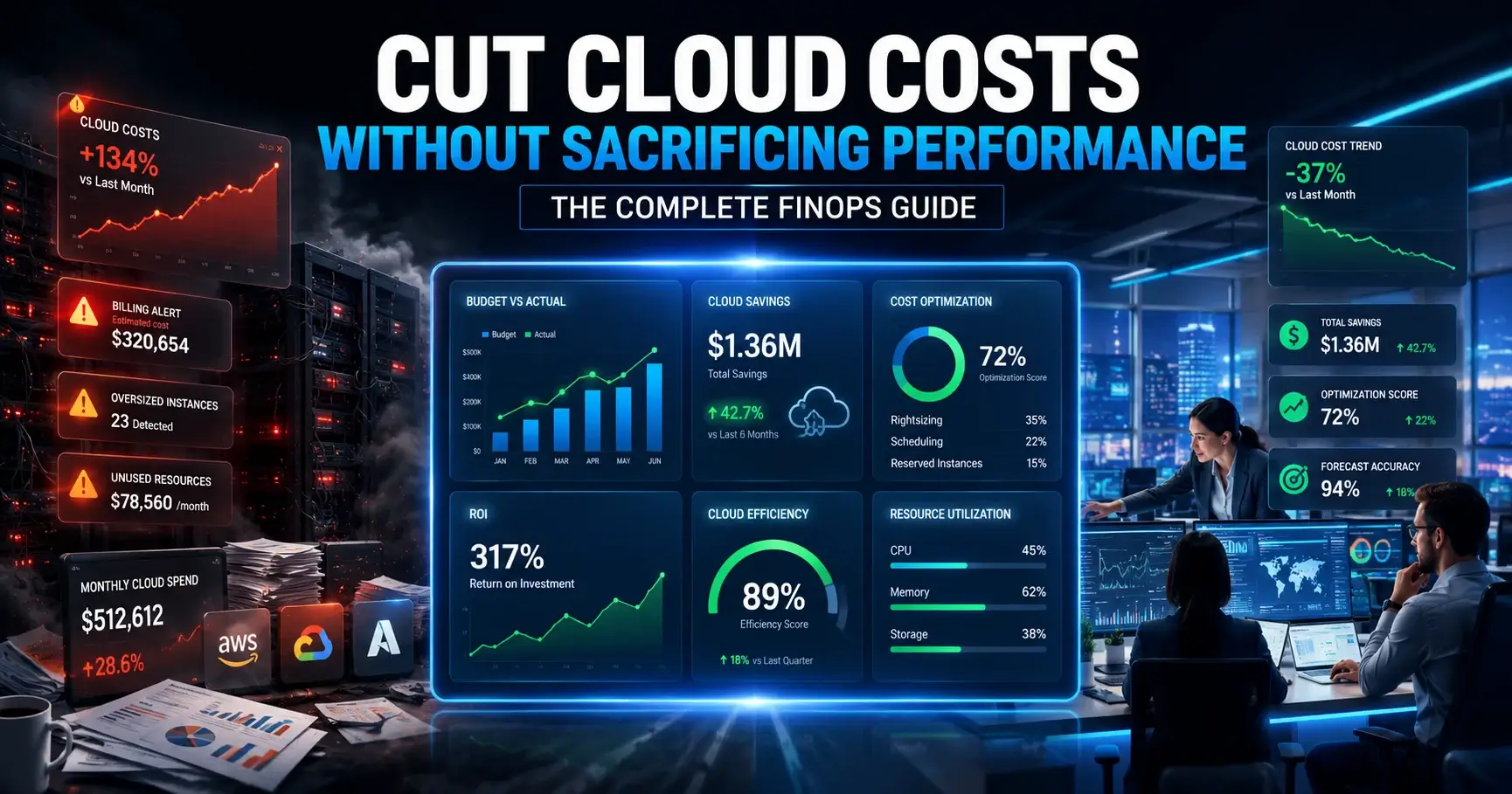
    • Optimization — continuously identifying waste (idle resources, oversized instances, forgotten test environments) rather than treating cost-cutting as a one-time project.
    • Business alignment — connecting infrastructure spend to the business value it produces, so cost conversations happen in terms leadership actually cares about.

    Infrastructure Cost Optimization

    Practically, FinOps programs focus on a recurring set of levers:

    • Resource rightsizing — matching instance types and storage tiers to actual usage patterns instead of the "just in case" oversizing that's common after a migration.
    • Reserved instances and savings plans — committing to predictable workloads in exchange for meaningfully lower rates, while keeping burst capacity on-demand.
    • Cost monitoring — real-time dashboards and anomaly alerts that catch a runaway bill before it becomes a monthly surprise.
    • Capacity planning — forecasting future needs based on business growth, not just extrapolating last month's usage.

    Sustainability and Green IT

    Cost optimization and sustainability turn out to overlap more than most teams expect, since idle or oversized infrastructure wastes both money and energy:

    • Carbon reduction goals are increasingly tied to infrastructure decisions, particularly for enterprises reporting under ESG frameworks.
    • Efficient infrastructure design — right-sizing, workload consolidation, and choosing energy-efficient regions — cuts both cost and environmental impact at the same time.
    • Energy optimization at the data center level is becoming a genuine selection criterion when enterprises choose cloud regions or colocation providers.

    The Flexera 2025 State of the Cloud Report puts a fine point on this: managing cloud costs has been the top challenge for cloud decision-makers for nine consecutive years, which says less about any single technical failure and more about how much harder cost management gets as environments scale and diversify. For a deeper walkthrough of the operating model, see our guide to the FinOps framework.

    Optimize your IT infrastructure

    Edge Computing Is Expanding Infrastructure Management Beyond Data Centers

    Why Edge Computing Matters

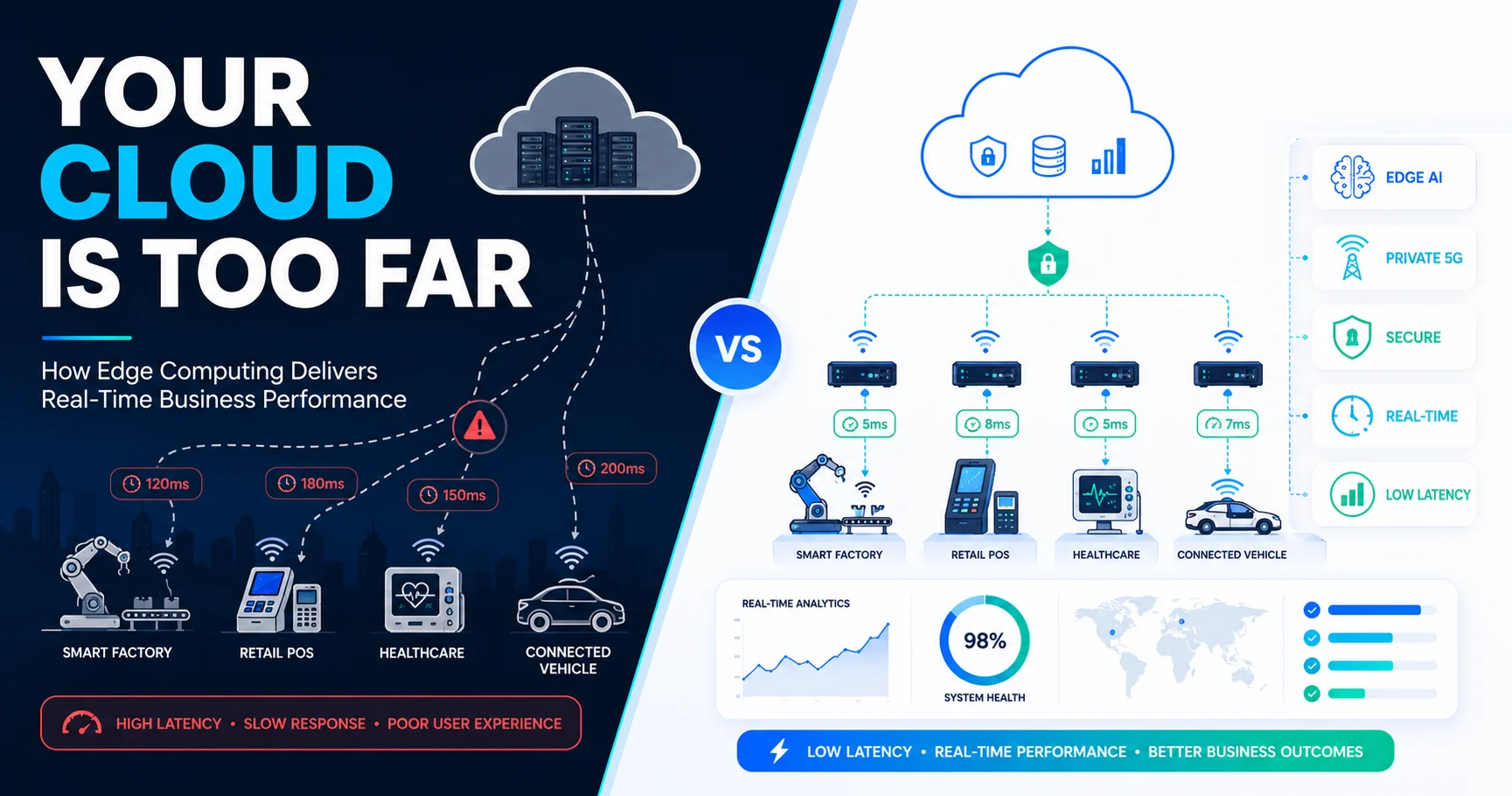
    Edge computing pushes processing power closer to where data gets generated, rather than routing everything back to a centralized data center or cloud region. That matters most in industries where latency, bandwidth, or connectivity constraints make the round trip impractical:

    • Manufacturing relies on edge devices for real-time quality control and equipment monitoring on the factory floor, where a delay of even a few hundred milliseconds can mean a defective batch making it downstream.
    • Logistics companies use edge infrastructure to track fleets and manage warehouse automation in locations with unreliable connectivity.
    • Smart cities run traffic systems, public safety sensors, and utility grids that need local processing to function reliably regardless of network conditions.
    • Healthcare uses edge computing for real-time patient monitoring and diagnostic equipment, where latency isn't just an inconvenience — it can be a safety issue.
    • Retail deploys edge infrastructure for in-store analytics, inventory tracking, and point-of-sale systems that need to keep working even if the connection to central systems drops.

    Edge Infrastructure Challenges

    Edge environments introduce a different set of operational problems than centralized infrastructure:

    • Device management at scale — some enterprises are managing thousands of edge nodes spread across hundreds of physical locations.
    • Remote monitoring without the luxury of someone physically nearby to check a device that's stopped responding.
    • Security gets harder when devices sit outside the traditional network perimeter, often in physically accessible locations.
    • Connectivity can't be assumed to be constant or reliable, unlike a data center with redundant network links.
    • Software updates need to roll out reliably to devices that might be offline, low-bandwidth, or geographically scattered.

    Modern Edge Management

    The enterprises managing edge infrastructure well share a few common approaches:

    • Unified control — managing edge devices through the same platform used for cloud and data center infrastructure, rather than a separate siloed tool.
    • Remote automation — pushing updates, configuration changes, and patches without requiring a technician on-site.
    • Edge governance — applying the same policy-as-code principles used in the cloud to edge deployments.
    • AI-powered edge operations — using lightweight, on-device models for anomaly detection when sending data back to a central system for analysis simply isn't fast enough.

    Our edge computing strategy guide covers deployment patterns for organizations building out their first large-scale edge footprint.

    Observability Is Replacing Traditional Infrastructure Monitoring

    Monitoring vs. Observability

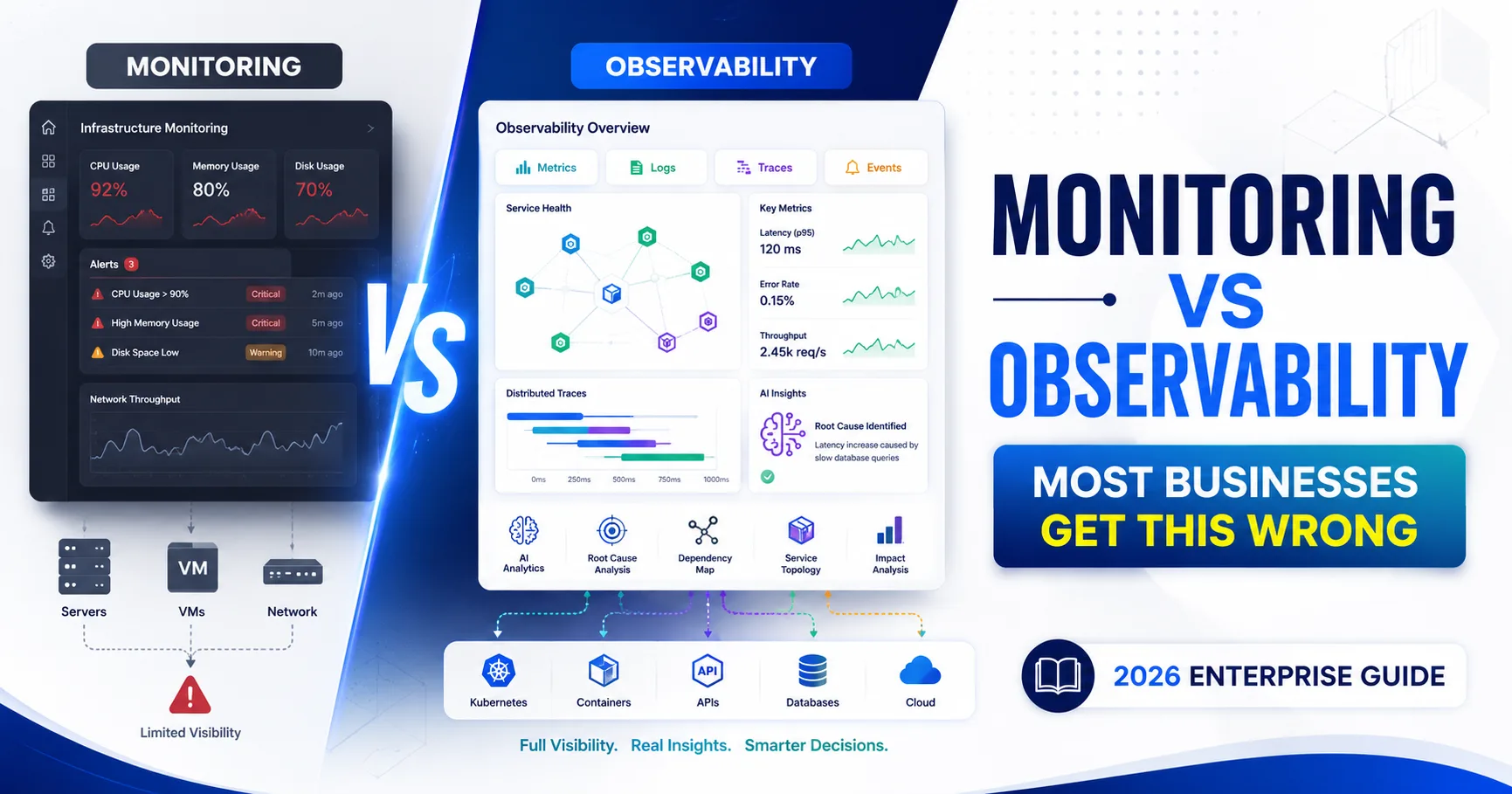
    Traditional monitoring tells you that something is wrong. Observability tells you why. That distinction matters more than it sounds like it should, because knowing a service's error rate spiked doesn't help much if you can't trace it back to the specific deployment, dependency, or database query that caused it.

    Capability

    Traditional Monitoring

    Observability

    Metrics

    Predefined dashboards, fixed thresholds

    Explorable, correlated with other signals

    Logs

    Searched manually, siloed by system

    Structured, correlated across services

    Events

    Alerts on known failure conditions

    Correlated into a single incident timeline

    Traces

    Rarely available

    Distributed tracing across services

    Business context

    Absent

    Tied to actual user and revenue impact

    Core Components

    Observability is typically built on four data types working together:

    • Metrics — the numeric time-series data (CPU usage, request latency, error rates) that forms the backbone of any monitoring practice.
    • Logs — detailed event records that provide the specific context metrics alone can't capture.
    • Distributed tracing — following a single request as it moves across dozens of microservices, which is often the only way to find where in a complex chain something actually failed.
    • Event correlation — automatically linking related signals from different systems into one coherent incident, instead of leaving an engineer to manually piece it together across five browser tabs.

    Benefits

    • Faster troubleshooting, since engineers can trace a problem to its root cause instead of guessing based on symptoms.
    • Better user experience, because performance issues that don't trigger a hard failure — but still degrade the experience — actually get caught.
    • Reduced MTTR (mean time to resolution), often the single most-cited metric when enterprises justify observability investment to leadership.
    • AI-powered diagnostics, where machine learning models trained on historical incident data can suggest a likely root cause before a human even opens the dashboard.

    For teams building or evaluating their observability stack, see our comparison of observability and monitoring tools, and our overview of what to look for in an AI observability platform.

    GPU Orchestration Is Emerging as a Critical Infrastructure Capability

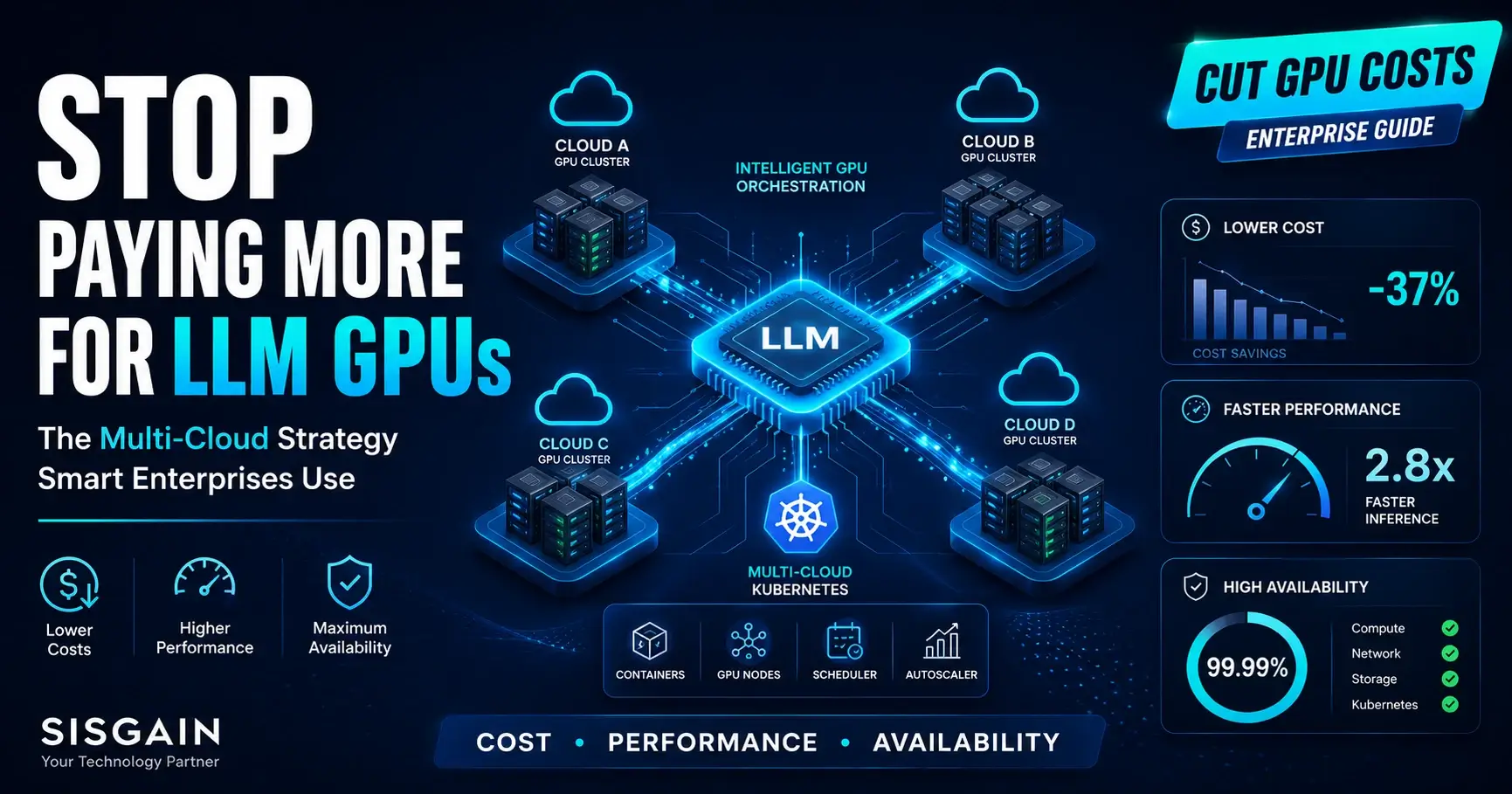
    AI workloads have created an entirely new category of infrastructure demand, and GPU orchestration sits right at the center of it. Training or serving large language models requires coordinating expensive, often scarce GPU resources across teams and workloads — and doing it efficiently, since idle GPU time is one of the most expensive kinds of waste an infrastructure team can have on its books.

    The core capabilities enterprises are building out include:

    • AI workload scheduling that allocates GPU capacity based on job priority and actual resource needs, rather than first-come-first-served.
    • LLM deployment infrastructure that can scale inference capacity up during peak demand and back down when it isn't needed, since running GPUs at idle is expensive in a way CPU idle time never was.
    • GPU scheduling that maximizes utilization across teams sharing a limited pool of hardware, which matters enormously given how constrained GPU supply has been.
    • Resource optimization techniques like model quantization and batching that stretch existing GPU capacity further instead of just buying more hardware.
    • Kubernetes integration — most enterprises are extending their existing container orchestration platforms to handle GPU scheduling rather than standing up entirely separate infrastructure.
    • Enterprise AI clusters — dedicated, often hybrid, infrastructure purpose-built for training and serving models at scale.

    This is one of the fastest-moving areas in infrastructure management right now, largely because a lot of enterprises are building this capability for the first time and learning on the job. Teams that treat GPU orchestration as a core infrastructure discipline — with the same rigor applied to cost management, monitoring, and automation as any other resource — tend to get meaningfully more value out of their AI investments than teams that bolt GPU management onto existing processes as an afterthought.

    Platform Engineering and SRE Are Reshaping Infrastructure Teams

    Two organizational models have emerged as the dominant way enterprises structure infrastructure teams for this level of complexity.

    Internal Developer Platforms (IDPs) give development teams self-service access to infrastructure — spinning up a new environment, provisioning a database, or deploying a service — without filing a ticket and waiting on the infrastructure team. The platform team's job shifts from handling individual requests to building and maintaining the golden paths that make self-service safe and consistent.

    Site Reliability Engineering (SRE) principles bring engineering discipline to operations, built around a few core concepts:

    • Error budgets define how much unreliability is acceptable before feature work pauses in favor of reliability work — a concrete, numeric way to balance speed against stability instead of arguing about it in the abstract.
    • SLAs (Service Level Agreements) are the external commitments made to customers or business stakeholders.
    • SLOs (Service Level Objectives) are the internal targets a team sets to make sure it actually hits those SLAs, usually with some margin.
    • Reliability engineering treats operational excellence as an engineering problem to be solved with code and process, not just a matter of hiring more on-call staff.

    The broader trend here is DevOps evolving into something more structured. DevOps proved that developers and operations shouldn't work in silos; platform engineering and SRE are the next step, giving that collaboration a defined structure, clear ownership, and measurable targets instead of leaving it as a loosely defined cultural aspiration.

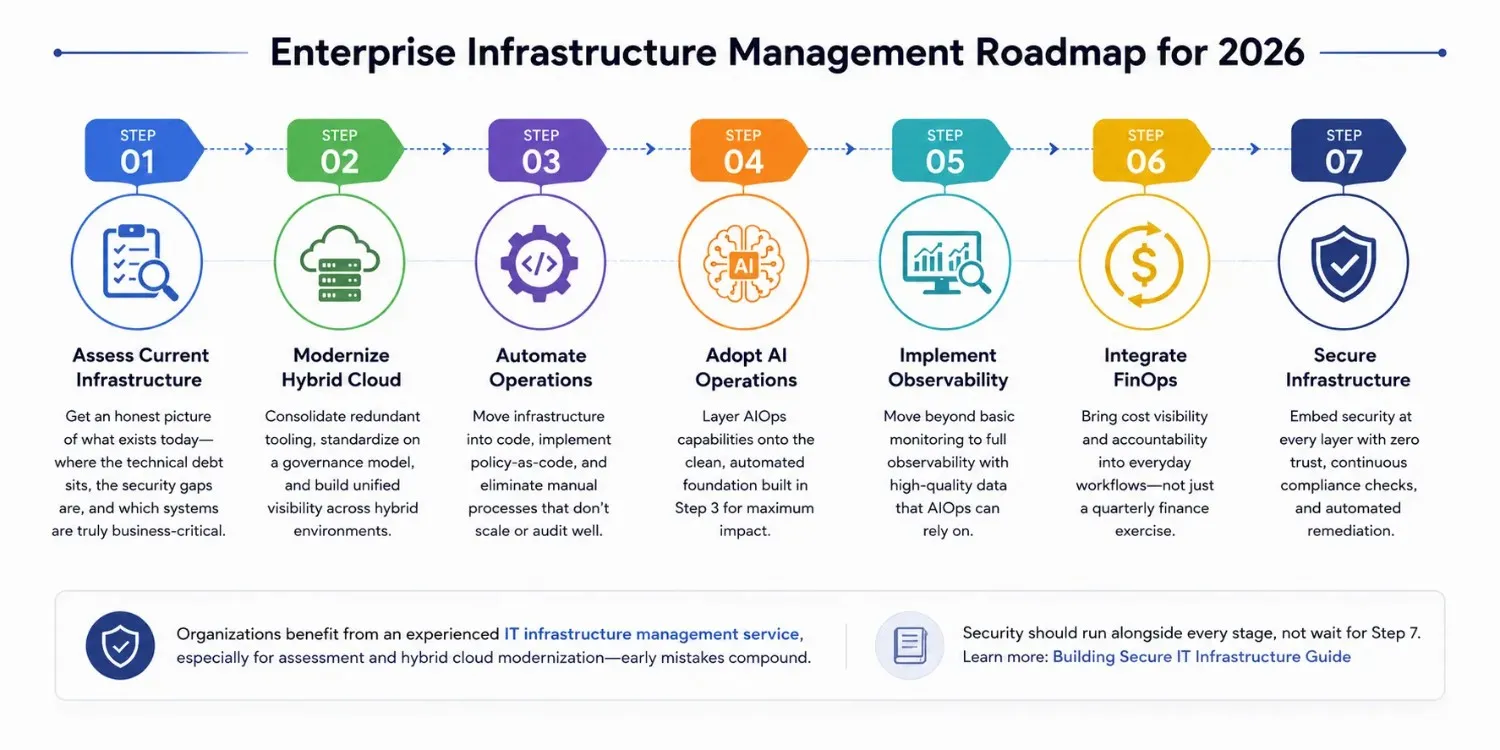
    Enterprise Infrastructure Management Roadmap for 2026

    Modernization rarely works as a single big-bang project. The enterprises that pull it off tend to move through roughly the same sequence, adapted to their starting point.

    Step 1: Assess Current Infrastructure 

    Get an honest picture of what exists today — where the technical debt sits, where the security gaps are, and which systems are actually business-critical versus just old.

    Step 2: Modernize Hybrid Cloud

    Consolidate redundant tooling, standardize on a governance model, and build the unified visibility that hybrid environments need to be manageable at all.

    Step 3: Automate Operations

    Move infrastructure into code, implement policy-as-code, and start eliminating the manual processes that don't scale and don't hold up under audit.

    Step 4: Adopt AI Operations

    Layer AIOps capabilities onto the clean, automated foundation built in Step 3 — this only works well once the underlying telemetry and automation are solid.

    Step 5: Implement Observability

    Move past basic monitoring to full observability, so the AI operations layered in above actually has the data quality it needs to be useful.

    Step 6: Integrate FinOps

    Bring cost visibility and accountability into the same workflows as everything else, rather than treating it as a separate quarterly finance exercise.

    Step 7: Secure Infrastructure

    Bake security into every layer above rather than treating it as a final gate — zero trust principles, continuous compliance checks, and automated remediation for security findings.

    Organizations working through this sequence often benefit from an outside IT infrastructure management service that's done this migration before, particularly for the assessment and hybrid cloud modernization stages, where mistakes made early tend to compound through every later step. Security should run alongside every stage rather than waiting for Step 7 in practice — see our guide to building secure IT infrastructure from the ground up.
    Infrastructure Roadmap 2026

    Common Infrastructure Management Challenges

    Even with all this progress, most enterprises are still wrestling with a familiar set of problems:

    • Legacy infrastructure that's too business-critical to rip out but too outdated to integrate cleanly with modern tooling.
    • Rising cloud costs that keep outpacing the budgets set to contain them, often because of workloads that scaled faster than anyone predicted.
    • Operational silos between infrastructure, security, and development teams that slow down every cross-functional decision.
    • A persistent skills shortage, particularly for roles that combine cloud, security, and AI operations expertise — that combination is rare and expensive.
    • Security threats that keep growing in sophistication, from ransomware to increasingly convincing social engineering.
    • Compliance requirements that multiply every time an enterprise enters a new market or industry vertical.
    • Vendor lock-in risk, especially for enterprises that built deeply on a single cloud provider's proprietary services early on.
    • AI workload management — a genuinely new problem for most teams, who are learning to manage GPU-heavy, cost-intensive workloads with very different characteristics than traditional applications.

    Best Practices for Modern Infrastructure Leaders

    1. Standardize Infrastructure as Code across every environment, so configuration drift stops being a recurring incident cause.
    2. Adopt Zero Trust principles — verify every access request explicitly instead of trusting anything inside the network perimeter by default.
    3. Implement centralized observability before layering AI operations on top of it; AI is only as good as the data it's given.
    4. Use predictive AI operations to shift from reactive firefighting to proactive capacity and reliability planning.
    5. Align infrastructure KPIs with business outcomes — track things like revenue impact of downtime, not just uptime percentages in isolation.
    6. Build platform engineering capabilities so developers can self-serve safely, freeing infrastructure teams to focus on higher-value work.
    7. Measure FinOps KPIs consistently — cost per workload, unit economics, and waste percentage, reviewed on a recurring cadence rather than annually.
    8. Continuously optimize hybrid cloud environments, since a setup that made sense a year ago rarely still fits today's workload mix.
    9. Treat security as a design constraint, not a checklist applied after the architecture is already decided.
    10. Invest in skills development, not just tooling — the best automation platform still needs people who understand what it's automating.
    11. Document runbooks and incident processes before automating them, since automating an undocumented process usually just automates the confusion.
    12. Review vendor and tooling sprawl at least annually; consolidation often saves more than any single point optimization.

    Industry Use Cases

    Manufacturing — Smart factories run edge infrastructure for real-time equipment monitoring and quality control, paired with predictive maintenance models that flag equipment issues before they cause costly downtime on the production line.

    Healthcare — Mission-critical infrastructure has to meet uptime standards that most industries never have to think about, since a systems outage in a hospital setting can directly affect patient care rather than just business operations.

    Banking — High availability is non-negotiable, with infrastructure architected around multi-region failover and continuous compliance monitoring, given how tightly regulated financial data handling is.

    Retail — Omnichannel infrastructure has to keep in-store, online, and mobile experiences in sync, with edge computing increasingly handling in-store analytics and inventory management in near real time.

    Government — Secure digital infrastructure is central to public sector modernization efforts, with a heavy emphasis on compliance frameworks and data sovereignty that often exceed private-sector requirements.

    SaaS — Cloud-native operations are the default here, with infrastructure teams focused on multi-tenancy, elastic scaling, and driving down the cost per customer as the business grows.

    Future Outlook Beyond 2026

    A few directions look set to define the next phase of infrastructure management:

    Autonomous infrastructure will keep expanding as AI agents take on more operational decisions independently, moving from today's recommend-and-approve model toward genuine autonomy in defined, lower-risk domains first.

    Digital twins — virtual replicas of physical infrastructure — will let teams simulate changes and test failure scenarios before touching production systems, reducing the risk of change management in complex environments.

    Quantum-ready infrastructure is still early, but enterprises in security-sensitive industries are starting to plan for post-quantum cryptography standards well ahead of when they'll actually be required.

    Sustainable AI data centers will keep getting more attention as AI workloads drive up energy consumption industry-wide, pushing efficiency from a nice-to-have into a genuine design requirement.

    Hyperautomation will extend automation beyond infrastructure operations into the broader business processes infrastructure supports, closing the gap between IT automation and business process automation.

    Intelligent infrastructure platforms will likely consolidate today's fragmented tool landscape — IaC, observability, FinOps, security — into more unified platforms, reducing the tool sprawl that's currently one of the biggest operational headaches enterprises report.

    Conclusion

    Infrastructure management has moved well past its old job description of keeping servers online. It's now an intelligent, AI-assisted capability that directly shapes how resilient, secure, and cost-efficient a business can be — and increasingly, how fast it can move on AI initiatives that depend entirely on the infrastructure underneath them.

    The enterprises pulling ahead aren't necessarily the ones with the biggest budgets. They're the ones treating automation, observability, hybrid cloud governance, and FinOps as connected parts of a single strategy instead of separate initiatives run by separate teams. That's the difference between infrastructure that merely supports the business and infrastructure that actively drives it forward.

    Infrastructure Assessment

    This article was written and reviewed by an enterprise infrastructure specialist with hands-on experience across cloud migration, DevOps transformation, and large-scale IT operations. Statistics referenced include findings from Flexera's State of the Cloud Report and industry analysis from Gartner and IDC; where forecasts are cited, they are distinguished from current, measured adoption.

    Frequently Asked Questions (FAQs)

    Infrastructure management is the practice of provisioning, monitoring, securing, and optimizing the servers, networks, cloud resources, and edge devices that support an organization's applications and services.
    The leading trends are AI-driven operations (AIOps and agentic AI), infrastructure automation and self-healing systems, hybrid and multi-cloud architectures, observability, FinOps, edge computing, and GPU orchestration for AI workloads.
    AI enables predictive maintenance, automated root cause analysis, and self-healing remediation, shifting infrastructure teams from reactive troubleshooting toward proactive, and increasingly autonomous, operations.
    Observability combines metrics, logs, traces, and event correlation to explain why a system failed, not just that it failed — which traditional monitoring, built around fixed dashboards and thresholds, was never designed to do
    FinOps is a discipline that brings financial accountability and continuous optimization to cloud spending, giving engineering and finance teams shared visibility into infrastructure costs.
    Hybrid cloud lets enterprises meet compliance and data sovereignty requirements, optimize costs across providers, and maintain business continuity if one cloud region or provider experiences an outage.
    Self-healing infrastructure automatically detects and remediates issues — restarting failed services, rolling back bad deployments, rerouting traffic — without requiring manual intervention for routine failures.
    Edge computing extends infrastructure management beyond centralized data centers to distributed devices in factories, stores, and other remote locations, introducing new challenges around device management, security, and connectivity.
    Infrastructure as Code (IaC) is the practice of provisioning and managing infrastructure through version-controlled code rather than manual configuration, using tools like Terraform, Ansible, and Pulumi.
    Organizations typically modernize by assessing current infrastructure, consolidating hybrid cloud environments, automating operations, adopting AI-driven operations, implementing observability, integrating FinOps, and embedding security throughout the process rather than bolting it on at the end.

    Director of Delivery & Operations specializing in cloud infrastructure, application development, cybersecurity, outsourcing, quality assurance, and support services.

    View full profile

    Start Build Your
    Next Digital Solution?

    Let’s build scalable, future-ready digital solutions tailored to your business goals. Connect with our experienced technology consultants to discuss your vision, strategy, and growth opportunities — with zero obligation and complete transparency.

    • Free 60-minute digital transformation consultation
    • Detailed project roadmap & cost estimate within 48 hours
    • NDA signed before any business discussion begins
    • Direct access to senior strategists & developers
    • Flexible engagement models tailored to your business
    • Post-launch support & long-term technology partnership

    Start Your Project

    Get a free consultation and cost estimate for your digital solution

    Connect with our team