























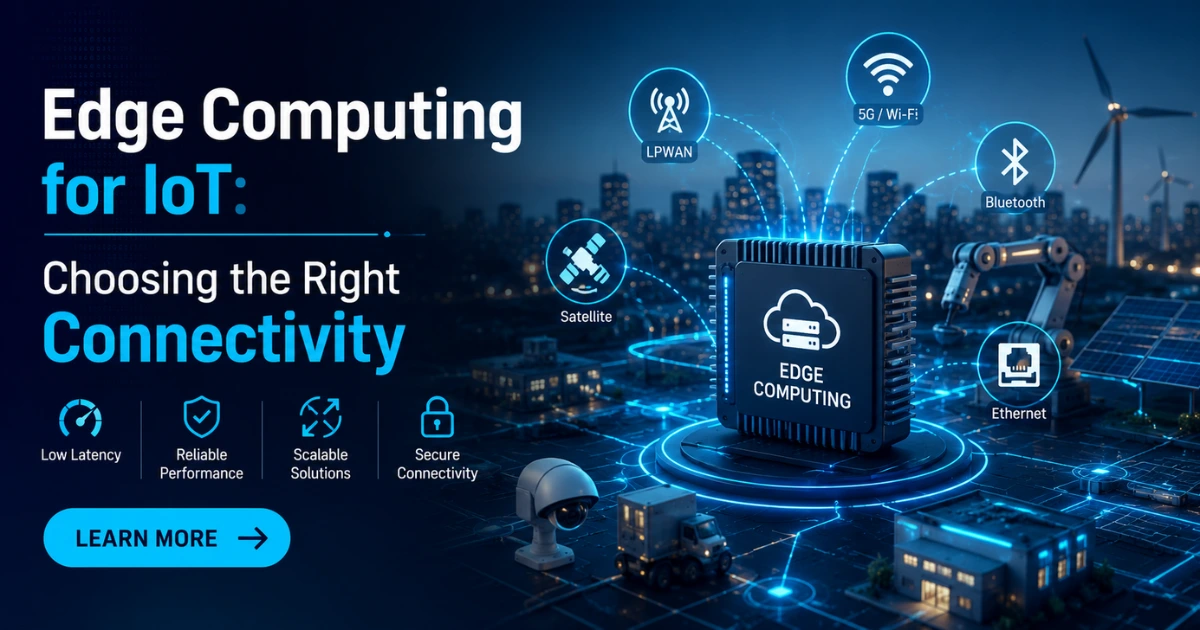
Edge Computing for IoT: Choosing the Right Connectivity
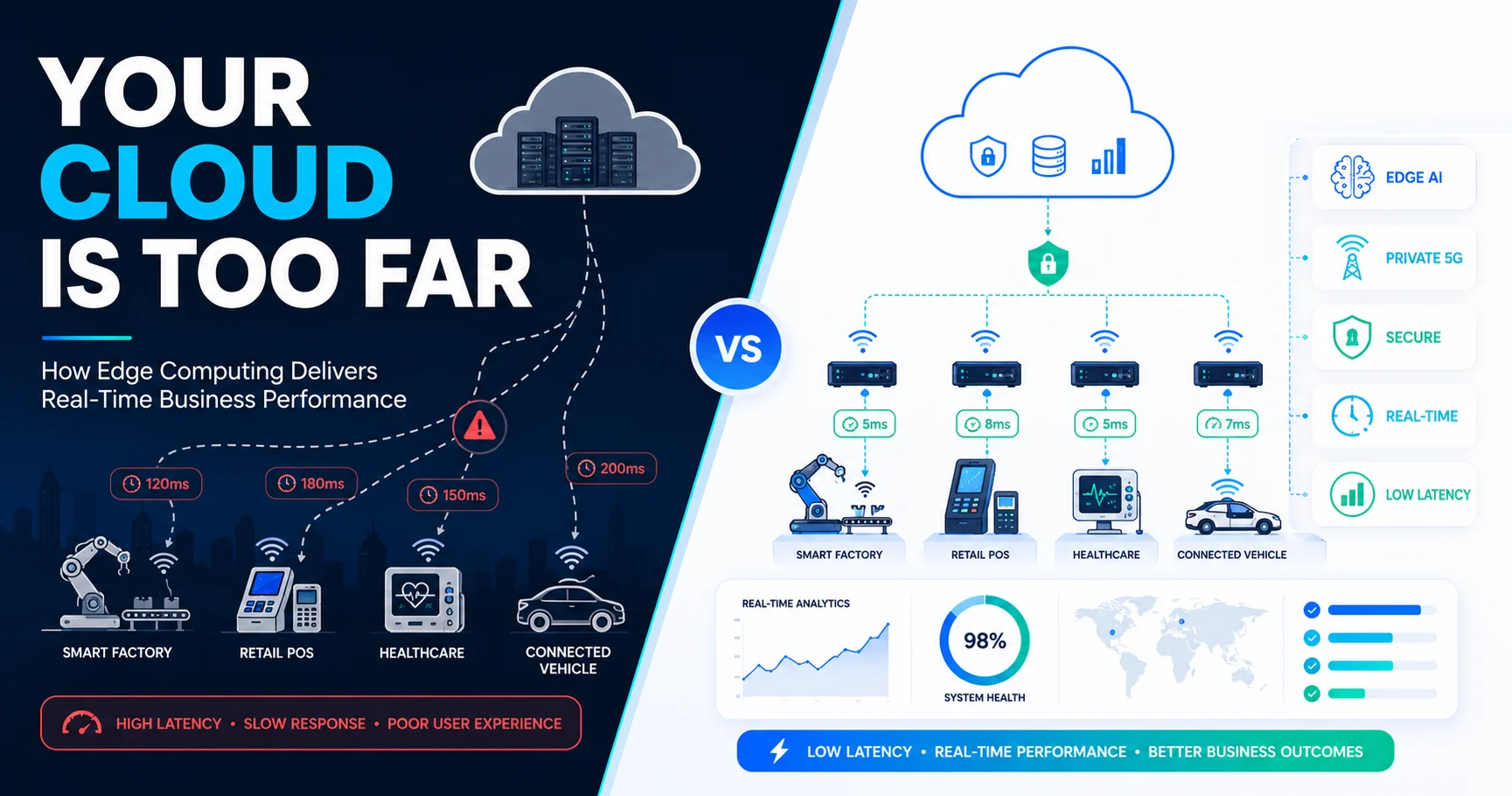
Connected devices have moved from novelty to infrastructure. In the United States alone, homes, factories, farms, hospitals, and city streets are filling up with sensors, meters, cameras, and controllers, each one generating a steady stream of data. For years, the default architecture was simple: collect data at the edge, send it to the cloud, and let centralized servers do the thinking. That model is starting to buckle under its own weight. Cloud-only IoT architectures were never designed for millions of devices transmitting continuously. As device counts climb, so do latency, bandwidth costs, and the risk of a single point of failure taking an entire deployment offline. A factory robot that has to wait 300 milliseconds for a cloud round-trip isn't "smart" — it's slow. A soil sensor that burns through its battery pushing raw data every few seconds isn't sustainable in a field with no power outlet for miles. This is where edge computing earns its place. By processing data closer to where it's generated — on a local gateway, a device itself, or a nearby micro data center — edge computing cuts latency, reduces the volume of data that needs to travel over a network, and keeps systems running even when connectivity drops. But edge computing is only half the equation. The other half, and the part organizations most often get wrong, is connectivity. Choosing between Wi-Fi, Wi-Fi HaLow, LTE-M, NB-IoT, LoRaWAN, and 5G isn't a technical afterthought — it's a business decision that determines battery life, operating cost, scalability, and how well a deployment performs three years from now. Pick the wrong network and you'll either overpay for capability you don't need or underdeliver on the performance your application demands. This guide walks through how edge computing works, breaks down the major IoT connectivity options available in the U.S. market, and gives you a practical framework for matching the right network to the right device — whether you're deploying a handful of sensors or planning an End-to-End IoT Application Development rollout across an entire facility. Quick Answer: What Is the Best Connectivity for Edge Computing in IoT? There is no single "best" connectivity option for edge computing — the right choice depends on the device's mobility, data volume, power budget, and latency needs. As a general rule: use Wi-Fi for high-bandwidth local deployments like cameras and smart building systems; Wi-Fi HaLow for long-range, low-power indoor sensor networks; LTE-M for mobile IoT devices such as fleet trackers and wearables that need near real-time communication; NB-IoT for static, low-data sensors like smart meters where battery life matters most; LoRaWAN for long-range, infrequent telemetry across agriculture, utilities, and smart cities; and 5G or private LTE for latency-sensitive, high-throughput industrial workloads like robotics and video analytics. Matching the network to the device's actual behavior, not to marketing claims, is what separates a scalable IoT deployment from an expensive one. Key Takeaways Edge computing reduces latency by processing data locally instead of round-tripping to the cloud. Battery-powered devices last significantly longer when they transmit selectively rather than continuously. 5G is not necessary for every IoT deployment — it solves specific problems and comes at a specific cost. LTE-M offers the best balance of mobility, real-time performance, and power efficiency for mobile IoT devices. NB-IoT is ideal for fixed, low-data sensors that prioritize battery life over speed. LoRaWAN excels in agriculture, utility monitoring, and other wide-area, low-frequency telemetry use cases. Wi-Fi HaLow extends indoor and campus coverage while using far less power than traditional Wi-Fi. Connectivity decisions should be driven by device behavior — mobility, data volume, latency tolerance — not by network marketing or hype. Hybrid edge-cloud architectures lower operational costs by keeping routine processing local and reserving the cloud for aggregation and long-term analytics. Choosing the right network from the start improves scalability, reliability, and long-term ROI. What Is Edge Computing in IoT? Edge computing is an architecture where data is processed near the point where it's generated — on the device itself, on a local gateway, or on a small server physically close to the sensors — instead of sending every reading to a centralized cloud data center first. In an IoT context, this means the "thinking" happens close to the "sensing." The core idea is straightforward: local processing plus reduced cloud dependency. Rather than treating the cloud as the only place where data becomes information, edge computing pushes filtering, analysis, and even decision-making down to the network's outer layer. The cloud is still involved, but its role shifts from doing everything to handling what benefits from centralization: long-term storage, cross-site analytics, model training, and dashboards. How Edge Computing Works A typical edge IoT architecture involves four layers working together: Sensors — the devices collecting raw data: temperature, vibration, motion, location, image frames, and so on. Edge gateway — a local hub that aggregates data from multiple sensors, applies initial processing, and manages connectivity back to the cloud. Local AI — lightweight machine learning models running on the gateway or device that can detect anomalies, classify events, or trigger actions without waiting for a cloud response. Cloud synchronization — periodic or event-driven transmission of processed, summarized, or exception data to the cloud for storage, reporting, and cross-device analytics. Diagram Suggestion: Device → Edge Gateway → AI Processing → Cloud Dashboard This layered approach means a vibration sensor on a factory motor doesn't need to send raw waveform data to the cloud every second. It can process the signal locally, recognize a pattern that indicates bearing wear, and send a single alert — saving bandwidth, battery, and cloud compute cost in one move. Why Low-Power IoT Devices Need the Right Connectivity Most IoT devices aren't plugged into a wall outlet. They run on batteries that need to last months or years, which means every radio transmission has a direct cost measured in milliamp-hours. Get the connectivity choice wrong, and you'll be sending truck rolls to replace batteries far sooner than your budget planned for. Battery constraints shape everything about how an IoT device should communicate. Continuous transmission — constantly streaming raw sensor data — is the single fastest way to drain a battery. Radios draw significantly more power when transmitting than when idle, so a device that "talks" too often will always underperform its rated battery life. This is where edge intelligence changes the equation. Local filtering means a device or gateway only transmits data that matters — a temperature reading outside a threshold, a door that opened, a tank that dropped below a set level — instead of a constant stream of routine values. Event-driven communication takes this further: the device stays silent until something worth reporting actually happens. The payoff shows up in three places: Data reduction — sending summaries or exceptions instead of raw streams can cut transmitted data by 80–95% in many sensor deployments. Bandwidth savings — less data moving over the network means lower carrier costs and less network congestion, especially in dense deployments with thousands of devices. Network resilience — devices that buffer data locally and transmit intelligently are far less disrupted by intermittent connectivity than devices dependent on constant, real-time links. Edge Computing vs Cloud Computing for IoT Neither approach replaces the other — most production IoT systems use both. But understanding where each one wins helps clarify why architecture and connectivity decisions need to be made together. Feature Edge Computing Cloud Computing Latency Low — processing happens locally, often in milliseconds Higher — depends on network round-trip time Bandwidth Lower — only relevant/processed data is transmitted Higher — often requires continuous raw data transmission Battery Life Extended — fewer, smaller transmissions Reduced — frequent large transmissions drain batteries faster Reliability High for local operations — functions during network outages Dependent on constant connectivity Offline Capability Strong — local processing continues without a live connection Limited to none — most functions halt without connectivity Operating Cost Lower ongoing data/bandwidth costs, but higher upfront hardware cost Lower upfront hardware cost, but higher recurring data and compute costs Security Reduces exposure by keeping sensitive raw data local Centralized security controls, but larger attack surface in transit Latency is often the deciding factor for time-critical applications. A robotic arm that needs to stop within milliseconds of detecting an obstruction can't wait for a cloud server halfway across the country to respond — the decision has to happen at the edge. Bandwidth and cost scale together. As device counts grow into the thousands, sending raw data to the cloud becomes both a network bottleneck and a recurring cost line item. Edge processing keeps that cost curve flatter. Reliability and offline capability matter most in environments where connectivity isn't guaranteed — rural agriculture, remote pipelines, or manufacturing floors with spotty Wi-Fi. Edge systems can continue operating, logging, and even making decisions locally, then sync once connectivity returns. Security benefits from data minimization: the less raw, sensitive data that travels over a network, the smaller the exposure if that network is compromised. Cloud computing still plays a critical role in centralized policy management and long-term monitoring, but edge computing reduces how much needs to be transmitted in the first place. Understanding the Major IoT Connectivity Options No single network technology solves every IoT challenge, and that's by design. A wearable that needs to move with a person has different requirements than a soil moisture sensor buried in a field or a robotic arm on an assembly line. Choosing connectivity means matching a technology's strengths — range, power draw, throughput, mobility support — to what the device actually needs to do. Wi-Fi & Wi-Fi HaLow Traditional Wi-Fi remains the default for high-bandwidth, short-range deployments: security cameras, smart building controls, point-of-sale systems, and anything that needs to move a lot of data over a relatively small area. It's fast, well understood, and doesn't require carrier contracts. Wi-Fi HaLow (802.11ah) is a newer variant purpose-built for IoT. It operates in a lower frequency band than standard Wi-Fi, which gives it significantly longer range and better wall penetration, while using far less power — making it a strong fit for large indoor deployments like warehouses, smart buildings, and campuses where hundreds of low-power sensors need to connect to a single access point. Advantages: high throughput (standard Wi-Fi), extended range and lower power draw (HaLow), no carrier fees, easy integration with existing IT infrastructure. Limitations: standard Wi-Fi has limited range and higher power consumption; HaLow adoption is still growing, and device/chipset availability is more limited than mainstream Wi-Fi. Ideal use cases: smart buildings, warehouses, campuses, indoor asset tracking, and any deployment where infrastructure is already Wi-Fi-enabled. LTE-M LTE-M (LTE for Machines) is a cellular IoT technology built for devices that move and need to communicate closer to real time. Because it rides on existing LTE cellular infrastructure, it offers wide, carrier-grade coverage without the need to deploy private infrastructure. It's particularly well suited to asset tracking, fleet management, and wearables — anything where the device changes location and needs to maintain a connection while doing so, including support for cellular handoff between towers. Pros: true mobility support, lower latency than NB-IoT, voice support in some implementations, strong nationwide carrier coverage in the U.S. Cons: higher power consumption than NB-IoT, ongoing carrier data costs, coverage still depends on cellular network availability in remote areas. Deployment recommendations: best for devices that move, need near real-time updates, or benefit from carrier-grade reliability — think delivery fleets, medical wearables, and mobile equipment tracking. NB-IoT Narrowband IoT (NB-IoT) trades speed and mobility for exceptional power efficiency and deep coverage, including inside buildings and underground where signals typically struggle. It's designed for devices that don't move and don't need to send much data. It's the technology of choice for smart meters, environmental monitoring stations, and utility infrastructure — static devices that need to report a small amount of data on a predictable schedule for years without a battery change. Advantages: exceptional battery life (often 5–10+ years on a single charge), strong signal penetration, lower module cost than LTE-M. Limitations: low throughput, higher latency, no support for device mobility, not suitable for real-time or time-sensitive applications. Battery performance: because NB-IoT devices typically transmit small data packets infrequently and spend most of their time in deep sleep, they consistently deliver some of the longest battery lifespans of any cellular IoT technology. LoRaWAN LoRaWAN is a low-power, wide-area network (LPWAN) protocol that trades throughput for exceptional range — often several miles in rural, unobstructed environments. Unlike cellular options, LoRaWAN typically runs on private gateways, giving organizations more control over infrastructure and ongoing costs. It's widely deployed in agriculture (soil and irrigation monitoring), smart cities (parking, lighting, waste management), oil & gas (remote asset monitoring), and utility monitoring across large geographic areas. Benefits: very long range, low power consumption, no recurring carrier fees once gateways are deployed, strong fit for large outdoor areas with sparse device density. Challenges: limited data throughput, unlicensed spectrum can face interference in dense deployments, requires organizations to manage their own gateway infrastructure. Scalability: a single LoRaWAN gateway can support thousands of end devices, making it one of the most cost-effective options for large-scale, low-frequency telemetry — a major reason it shows up so often in application of IoT in smart city deployments. 5G and Private LTE 5G and private LTE networks are built for the opposite end of the spectrum from NB-IoT and LoRaWAN: high throughput, ultra-low latency, and the ability to support dense, data-intensive deployments. These networks make sense when milliseconds and megabits both matter. Typical use cases include robotics, manufacturing automation, automated vehicles, video analytics, and other industrial automation scenarios where large volumes of data — like high-resolution video — need to move with minimal delay. When it's worth the investment: 5G and private LTE justify their cost when a deployment genuinely needs sub-10-millisecond latency, needs to support many high-bandwidth devices in a confined area, or requires network slicing and dedicated capacity that public networks can't guarantee — common in industrial IoT solutions built around real-time control and computer vision. LTE-M vs NB-IoT vs LoRaWAN Comparison These three technologies are the ones organizations confuse most often, largely because they're all marketed as "low-power, wide-area" solutions. In practice, they serve different needs. Criteria LTE-M NB-IoT LoRaWAN Coverage Wide (carrier network) Wide, strong indoor/underground penetration Long-range (miles), gateway-dependent Mobility Full support, including handoff Not supported Limited Battery Life Moderate (years) Excellent (5–10+ years) Excellent (years) Latency Low-moderate High Moderate-high Cost Higher module + recurring carrier cost Lower module cost, recurring carrier cost Low recurring cost, upfront gateway investment Throughput Moderate (up to ~1 Mbps) Low (tens of kbps) Very low (kbps range) Best Industry Fleet management, wearables, healthcare Utilities, smart metering Agriculture, smart cities, utilities Deployment Complexity Low (uses carrier network) Low (uses carrier network) Moderate (requires gateway setup) Scalability High, carrier-managed High, carrier-managed Very high, self-managed Real-Time Capability Good Poor Poor-moderate LTE-M wins when a device moves and needs a responsive connection — it's the only one of the three built for true mobility. NB-IoT wins when a device is fixed, transmits small amounts of data infrequently, and battery life is the top priority — it consistently edges out LTE-M on power efficiency. LoRaWAN wins on pure range and cost-efficiency at scale, particularly for organizations willing to deploy and manage their own gateway infrastructure rather than paying ongoing carrier fees for every device. The mistake most organizations make is picking one of these three based on whichever they've heard of first, rather than mapping the comparison table above against their actual device requirements. Which Connectivity Is Best for Different IoT Applications? Connectivity choice should follow the application, not the other way around. Here's how it typically breaks down across major industries. Healthcare — Wearables and patient monitors benefit from LTE-M for its mobility support and near real-time reporting, paired with edge processing on the device to flag anomalies (like irregular heart rhythms) without waiting on a cloud round-trip. Reasoning: patient safety depends on both mobility and low latency. Manufacturing — Private 5G or LTE for robotics, machine vision, and automation lines; LoRaWAN or NB-IoT for less time-sensitive monitoring like environmental sensors on the plant floor. Reasoning: production lines need deterministic, low-latency control, while ancillary monitoring doesn't. Transportation — LTE-M for fleet and asset tracking that needs to maintain connectivity across a moving route. Reasoning: mobility and handoff support are non-negotiable. Retail — Wi-Fi for in-store systems (POS, inventory scanners, digital signage) with edge processing for real-time inventory and customer analytics. Reasoning: high bandwidth needs within a fixed, well-covered space. Agriculture — LoRaWAN for soil moisture, irrigation, and livestock monitoring across large rural acreage. Reasoning: long range and low power outweigh the need for high throughput. Energy — NB-IoT or LoRaWAN for remote infrastructure monitoring (pipelines, substations); private LTE where real-time control is required. Reasoning: most energy infrastructure sensors are static and prioritize battery life and coverage over speed. Utilities — NB-IoT for smart metering at scale. Reasoning: millions of static endpoints need years of battery life and minimal recurring cost per device. Logistics — LTE-M for in-transit asset and container tracking. Reasoning: shipments move across regions and need continuous location updates. Smart Buildings — Wi-Fi HaLow for large-scale indoor sensor networks (occupancy, HVAC, lighting). Reasoning: long indoor range with lower power draw than standard Wi-Fi. Smart Cities — A mix of LoRaWAN (parking, lighting, waste) and 5G (traffic cameras, public safety analytics). This is one of the clearest examples of the application of IoT in smart city planning, where connectivity is deliberately layered rather than standardized on one network. A Decision Framework for Selecting IoT Connectivity Rather than starting with a network technology, start with the device. Walking through these eight questions in order will narrow the field quickly. Step 1 — How much data does your device generate? High-volume data (video, vibration waveforms) points toward Wi-Fi, private LTE, or 5G. Small, periodic readings point toward NB-IoT or LoRaWAN. Step 2 — Does it move? If yes, LTE-M or 5G (for mobile robotics) are the realistic options — NB-IoT and LoRaWAN don't support handoff well. If no, every option is on the table. Step 3 — How often does it transmit? Frequent transmission favors Wi-Fi or LTE-M. Infrequent, event-driven transmission favors NB-IoT or LoRaWAN, which are optimized for exactly that pattern. Step 4 — What latency is acceptable? Sub-second requirements point toward Wi-Fi, LTE-M, or 5G. If seconds or minutes of delay are acceptable, NB-IoT and LoRaWAN become viable and more cost-effective. Step 5 — Battery expectations Multi-year battery life without replacement strongly favors NB-IoT or LoRaWAN. If the device is powered or charged regularly, this constraint disappears and opens up more options. Step 6 — Coverage requirements Wide rural coverage favors LoRaWAN or cellular (LTE-M/NB-IoT) over Wi-Fi. Confined indoor spaces favor Wi-Fi or Wi-Fi HaLow. Step 7 — Operational costs Carrier-based options (LTE-M, NB-IoT, 5G) come with recurring per-device data fees. LoRaWAN and Wi-Fi shift cost toward upfront gateway/infrastructure investment with lower recurring fees. Step 8 — Security requirements Highly sensitive data may favor private network options (private LTE, self-managed LoRaWAN gateways) where the organization controls the infrastructure end-to-end, rather than relying solely on public carrier or shared spectrum networks. Cost Considerations Beyond Connectivity The connectivity bill is only one line item in the total cost of an IoT deployment. A full total cost of ownership (TCO) view includes: Hardware costs — sensors, gateways, and modules, which vary significantly by radio technology and required certifications. Carrier costs — recurring per-device data plans for cellular options like LTE-M, NB-IoT, and 5G. Battery replacement — labor and logistics costs for physically replacing batteries in devices that weren't optimized for power efficiency. Maintenance — firmware updates, gateway upkeep, and troubleshooting across a distributed fleet of devices. Data transmission — bandwidth costs that scale with how much raw versus processed data moves across the network. Cloud processing — compute and storage costs for ingesting, analyzing, and storing data centrally. Edge infrastructure — the upfront investment in gateways, local compute, and edge software platforms. Edge computing directly lowers several of these line items over the life of a deployment. By filtering data locally, it reduces data transmission and cloud processing costs. By reducing radio "on-air" time, it extends battery life and delays replacement costs. The upfront investment in edge infrastructure typically pays for itself within the first one to two years of operation for deployments beyond a few hundred devices — and the savings compound as the fleet scales. Common Mistakes Organizations Make Using 5G unnecessarily — deploying premium, high-cost connectivity for sensors that transmit a few bytes a day, driving up cost with no corresponding benefit. Ignoring battery consumption — selecting a network based on throughput or coverage without modeling how transmission frequency will affect real-world battery life. Choosing networks based only on speed — treating throughput as the primary spec when latency, power, and mobility are often more relevant to the actual use case. Underestimating coverage — assuming cellular or Wi-Fi coverage will be adequate without site surveys, especially in rural, underground, or shielded industrial environments. No edge analytics — building a connectivity-first architecture and bolting on intelligence later, missing the bandwidth and latency benefits edge processing was supposed to deliver. Poor scalability planning — designing for a pilot of 50 devices on infrastructure that won't reasonably extend to 5,000. Security oversight — treating connectivity selection purely as a technical/cost decision without evaluating encryption, authentication, and data exposure at each network layer. Future Trends in Edge Computing and IoT Connectivity The edge computing and connectivity landscape continues to evolve quickly, and several trends are shaping what the next generation of deployments will look like: Edge AI — increasingly capable machine learning models running directly on gateways and even constrained devices, reducing reliance on cloud inference. TinyML — machine learning models small enough to run on microcontroller-class hardware, bringing intelligence to even the most power-constrained sensors. AI-powered gateways — edge gateways that don't just relay data but actively make decisions, prioritize traffic, and adapt transmission schedules in real time. Satellite IoT — connectivity for devices in areas with no cellular or Wi-Fi coverage at all, extending IoT reach to open ocean, remote wilderness, and disaster zones. 6G research — early-stage work on the next cellular generation, expected to push latency and density capabilities further for industrial and autonomous applications. Autonomous edge systems — devices and gateways capable of self-configuring, self-healing, and adapting to network conditions without manual intervention. Digital twins — real-time virtual replicas of physical assets, powered by continuous edge-processed sensor data. Predictive maintenance — edge AI models that detect early signs of equipment failure locally, well before a cloud-based batch analysis would catch the same pattern. Federated learning — training machine learning models across distributed edge devices without centralizing raw data, improving both privacy and bandwidth efficiency. Sustainable IoT infrastructure — growing emphasis on energy-efficient hardware, solar and energy-harvesting sensors, and connectivity choices that minimize both power and carbon footprint. Final Thoughts There is no universal connectivity solution for IoT, and any vendor pitching one should be treated with skepticism. The best architecture starts with understanding the device's data volume, mobility, latency requirements, and power constraints — not with picking whichever network technology is generating the most headlines. Edge computing delivers the greatest value when it's paired with the right connectivity strategy from day one. Together, they enable IoT deployments that are scalable, cost-efficient, and resilient across industries — from a single smart building to a nationwide fleet of connected devices, and everything built on strong IoT analytics foundations in between. Build Smarter Edge IoT Solutions with Expert Guidance Whether you're deploying industrial sensors, smart city infrastructure, connected healthcare devices, or enterprise automation systems, choosing the right combination of edge computing and connectivity is essential for long-term success. Our team designs secure, scalable, and high-performance IoT ecosystems tailored to your operational needs — including End-to-End IoT Application Development Services — helping you reduce latency, optimize power consumption, and maximize ROI. table { width: 100%; max-width: 100%; border-collapse: collapse; margin: 24px 0; font-size: 15px; line-height: 1.6; background: #ffffff; border: 1px solid #d9e2ec; display: block; overflow-x: auto; overflow-y: hidden; white-space: nowrap; -webkit-overflow-scrolling: touch; border-radius: 10px; } table tbody { display: table; width: 100%; } table th { background: #0b2a4a; color: #ffffff; font-weight: 700; text-align: left; padding: 14px 16px; border: 1px solid #0b2a4a; } table td { padding: 13px 16px; border: 1px solid #d9e2ec; color: #1f2937; vertical-align: top; } table tr:nth-child(even) td { background: #f8fbff; } table tr:hover td { background: #eef6ff; } table p { margin: 0; } /* Mobile Optimization */ @media (max-width: 768px) { table { font-size: 14px; } table th, table td { padding: 12px; } }




 +1 844-445-5767
 +971 56-848-5757
 +91 921-208-0630