
 +1 844-445-5767
 +971 56-848-5757
 +91 921-208-0630
For Business & Service Inquiries
Sales Team
Project quotes, partnerships, implementation

Most engineering leaders don't lose sleep over a single cloud outage. They lose sleep over the spreadsheet of manual server configurations nobody fully understands anymore, spread across three cloud providers and five regions. That's the real business pain behind multi-cloud infrastructure at enterprise scale, and it's why Infrastructure as Code has moved from a DevOps nicety to a board-level priority. This article breaks down exactly how large enterprises solve that problem in practice.
Multi-cloud infrastructure is no longer an experiment for Fortune 500 companies — it's the default operating model. Regulatory pressure, vendor negotiation leverage, and the need for regional performance have pushed enterprises to run workloads across AWS, Azure, and Google Cloud simultaneously. But running infrastructure across three providers using manual processes doesn't scale. A single misconfigured firewall rule, applied inconsistently across clouds, can take down a production system or trigger a compliance violation.
This is where Infrastructure as Code changes the equation. Instead of engineers manually clicking through cloud consoles, IaC lets teams define infrastructure in version-controlled code that can be tested, reviewed, and deployed identically across environments. Large enterprises use IaC not just for speed, but for governance — the ability to prove, at any moment, exactly what infrastructure exists and why.
This article explains why multi-cloud has become standard practice, what IaC actually does, and — most importantly — how Fortune 500 organizations structure their tooling, governance, and teams to make multi-cloud infrastructure manageable rather than chaotic. You'll walk away with a practical framework, not just theory.
Enterprises rarely choose multi-cloud because it's fashionable. They choose it because single-cloud dependency creates real business risk. A regional outage at one provider can halt operations if there's no failover path on a second cloud. Regulators in banking, healthcare, and insurance increasingly require data residency and processing controls that no single cloud region can satisfy alone.
Vendor diversification also gives enterprises negotiating leverage on pricing and support terms. Global expansion adds another layer — a company entering the EU or APAC markets often finds one provider has stronger regional presence and compliance certifications than another. None of this is theoretical; it shows up directly in procurement and risk committee decisions.
Organizations undertaking large-scale Cloud Migration & Modernization initiatives frequently discover that legacy workloads perform better, or are simply cheaper to run, on a specific provider — which naturally produces a multi-cloud footprint rather than a single-vendor one.
|
Business Challenge |
Multi-Cloud Benefit |
|
Single point of failure during outages |
Workload failover across independent providers |
|
Vendor lock-in and pricing leverage |
Competitive negotiating position across vendors |
|
Data residency and regulatory requirements |
Region-specific hosting to satisfy local law |
|
Inconsistent global performance |
Deploy closer to users on the best-performing cloud |
|
Disaster recovery limitations |
Cross-cloud backup and recovery architecture |
|
Slow entry into new markets |
Faster expansion using local cloud infrastructure |
Infrastructure as Code means defining servers, networks, databases, and security policies in machine-readable configuration files instead of provisioning them by hand. Those files live in version control, just like application code, which means every infrastructure change is tracked, reviewed, and reversible.
IaC tools generally follow a declarative model — you describe the desired end state, and the tool figures out how to get there — rather than an imperative model, where you script each individual step. Declarative approaches, used by Terraform and OpenTofu, are what most enterprises standardize on because they're easier to audit and less prone to human error.
Reusable templates, often called modules, let platform teams package approved infrastructure patterns — a compliant VPC, a hardened Kubernetes cluster — so application teams can consume them without reinventing security controls each time. Combined with CI/CD pipelines and GitOps practices, infrastructure changes flow through the same automated, peer-reviewed process as application releases.
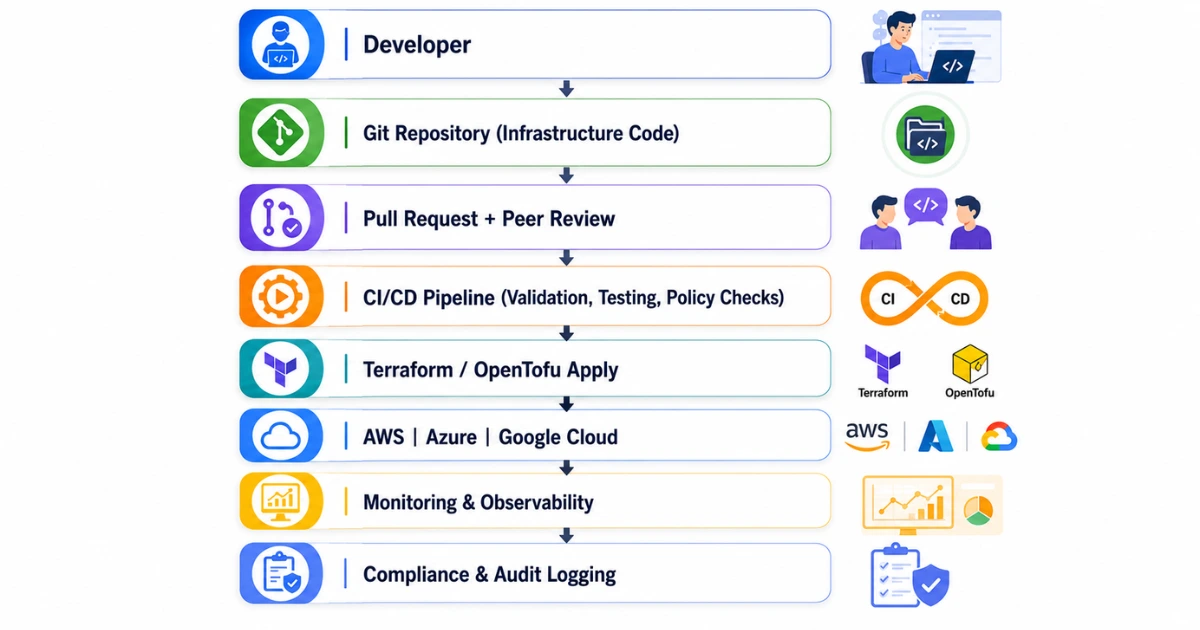
This workflow is what makes Cloud Architecture & Infrastructure Services repeatable across business units, rather than dependent on any single engineer's tribal knowledge. It's also the foundation that makes multi-cloud governance possible at scale.
This is where theory meets practice. Large enterprises don't run Terraform the way a five-person startup does. They build centralized governance structures around it, because dozens of teams touching cloud infrastructure independently creates chaos fast.
Centralized governance starts with a platform team that owns the core Terraform modules and cloud landing zones. Application teams consume these modules rather than writing raw provider code, which keeps security baselines consistent across AWS, Azure, and GCP. This single decision eliminates most of the inconsistency that causes outages and audit failures.
Terraform modules and OpenTofu form the technical backbone. Since Terraform's licensing change, many enterprises have adopted OpenTofu, the open-source fork, specifically to avoid vendor licensing risk while keeping the same module syntax and workflow their teams already know.
GitOps extends this discipline to Kubernetes and application deployments. Tools like ArgoCD continuously reconcile the live cluster state against what's declared in Git, automatically correcting configuration drift before it becomes an incident. This is a critical piece of managing multi-cloud infrastructure consistently, because drift is often invisible until something breaks.
Policy as Code — using tools like Open Policy Agent (OPA) or HashiCorp Sentinel — lets security and compliance teams codify rules directly into the deployment pipeline. Instead of reviewing every change manually, a policy engine automatically blocks non-compliant infrastructure, like an unencrypted storage bucket, before it ever reaches production.
Secrets management through platforms like HashiCorp Vault ensures credentials, API keys, and certificates are never hardcoded into IaC files. This is non-negotiable in regulated industries, where a leaked credential in a public repository can trigger a serious incident.
Platform engineering ties all of this together. Rather than every team learning Terraform from scratch, platform teams build internal developer platforms (IDPs) that expose "golden paths" — pre-approved, self-service templates for common infrastructure needs. A developer requests a new environment through a simple interface, and the underlying IaC handles the provisioning, security, and compliance automatically.
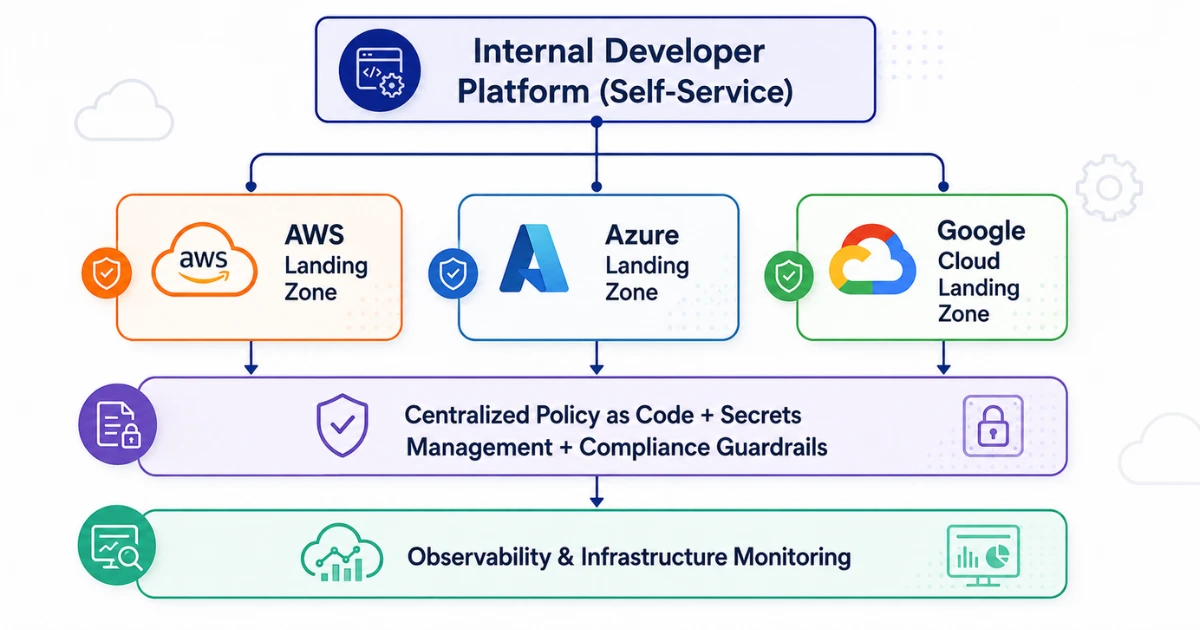
None of this replaces good Infrastructure Management Services; it complements them by giving internal and external teams a shared, auditable source of truth for every cloud resource in production.
Ready to bring this level of governance to your own cloud environment? Enterprise infrastructure modernization doesn't happen through a single tool purchase — it requires the right architecture, the right guardrails, and a team that has done this before. If your organization is evaluating how to consolidate multi-cloud sprawl into a governed IaC model, this is the moment to get expert guidance before technical debt compounds further.
Observability closes the loop. Prometheus and Grafana are the most common combination enterprises use to monitor infrastructure health across clouds, while centralized logging feeds into compliance reporting systems that satisfy auditors without manual evidence collection. Together, these practices are what separate mature enterprise infrastructure programs from teams still fighting fires reactively.
|
Layer |
Purpose |
Popular Enterprise Tools |
|
Provisioning |
Define and deploy cloud infrastructure |
Terraform, OpenTofu, Pulumi |
|
Cloud Providers |
Underlying compute, storage, networking |
AWS, Microsoft Azure, Google Cloud |
|
Container Orchestration |
Deploy and scale containerized workloads |
Kubernetes |
|
Secrets Management |
Secure storage of credentials and keys |
HashiCorp Vault |
|
Policy Enforcement |
Automated compliance and governance |
Open Policy Agent (OPA), Sentinel |
|
CI/CD Pipelines |
Automate testing and deployment |
GitHub Actions, GitLab CI/CD, Azure DevOps |
|
Monitoring & Observability |
Track infrastructure health and performance |
Prometheus, Grafana |
|
GitOps Delivery |
Continuous reconciliation of cluster state |
ArgoCD |
Even with IaC in place, enterprises run into recurring problems. Configuration drift happens when someone makes a manual change directly in a cloud console, bypassing the code that's supposed to represent the source of truth. Over time, this creates a gap between what's documented and what's actually running.
Cloud sprawl is another common issue — teams spin up resources without central visibility, leading to unused infrastructure and unnecessary spend. Security gaps often emerge from inconsistent configurations across providers, since AWS, Azure, and GCP each have different default settings and terminology for similar controls. Strong cloud infrastructure security practices require normalizing these differences through shared policy definitions rather than managing each cloud separately.
The talent shortage compounds all of this. Terraform, Kubernetes, and multi-cloud networking require specialized skills that are expensive to hire and retain, which is why many enterprises turn to managed enterprise infrastructure management partners to fill capability gaps rather than building every function in-house.
|
Challenge |
Solution |
|
Configuration drift |
GitOps reconciliation and drift detection tooling |
|
Cloud sprawl |
Centralized tagging, budgets, and resource governance |
|
Inconsistent security controls |
Policy as Code applied uniformly across providers |
|
Compliance reporting overhead |
Automated audit logging tied to IaC pipelines |
|
Rising cloud costs |
FinOps practices with real-time cost visibility |
|
Skills gap in Terraform/Kubernetes |
Managed services and internal platform teams |
|
Operational complexity across clouds |
Unified internal developer platform (IDP) |
Publicly documented patterns across industries show how these principles play out in practice, without revealing confidential implementation details.
Financial services firms typically prioritize multi-cloud for regulatory compliance and disaster recovery, using strict Policy as Code enforcement given the sensitivity of financial data and strict audit requirements.
Healthcare organizations commonly adopt multi-cloud to satisfy data residency requirements under regulations like HIPAA, relying heavily on encrypted secrets management and detailed audit logging.
Retail companies often use multi-cloud infrastructure to handle seasonal traffic spikes, distributing load across providers during peak shopping periods to avoid single-vendor capacity constraints.
Manufacturing enterprises frequently pair multi-cloud with edge computing, since IaC allows consistent infrastructure templates to be deployed across factories and data centers globally.
SaaS companies typically adopt a hybrid cloud strategy that blends multi-cloud public infrastructure with private data centers, using IaC to keep both environments provisioned from the same codebase.
AI-assisted IaC is emerging quickly, with tools that can generate, review, and suggest fixes for infrastructure code before deployment. This won't replace platform engineers, but it will meaningfully speed up module creation and code review.
Platform engineering and internal developer platforms will continue expanding, as enterprises look for ways to give developers self-service infrastructure without sacrificing governance. OpenTofu's community-driven development is likely to gain further enterprise adoption as organizations diversify away from single-vendor tooling risk.
Autonomous infrastructure — systems that can detect issues and remediate them without human intervention — is advancing alongside predictive monitoring, which flags potential failures before they occur. Cloud sustainability and AI governance are also becoming standard agenda items at the infrastructure strategy level, not just afterthoughts.
Multi-cloud infrastructure has become the standard operating model for Fortune 500 companies, driven by business continuity, compliance, and performance needs rather than trend-chasing. Infrastructure as Code is what makes that model sustainable — turning a fragile web of manual configurations into a governed, auditable, repeatable system. Organizations that treat IaC as a core governance discipline, not just a scripting convenience, are the ones successfully scaling across three or more cloud providers without losing control.
The business impact is direct: fewer outages, faster audits, lower operational overhead, and engineering teams that spend more time building products instead of firefighting infrastructure. Enterprises serious about scaling should invest now in centralized module governance, Policy as Code, and platform engineering before complexity outpaces their ability to manage it.
Enterprises that delay building a governed IaC foundation don't just move slower — they accumulate risk with every manual change. Whether you need Cloud Managed Services to operate infrastructure at scale, or you're exploring Serverless Architecture Development to reduce operational overhead entirely, the right partner can help you build a multi-cloud foundation that scales with confidence instead of chaos. Connect with our enterprise infrastructure team to assess where your organization stands today.



Start Build Your
Next Digital Solution?
Let’s build scalable, future-ready digital solutions tailored to your business goals. Connect with our experienced technology consultants to discuss your vision, strategy, and growth opportunities — with zero obligation and complete transparency.
Get a free consultation and cost estimate for your digital solution
Our expert will contact you within 24 hours. Check your email for confirmation.
Partner with SISGAIN experts to build secure, scalable AI-powered IT Solutions that transform your business operations.









DUQE FREEZONE Quarter Deck, Queen Elizabeth 2, Mina Rashid, Dubai, UAE

100 Consilium Pl Suite 200, Scarborough, ON M1H 3E3, Canada

C-109, Sector 2, Noida, Uttar Pradesh 201301 India
Project quotes, partnerships, implementation
Open roles, referrals, campus hiring