
 +1 844-445-5767
 +971 56-848-5757
 +91 921-208-0630
For Business & Service Inquiries
Sales Team
Project quotes, partnerships, implementation
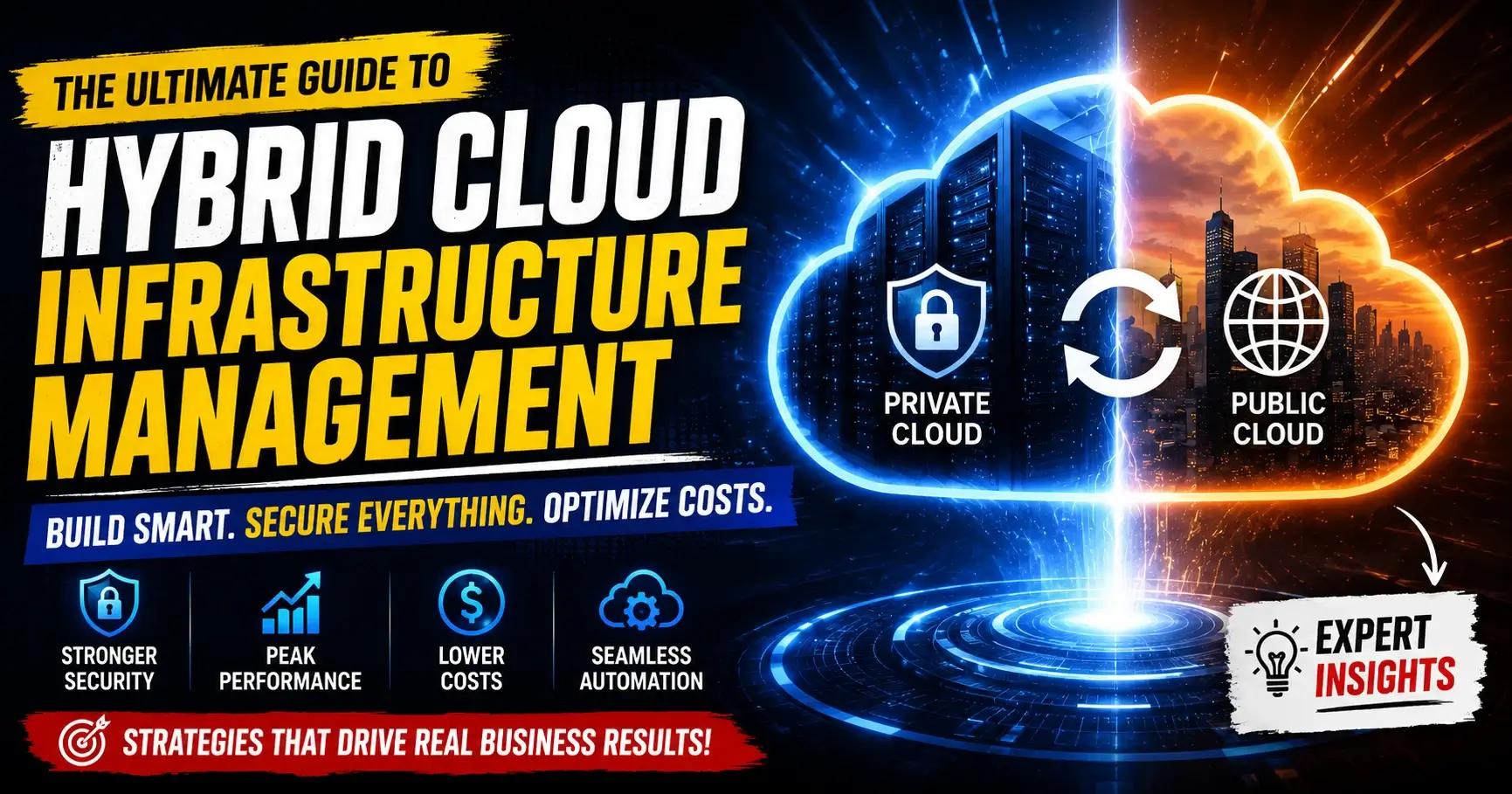
TL;DR: Hybrid cloud infrastructure management is the practice of governing workloads, data, and policies across on-premises infrastructure and public cloud environments through a unified control plane. It delivers regulatory compliance, workload flexibility, cost efficiency, and operational resilience. According to Precedence Research (2025), the global hybrid cloud market is valued at USD 134.22 billion in 2025 and is projected to reach USD 578.72 billion by 2034.
Enterprise infrastructure has never been more distributed. Workloads run on private data centers, public clouds, edge nodes, and everything in between. Managing this complexity without losing visibility, security, or cost control is the defining challenge for CIOs, CTOs, and infrastructure teams today.
Hybrid cloud infrastructure management provides the governance framework to bring these environments under a single operational model. But understanding what it means in practice—how the architecture works, what components require oversight, where most organizations fail, and how to build a strategy that scales—requires more than a surface-level overview.
This guide covers the full picture. From core components and architecture patterns to industry use cases, best practices, and technology stacks, it is designed to help enterprise decision-makers and technical teams build hybrid cloud environments that are secure, cost-efficient, and operationally sound.
Quick answer: Hybrid cloud infrastructure management is the coordinated governance of compute, storage, networking, security, and data across private on-premises infrastructure and public cloud platforms using a unified management plane. The goal is consistent visibility, policy enforcement, and workload control regardless of where applications run.
At its core, hybrid cloud infrastructure management is about closing the gap between isolated environments. Private infrastructure gives organizations control over sensitive data and latency-sensitive workloads. Public cloud provides scalability, global reach, and access to managed services. Without a unified management layer, operating both simultaneously creates fragmented visibility, duplicate tooling, inconsistent security policies, and unpredictable cost behavior.
The discipline covers lifecycle management, monitoring and observability, identity and access control, security posture management, cost optimization, and automation—applied consistently across every environment in the enterprise footprint.
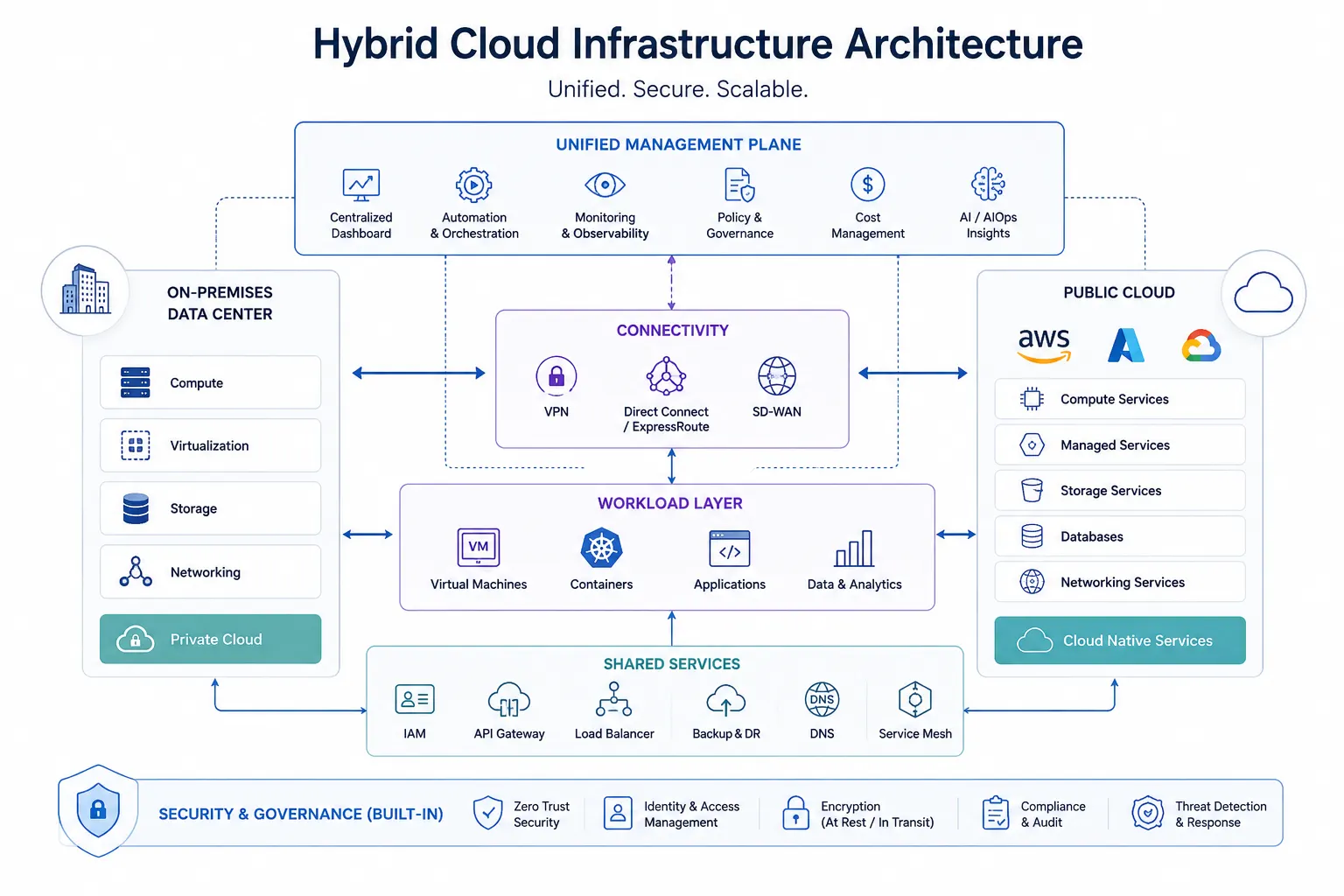
Hybrid cloud computing combines private infrastructure—whether on-premises data centers or dedicated private cloud tenancies—with one or more public cloud platforms such as AWS, Microsoft Azure, or Google Cloud. The defining characteristic is integration: workloads actively span both environments, and a unified management layer governs them together rather than treating them as separate silos.
This is distinct from simply using both types of infrastructure independently. Hybrid cloud involves data portability, consistent identity and access controls, shared governance policies, and coordinated networking across environments.
Hybrid cloud infrastructure refers to the combined set of physical and virtual resources—servers, storage, networking, containers, and cloud services—that an organization operates across its private and public cloud environments. It includes on-premises hardware, virtualized resources, cloud-native services, and the integration technologies (APIs, VPNs, direct connect circuits) that allow workloads to communicate across boundaries.
|
Attribute |
Traditional On-Premises |
Hybrid Cloud Infrastructure |
|---|---|---|
|
Scalability |
Constrained by physical hardware capacity |
Elastic—burst to public cloud on demand |
|
Capital Expenditure |
High upfront investment |
Shifts CapEx to OpEx with variable cloud spend |
|
Time to Provision |
Days to weeks |
Minutes to hours via automation |
|
Geographic Reach |
Limited to owned data center locations |
Global through cloud provider regions |
|
Security Control |
Full control, higher compliance burden internally |
Shared responsibility with cloud providers |
|
Disaster Recovery |
Complex, expensive redundancy required |
Cross-environment failover built into architecture |
|
Innovation Speed |
Slower—tied to procurement cycles |
Faster access to managed services and AI infrastructure |
|
Management Complexity |
Single environment, well-understood |
Multi-environment, requires unified governance |
For enterprises running legacy systems alongside modern cloud-native applications, hybrid infrastructure bridges that gap without requiring a wholesale migration.
Quick answer: Enterprises adopt hybrid cloud infrastructure to meet regulatory requirements, reduce infrastructure costs, support digital transformation, and gain the workload placement flexibility that single-environment architectures cannot provide.
According to Flexera's 2026 State of the Cloud Report, 73% of organizations now operate on hybrid cloud estates. That number reflects a structural shift, not a trend. Several converging forces are driving adoption:
Regulatory pressure is tightening across every industry. Healthcare organizations must keep patient records under strict data sovereignty rules. Financial institutions face GDPR, PCI-DSS, and DORA compliance requirements. Government agencies operate under data residency mandates that public cloud alone cannot satisfy. Hybrid infrastructure lets these organizations keep regulated data on private infrastructure while using public cloud for everything else.
Digital transformation timelines are compressing. Organizations that need to launch new digital services cannot wait for traditional infrastructure procurement cycles. Public cloud delivers immediate access to compute, AI/ML platforms, managed databases, and global CDN, while core business applications continue to run on proven private infrastructure. To accelerate this transition with minimal disruption, many enterprises adopt Cloud Migration & Modernization services that help assess workloads, modernize legacy applications, and build a scalable hybrid cloud environment.
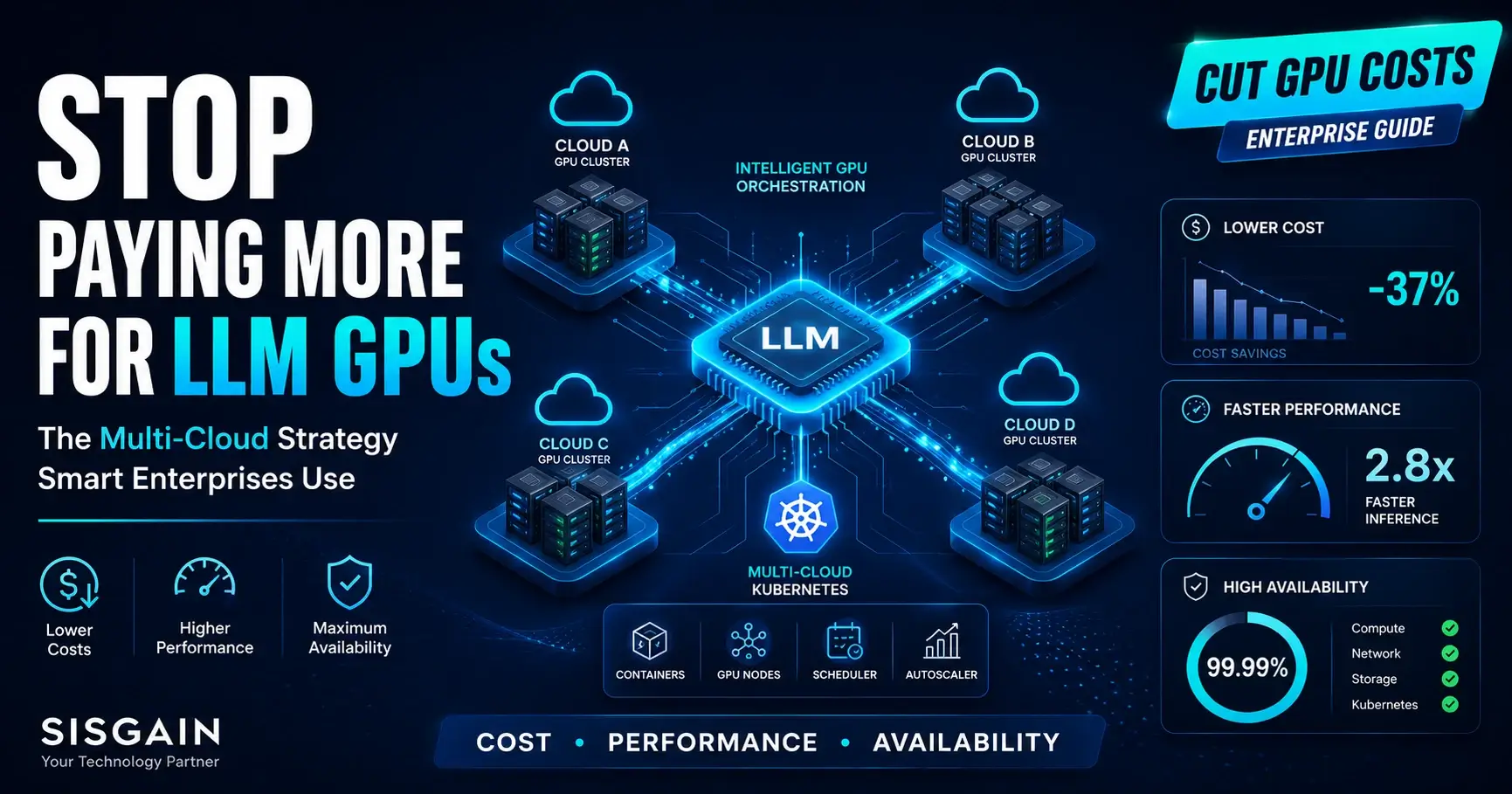
GenAI workloads are creating new infrastructure demands. Training large language models requires burst GPU capacity that few organizations can sustain on private hardware alone. A hybrid strategy lets enterprises prototype on public cloud GPU infrastructure, then move proven workloads to cost-optimized private environments for inference at scale.
Cost optimization drives hybrid adoption for organizations that have already experienced public cloud bill shock. Moving stable, predictable workloads back to private infrastructure while retaining public cloud for variable and burst capacity significantly reduces total cost of ownership.
[Illustration Suggestion: Enterprise Hybrid Cloud Management Workflow showing each component layer with arrows indicating data flow and governance controls]
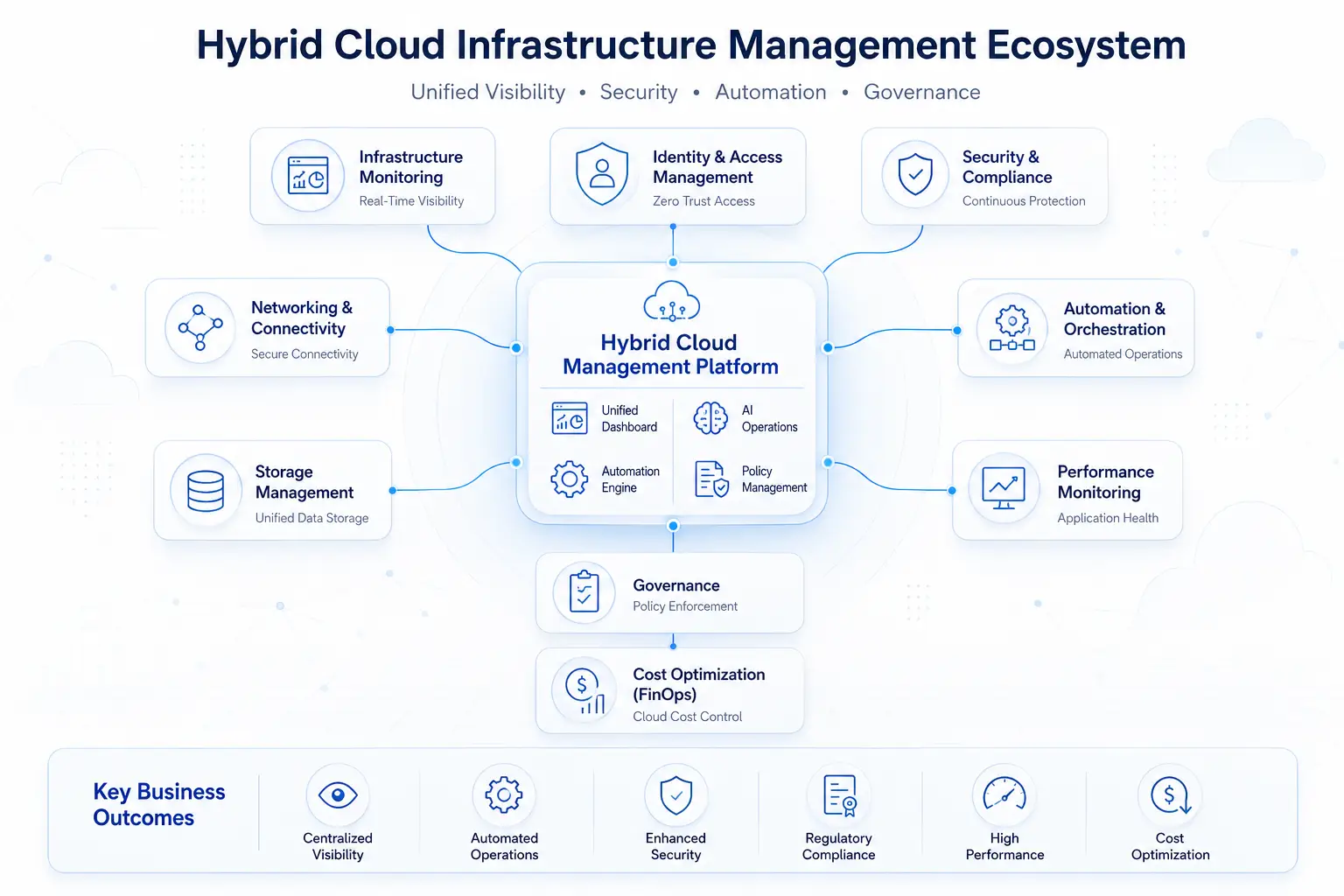
Effective hybrid cloud infrastructure management requires coordinated oversight across multiple operational domains. Each component addresses a specific category of risk or operational requirement.
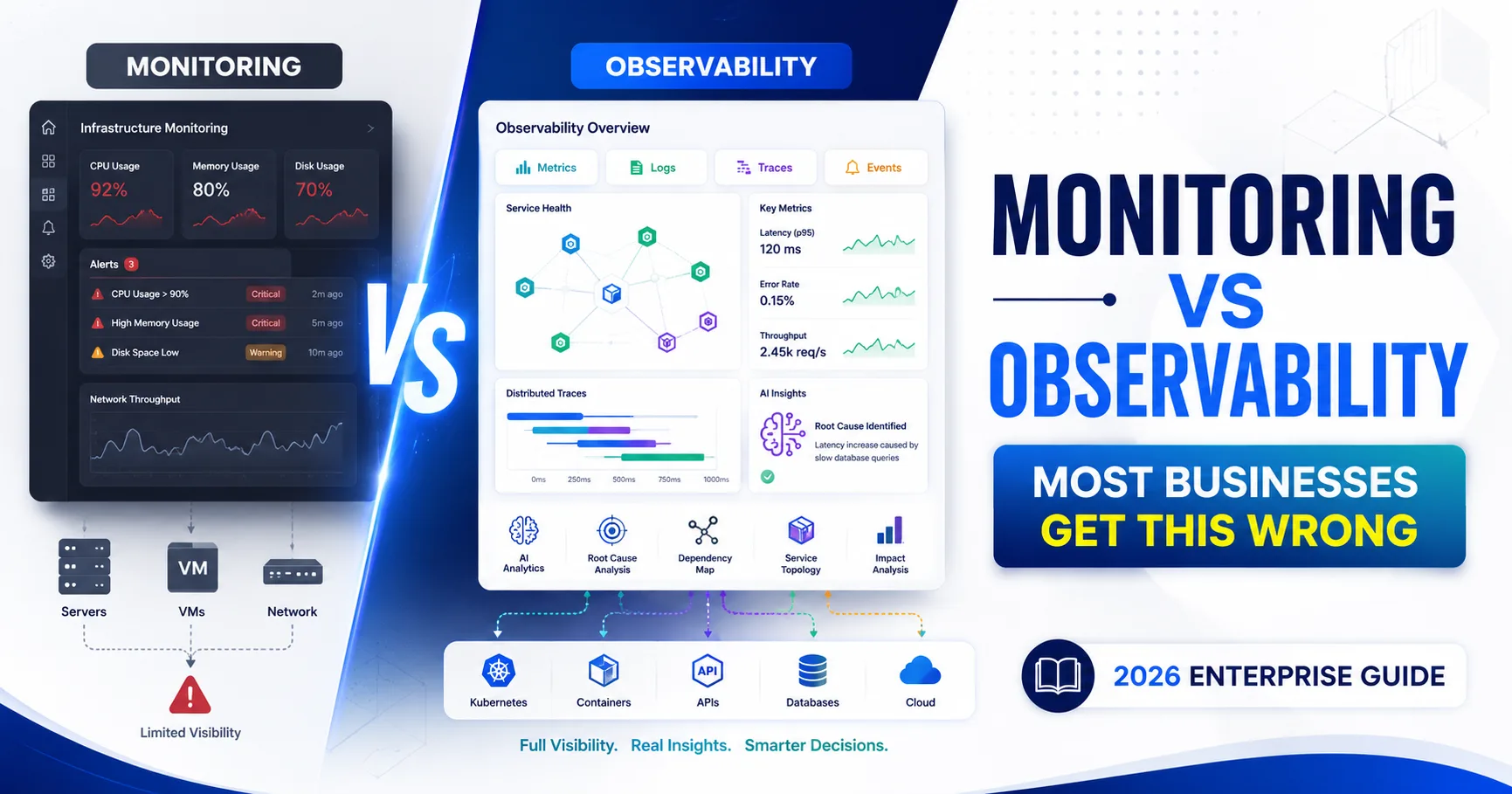
Real-time visibility into the health, performance, and availability of every resource across both environments. Effective infrastructure monitoring covers CPU, memory, disk I/O, network throughput, application response times, and container health—aggregated into a single observability layer rather than managed through separate tools for each environment.
According to Dynatrace research, the average multi-cloud environment relies on approximately 10 separate monitoring tools, and 85% of technology leaders report that this fragmentation actively increases operational complexity.
Provisioning, configuring, and decommissioning compute, storage, and networking resources across environments through automated, policy-driven workflows. Cloud resource management prevents orphaned instances, enforces tagging standards, and ensures every resource is tied to a cost center and owner.
Unified IAM applies consistent least-privilege access controls regardless of where a workload runs. This means a single identity provider, consistent role-based access control (RBAC) policies, multi-factor authentication for privileged operations, and audit trails that span private and public environments without gaps.
Secure, reliable connectivity between private and public environments through VPNs, dedicated private connections (AWS Direct Connect, Azure ExpressRoute), software-defined networking, and network segmentation. Network design decisions at this layer directly affect latency, data transfer costs, and the blast radius of security incidents.
Coordinating data placement across on-premises storage arrays, object storage, block storage, and cloud-native storage services. Storage management includes replication policies, backup schedules, data tiering, archival workflows, and encryption at rest—applied consistently across all storage environments.
Hybrid environments expand the attack surface significantly. Security management covers cloud security posture management (CSPM), endpoint protection, secrets management, encryption key governance, vulnerability scanning, and compliance monitoring against frameworks such as CIS, NIST, ISO 27001, and SOC 2. For a detailed breakdown of enterprise security controls, refer to this IT infrastructure security best practices guide.
Infrastructure as Code (IaC), configuration management, automated patching, and self-healing workflows reduce toil and eliminate the configuration drift that accumulates when environments are managed manually. Automation is the mechanism that makes consistent governance across heterogeneous environments operationally feasible.
Governance defines who owns what, what policies apply where, how exceptions are handled, and how compliance is audited. Without explicit governance frameworks, hybrid environments develop inconsistencies at the boundaries between teams and platforms. Governance documentation, policy engines, and approval workflows make those boundaries explicit and enforceable. Learn more about infrastructure management services and how governance fits into the broader operational model.
Application performance management (APM) tracks response times, throughput, error rates, and user experience across services that span hybrid environments. Performance baselines inform capacity planning decisions and trigger proactive scaling before degradation affects end users.
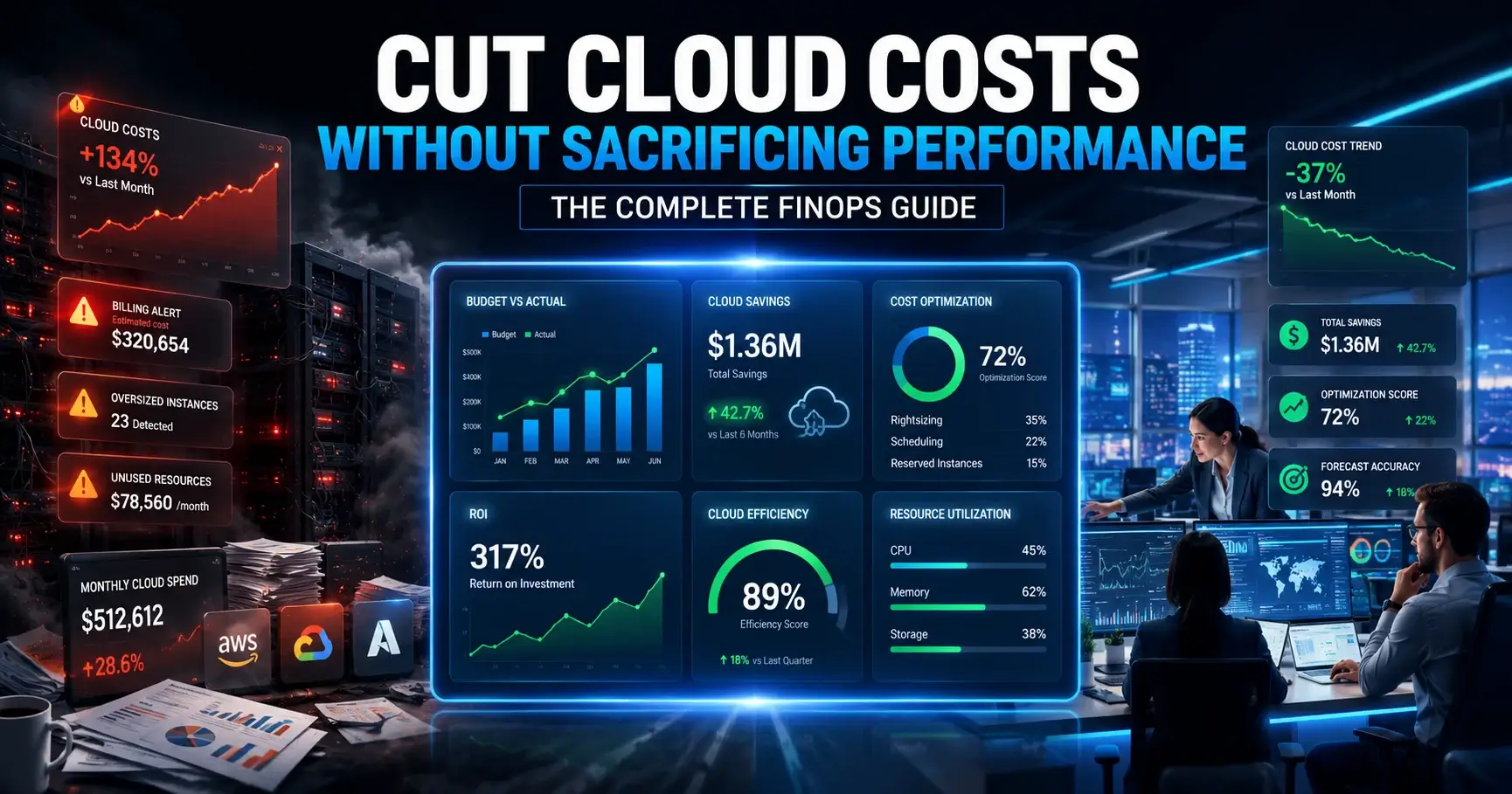
FinOps practices applied to hybrid infrastructure require normalized cost reporting across environments that use incompatible pricing models. Private infrastructure has fixed capacity costs; public cloud has variable per-use costs. Right-sizing, workload placement optimization, reserved capacity planning, and automated scale-down policies all contribute to keeping hybrid infrastructure cost-efficient. Industry data from Harness (2025) estimates that approximately USD 44.5 billion in cloud infrastructure spend goes to underutilized resources annually.
Quick answer: The primary benefits of hybrid cloud infrastructure management are regulatory compliance, workload placement flexibility, cost optimization, operational resilience, and faster access to cloud-native innovation—delivered without sacrificing control over sensitive data or mission-critical systems.
|
Benefit |
What It Delivers |
|---|---|
|
Data Sovereignty |
Sensitive data stays in compliant environments; regulated workloads isolated by design |
|
Workload Flexibility |
Place each workload where cost, performance, compliance, and latency requirements are best met |
|
Cost Efficiency |
Stable workloads on private infrastructure; variable workloads on public cloud eliminates waste |
|
Operational Resilience |
Cross-environment failover reduces single points of failure; hybrid DR is measurably more robust |
|
Compliance Alignment |
Consistent policy enforcement satisfies multi-framework regulatory requirements |
|
Innovation Access |
Public cloud provides immediate access to AI/ML, serverless, and managed services |
|
Performance Optimization |
Latency-sensitive workloads remain on-premises; global traffic uses edge and CDN |
|
Vendor Independence |
Avoids lock-in by distributing workloads across private and multiple public environments |
Rackspace's 2025 State of the Cloud Report, which surveyed 1,420 IT professionals, found that 82% of IT decision-makers using hybrid cloud reported satisfaction with operational efficiency—a higher rate than any other cloud model.
Quick answer: The most persistent hybrid cloud infrastructure management challenges are visibility fragmentation, security policy inconsistency at environment boundaries, FinOps complexity across incompatible cost models, skills gaps, and the difficulty of maintaining governance at scale across tools built for single environments.
|
Challenge |
Root Cause |
Operational Impact |
|---|---|---|
|
Visibility and Tool Sprawl |
Separate monitoring stacks per environment |
Delayed incident detection; manual correlation |
|
Security Boundary Gaps |
Different policies applied to each side |
Lateral movement goes undetected; compliance failures |
|
FinOps Complexity |
Incompatible pricing models across private and public |
Budget overruns; orphaned resources; inaccurate forecasting |
|
Skills Shortages |
Hybrid expertise spans multiple disciplines |
Slower operations; reliance on external support |
|
Governance Inconsistency |
Policy ownership unclear at environment boundaries |
Configuration drift; audit failures; compliance risk |
|
Disaster Recovery Uncertainty |
SLAs documented but not cross-environment tested |
False confidence in RTO/RPO commitments |
|
Cloud-Native Service Dependencies |
Proprietary services don't translate across environments |
Integration failures during workload migration |
Security visibility is particularly acute. Tools built for private infrastructure have no visibility into public cloud workloads. Public cloud-native security tools don't extend into on-premises environments. Lateral movement across the boundary between them goes undetected by both—and the integration point between environments, where policy ownership is least clearly defined, is precisely where misconfigurations are most likely to surface.
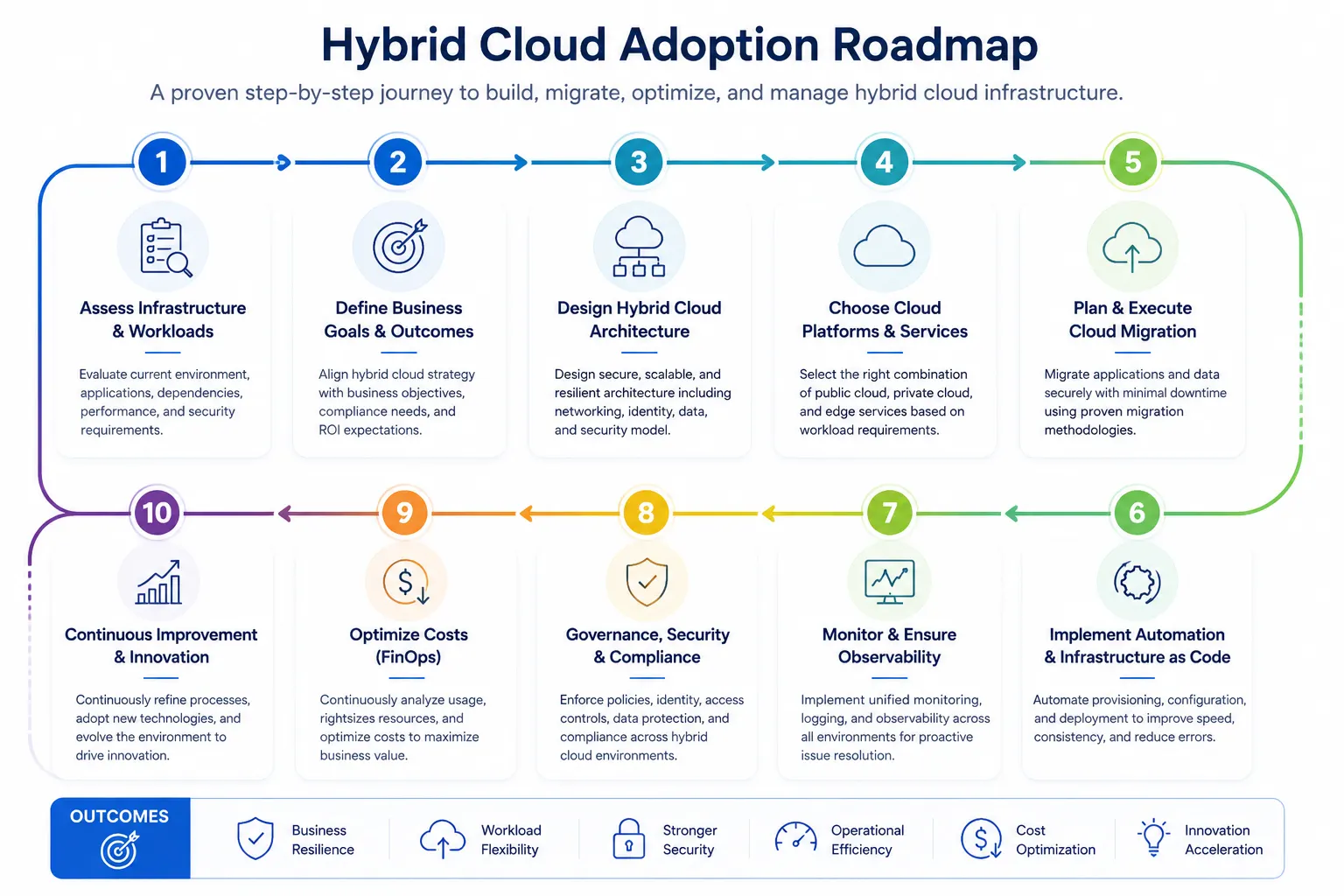
Quick answer: An effective hybrid cloud strategy follows four phases—Assess, Plan, Deploy, Optimize—and aligns workload placement decisions with measurable business objectives including delivery speed, security posture, compliance requirements, and total cost of ownership.
[Illustration Suggestion: Enterprise Hybrid Cloud Management Workflow with four-phase lifecycle: Assess → Plan → Deploy → Optimize]
Start with a complete workload inventory. Classify each application by data sensitivity, compliance requirements, latency tolerance, compute profile, and business criticality. Identify dependencies—especially proprietary services that may not translate across environments. Map the current cost baseline for every workload category. This assessment is the foundation every subsequent decision builds on.
Translate operational requirements into measurable objectives. Define SLAs, RTO/RPO targets, acceptable latency thresholds, cost reduction targets, and compliance frameworks that must be satisfied. Ambiguous goals produce ambiguous architectures.
Architecture decisions at this stage determine the security posture, networking topology, and governance model for the entire environment. Define where workloads will run based on the classification completed in the assessment phase. Design network connectivity, data replication patterns, and encryption policies before provisioning anything. Many organizations work with Cloud Architecture & Infrastructure Services specialists to design resilient, secure, and scalable hybrid cloud architecture that aligns with business objectives and compliance requirements. For a comprehensive walkthrough of architecture design principles, this cloud infrastructure management guide covers the key considerations in detail.
Select public cloud providers based on geographic availability, service ecosystem, compliance certifications, and pricing structures relevant to your workload mix. Vendor-lock-in risk should factor into this decision—evaluate portability at the architecture level, not just the contract level.
Codify every provisioning and configuration workflow in Infrastructure as Code. Automate policy enforcement, patch management, scaling, and backup. Automation reduces human error, enforces consistency, and makes governance auditable by design.
Implement unified observability from day one. Centralize metrics, logs, and traces across environments before workloads go live. Retrospectively adding observability to a running hybrid environment is significantly more difficult and costly than building it into the architecture from the start.
Define ownership boundaries, change management procedures, compliance audit schedules, and exception handling workflows. Publish governance documentation and enforce it through automated policy engines rather than manual reviews.
Implement FinOps practices from the first billing cycle. Enforce resource tagging at provisioning time. Review cost reports by workload, team, and environment on a regular cadence. Identify candidates for rightsizing, reserved capacity, or workload migration between private and public environments.
Hybrid cloud environments evolve. Conduct regular architecture reviews, update workload placement decisions as business requirements change, test disaster recovery scenarios on a scheduled basis, and revise cost optimization strategies as pricing models and usage patterns shift.
Quick answer: The most effective hybrid cloud infrastructure management practices are unified observability, IaC-enforced configuration baselines, Zero Trust access controls, automated compliance checking, cross-environment DR testing, and FinOps dashboards that normalize cost data across private and public infrastructure.
[Checklist Graphic: Hybrid Cloud Best Practices]
Container technology packages applications and their dependencies into portable, environment-agnostic units. Containers run consistently across development, test, and production environments—whether on-premises or in public cloud—eliminating the "works on my machine" problem at scale.
Kubernetes is the industry-standard container orchestration platform for hybrid cloud infrastructure. It automates the deployment, scaling, and management of containerized workloads across clusters running on any infrastructure. Organizations implementing enterprise container platforms often leverage Kubernetes & Containerization services to simplify orchestration, improve workload portability, and accelerate application modernization across private and public cloud environments.
IaC tools such as Terraform, Ansible, Pulumi, and CloudFormation define infrastructure in version-controlled configuration files. Applied to hybrid environments, IaC enforces consistent provisioning templates across private and public infrastructure, enables drift detection, and makes every change auditable.
Continuous integration and continuous deployment pipelines automate the testing and delivery of application changes across hybrid environments. GitOps-style workflows (using tools like Argo CD or Flux) extend CI/CD to infrastructure configuration, treating infrastructure changes with the same rigor as application code.
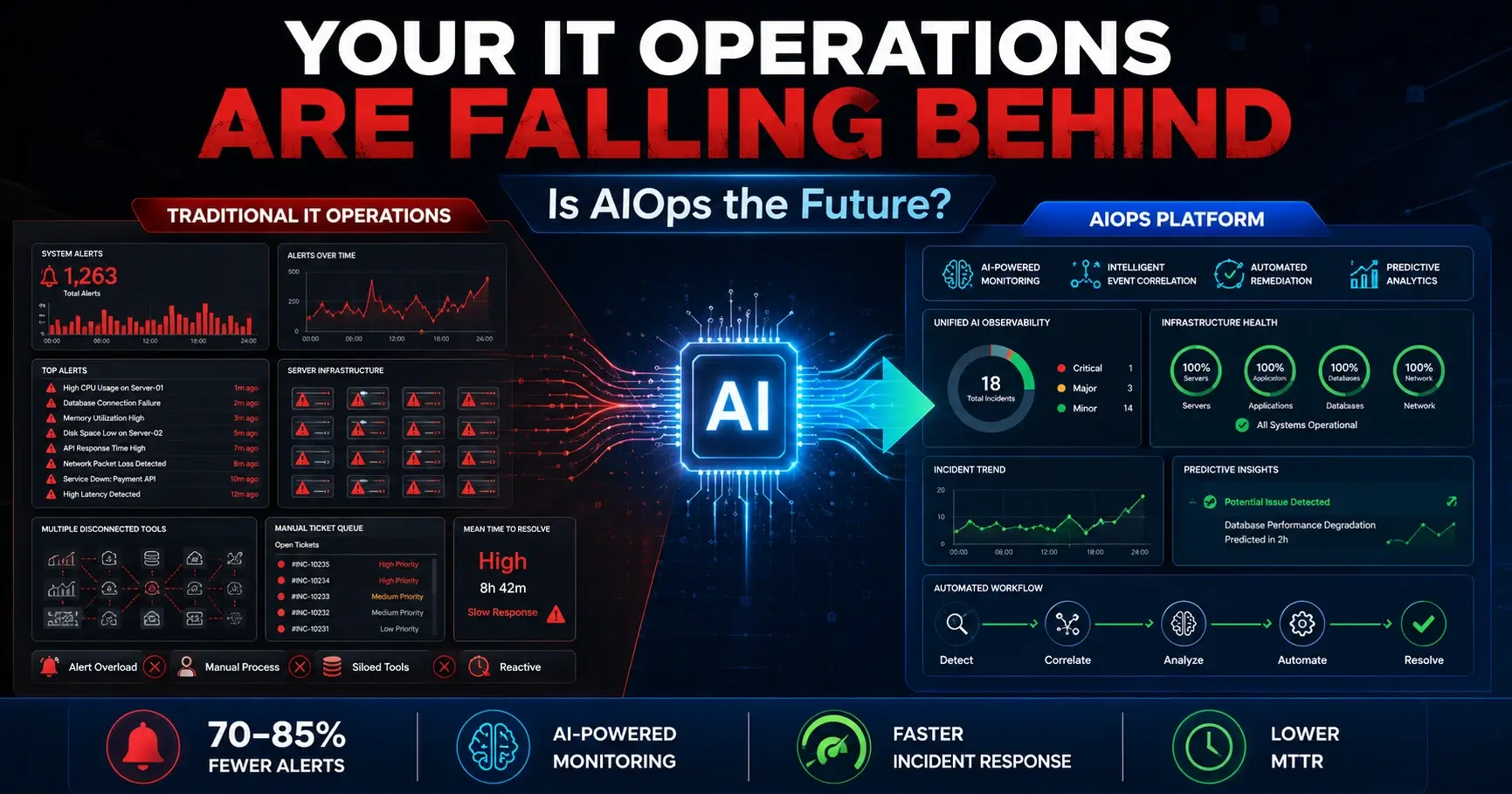
AI for IT operations platforms apply machine learning to monitoring data to detect anomalies, identify root causes, predict failures, and automate remediation. In hybrid environments with high volumes of telemetry data from multiple sources, AIOps dramatically reduces the manual effort required to maintain operational stability.
Observability platforms—built on metrics, logs, and traces—provide the full-stack visibility required to troubleshoot distributed applications in hybrid environments. Tools such as Prometheus, Grafana, OpenTelemetry, and unified APM platforms centralize this data and make cross-environment correlation operationally feasible.
Cloud Security Posture Management (CSPM), Cloud Workload Protection Platforms (CWPP), and policy engines such as Open Policy Agent (OPA) and Kyverno enforce security baselines across hybrid environments. These tools detect misconfigurations, enforce access policies, and generate compliance evidence automatically.
Configuration management tools (Ansible, Puppet, Chef), event-driven automation frameworks, and workflow orchestration platforms reduce manual operations overhead. Automation tools enable self-healing infrastructure that detects and remediates configuration drift without human intervention.
[Comparison Graphic: Hybrid Cloud vs Multi-Cloud]
|
Dimension |
Hybrid Cloud |
Multi-Cloud |
|---|---|---|
|
Definition |
Combines private infrastructure with one or more public clouds |
Uses two or more public cloud providers without a private component |
|
Primary Driver |
Data sovereignty, compliance, workload control |
Vendor redundancy, best-of-breed service selection |
|
Infrastructure Ownership |
Organization owns and operates private infrastructure |
All infrastructure operated by cloud providers |
|
Data Control |
High—sensitive data stays on private infrastructure |
Variable—depends on provider configurations |
|
Complexity |
High—requires integration across private and public environments |
Moderate to high—multiple vendor interfaces and APIs |
|
Cost Model |
CapEx for private + OpEx for public cloud |
Primarily OpEx across multiple providers |
|
Governance |
Unified control plane governing both environments |
Often separate governance per provider |
|
Compliance Fit |
Strong—purpose-built for regulated industries |
Dependent on provider compliance certifications |
|
Portability |
Workloads designed to span environments |
Portability varies by application architecture |
|
Best For |
Healthcare, banking, government, manufacturing |
SaaS, digital-native companies, vendor diversification |
Many large enterprises operate architectures that combine both models—using a hybrid foundation with multiple public cloud providers. This is sometimes called hybrid multi-cloud, and it combines the control advantages of private infrastructure with the redundancy and service breadth of multiple public providers.
|
Feature |
Public Cloud |
Private Cloud |
Hybrid Cloud |
|---|---|---|---|
|
Infrastructure Ownership |
Cloud provider |
Organization |
Both |
|
Scalability |
High—near-infinite on demand |
Limited by physical capacity |
High—burst to public cloud |
|
Cost |
Pay-per-use, variable |
Fixed CapEx investment |
Mixed model |
|
Security Control |
Shared responsibility |
Full organizational control |
Tailored per workload |
|
Compliance |
Provider certifications |
Full internal control |
Flexible—by workload |
|
Latency |
Variable—network dependent |
Low—internal network |
Low for private; variable for public |
|
Ideal For |
Variable workloads, startups, innovation |
Regulated data, core systems |
Enterprises needing both |
Hospitals and health systems store electronic patient records (EPR) on private infrastructure to meet HIPAA and local data residency requirements. Anonymized imaging data moves to public cloud GPU infrastructure for AI-powered diagnostic workloads. Hybrid connectivity allows clinical staff to access records in real time while keeping identifiable data in compliant private environments.
Core banking systems—ledger, payments processing, and fraud detection—run on private infrastructure where latency and regulatory controls are tightest. Customer-facing mobile and web applications run on public cloud for elasticity and global reach. BFSI organizations use hybrid architecture to meet PCI-DSS, GDPR, and EU DORA requirements while supporting digital banking innovation.
Government agencies retain classified and sensitive datasets on sovereign private infrastructure. Unclassified workloads—citizen-facing services, collaboration platforms—run on commercial cloud. Federated hybrid models allow multiple agencies to share private infrastructure governed by common compliance frameworks while independently using public cloud services.
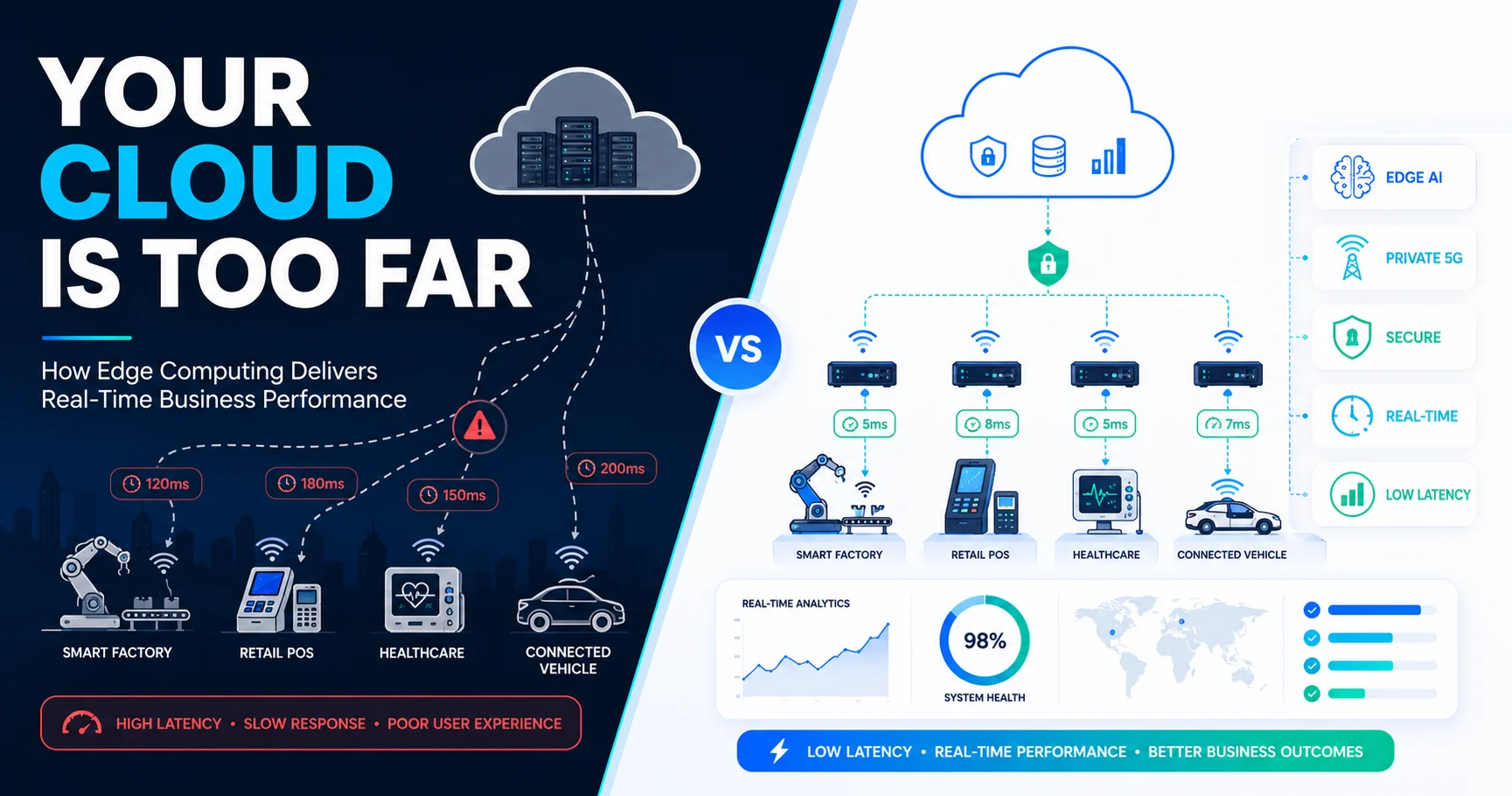
Smart manufacturing deployments extend hybrid architecture to factory floors. Edge computing nodes process real-time equipment telemetry locally for time-critical decisions. Summarized data moves to private data centers for operational analytics, then to public cloud for enterprise reporting and supply chain integration.
Retail organizations use hybrid infrastructure to handle extreme demand variability. Core inventory management and POS systems run on private infrastructure. During peak periods—major sales events, holiday seasons—customer-facing e-commerce platforms burst to public cloud. Personalization engines run on cloud-native AI/ML services while customer data stays in compliant private storage.
Global logistics networks require real-time visibility across operations that span geographies, time zones, and partner systems. Hybrid infrastructure connects warehouse management systems (running on private infrastructure) with cloud-native tracking platforms, route optimization services, and customer-facing shipment portals.
Universities and large school systems use hybrid architecture to support research computing, student information systems, and distance learning platforms. Research workloads requiring significant GPU capacity burst to public cloud. Student records and financial data remain on private infrastructure governed by FERPA and institutional data policies.
Enterprise SaaS companies use hybrid infrastructure to serve customers under varying data residency requirements. Multi-tenant application layers run on public cloud for scalability. Dedicated private cloud environments support enterprise customers with strict data sovereignty requirements. This hybrid SaaS model allows a single product to serve both standard and regulated customer segments.
Quick answer: Choose hybrid cloud solutions based on workload placement flexibility, unified management capabilities, compliance certification coverage, automation maturity, and the vendor's ability to support your specific industry regulatory requirements—not solely on pricing or platform brand recognition.
The hybrid cloud vendor landscape spans platform vendors (AWS Outposts, Azure Arc, Google Anthos, VMware Cloud Foundation), managed service providers, and specialist infrastructure management firms. Evaluation criteria should include:
The right choice depends on your current infrastructure maturity, workload mix, compliance obligations, and internal skill sets. There is no universal answer—only the architecture that best serves your specific operational requirements.
Building a hybrid cloud environment that is secure, cost-efficient, and operationally sustainable requires expertise across infrastructure assessment, architecture design, migration execution, automation engineering, and ongoing management. These disciplines rarely exist in full depth within a single internal team.
SISGAIN's infrastructure management practice supports enterprise organizations across the full hybrid cloud lifecycle:
Infrastructure Assessment and Workload Classification: SISGAIN conducts detailed discovery of existing infrastructure estates to identify workload profiles, application dependencies, compliance requirements, and current cost baselines. This assessment informs workload placement decisions and migration prioritization.
Hybrid Cloud Architecture Consulting: Working with CTOs, Cloud Architects, and Infrastructure Managers, SISGAIN designs hybrid cloud architectures that align with business objectives, regulatory constraints, and technical requirements. Architecture deliverables include network topology, security policy frameworks, identity and access models, and disaster recovery designs.
Cloud Migration Planning and Execution: SISGAIN supports organizations in migrating workloads from on-premises environments to hybrid cloud architectures with minimal disruption to production operations. Migration waves are sequenced by complexity, dependency mapping, and business risk.
Automation and Infrastructure as Code: SISGAIN engineers implement IaC-based provisioning, automated patching, policy enforcement automation, and GitOps-style deployment workflows across hybrid environments—reducing operational overhead and configuration drift.
Infrastructure Monitoring and Observability: Drawing on proven monitoring architectures, SISGAIN deploys unified observability platforms that centralize metrics, logs, and traces across private and public cloud environments, enabling proactive incident detection and performance optimization.
Security and Compliance Management: SISGAIN implements security baselines, CSPM tooling, identity governance frameworks, and automated compliance checks aligned to relevant regulatory frameworks—covering both the private infrastructure and public cloud footprint.
Performance Optimization and Cost Governance: Ongoing managed services from SISGAIN include FinOps reporting, workload rightsizing recommendations, reserved capacity planning, and continuous performance tuning across hybrid environments.
The hybrid cloud market is growing at a CAGR of 17.63%—from USD 134.22 billion in 2025 to a projected USD 578.72 billion by 2034 (Precedence Research, 2025). That growth reflects something real: organizations across every industry have concluded that hybrid infrastructure is not a transitional state on the way to full cloud migration. It is the destination architecture for enterprises that need both control and agility.
The organizations that manage hybrid cloud well share common characteristics. They have unified observability across every environment. They enforce security policy at the architecture level, not through manual reviews. They treat governance as an automated function, not a quarterly audit. And they make workload placement decisions based on complete cost, performance, and compliance data—not assumptions.
The organizations that struggle treat their private infrastructure and public cloud as separate operational concerns managed by separate teams with separate tools. The complexity compounds until costs escalate, security gaps widen, and governance frameworks collapse under the weight of exceptions.
Building hybrid cloud infrastructure management capabilities is not a one-time project. It is an ongoing operational discipline that requires the right architecture, the right tooling, and the right expertise to execute at enterprise scale. For organizations ready to establish or mature that capability, the framework outlined in this guide provides both the strategic structure and the practical detail to move forward with confidence.

Start Build Your
Next Digital Solution?
Let’s build scalable, future-ready digital solutions tailored to your business goals. Connect with our experienced technology consultants to discuss your vision, strategy, and growth opportunities — with zero obligation and complete transparency.
Get a free consultation and cost estimate for your digital solution
Our expert will contact you within 24 hours. Check your email for confirmation.
Partner with SISGAIN experts to build secure, scalable AI-powered IT Solutions that transform your business operations.









DUQE FREEZONE Quarter Deck, Queen Elizabeth 2, Mina Rashid, Dubai, UAE

100 Consilium Pl Suite 200, Scarborough, ON M1H 3E3, Canada

C-109, Sector 2, Noida, Uttar Pradesh 201301 India
Project quotes, partnerships, implementation
Open roles, referrals, campus hiring