
 +1 844-445-5767
 +971 56-848-5757
 +91 921-208-0630
For Business & Service Inquiries
Sales Team
Project quotes, partnerships, implementation
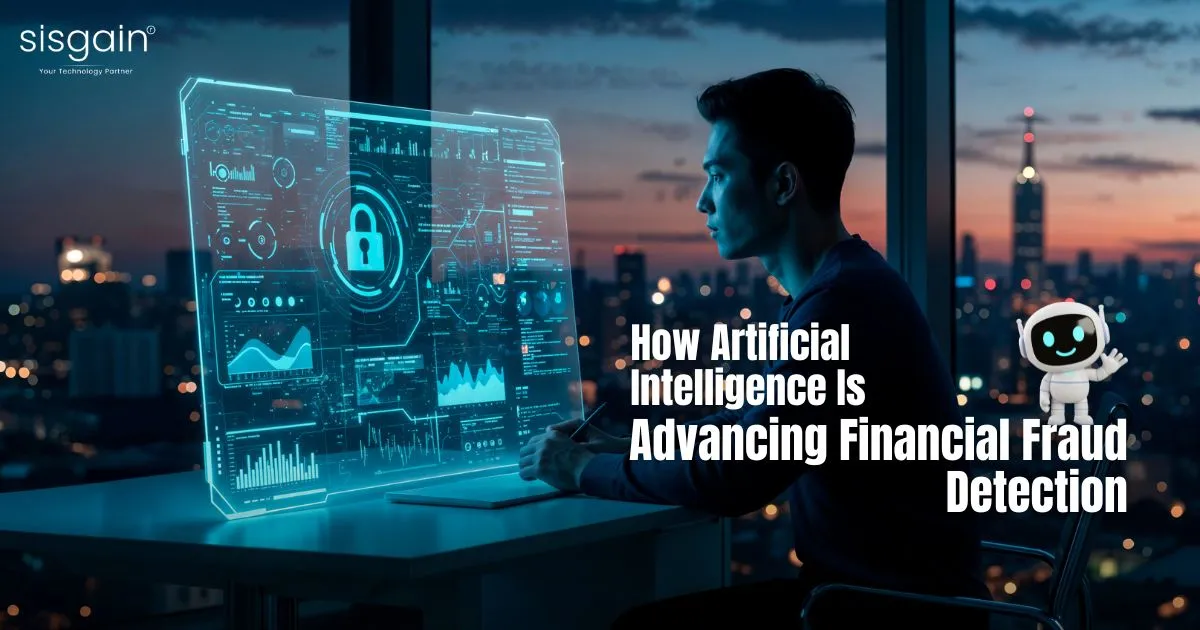
Financial fraud has always existed, but in today’s hyper-digital economy, it has become faster, smarter, and far more damaging. As businesses and consumers increasingly rely on online banking, digital payments, and mobile transactions, fraudsters have found new opportunities to exploit vulnerabilities. Traditional fraud detection methods, once considered reliable, are now struggling to keep pace with modern threats.
This is where Artificial Intelligence (AI) has emerged as a game changer. Leveraging advanced AI development services, organizations can build intelligent systems that not only detect fraud but also predict and prevent it before it occurs. AI is fundamentally transforming how financial risks are identified, analyzed, and mitigated. By learning from data, adapting to new patterns, and responding in real time, these AI-powered solutions enable businesses to move from reactive fraud prevention to proactive defense.
In this blog, we explore how artificial intelligence is advancing financial fraud detection, why it matters for modern businesses, and how AI-driven solutions are shaping the future of financial security.

Financial fraud today looks very different from what it did a decade ago. Earlier, fraud attempts were often easy to spot—suspicious transactions, obvious anomalies, or simple identity theft. Now, fraudsters use advanced techniques that closely mimic legitimate customer behavior, making detection far more complex.
Modern fraud schemes often involve multiple touchpoints, including compromised devices, fake identities, social engineering, and real-time transaction manipulation. Fraudsters analyze systems just as businesses do, constantly testing weaknesses and adjusting their strategies. This evolving nature of fraud makes static, rule-based systems increasingly ineffective.
What makes this new wave of fraud particularly dangerous is its scale and speed. Thousands of fraudulent transactions can occur within minutes, causing financial losses, reputational damage, and regulatory complications. Businesses can no longer afford to rely on outdated tools—they need intelligent systems that evolve as quickly as the threats themselves.
For many years, financial institutions relied on rule-based systems as the foundation of fraud prevention. These systems operated on predefined conditions, such as flagging high-value transactions or blocking activity from specific regions. While they once worked well, understanding what is fintech today reveals why these methods are no longer enough. Modern fintech is built on real-time payments, digital platforms, and data-driven services, which have exposed the limitations of rigid, rule-based fraud detection in a fast-moving financial environment.
One of the biggest challenges with rule-based systems is their lack of adaptability. Once fraudsters understand how these rules work, they can easily find ways to bypass them. At the same time, fixed rules often generate a high number of false positives, blocking genuine transactions and frustrating customers. This increases the need for manual reviews, raises operational costs, and negatively impacts the overall user experience.
Scalability is another critical concern. As transaction volumes grow and fintech ecosystems become more complex, traditional systems struggle to process data efficiently. They tend to react only after fraud has already occurred. In contrast, AI-powered fraud prevention solutions—designed for the realities of what is fintech today—learn continuously, adapt to emerging threats, and respond proactively, making them far more effective for modern fraud detection.
Artificial Intelligence brings a fundamental shift in the way fraud detection functions. Instead of being based on rigid rules AI machines analyze large quantities of data to comprehend the normal behaviour of people and immediately detect when something is different from the normal behavior.
The fraud detection technology of AI relies on machine-learning models that constantly learn from real-time and historical data. The models study patterns of transactions and user behaviour as well as device data and contextual signals to find subtle signs of fraud. As time passes the system gets smarter and more accurate with each new information point.
What is it that makes AI especially efficient is its ability to identify patterns that are not visible to humans. For instance, AI can identify unusual patterns in transactions, behavioral anomalies or hidden connections between accounts. This allows companies to identify fraud schemes in the early stages, usually before financial loss takes place.
One of the most powerful aspects of AI-driven fraud detection is behavioral analysis. Every user interacts with financial systems in a unique way—how they type, the time they transact, the devices they use, and even how frequently they log in.
AI systems build behavioral profiles for users and continuously compare new activity against these profiles. When behavior suddenly changes in an unusual way, the system raises an alert. This approach is highly effective because it focuses on behavior rather than just transaction values.
Behavioral intelligence also helps reduce false positives. Instead of blocking transactions solely based on rigid thresholds, AI evaluates context, ensuring legitimate users are not unnecessarily disrupted. This balance between security and user experience is a major reason why AI adoption is accelerating across the financial sector.
In the world of digital finance, speed is everything. A delay of even a few seconds can mean the difference between stopping a fraudulent transaction and suffering a financial loss.
AI-driven fraud detection systems operate in real time, analyzing transactions as they happen. These systems assess risk instantly and can trigger automated actions such as transaction blocks, alerts, or additional verification steps. This real-time capability significantly reduces the window of opportunity for fraudsters.
By processing vast amounts of data at lightning speed, AI enables businesses to respond proactively rather than reactively. This not only minimizes losses but also strengthens customer trust by ensuring secure and seamless transactions.
AI is not just a security tool—it is a strategic asset for businesses. By preventing fraud effectively, AI helps organizations protect revenue, maintain compliance, and enhance customer confidence.
AI-driven systems reduce dependency on manual reviews, lowering operational costs and improving efficiency. They also provide valuable insights into emerging fraud trends, allowing businesses to strengthen their defenses continuously. For industries such as banking, fintech, eCommerce, and insurance, AI has become an essential part of risk management strategies.
Many organizations are now investing in tailored solutions through professional AI development services, ensuring their fraud detection systems align with specific business needs and regulatory requirements.
Traditional fraud prevention strategies are largely reactive, focusing on identifying and managing damage after fraud has already occurred. AI fundamentally changes this approach by enabling proactive and predictive fraud prevention. Instead of waiting for red flags, AI identifies early indicators of suspicious behavior before losses escalate.
Through predictive analytics, AI assesses risk levels based on historical trends, behavioral shifts, and real-time signals. This allows businesses to take preventive actions, such as tightening authentication or limiting transaction capabilities, before fraud attempts succeed. Over time, this proactive approach significantly reduces exposure to financial and operational risks.
As AI systems continue to learn, businesses gain deeper visibility into vulnerabilities and attack patterns. This insight supports better long-term planning, smarter policy decisions, and more resilient security frameworks. The result is a fraud prevention strategy that evolves continuously rather than reacting to threats after the fact.
AI-powered fraud detection systems rely on a combination of advanced technologies working together to deliver accurate, real-time insights. Machine learning forms the foundation, enabling systems to learn from historical and live data while continuously improving detection accuracy. These models adapt automatically as fraud patterns change.
Deep learning techniques enhance this capability by analyzing complex, non-linear relationships across vast datasets. Natural Language Processing adds another layer by identifying fraud-related signals in emails, messages, and other communications, helping detect phishing and social engineering attacks. Together, these technologies provide a multi-dimensional view of fraud risk.
Big data analytics and cloud computing ensure scalability and performance. They allow AI systems to process massive volumes of data efficiently while maintaining the speed required for real-time decision-making. Combined, these technologies create intelligent, adaptive fraud detection systems that evolve alongside emerging threats.
Developing an effective AI-driven fraud detection system requires more than advanced algorithms. It demands expertise in data engineering, cybersecurity, regulatory compliance, and system integration. This is where experienced AI software development companies play a vital role.
These companies help businesses design and deploy fraud detection solutions tailored to their specific operational and regulatory environments. From data preparation and model training to system integration and performance optimization, they ensure AI solutions deliver measurable and sustainable results.
By partnering with the right development team, organizations can implement robust AI systems without disrupting existing workflows. This allows businesses to focus on growth and innovation while maintaining a strong, future-ready fraud prevention framework.

As AI adoption accelerates, many organizations are turning to specialized artificial intelligence services companies to guide their digital transformation. These companies provide end-to-end support, covering strategy development, solution design, implementation, and continuous optimization.
Their expertise ensures AI systems are accurate, transparent, and scalable while meeting strict regulatory requirements. This is particularly important in financial services, where explainability, auditability, and data security are critical for compliance and trust.
By working with experienced AI partners, businesses can accelerate innovation, reduce implementation risks, and maximize the long-term value of AI investments. This collaborative approach enables organizations to stay competitive in an increasingly complex fraud landscape.
One of the most persistent challenges in fraud detection is finding the right balance between strong security and a seamless user experience. When systems generate too many false positives, legitimate transactions are declined, leading to customer frustration, abandoned purchases, and loss of trust. Traditional rule-based models often struggle with this balance because they rely on fixed thresholds that fail to consider real-world context. Artificial Intelligence addresses this limitation by evaluating risk in a far more intelligent and adaptive way, allowing businesses to protect transactions without creating unnecessary friction for genuine users.
Rather than depending on rigid rules, AI analyzes multiple data points simultaneously, including user behavior, transaction patterns, device signals, and situational context. This layered assessment enables AI to distinguish between genuine anomalies and actual fraud attempts with greater accuracy. As a result, fewer legitimate transactions are interrupted, approval rates improve, and customers enjoy a smoother experience—while businesses continue to maintain robust, reliable fraud prevention mechanisms.
Regulatory compliance is a critical priority for financial institutions, and failing to meet standards can result in heavy penalties and reputational damage. Modern AI solutions simplify compliance by automating monitoring, reporting, and risk assessment processes. Through advanced analytics and continuous tracking of transactions and user activities, AI can quickly identify suspicious behavior and flag potential regulatory issues. By integrating intelligent monitoring systems developed through professional AI development services, organizations can ensure that their compliance processes are accurate, consistent, and scalable across multiple operations.
Beyond improving accuracy, AI-driven compliance solutions free up valuable human resources. Teams no longer need to spend hours manually reviewing transactions or generating reports, allowing them to focus on strategic initiatives and higher-value tasks. The automation provided by AI not only reduces regulatory risk but also enhances operational efficiency, ensuring that businesses can confidently meet compliance requirements while maintaining strong security and customer trust.
The role of Artificial Intelligence in financial fraud detection is set to grow significantly as technologies advance. Future AI systems will become more autonomous, capable of analyzing vast amounts of data with minimal human intervention while making real-time, predictive decisions. These systems will not only detect fraud faster but also anticipate potential risks by identifying subtle patterns that indicate emerging threats. Collaboration across platforms and institutions will further strengthen fraud prevention, allowing AI models to share intelligence and adapt to new tactics as soon as they are observed.
As fraudsters continue to innovate and develop increasingly sophisticated techniques, AI will remain the most effective defense. Its ability to learn continuously from data, evolve with changing patterns, and respond proactively ensures businesses can stay ahead of threats. By investing in advanced AI solutions today, organizations can build a resilient fraud prevention framework that safeguards both revenue and customer trust for the future.
SISGAIN stands out as a forward-thinking technology partner that helps businesses turn Artificial Intelligence into a real competitive advantage. As an experienced AI app development company, SISGAIN designs intelligent, scalable solutions that address complex challenges such as financial fraud detection, risk analysis, and real-time monitoring. Their approach goes beyond building software—they focus on understanding business processes, user behavior, and security requirements to deliver AI systems that are both powerful and practical.
Unlike many AI software development companies that offer generic solutions, SISGAIN specializes in customized AI applications tailored to industry-specific needs. From developing advanced machine learning models to seamless system integration and ongoing optimization, SISGAIN ensures that AI solutions evolve alongside emerging fraud patterns. This commitment to innovation, accuracy, and long-term value makes SISGAIN a reliable partner for organizations looking to strengthen security while maintaining a smooth customer experience.

Artificial Intelligence is no longer a luxury for financial institutions—it has become essential. The complexity and speed of modern financial fraud require intelligent, adaptive solutions that traditional systems alone cannot handle. Companies that embrace AI gain the ability to detect, prevent, and respond to threats in real time, protecting both revenue and customer trust.
At SISGAIN, we combine deep industry expertise with advanced AI technologies to deliver solutions that are tailored, scalable, and future-ready. By leveraging professional AI development services, businesses can implement robust fraud detection systems that evolve alongside emerging risks, ensuring security without compromising operational efficiency.
Secure your business and stay in front of scammers. Work in SISGAIN today to leverage AI-powered solutions that can ensure your financial operations are protected with confidence.







Start Build Your
Next Digital Solution?
Let’s build scalable, future-ready digital solutions tailored to your business goals. Connect with our experienced technology consultants to discuss your vision, strategy, and growth opportunities — with zero obligation and complete transparency.
Get a free consultation and cost estimate for your digital solution
Our expert will contact you within 24 hours. Check your email for confirmation.
Partner with SISGAIN experts to build secure, scalable AI-powered IT Solutions that transform your business operations.









DUQE FREEZONE Quarter Deck, Queen Elizabeth 2, Mina Rashid, Dubai, UAE

100 Consilium Pl Suite 200, Scarborough, ON M1H 3E3, Canada

C-109, Sector 2, Noida, Uttar Pradesh 201301 India
Project quotes, partnerships, implementation
Open roles, referrals, campus hiring