
 +1 844-445-5767
 +971 56-848-5757
 +91 921-208-0630
For Business & Service Inquiries
Sales Team
Project quotes, partnerships, implementation

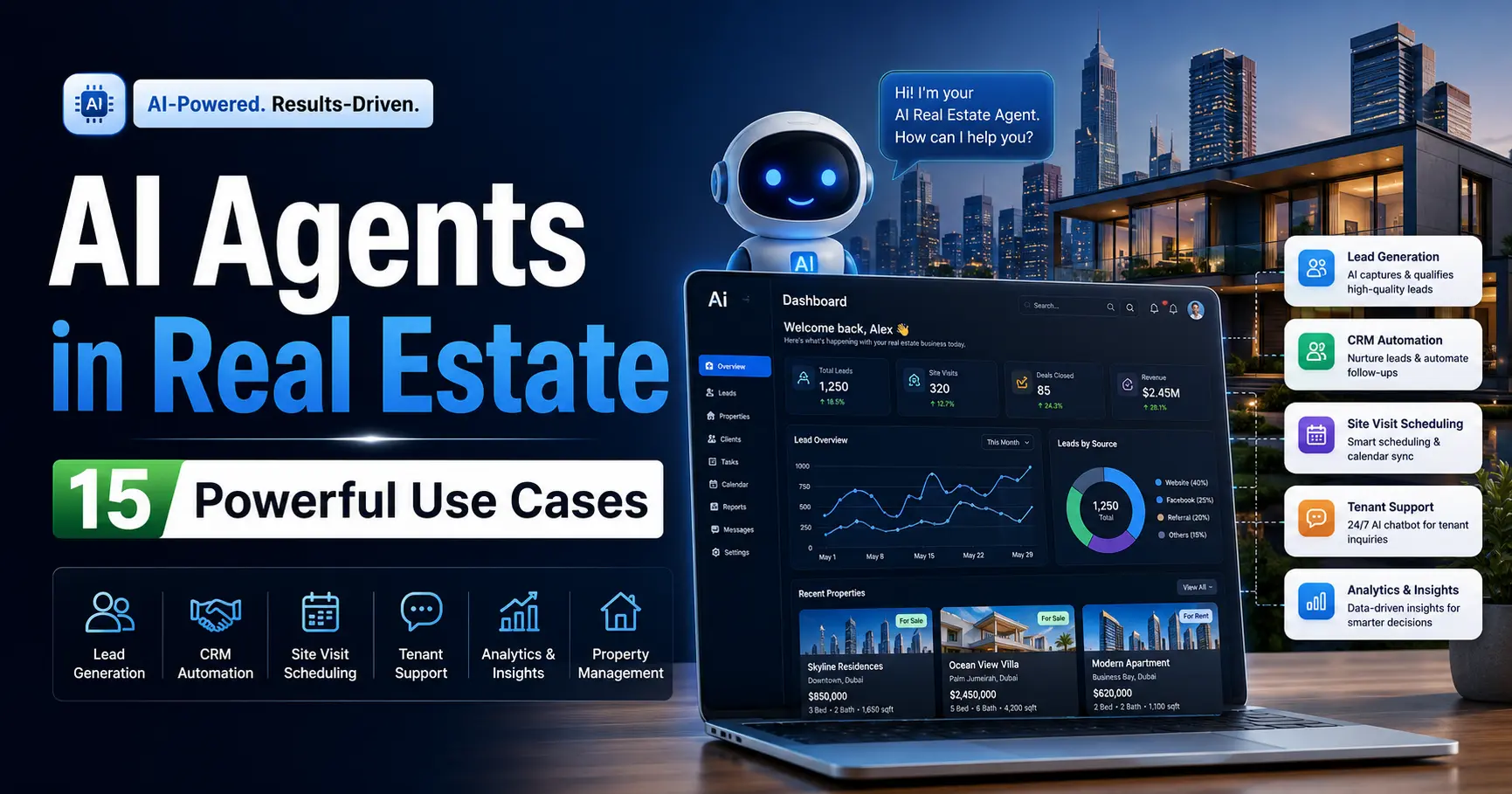
Key Takeaways A modern real estate AI chatbot can capture, qualify, and nurture leads 24/7 without increasing operational workload. Agencies responding to inquiries within the first few minutes are significantly more likely to convert leads into viewings and closed deals. AI chatbot for real estate businesses is no longer limited to FAQs — modern systems now support MLS integrations, WhatsApp automation, appointment booking, multilingual communication, and CRM syncing. Chatbots in real estate help reduce repetitive admin tasks, allowing agents to focus more on negotiations, relationship-building, and conversions. A chatbot for real estate agents can automate lead qualification, viewing scheduling, follow-ups, and buyer engagement across multiple channels. Property management chatbot solutions are becoming increasingly valuable for tenant support, lease renewals, maintenance requests, and rental communication workflows. Real estate businesses adopting AI early are building stronger operational scalability and faster customer response systems than traditional competitors. The future of AI in real estate is shifting toward predictive AI, voice assistants, hyper-personalized recommendations, and proactive conversational automation. Choosing the right chatbot depends on your lead volume, CRM ecosystem, target market, communication channels, and long-term scalability goals. The highest-performing real estate businesses in 2026 are not just adopting AI tools — they are building AI-powered communication ecosystems. It’s 11:43 PM. A potential buyer in Dubai is scrolling through luxury apartments after work. After browsing multiple listings, they finally find a property that feels perfect — sea-facing views, modern interiors, close to Downtown Dubai, and within budget. They click the chat button on the agency website and type: “Is this apartment still available? Can I schedule a viewing tomorrow?” But no one replies. Ten minutes later, the buyer is already chatting with another brokerage. That’s how fast modern real estate moves today. Buyers no longer wait for office hours to inquire about properties. They browse listings during late-night scrolling sessions, lunch breaks, airport layovers, and weekend property hunts. Whether it’s a first-time buyer in London, an investor in Singapore, or a tenant searching apartments in Mumbai, customer expectations have changed dramatically across global markets. People now expect instant answers and in a highly competitive market where responsiveness directly impacts trust, slow communication quietly becomes one of the biggest reasons agencies lose qualified leads. This is exactly why the rise of the real estate AI chatbot has become one of the biggest operational shifts in the property industry. Brokerages are no longer competing only on listings, ad budgets, or market expertise. They’re competing on speed, customer experience, lead management, and automation. An advanced AI chatbot for real estate can now capture leads 24/7, qualify buyers automatically, answer property questions instantly, schedule appointments, automate follow-ups, support tenants, and integrate directly with CRM and MLS systems. More importantly, modern chatbots in real estate are no longer basic FAQ widgets with robotic replies. They’ve evolved into intelligent communication systems powered by conversational AI, machine learning, automation workflows, and real-time property data. This guide is built from the analysis of real-world AI deployments across residential agencies, commercial brokerages, leasing companies, and property management operations worldwide. No fluff ,No exaggerated promises and No vendor bias. Just a practical, strategic breakdown of how AI chatbots are reshaping real estate operations in 2026 — and what smart agencies are doing differently. Real Estate Is Entering Its “AI Infrastructure” Era For years, artificial intelligence in real estate was viewed as an experimental trend rather than a business necessity. Most traditional brokerages treated AI as something futuristic — a technology explored mainly by large enterprises and PropTech startups. But in 2026, that perception has changed completely. AI is no longer an optional upgrade for modern real estate businesses. It is becoming operational infrastructure. Just as CRM platforms, listing portals, and digital advertising became essential over the last decade, AI-powered automation is now deeply integrated into brokerage workflows worldwide. AI is now reshaping workflows across AI in real estate, especially in lead management and customer communication. The rise of Artificial Intelligence in real estate accelerated after 2020 as agencies began facing rising lead acquisition costs, growing customer expectations, staffing inefficiencies, and increasing pressure to respond instantly. According to recent customer engagement studies, nearly 70% of buyers now expect businesses to respond within minutes rather than hours. As a result, modern real estate companies are no longer competing only on listings, pricing, or market expertise. They are competing on responsiveness — and responsiveness has become a major trust signal. Buyers often interpret delayed replies as poor service quality, low urgency, or outdated operational systems. Imagine two agencies with similar property listings. One responds instantly with personalized recommendations, viewing schedules, financing guidance, and multilingual support. The other replies six hours later with a simple “Sorry for the delay.” The outcome is predictable. This is where a real estate AI chatbot changes the game. Not because AI replaces agents, but because it removes operational friction. Modern AI systems help agencies capture inquiries 24/7, automate repetitive conversations, prioritize high-intent buyers, and maintain communication across multiple channels without overwhelming teams. The agencies scaling fastest in 2026 are not necessarily the ones hiring more agents — they are the ones building smarter systems. The future of real estate is no longer just digital. It’s conversational. The Hidden Cost of Slow Real Estate OperationsMost brokerages underestimate how much revenue they lose because of operational delays. In many cases, the issue isn’t lead generation or marketing performance. Modern agencies are already investing heavily in Google Ads, Meta campaigns, listing portals, SEO, referrals, and social media marketing to attract buyers and sellers. The real problem usually begins after the lead arrives. 1.The 5-Minute Window Most Agencies Still Ignore According to multiple sales and conversion studies, leads contacted within the first five minutes are significantly more likely to convert compared to leads contacted after 30 minutes. Yet delayed responses are still one of the most common operational problems in real estate. A typical Monday morning inbox for many agents often looks like this: 17 unread portal inquiries 9 WhatsApp messages 6 missed calls 4 Instagram DMs 11 email leads 3 property viewing requests multiple tenant maintenance questions Now multiply that across several agents, dozens of active listings, and multiple time zones. The result is operational chaos. And operational chaos creates lead leakage. Every delayed response increases the likelihood that the buyer contacts another agency, loses interest, or forgets the inquiry entirely. 2. Manual Qualification Is Draining Real Estate Teams One of the biggest hidden inefficiencies in real estate is repetitive communication. Agents spend a large portion of their day answering the same questions repeatedly: “Is this property still available?” “What’s the down payment?” “Can I schedule a viewing?” “Is parking included?” “Do you allow pets?” “What are the maintenance charges?” Individually, these questions seem small. Collectively, they consume hours every single day. As a result, highly skilled agents end up spending more time on administrative filtering instead of focusing on negotiations, relationship building, deal structuring, and closing. This is where a properly implemented chatbot for real estate agents creates real operational value. Instead of replacing agents, it automates repetitive conversations while routing high-intent buyers directly to the right human at the right time. 3. The “Always-On Buyer” Problem Modern real estate has become a 24/7 global marketplace. International investors browse listings across time zones, rental inquiries arrive late at night, and luxury buyers increasingly expect concierge-level responsiveness. Traditional office-hour workflows simply cannot keep pace with these expectations anymore. This is one of the biggest reasons chatbots in real estate are growing so rapidly worldwide. They allow agencies to remain available even when internal teams are offline. And in today’s property market, availability directly impacts conversion rates. 4.The Cost of Waiting to Adopt AI Some brokerages still view AI automation as something they will “implement later.” But that delay has a growing business cost. Competitors adopting AI today are already: capturing more after-hours leads, reducing administrative workload, increasing appointment booking rates, improving response times, and scaling customer communication without massively increasing headcount. The gap between AI-enabled agencies and traditional operations is widening every quarter. And as customer expectations continue rising, the longer businesses wait to modernize their communication systems, the harder it becomes to compete on customer experience. What a Modern Real Estate AI Chatbot Actually Does If your last experience with chatbots involved robotic pop-ups saying: Please choose option 1 or option 2. then modern AI systems are completely different. Today’s real estate AI chatbot technology is powered by conversational AI, natural language processing (NLP), machine learning, and automation workflows. Instead of following rigid scripts, modern systems understand context, interpret buyer intent, and respond more naturally. For example, a buyer can type: “Show me 3-bedroom apartments near Downtown Dubai under AED 2M.” A modern AI chatbot for real estate can instantly analyze the request, search connected listings, and recommend suitable properties within seconds. Modern chatbots in real estate can now: Capture and qualify leads 24/7 Answer property-related questions instantly Schedule property viewings automatically Send follow-up reminders Integrate with CRM and MLS systems Support WhatsApp and social media conversations Handle tenant and rental inquiries More importantly, these systems continuously improve through machine learning by analyzing customer behavior and conversation patterns over time. In simple terms, a chatbot for real estate agents helps reduce repetitive work, improve response speed, and create a smoother customer experience in today’s fast-moving property market. Why 2026 AI Chatbots Are Completely Different From Older Bots Traditional Chatbots Modern AI Chatbots Scripted responses Conversational communication FAQ-based logic Intent recognition No personalization Contextual memory Static workflows Adaptive automation Limited integrations CRM + MLS + WhatsApp integration Basic support Intelligent lead qualification Modern AI systems are now capable of understanding complex and highly detailed buyer queries in a natural conversational format. Instead of relying on fixed keywords or scripted inputs, a real estate AI chatbot can analyze customer intent, preferences, budget range, location priorities, and property requirements simultaneously. This level of intelligence is powered by advanced natural language processing (NLP) and machine learning technologies. Over the last few years, conversational AI platforms and machine learning development services have evolved significantly, allowing chatbots to deliver faster, smarter, and more personalized interactions for modern real estate businesses. The Technology Stack Behind Modern AI Chatbots Behind the scenes, advanced real estate chatbots operate using several connected systems: 1. Natural Language Processing (NLP) Natural Language Processing allows the chatbot to understand human conversations in a more natural and contextual way. Instead of reacting only to keywords, the system can interpret buyer intent, preferences, and conversational meaning to deliver more relevant responses. 2. CRM Integration Modern chatbots can sync lead data directly into CRM platforms like HubSpot, Salesforce, Zoho, Follow Up Boss, and Pipedrive. This helps agencies centralize customer communication, automate lead tracking, and reduce manual data entry across sales teams. 3. MLS/IDX Integration With MLS and IDX integration, the chatbot can access live property listings, pricing updates, and availability data in real time. This allows buyers to receive accurate property recommendations instantly without waiting for manual responses from agents. 4. Automation Workflows Advanced automation workflows help manage repetitive operational tasks automatically. Viewing confirmations, appointment reminders, lead routing, and follow-up sequences can all run in the background without requiring constant manual coordination. 5. Multi-Channel Communication Modern AI chatbots are designed to work across multiple communication channels simultaneously, including websites, WhatsApp, Facebook Messenger, Instagram, SMS, and mobile apps. This helps agencies maintain consistent customer engagement wherever buyers prefer to communicate. Most legacy real estate software tools are being replaced with unified AI-powered systems that combine CRM, MLS, and automation. The 4-Layer AI Framework Powering Modern Real Estate Chatbots To understand how modern AI systems operate in real estate, it helps to think about them in four layers. Modern real estate AI systems are far more advanced than simple customer support tools. The most effective chatbots operate through a layered automation framework that helps agencies capture leads, qualify buyers, improve conversions, and manage long-term customer communication at scale. Layer 1 — Lead Capture Layer The first layer focuses on capturing every possible inquiry across multiple communication channels. This includes website chat widgets, WhatsApp, property portals, landing pages, Facebook, Instagram, and other digital touchpoints. The goal is simple: never let a potential lead go unanswered. Instead of depending entirely on office hours or manual responses, the chatbot remains active 24/7 and ensures buyers can engage with the business anytime. Layer 2 — Qualification Layer Once the conversation starts, the chatbot moves into lead qualification. It gathers important buyer information such as budget, preferred location, property type, financing status, timeline, and investment goals. This allows the system to intelligently score leads and identify which inquiries are high-intent, warm, or low-priority. As a result, agents spend less time filtering conversations manually and more time focusing on serious buyers. Layer 3 — Conversion Layer The third layer is focused on turning interest into action. Here, the system can recommend relevant properties, schedule viewings, send reminders, automate follow-ups, and instantly route hot leads to agents. This significantly improves response speed and helps agencies reduce lead leakage during the decision-making process. Layer 4 — Retention Layer The final layer becomes especially valuable for leasing companies and property management operations. The chatbot continues supporting customers even after the initial transaction by handling tenant communication, maintenance requests, renewal reminders, payment notifications, and ongoing support queries. This layered approach transforms a chatbot from a basic support feature into a scalable real estate business system capable of supporting sales, operations, and customer experience simultaneously. 12 High-Impact Ways AI Chatbots Generate Real Estate Leads Based on deployments across residential agencies, commercial brokerages, and leasing businesses, these are the use cases consistently delivering the strongest ROI. 1. 24/7 Lead Capture Across Multiple Channels A modern real estate AI chatbot ensures every property inquiry receives an instant response, regardless of office hours or time zones. It can automatically collect buyer details like budget, preferred location, timeline, and property type while helping agencies capture leads that might otherwise be lost. 2. AI-Powered Lead Qualification Modern AI systems can automatically qualify leads by asking smart questions related to budget, financing status, and buying intent. This helps agents focus more on serious buyers instead of spending hours filtering low-intent inquiries manually. 3. Live Property Search With MLS/IDX Integration AI chatbots can instantly recommend relevant property listings based on customer preferences and live market data. This creates a faster and more personalized buying experience compared to traditional manual property sharing. 4. Automated Viewing & Appointment Scheduling Modern chatbots can integrate with scheduling platforms to automate property viewing bookings, confirmations, and reminders. This reduces manual coordination work and helps agencies minimize missed appointments and no-shows. 5. WhatsApp Automation for Global Buyers In mobile-first markets, chatbots can automate conversations directly through WhatsApp by sharing listings, brochures, viewing details, and follow-ups instantly. This creates a smoother communication experience for modern buyers. 6. AI Follow-Up That Revives Cold Leads AI systems can automatically send personalized follow-ups based on user behavior, search preferences, and previous conversations. This helps agencies re-engage buyers who may have gone inactive during the decision-making process. 7. Virtual Tours & Interactive Property Discovery Modern AI chatbots can guide buyers through virtual tours, 3D walkthroughs, interactive floor plans, and video property experiences directly within the conversation flow. This is especially useful for remote and international buyers. 8. Mortgage Pre-Qualification Automation AI chatbots can help brokerages pre-screen buyers by collecting financial information and connecting qualified users with financing partners. This speeds up the sales process while improving lead quality for agents. 9. Seller Lead Generation Automation Modern systems can automate “What’s My Home Worth?” workflows by collecting property details, generating estimated valuations, and routing seller inquiries directly to agents for faster follow-up. 10. Property Management Chatbot Workflows A property management chatbot can automate tenant communication, maintenance requests, lease renewals, payment reminders, and onboarding support. This helps leasing businesses reduce repetitive operational workload significantly. 11. AI Leasing Assistants for Rental Businesses AI leasing assistants can automate rental inquiries, qualification checks, viewing coordination, and lease-related FAQs. This allows leasing teams to focus more on conversions and tenant relationships instead of repetitive communication. 12. Multilingual Buyer Engagement at Scale Modern AI systems support multiple languages, allowing agencies to communicate more effectively with international buyers and investors. This creates a more personalized customer experience across global real estate markets. Real ROI: What AI Chatbots Actually Change in a Real Estate Business The biggest misconception about AI chatbots is that they’re primarily “support tools.” In reality, their biggest impact is operational. They improve: response speed, lead quality, booking efficiency, customer experience, and agent productivity. 1. Faster Responses = Higher Conversion Rates One of the strongest ROI drivers is speed. With AI automation, real estate agencies can reduce response time from hours to just seconds. This faster engagement directly increases conversion rates because buyers are contacted while intent is still high. 2. Reduced Cost Per Qualified Lead When AI chatbots automatically filter and qualify leads, agents spend less time on low-intent inquiries. This improves efficiency, reduces wasted ad spend, and ensures that marketing budgets generate better-quality prospects. 3. More Bookings Without Hiring More Agents Instead of scaling through hiring, AI allows brokerages to scale communication. This makes growth more sustainable because agencies can handle more inquiries without increasing headcount or operational pressure. 4. Better Agent Productivity Top-performing agents should focus on high-value activities like negotiations, relationship building, property showings, and closing deals. AI removes repetitive FAQ handling so agents can focus on revenue-generating tasks. 5.AI Automation vs Expanding Your Sales Team Metric Traditional Agency AI-Enabled Agency Response Time Hours Seconds Lead Qualification Manual Automated Weekend Lead Capture Limited 24/7 Admin Workload High Reduced Follow-Up Consistency Variable Automated Scalability Hiring-dependent System-driven 6. Case Study: Dubai Brokerage A mid-sized Dubai brokerage implemented WhatsApp automation and website AI chat across its luxury property division. Within months, they saw faster response times, higher booking requests, and improved after-hours lead capture. The key factor was not full automation — but starting small with focused workflows like lead qualification, property search, and appointment booking. 7. Case Study: UK Lettings Agency A UK-based rental agency used a property management chatbot to automate tenant support. This reduced workload on support teams and improved response consistency. Maintenance requests were also categorized and routed more efficiently, reducing missed tickets. What This Means for Small Agencies Even small agencies can benefit significantly from AI adoption. For example, if the average commission is $8,000 and a chatbot generates even a few extra qualified leads per month, the ROI can justify the investment quickly. This is why many agencies now see AI in real estate not as a trend, but as a long-term operational advantage. Why Most Chatbots in Real Estate Fail Not every chatbot deployment succeeds. In fact, many fail because agencies treat AI like a plug-and-play tool instead of an operational system. Mistake 1: Treating AI as instant magic instead of a system that needs workflow planning, integration, training, and continuous optimization. This usually happens when businesses avoid custom real estate software development and depend on generic chatbot solutions that don’t fit their workflow. Mistake 2: Weak CRM and MLS integration that creates data silos and breaks real estate lead flow and visibility, making it difficult for teams to track, manage, and convert leads efficiently across different systems. Mistake 3: Robotic conversations that feel repetitive, generic, and frustrating, which reduce user trust and engagement because most chatbots rely on rigid scripts instead of understanding intent and context, making buyers feel like they are talking to a machine rather than a helpful assistant. Mistake 4: No human escalation strategy, leaving users stuck without access to an agent during urgent, emotional, or high-value conversations. Without a proper handoff system, complex queries cannot be resolved effectively, which creates frustration for serious buyers and reduces the chances of closing high-value deals. . Mistake 5: Ignoring mobile and WhatsApp experience leads to poor performance and major lead loss in mobile-first real estate markets due to lack of optimization for WhatsApp automation, mobile responsiveness, and instant replies. Mistake 6: Set and forget” deployment without maintenance, despite changing listings, market shifts, and evolving AI systems that require ongoing optimization. Chatbots need continuous updates, training, and performance monitoring to stay accurate and aligned with real estate market dynamics and buyer behavior trends. 2026 AI Trends That Will Redefine Real Estate Here are the key AI trends that will shape the future of real estate communication and property discovery. These technologies are moving real estate from reactive systems to highly predictive and personalized experiences. AI Trend Real Estate Impact Voice AI Call handling, lead screening, booking automation Agentic AI Proactive leads, alerts, personalized outreach AI Property Advisors Smart property matching based on lifestyle Predictive AI Identifies buyer intent before search Conversational Commerce Natural language property search AI + AR/VR Tours Immersive remote property viewing Hyper-Personalization Memory-based recommendations & CRM targeting How to Successfully Implement an AI Chatbot in Your Real Estate Business Implementing an AI chatbot in real estate is not just a technical setup, but a structured business strategy. Success depends on how well you plan, integrate, and continuously optimize the system. Step 1 — Audit Your Existing Lead Funnel Analyze your lead sources, response times, and bottlenecks to identify where prospects are getting delayed or lost. Step 2 — Define Your Automation Goals Set clear objectives like faster responses, better lead qualification, appointment booking, or improved tenant support. Step 3 — Choose the Right AI Architecture Select lightweight SaaS tools for small teams or custom AI systems with advanced workflows for larger enterprises. Step 4 — Connect CRM, MLS & Communication Channels Integrate all systems to ensure smooth lead flow, centralized communication, and accurate tracking. Step 5 — Train the AI With Real Buyer Conversations Use real customer queries and interactions to make chatbot responses more natural and relevant. Step 6 — Launch, Measure & Optimize Track performance metrics like conversions, bookings, response time, and continuously improve the system. How to Choose the Right AI Chatbot for Real Estate Choosing the right AI chatbot for real estate means picking a solution that matches your business needs while ensuring smooth integration, scalability, and long-term efficiency beyond basic automation, which is why working with an experienced AI chatbot development company ensures proper CRM integration, scalability, and long-term automation success. Lead Volume — Understand how many inquiries your brokerage handles daily or monthly to choose a system that can manage the load effectively.Market Complexity — Consider whether you serve local buyers, international clients, or multiple regions with different needs.Team Size — Select a solution that fits your internal workflow and the number of agents handling leads.Language Support — Ensure the chatbot can communicate in all required languages for your audience.CRM Integration — Check whether it connects seamlessly with your CRM, MLS, or IDX systems for smooth data flow.Channel Support — Verify support for platforms like WhatsApp, website chat, and other communication channels.Scalability — Choose a system that can grow as your business expands without performance issues.Human Handoff — Ensure there is an option to transfer conversations to human agents when needed.Compliance — Confirm the platform follows data protection standards like GDPR or local regulations. Basic SaaS chatbots suit small agencies with simple workflows and low lead volume, offering quick setup and ease of use. Mid-market tools are better for growing brokerages that need stronger integrations and more control over operations. Custom AI systems are ideal for enterprise-level businesses with high lead volume, complex workflows, and advanced integration needs, offering better scalability and long-term flexibility. Build a Real Estate AI System — Not Just a Chatbot Real estate automation is no longer just about adding a chat widget. It is about building a scalable system that captures leads, responds instantly, and manages the entire buyer journey in a structured and intelligent way. Many brokerages now prefer custom AI development solutions over generic chatbot tools to gain full control over workflows, integrations, and long-term scalability. Companies like SISGAIN help businesses develop custom AI-driven systems that go beyond basic chatbot functionality and focus on end-to-end automation and seamless integration. Top agencies today are not just using software—they are transforming how customer communication and lead management operate as a unified, connected system. Conclusion At the end of the day, real estate is still a people-driven business. AI can respond faster, organize better, and never miss a lead, but it works best when it supports—not replaces—human connection. The real value lies in using these systems to remove delays, reduce friction, and make sure every serious buyer gets the right attention at the right time. The best chatbot in the world won’t close a deal. But it will make sure the right human is on the phone when it matters most.

Are you still juggling spreadsheets, calls, emails, and paperwork to manage properties and clients? In today’s competitive market, relying on manual processes can slow you down and cost you valuable deals. This is where real estate software becomes a game changer. From lead generation and listings to transactions and property management, modern realtor software helps professionals work smarter, close faster, and scale efficiently.In this detailed guide, we’ll explore what real estate software is, its benefits, key selection criteria, a deep dive into the top 16 real estate software tools and how to use these tools effectively.What is real estate software?Real estate software refers to digital tools and platforms designed to support real estate agents, brokers, property managers, and agencies in managing daily operations. These tools cover everything from lead management, customer relationships, and marketing to property listings, accounting, compliance, and analytics.Whether it’s software for realtors, real estate agent software programs, or an all-in-one real estate platform software, these solutions help centralize data, automate workflows, and improve collaboration across teams.In short, a real estate software program replaces fragmented manual systems with a unified, scalable digital ecosystem.Benefits of using real estate softwareImplementing the best real estate software offers clear advantages for agents and agencies of all sizes which are detailed below:1. Improved productivity: Automation reduces repetitive tasks like follow-ups, scheduling, and document handling, allowing agents to focus on closing deals.2. Better lead and client management: With real estate agent management software, leads are captured, tracked, and nurtured systematically, improving conversion rates.3. Centralized property listings: Real estate listing software ensures all listings, images, pricing, and availability are stored and updated in one place.4. Enhanced customer experience: Fast responses, accurate information, and professional communication improve trust and long-term relationships.5. Data-driven decisions: Analytics and reporting from real estate softwares help you understand performance, market trends, and ROI.6. Scalability and growth: The right software for real estate supports business growth without increasing operational complexity.What to consider when choosing real estate softwareBefore investing in software for estate agents, it’s important to evaluate your business needs carefully to ensure you select a solution that delivers long-term value. The right real estate software should not only support current operations but also scale with your growth.Business size and goals: Solo agents, small brokerages, and large enterprises all require different capabilities. While individual agents may prioritize lead management and listings, larger firms often need advanced reporting, multi-user access, and real estate agent management software to coordinate teams and portfolios.Ease of use: The best software for realtors should be intuitive and easy to adopt. A user-friendly interface reduces training time, improves adoption, and ensures agents can focus more on clients rather than technology.Customization: Every real estate business operates differently. Flexible workflows, customizable dashboards, and adaptable features are essential, especially when using specialized real estate software programs.Integration: Choose tools that integrate seamlessly with MLS, accounting, marketing, and communication platforms. Strong integrations reduce manual work and create a unified ecosystem.Mobile accessibility: Modern agents need real-time, on-the-go access. Mobile-friendly real estate agent software enables updates, communication, and document handling from anywhere.Security and compliance: Protecting client and financial data is critical. Look for secure systems with encryption, access controls, and compliance support.Cost and ROI: Evaluate pricing against features, efficiency gains, and scalability. The best software for real estate agents aligns technology with your operational needs and growth plans.Top 16 real estate software toolsBelow are the top 16 real estate software programs widely used across the globe, offering powerful solutions that help agents, brokers, and real estate businesses manage operations efficiently:1. SISGAIN – Custom Real Estate Software SolutionsSISGAIN specializes in delivering tailored, scalable, and secure real estate technology designed to meet the evolving needs of agents, brokers, and enterprises. As a trusted real estate software development company, SISGAIN focuses on building solutions that align perfectly with business workflows rather than forcing businesses to adapt to generic platforms.Customized Real Estate Software Development: SISGAIN develops fully customized real estate software programs that cover CRM, property and listing management, transaction workflows, and commission tracking. These solutions are designed to simplify daily operations while improving efficiency and accuracy across teams.End-to-End Real Estate Platform Solutions: From lead generation to deal closure, SISGAIN builds complete real estate platform software that supports the entire real estate lifecycle. This includes client portals, agent dashboards, admin panels, and integrated analytics for data-driven decision-making.Advanced Integrations and Scalability: SISGAIN ensures seamless integration with MLS systems, payment gateways, accounting software, and marketing tools. Their real estate agent software solutions are built with scalability in mind, allowing businesses to expand portfolios, agents, and locations without performance issues.Security, Compliance, and Performance: All solutions are developed with strong security protocols, including role-based access control, data encryption, and compliance-ready architecture. This makes SISGAIN ideal for businesses seeking reliable and future-ready real estate office software that supports long-term growth.2. HubSpot CRMHubSpot CRM is a widely used real estate agent software that helps agents, brokers, and real estate teams manage leads, clients, and sales pipelines from a single platform. Known for its user-friendly interface, HubSpot is especially popular among real estate professionals who want powerful features without complex setup.Lead and Contact Management: HubSpot allows real estate businesses to capture leads from websites, landing pages, and social media and store them in a centralized database. Agents can track every interaction, including calls, emails, and meetings, making it easier to nurture prospects and build long-term relationships.Sales Pipeline and Deal TrackingWith customizable pipelines, HubSpot functions as effective software for realtors to monitor deals at every stage—from initial inquiry to closing. Automated task reminders and deal stages help agents stay organized and never miss a follow-up.Marketing Automation and Email Tools: HubSpot includes built-in email marketing, automation, and lead nurturing tools. Real estate teams can send personalized property updates, market reports, and follow-up sequences, making it one of the most efficient real estate software programs for client engagement.Reporting and Integration: The platform offers detailed reports and dashboards to track performance, conversion rates, and agent productivity. HubSpot also integrates smoothly with listing websites, marketing tools, and other real estate software, making it a flexible choice for growing agencies.3. Salesforce Salesforce is an enterprise-level CRM platform commonly adopted by large real estate brokerages and property organizations that need advanced control over sales operations and client data.Lead, Client, and Agent Management: Salesforce enables teams to manage prospects, clients, properties, and agents within a centralized system. Custom fields and dashboards help brokerages track performance, assign leads efficiently, and monitor deal progress across multiple teams.Workflow Automation: One of Salesforce’s strongest features is automation. Tasks such as follow-ups, approvals, notifications, and status updates can be automated, reducing manual work and ensuring consistency across transactions.Data Analytics and Reporting: Salesforce provides powerful analytics tools that offer real-time visibility into pipelines, revenue trends, and operational performance. These insights support informed decision-making and long-term planning.Integration and Scalability: The platform integrates with MLS services, marketing tools, and accounting systems. Its scalable architecture makes Salesforce suitable for organizations managing high volumes of listings, agents, and transactions.4. BoomTownBoomTown is a lead generation and CRM-focused software for realtors designed to help agents and brokerages attract, manage, and convert leads efficiently. It is especially valuable for teams that rely on online marketing and need fast lead response capabilities.Lead Generation and Advertising: BoomTown enables real estate professionals to generate high-quality leads through targeted ads and optimized landing pages. Inquiries from buyers and sellers are captured from multiple digital channels and stored in a centralized system for easy management.Intelligent Lead Routing and Follow-Ups: A standout feature of this software for realtors is its intelligent lead routing. New leads are automatically assigned to agents based on predefined rules, ensuring immediate follow-up. Automated reminders, task assignments, and notifications keep agents responsive and reduce missed opportunities.CRM and Relationship Management: BoomTown includes a robust CRM to track interactions, manage client relationships, and monitor prospect engagement. Agents can access complete histories of communication, helping them personalize outreach and nurture leads effectively through the sales funnel.Performance Tracking and Insights: The platform offers detailed reporting and analytics, providing insights into lead flow, agent performance, and conversion rates. These analytics help brokerages optimize marketing campaigns, improve response times, and increase overall sales efficiency.5. AppFolioAppFolio is a cloud-based property management solution widely used by real estate professionals to streamline operations, manage tenants, and optimize property performance. It serves as a comprehensive real estate software program for residential, commercial, and community property managers.Property and Tenant Management: AppFolio allows property managers to handle leases, track rent payments, manage maintenance requests, and communicate with tenants from a single platform. Automated notifications and online portals make it easier for tenants to pay rent and submit requests, reducing administrative workload.Accounting and Financial Management: The platform includes built-in accounting tools to track income, expenses, and owner distributions. Property managers can generate financial statements, reconcile accounts, and manage multiple portfolios efficiently without relying on separate software systems.Marketing and Leasing Tools: AppFolio offers marketing features for listing vacancies online, screening prospective tenants, and managing applications digitally. This helps landlords fill vacancies faster while maintaining compliance and transparency.Reporting and Analytics: With detailed reporting and dashboards, AppFolio provides insights into occupancy rates, revenue, and operational performance. Property managers can make data-driven decisions and identify areas for improvement.Mobile Accessibility: AppFolio’s mobile app ensures managers can handle tasks on the go, from tracking maintenance requests to processing rent payments, making it a truly flexible solution for modern property management needs.6. BuildiumBuildium is a cloud-based property management platform designed to simplify operations for real estate professionals managing residential, commercial, or community properties. It is recognized as one of the leading real estate agent software programs for small- to mid-sized portfolios.Lease and Tenant Management: Buildium allows property managers to handle lease agreements, track tenant details, and manage move-ins and move-outs efficiently. Tenants can submit maintenance requests and pay rent online, reducing administrative work for property managers.Accounting and Financial Tracking: The platform includes robust accounting tools for managing income, expenses, and owner statements. Users can track cash flow, reconcile accounts, and generate financial reports seamlessly, all within one system.Marketing and Vacancy Management: Buildium helps landlords market vacant properties through online listings, automated syndication to property portals, and applicant screening. This accelerates leasing processes and ensures compliance with rental regulations.Reporting and Analytics: The platform provides real-time reporting and dashboards to track occupancy rates, rent collection, and property performance. This helps managers make informed decisions and improve operational efficiency.Mobile Access and Collaboration: Buildium’s mobile app enables property managers and team members to manage tasks, communicate with tenants, and access essential property information from anywhere, making it a flexible and reliable real estate agent software program.7. YardiYardi is an enterprise-level property management and investment platform widely used by large real estate firms and property management companies. It is a comprehensive real estate platform software designed to handle complex portfolios, streamline operations, and optimize investment performance.Property and Lease Management: Yardi enables users to manage residential, commercial, and mixed-use properties with ease. Lease tracking, tenant communications, and automated reminders help property managers maintain strong relationships while ensuring smooth operations.Investment and Financial Management: The platform includes advanced accounting and financial tools for budgeting, forecasting, and investor reporting. Property managers and investors can track revenue, expenses, and ROI across multiple properties in real time.Marketing and Leasing Automation: Yardi offers marketing tools to syndicate listings online, attract prospective tenants, and process applications digitally. Automated workflows reduce manual effort and speed up the leasing process.Reporting and Analytics: With robust analytics, Yardi provides insights into portfolio performance, occupancy rates, and market trends. Custom dashboards allow managers to make informed decisions and optimize property operations.Scalability and Integration: Yardi’s architecture supports large portfolios and multiple users, making it ideal for growing organizations. It integrates with third-party tools for accounting, marketing, and tenant screening, enhancing overall efficiency of the real estate platform software.8. DocuSignDocuSign is a leading electronic signature and digital transaction management platform widely used in the real estate industry to streamline document workflows and ensure secure, legally binding signatures.E-Signature and Document Management: DocuSign allows real estate professionals to send contracts, agreements, leases, and disclosures electronically. Clients and agents can sign documents from anywhere, reducing the need for in-person meetings and paper-based processes.Workflow Automation: The platform enables automation of repetitive tasks such as sending contracts for signature, routing documents to multiple parties, and tracking completion status. This ensures faster transaction cycles and minimizes errors.Security and Compliance: DocuSign provides strong security features including encryption, multi-factor authentication, and audit trails. It complies with e-signature regulations globally, making it a trusted tool for real estate agent software and property transactions.Integration Capabilities: DocuSign integrates seamlessly with CRMs, property management systems, and transaction platforms, allowing users to manage documents directly within their existing workflows.Mobile Accessibility: With its mobile app, agents, brokers, and clients can review, sign, and manage documents on the go, enhancing flexibility and ensuring that deals move forward without delays.9. DotloopDotloop are popular real estate software programs designed for transaction management, helping agents, brokers, and offices streamline the process of closing deals efficiently and securely. These platforms combine document management, e-signatures, and compliance tracking in a single solution.Transaction Management: Dotloop allows users to create, manage, and store transaction files digitally. Agents can track the progress of each deal, ensuring that all tasks, deadlines, and signatures are completed on time, reducing errors and delays.Document Storage and E-Signatures: These platforms provide secure document storage and integrated e-signature capabilities. Agents can upload contracts, disclosures, and agreements, send them to clients and other parties for signature, and maintain a complete audit trail for compliance purposes.Compliance and Audit: Dotloop help brokers maintain regulatory compliance by monitoring transactions for completeness and adherence to local laws. Alerts and automated reminders ensure that all necessary documents are submitted and verified.Collaboration and Workflow Automation: Agents, clients, and office staff can collaborate within the platform, comment on documents, and assign tasks. Automated workflows reduce manual follow-ups and streamline deal management from offer to closing.Reporting and Insights: Both platforms provide reporting dashboards that give insights into transaction status, agent performance, and overall office productivity, making it easier for brokerages to optimize operations and close deals faster.10. MatterportMatterport is an advanced 3D imaging and virtual tour platform widely used in real estate to create immersive property experiences. It allows agents, brokers, and property managers to showcase homes, commercial spaces, and rental properties digitally, enhancing marketing and client engagement.3D Virtual Tours and Floor Plans: Matterport enables the creation of interactive 3D tours that allow potential buyers or tenants to explore properties remotely. It also generates accurate floor plans, helping clients understand space layouts before visiting in person.Enhanced Marketing and Engagement: By embedding Matterport tours on listing websites, social media, and email campaigns, real estate professionals can increase engagement and attract more qualified leads. Virtual tours reduce unnecessary showings and help clients make faster decisions.Integration and Compatibility: Matterport integrates with multiple real estate software programs and listing platforms, allowing agents to sync property data, share tours, and update listings seamlessly.Mobile and Web Accessibility: Clients and agents can access Matterport tours on any device—desktop, tablet, or smartphone—ensuring a convenient and consistent viewing experience.Analytics and Insights: Matterport provides analytics on tour views, engagement time, and popular areas within the property. These insights help agents refine marketing strategies and better understand client preferences.11. Real GeeksReal Geeks is an all-in-one real estate software program designed to help agents and brokerages generate leads, manage prospects, and convert inquiries into clients efficiently. It combines CRM, lead generation, and marketing tools in a single platform tailored for real estate professionals.Lead Generation and Capture: Real Geeks allows agents to capture leads from websites, landing pages, and IDX property searches. Advanced lead capture forms and automated follow-up sequences ensure that inquiries are responded to promptly, improving conversion rates.CRM and Contact Management: The platform provides a centralized CRM for managing client relationships. Agents can track communications, schedule appointments, set reminders, and monitor the status of each lead, ensuring no opportunity is missed.Marketing Automation: Real Geeks includes email marketing, automated drip campaigns, and text message follow-ups. These tools help nurture prospects over time and keep potential buyers or sellers engaged with relevant property updates.Website Integration and IDX Search: The platform integrates seamlessly with agent websites, offering IDX-enabled property searches and personalized property recommendations. This enhances user experience and increases engagement on listing pages.Analytics and Reporting: Real Geeks provides performance insights into lead activity, conversion rates, and marketing campaign effectiveness. These analytics help agents and brokerages optimize their strategies and make data-driven decisions.12. ZillowZillow is one of the most widely recognized platforms in real estate, offering tools for listings, lead generation, and market insights. It serves as a valuable real estate software tool for agents, brokers, and property managers to reach potential buyers and sellers.Property Listings and Exposure: Zillow allows agents to list properties with detailed descriptions, photos, and virtual tours. Listings gain significant visibility due to Zillow’s large user base, increasing the chances of attracting qualified leads.Lead Management and CRM Features: Zillow provides tools for capturing and managing leads directly from property listings. Agents can respond to inquiries, track interactions, and follow up efficiently, helping to convert visitors into clients.Market Insights and Valuations: Zillow offers data-driven insights such as property valuations (Zestimate), neighborhood trends, and comparative market analysis. Agents can use this information to advise clients accurately and price properties competitively.Advertising and Promotion: Through Zillow Premier Agent, real estate professionals can advertise listings, gain enhanced visibility, and receive exclusive leads. The platform helps agents expand their reach and grow their client base.Mobile and Web Accessibility: Zillow’s website and mobile app make it easy for both agents and clients to access listings, schedule showings, and stay updated on market activity from anywhere.13. ZohoZoho CRM is a versatile platform widely used by real estate professionals as a real estate software to manage leads, clients, and sales pipelines efficiently. It combines contact management, automation, and reporting tools in one user-friendly interface.Lead and Contact Management: Zoho CRM allows agents to capture leads from websites, social media, and email campaigns, storing all interactions in a centralized database. Agents can track communications, set reminders, and monitor the status of each lead to ensure timely follow-ups.Sales Pipeline and Deal Tracking: With customizable pipelines, Zoho CRM helps real estate teams manage deals from initial inquiry to closing. Task automation, alerts, and notifications ensure agents stay organized and respond quickly to prospects.Marketing Automation: Zoho provides tools for email campaigns, workflows, and lead nurturing sequences. Agents can segment contacts, send personalized messages, and automate repetitive tasks to maintain engagement and improve conversion rates.Analytics and Reporting: Zoho CRM offers dashboards and reports that provide insights into lead sources, sales performance, and agent productivity. Real estate professionals can make data-driven decisions to optimize operations and boost revenue.Integration and Mobile Access: Zoho integrates with other real estate software programs, MLS platforms, and third-party applications. Its mobile app allows agents to manage leads, update deals, and communicate with clients from anywhere, enhancing flexibility and efficiency.14. Propertybase Inc.Propertybase Inc. is a comprehensive real estate agent software built on the Salesforce platform, offering CRM, marketing automation, and transaction management tailored specifically for real estate professionals. It helps agents, brokers, and teams streamline operations, manage clients, and grow their business efficiently.CRM and Contact Management: Propertybase provides a centralized CRM to manage leads, clients, and properties effectively. Agents can track interactions, assign leads, and monitor deal progress, ensuring that no opportunities are missed.Marketing Automation: The platform includes tools for email campaigns, landing pages, and automated lead nurturing workflows. Real estate professionals can segment contacts and deliver personalized communications to convert prospects into clients.Transaction and Deal Management: Propertybase allows users to manage the entire transaction lifecycle, from offers to closings. Features like automated workflows, e-signatures, and document storage reduce errors and speed up deal completion.Reporting and Analytics: With built-in dashboards and reporting tools, Propertybase provides insights into sales performance, agent productivity, and marketing effectiveness. These analytics enable real estate teams to make informed, data-driven decisions.Integration and Scalability: Built on Salesforce, Propertybase integrates seamlessly with MLS, accounting software, and other third-party tools. Its scalable architecture supports growing teams and large brokerages, making it a reliable real estate agent software solution for long-term business growth.How to Use Real Estate Software Tools?To maximize the benefits of real estate software for agents, it’s important to implement these tools strategically. Simply purchasing software is not enough - proper integration, automation, and training are essential to ensure efficiency, improve lead conversion, and enhance client satisfaction. Here’s a detailed guide on best practices:1. Build a Unified Tech StackStart by selecting a core CRM that aligns with your business needs. This CRM should serve as the central hub for managing leads, clients, and transactions. Integrate other essential tools such as property listing software, marketing platforms, email automation, accounting systems, and transaction management platforms. A unified tech stack eliminates data silos, ensures smooth communication across departments, and provides a single source of truth for your operations. Choosing the best software for realtors can significantly improve productivity and client satisfaction.2. Automate Repetitive WorkflowsMany tasks in real estate are repetitive and time-consuming. Automation can significantly increase efficiency. Use your software to automate lead routing, task assignments, follow-up emails, reminders for appointments, and document workflows. For example, when a new lead submits an inquiry, the system can automatically assign it to the nearest agent, send a welcome email, and create a follow-up task. This reduces human error and speeds up response times, making it an essential part of modern software for realtors.3. Standardize Data ManagementConsistency in data is critical for accurate reporting and smooth operations. Standardize naming conventions for clients, properties, listings, and transactions across all real estate softwares. Ensure that all agents follow the same data-entry procedures. This prevents duplicate records, simplifies integration between platforms, and enables better analytics for decision-making.4. Train Your TeamEven the most advanced real estate agent software solutions are ineffective without proper adoption. Provide clear Standard Operating Procedures (SOPs) and hands-on training sessions. Make sure every team member understands how to use the software, input data correctly, and follow workflows. Consider creating internal guides, video tutorials, or a knowledge base to support ongoing learning.5. Monitor Key Performance Indicators (KPIs)Track metrics that matter most to your business. Important KPIs include lead conversion rates, average days on market for listings, occupancy rates, agent productivity, and response times. Use dashboards and reports provided by your software to gain real-time insights. Regular monitoring helps identify bottlenecks, optimize workflows, and improve overall performance.6. Focus on Mobile UsageModern real estate work is increasingly mobile. Ensure your software provides robust mobile apps for agents to update listings, log client interactions, manage appointments, and access documents on the go. Mobile accessibility ensures agents remain productive in the field, respond to leads quickly, and maintain seamless communication with clients and team members.How SISGAIN can help to build real estate softwareWhen standard off-the-shelf tools fail to meet the unique requirements of your real estate business, SISGAIN offers tailored solutions as a trusted real estate software development company. Their expertise lies in creating custom platforms that streamline operations, improve efficiency, and enhance the overall client experience.What SISGAIN Offers:SISGAIN develops personalized CRMs and real estate agent software solutions that help manage leads, client interactions, transactions, and agent performance in one centralized system.The company builds comprehensive platforms to handle property listings, client communications, and transaction workflows from initial inquiry to deal closure, ensuring seamless operations.SISGAIN creates solutions for managing properties, tenants, and maintenance requests, automating routine tasks, and enhancing operational efficiency.Custom mobile applications enable agents and clients to access listings, communicate, and manage tasks on the go, ensuring real-time updates and engagement.SISGAIN’s platforms integrate with MLS, accounting, marketing, and other essential tools to create a unified ecosystem.The software provides actionable insights, helping businesses track performance, optimize strategies, and make data-driven decisions.All solutions are built with robust security, scalability, and flexibility, supporting long-term growth and differentiation.ConclusionThe real estate industry is evolving rapidly, and technology is no longer optional—it’s essential. The right mix of real estate software, from CRM and listings to transactions and analytics, empowers agents to work efficiently and deliver exceptional client experiences.Whether you choose ready-made tools or invest in custom solutions, adopting the best real estate software will help you stay competitive, scalable, and future-ready. With SISGAIN’s expertise in building tailored platforms, real estate professionals can unlock smarter operations and long-term success.


































































































Start Build Your
Next Digital Solution?
Let’s build scalable, future-ready digital solutions tailored to your business goals. Connect with our experienced technology consultants to discuss your vision, strategy, and growth opportunities — with zero obligation and complete transparency.
Get a free consultation and cost estimate for your digital solution
Our expert will contact you within 24 hours. Check your email for confirmation.
Partner with SISGAIN experts to build secure, scalable AI-powered IT Solutions that transform your business operations.









DUQE FREEZONE Quarter Deck, Queen Elizabeth 2, Mina Rashid, Dubai, UAE

100 Consilium Pl Suite 200, Scarborough, ON M1H 3E3, Canada

C-109, Sector 2, Noida, Uttar Pradesh 201301 India
Project quotes, partnerships, implementation
Open roles, referrals, campus hiring