
 +1 844-445-5767
 +971 56-848-5757
 +91 921-208-0630
For Business & Service Inquiries
Sales Team
Project quotes, partnerships, implementation
The global healthcare industry is under more pressure today than ever before. Hospitals are managing rising operational costs, healthcare professionals are facing burnout at alarming rates, and patients expect faster, more personalized care across every stage of their medical journey. At the same time, healthcare systems are generating massive amounts of clinical data every second through electronic health records, wearable devices, medical imaging systems, insurance platforms, and connected healthcare applications.
Yet despite having access to more data than ever before, many healthcare organizations still struggle to transform that information into actionable clinical insights. Delayed diagnoses, administrative inefficiencies, fragmented patient records, and growing staff shortages continue to impact both patient outcomes and operational performance worldwide.
This is exactly where the role of machine learning in healthcare industry is becoming impossible to ignore.
Machine learning is helping healthcare providers move beyond reactive care models toward more predictive, data-driven, and personalized healthcare systems. From detecting diseases earlier to automating clinical workflows and improving treatment accuracy, machine learning technologies are rapidly reshaping how modern healthcare operates on a global scale.
Healthcare organizations are increasingly investing in technologies related to Artificial intelligence in healthcare because traditional systems alone are no longer enough to handle the growing complexity of patient care. According to recent global healthcare transformation trends, AI-driven healthcare technologies are being adopted not only by large hospitals and research institutions, but also by clinics, telemedicine providers, diagnostic laboratories, insurance companies, and digital health startups.
One of the biggest reasons behind this rapid adoption is the growing demand for faster and more accurate decision-making. Physicians today often manage overwhelming patient loads while simultaneously dealing with documentation requirements, compliance standards, and administrative tasks. Machine learning systems can help reduce this burden by analyzing large datasets in real time, identifying patterns that humans may overlook, and supporting healthcare professionals with clinical recommendations backed by data.
Another major factor driving innovation is the rise of predictive healthcare. Healthcare providers are no longer focused only on treating illnesses after symptoms appear. Instead, organizations are using intelligent technologies to identify risks earlier, prevent complications, and improve long-term patient outcomes. This shift toward proactive care is one of the strongest examples of how is machine learning used in healthcare today.
At the same time, patients themselves are becoming more digitally connected and informed. People now expect healthcare experiences similar to other modern digital services — faster communication, personalized recommendations, remote monitoring, and instant access to medical information. This rising demand for convenience and efficiency is accelerating investments in AI-powered healthcare ecosystems and many of the AI trending right now are directly connected to healthcare transformation.
As healthcare systems continue evolving globally, machine learning is emerging as one of the most impactful technologies shaping the future of medicine. Whether it is improving diagnostics, supporting clinical decisions, streamlining hospital operations, or enabling personalized treatments, machine learning is becoming a foundational part of next-generation healthcare infrastructure.
Machine learning in healthcare refers to the use of intelligent algorithms that can analyze healthcare data, identify patterns, learn from historical information, and improve decision-making over time without being explicitly programmed for every scenario. In simple terms, machine learning allows healthcare systems to process enormous volumes of medical data and generate insights that help doctors, hospitals, and healthcare organizations make faster and more accurate decisions.
Although people often use artificial intelligence and machine learning interchangeably, they are not exactly the same. Artificial intelligence is the broader concept of machines simulating human intelligence, while machine learning is a subset of AI that focuses specifically on systems learning from data and improving through experience.
In healthcare, machine learning algorithms continuously learn from patient records, clinical outcomes, medical imaging scans, lab reports, wearable devices, and real-time monitoring systems. The more high-quality data these systems process, the better they become at identifying trends, predicting risks, and supporting medical decisions.
For example, a machine learning model trained on thousands of radiology scans can eventually recognize signs of diseases such as cancer, pneumonia, or neurological disorders with remarkable speed and accuracy. Similarly, predictive healthcare systems can analyze patient histories and identify individuals who may be at risk of chronic illnesses long before severe symptoms develop.
This ability to transform raw healthcare data into meaningful clinical intelligence is one of the main reasons why machine learning for healthcare applications is expanding rapidly across hospitals, clinics, pharmaceutical companies, and healthcare technology platforms worldwide.
Modern healthcare environments generate data from multiple sources, including:
Machine learning systems analyze this information to identify patterns that may not always be visible through traditional analysis methods. This is especially important in modern medicine, where healthcare professionals often work with highly complex and time-sensitive information.
Another reason machine learning matters so much in healthcare is its ability to improve scalability. Healthcare providers worldwide are struggling with increasing patient volumes and limited clinical staff. Intelligent systems can automate repetitive tasks, reduce administrative workload, and help healthcare teams focus more on direct patient care.
Organizations investing in Machine Learning Development Services are increasingly building custom healthcare solutions that support predictive analytics, medical imaging analysis, intelligent patient management, and automated clinical workflows. At the same time, demand for AI software development services</a> continues to grow as healthcare providers seek scalable and secure technologies capable of supporting digital transformation initiatives.
As healthcare data continues expanding at an unprecedented pace, machine learning is becoming essential for improving efficiency, reducing errors, and enabling more intelligent patient care across the global healthcare ecosystem.
The healthcare industry is experiencing one of the largest digital transformations in its history, and machine learning is at the center of this shift. Healthcare organizations worldwide are no longer viewing intelligent technologies as optional innovations. Instead, they are becoming critical tools for improving patient outcomes, operational efficiency, and long-term sustainability.
One of the biggest reasons behind the rapid growth of machine learning in healthcare industry is the increasing pressure on global healthcare systems. Aging populations across many countries are significantly increasing demand for healthcare services. Older adults often require long-term care, chronic disease management, frequent diagnostics, and continuous monitoring, placing enormous strain on hospitals and healthcare providers.
At the same time, chronic illnesses such as diabetes, cardiovascular diseases, respiratory disorders, and cancer continue to rise globally. Managing these conditions requires continuous analysis of patient data, personalized treatment planning, and proactive healthcare interventions — areas where machine learning technologies are proving extremely effective.
Healthcare providers are also facing severe workforce shortages. Many hospitals struggle with limited staffing, physician burnout, and growing administrative burdens. Doctors often spend significant time managing documentation, reviewing patient histories, processing reports, and handling repetitive operational tasks. Machine learning systems help reduce this pressure by automating workflows, supporting clinical decisions, and streamlining healthcare operations.
Another major driver behind adoption is the urgent need to reduce medical errors and improve diagnostic accuracy. Even experienced healthcare professionals can face challenges when analyzing massive amounts of patient information under time-sensitive conditions. Machine learning models can process large datasets within seconds, identify hidden patterns, and assist healthcare teams with evidence-based recommendations that improve decision-making.
Healthcare organizations are also becoming more data-driven than ever before. Modern healthcare systems generate enormous volumes of information through EHR platforms, imaging systems, wearable devices, connected medical equipment, insurance records, and telemedicine applications. Without intelligent systems, much of this data remains underutilized. Machine learning allows organizations to convert complex healthcare information into actionable insights that support both clinical and operational improvements.
Globally, investment in AI-powered healthcare technologies continues to grow rapidly as organizations prioritize automation, predictive analytics, and intelligent healthcare infrastructure. Hospitals, diagnostic centers, pharmaceutical companies, and healthcare startups are increasingly integrating machine learning into their digital transformation strategies to remain competitive in an evolving healthcare environment.
Healthcare automation is also becoming essential from a financial perspective. Rising operational costs are pushing organizations to adopt technologies that improve efficiency while maintaining high-quality patient care. Machine learning solutions can optimize resource allocation, reduce unnecessary hospital readmissions, automate administrative workflows, and improve patient management processes — all of which contribute to long-term cost savings.
Beyond operational improvements, healthcare leaders are recognizing that patients now expect more personalized and connected healthcare experiences. People want faster access to care, better communication, remote healthcare support, and treatment plans tailored to their individual health conditions. Machine learning technologies help healthcare organizations meet these expectations by enabling predictive care, intelligent patient engagement, and real-time healthcare insights.
This combination of growing healthcare demands, workforce challenges, digital transformation, and rising patient expectations explains why machine learning adoption is accelerating globally across nearly every segment of the healthcare industry.
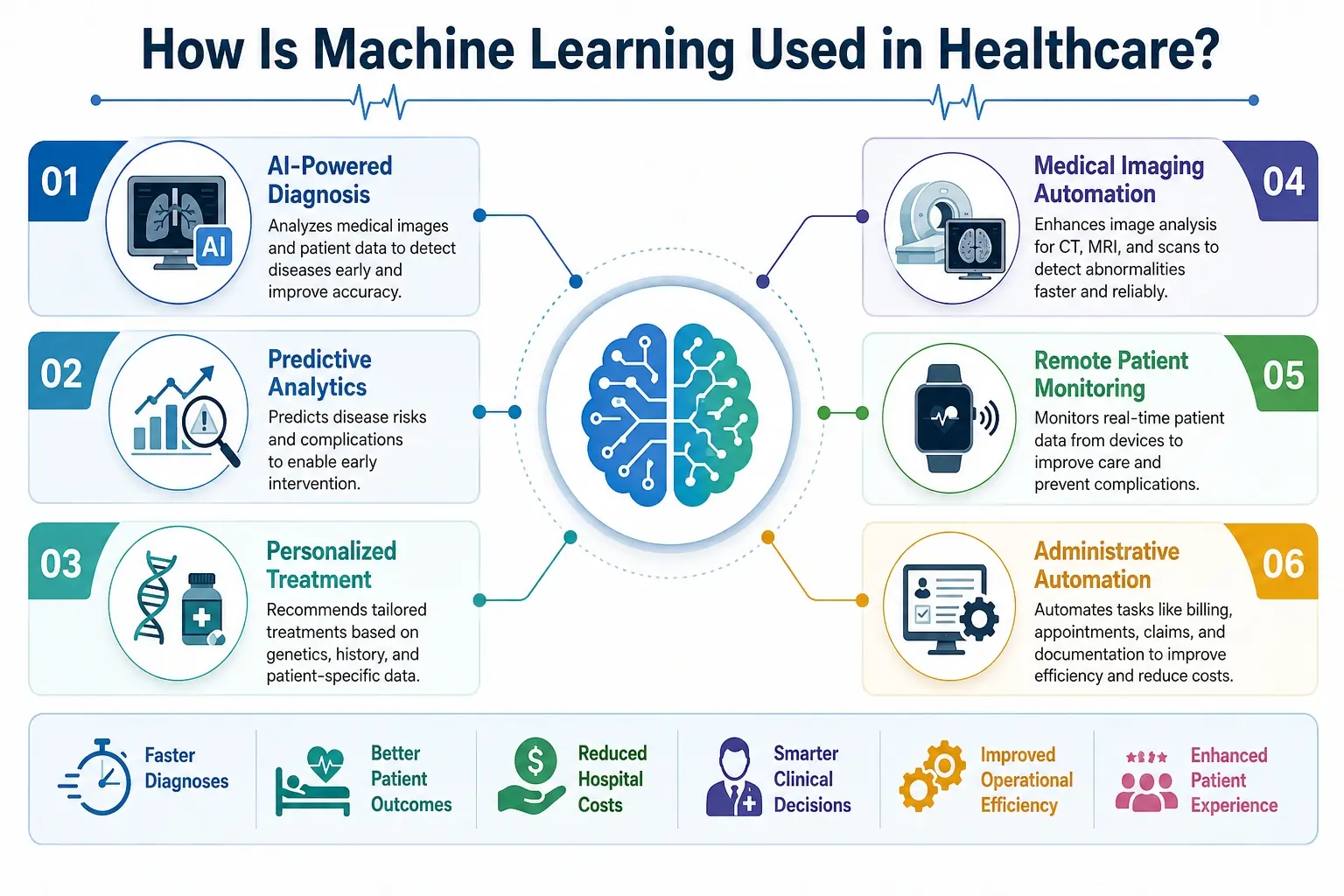
Machine learning is used in healthcare to analyze medical data, improve diagnostic accuracy, automate workflows, predict patient risks, and support personalized treatment planning. By processing large volumes of healthcare information in real time, machine learning systems help healthcare organizations make faster, smarter, and more accurate clinical and operational decisions.
As healthcare data becomes increasingly complex, machine learning technologies are being applied across a wide range of medical and administrative functions. From disease prediction to intelligent patient monitoring, machine learning is helping healthcare providers improve efficiency while delivering better patient outcomes.
One of the most transformative applications of machine learning in healthcare is medical diagnosis. Advanced machine learning models for healthcare can analyze clinical data, medical scans, pathology reports, and patient histories to assist physicians in identifying diseases earlier and more accurately.
In radiology, machine learning systems can analyze X-rays, CT scans, and MRI images to detect abnormalities such as tumors, fractures, neurological disorders, and cardiovascular conditions. AI-powered diagnostic tools are also being used for cancer detection, skin disease analysis, and pathology automation, helping healthcare professionals reduce diagnostic delays and improve treatment planning.
These systems do not replace doctors but instead support clinical decision-making by identifying patterns that may be difficult to detect manually, especially when physicians are managing high patient volumes.
Predictive healthcare analytics is another area where machine learning is creating significant impact. By analyzing historical patient data, genetic information, lifestyle factors, and clinical indicators, machine learning systems can predict the likelihood of diseases before severe symptoms appear.
Hospitals are increasingly using predictive analytics for:
Clinical decision support systems powered by machine learning help physicians identify high-risk patients earlier, enabling faster intervention and more proactive treatment strategies. This approach improves patient outcomes while reducing healthcare costs associated with emergency care and advanced-stage disease treatment.
Healthcare is rapidly moving away from one-size-fits-all treatment models. Machine learning enables more personalized care by analyzing patient-specific information such as genetics, medical history, lifestyle patterns, and treatment responses.
For example, machine learning systems can help healthcare providers determine which medications are most likely to work for individual patients, reducing trial-and-error treatment approaches. In oncology, AI-driven systems are being used to support precision medicine strategies that tailor cancer treatments based on genomic analysis and tumor characteristics.
Many healthcare organizations investing in Artificial intelligence in healthcare are prioritizing personalized treatment technologies because they improve both patient satisfaction and clinical outcomes.
Medical imaging generates enormous amounts of data every day, making it an ideal environment for machine learning applications. AI-powered imaging systems can process scans much faster than traditional workflows while helping radiologists identify abnormalities with greater consistency.
Machine learning technologies are now being used to:
These systems also help reduce radiologist workload by automating repetitive image analysis tasks, allowing healthcare professionals to focus more on complex clinical evaluations and patient care.
Remote healthcare has expanded rapidly worldwide, especially with the growth of wearable devices and connected health technologies. Machine learning systems analyze real-time patient data collected through smart devices to monitor health conditions continuously outside traditional hospital environments.
Healthcare providers use remote monitoring systems for:
Machine learning algorithms can detect unusual patterns, trigger smart alerts, and notify healthcare teams before conditions become critical. This proactive approach improves patient safety while reducing unnecessary hospital visits.
Many healthcare organizations are integrating advanced Healthcare IT solutions to support scalable remote patient monitoring and connected healthcare ecosystems.
Beyond clinical care, machine learning is also transforming healthcare administration. Hospitals and clinics manage large volumes of repetitive operational tasks that consume valuable staff time and resources.
Machine learning technologies help automate:
AI-powered virtual assistants, intelligent automation systems, and conversational technologies are increasingly improving operational efficiency across healthcare organizations. The growing adoption of AI agents in healthcare and AI chatbots in healthcare is helping providers streamline patient engagement while reducing administrative burdens on healthcare staff.
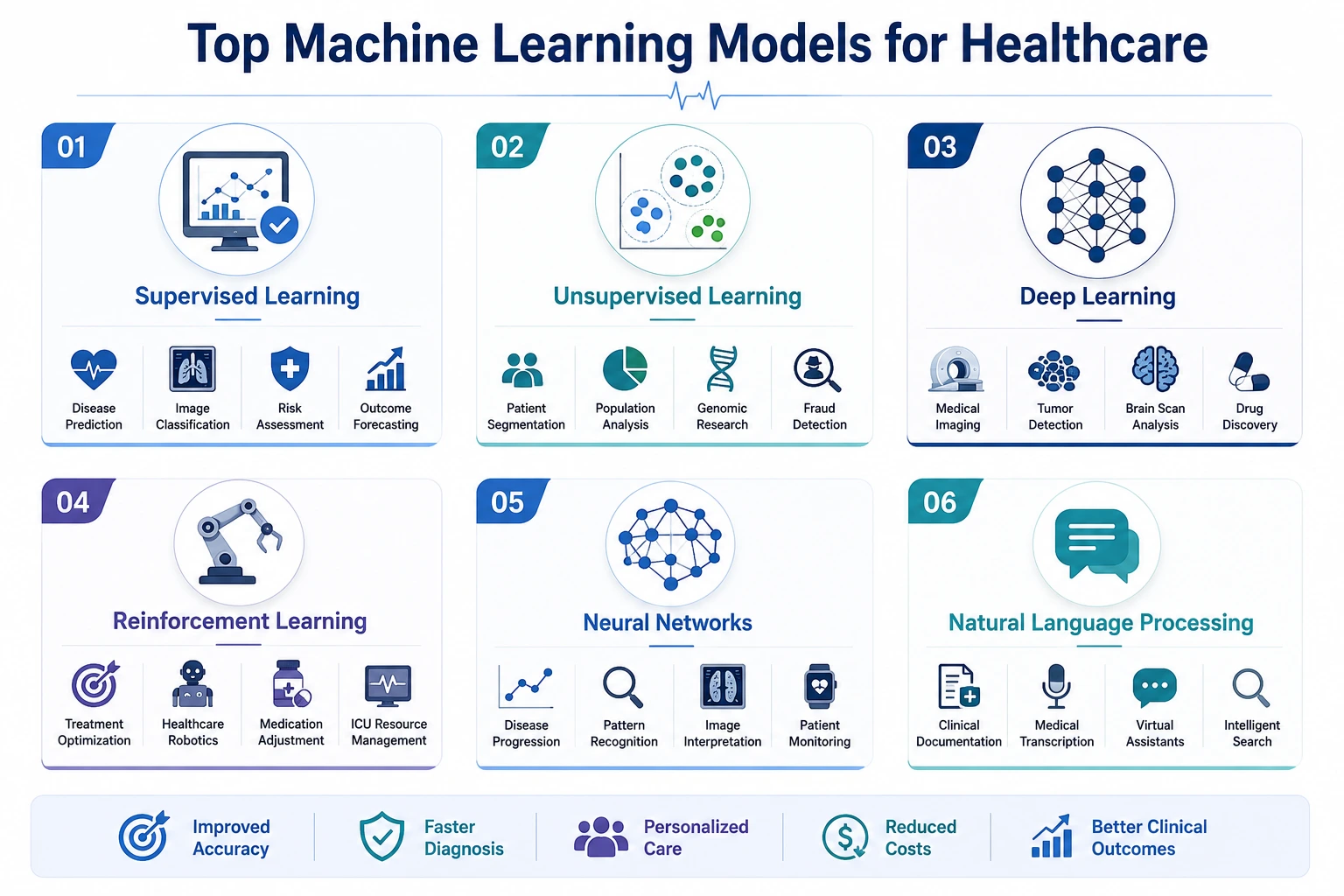
Different types of machine learning models are used in healthcare depending on the specific medical challenge, dataset, and clinical objective. These models help healthcare organizations analyze patient information, predict outcomes, automate diagnostics, and improve operational efficiency.
Supervised learning is one of the most widely used machine learning models for healthcare applications. In this approach, algorithms are trained using labeled datasets where the desired outcomes are already known.
Healthcare providers use supervised learning for:
For example, supervised learning systems can analyze thousands of historical patient records to predict the likelihood of heart disease or identify early warning signs of diabetes.
Unsupervised learning helps healthcare organizations discover hidden patterns within large datasets without predefined labels. These models are useful for identifying patient groups, behavioral trends, and unknown relationships in healthcare data.
Applications include:
This approach is especially valuable in large-scale healthcare analytics where organizations need to identify trends across massive datasets.
Deep learning is an advanced form of machine learning that uses layered neural networks to process highly complex healthcare data. It is particularly effective in medical imaging, speech recognition, and advanced diagnostics.
Deep learning models are widely used for:
These models can process enormous volumes of medical data with high accuracy, making them highly valuable for modern diagnostic systems.
Reinforcement learning focuses on systems learning through continuous feedback and optimization. In healthcare, these models are increasingly used for treatment planning, robotic surgery support, and adaptive healthcare systems.
Examples include:
As healthcare systems become more data-driven, reinforcement learning is expected to play a larger role in autonomous healthcare decision-making.
Neural networks are designed to simulate how the human brain processes information. These systems are capable of identifying complex relationships within healthcare data and are commonly used in predictive analytics and diagnostics.
Healthcare applications include:
Neural networks are especially powerful when working with large and highly detailed datasets such as genomic data and advanced imaging scans.
Natural Language Processing allows machine learning systems to understand and analyze human language. In healthcare, NLP is transforming how organizations process unstructured medical data such as physician notes, discharge summaries, research papers, and patient communications.
NLP applications include:
As healthcare organizations continue adopting intelligent technologies, NLP is becoming essential for improving workflow efficiency and extracting insights from large volumes of clinical text data.
The growing adoption of machine learning in healthcare industry is not only improving clinical outcomes but also transforming how healthcare organizations operate on a business level. As hospitals, clinics, and healthcare enterprises continue facing increasing operational pressure, machine learning is helping providers create smarter, faster, and more scalable healthcare systems.
One of the biggest advantages of machine learning is faster and more accurate diagnosis. Traditional diagnostic processes often require physicians to review large amounts of patient data manually, which can delay treatment decisions. Machine learning systems can analyze medical imaging, pathology reports, clinical histories, and laboratory results within seconds, helping healthcare professionals identify diseases earlier and with greater precision.
Early diagnosis is especially critical for conditions such as cancer, cardiovascular diseases, neurological disorders, and diabetes, where timely intervention can significantly improve survival rates and treatment outcomes.
Machine learning is also helping healthcare organizations reduce operational costs. Hospitals spend enormous resources managing administrative workflows, repetitive documentation tasks, insurance processing, and inefficient patient management systems. Intelligent automation powered by machine learning can streamline these operations, reduce manual workload, and improve overall efficiency.
Healthcare providers using AI-powered workflow automation often experience:
Beyond operational improvements, machine learning is directly contributing to better patient outcomes. Predictive healthcare systems can identify high-risk patients before conditions worsen, enabling earlier treatment and preventive care strategies. Personalized treatment recommendations also help physicians select therapies that are more likely to succeed for individual patients, reducing unnecessary treatments and improving recovery rates.
Another major benefit is the reduction of clinician workload. Healthcare professionals worldwide are dealing with rising patient volumes and increasing documentation requirements. Machine learning systems support clinicians by automating repetitive processes such as clinical note generation, medical record analysis, patient triage, and risk assessment. This allows doctors and nurses to spend more time focusing on patient care rather than administrative tasks.
Resource management is another area where machine learning is delivering measurable value. Hospitals can use predictive analytics to optimize staffing, manage ICU capacity, forecast patient admissions, and allocate medical resources more efficiently. These capabilities became especially important during global healthcare crises where healthcare systems faced sudden surges in patient demand.
Machine learning is also improving healthcare accessibility globally. Remote patient monitoring systems, intelligent telemedicine platforms, and AI-powered virtual healthcare assistants are helping healthcare providers reach patients in underserved and rural regions where access to specialists may be limited.
Perhaps most importantly, machine learning enables healthcare organizations to make more data-driven decisions. Instead of relying solely on reactive care models, healthcare providers can use predictive analytics and intelligent insights to improve treatment planning, operational strategy, and patient engagement.
As digital transformation accelerates across healthcare systems worldwide, machine learning is increasingly being viewed not simply as a technology upgrade, but as a long-term healthcare transformation investment capable of improving both financial performance and patient care quality.
Machine learning is no longer a future concept in healthcare. Today, hospitals, research institutions, pharmaceutical companies, and digital health organizations around the world are actively using machine learning technologies to improve diagnostics, automate operations, and enhance patient care.
One of the most well-known applications is AI-assisted cancer detection. Advanced machine learning systems are now capable of analyzing mammograms, pathology slides, and imaging scans to identify early signs of cancer with impressive accuracy. In several healthcare environments, AI-powered diagnostic systems are helping radiologists detect abnormalities faster while reducing diagnostic errors associated with manual analysis.
Machine learning is also playing a major role in predictive hospital management systems. Healthcare organizations are using predictive analytics to forecast patient admissions, optimize staffing levels, monitor ICU occupancy, and manage emergency room workflows more effectively. By analyzing historical hospital data and real-time operational information, machine learning systems help healthcare administrators improve efficiency while reducing patient wait times.
Drug discovery is another area experiencing significant transformation. Traditional pharmaceutical research can take years and require enormous financial investment. Machine learning platforms can analyze biological datasets, molecular structures, and clinical research data to identify potential drug candidates much faster than conventional methods. This accelerated approach is helping pharmaceutical companies reduce research timelines and improve innovation in precision medicine.
Virtual healthcare assistants are also becoming increasingly common across modern healthcare systems. AI-powered assistants can help patients schedule appointments, answer basic healthcare questions, provide medication reminders, and support patient engagement outside clinical environments. These systems improve operational efficiency while enhancing the patient experience.
Smart patient triage systems are another powerful example of machine learning for healthcare applications. Hospitals and telemedicine providers are using intelligent triage systems to assess symptoms, prioritize urgent cases, and direct patients toward appropriate levels of care. This reduces pressure on emergency departments while helping healthcare providers respond more efficiently to critical cases.
Globally, enterprise healthcare organizations are integrating machine learning into a wide range of clinical and operational systems. From predictive analytics platforms and intelligent medical imaging systems to remote monitoring technologies and healthcare automation tools, machine learning is becoming deeply embedded within modern healthcare infrastructure.
Organizations investing in AI software development services are increasingly focusing on building scalable healthcare platforms that combine predictive analytics, intelligent automation, and secure patient data management to support long-term digital healthcare transformation.
Despite its enormous potential, machine learning in healthcare also comes with significant challenges that healthcare organizations must address carefully. While intelligent technologies can improve efficiency and patient outcomes, successful implementation requires strong governance, responsible data management, and careful consideration of ethical and regulatory concerns.
One of the biggest concerns surrounding machine learning in healthcare is data privacy. Healthcare systems process highly sensitive patient information, including medical histories, diagnostic reports, insurance records, and personal identification data. Any misuse, unauthorized access, or data breach can create serious legal, financial, and reputational consequences for healthcare providers.
As healthcare systems become more digitally connected, cybersecurity risks are also increasing rapidly. Hospitals and healthcare organizations are frequent targets for cyberattacks because medical data is extremely valuable. Machine learning systems connected to electronic health records, cloud platforms, and medical devices require strong cybersecurity frameworks to prevent ransomware attacks, data theft, and operational disruptions.
Another major challenge involves bias in AI algorithms. Machine learning models learn from historical healthcare data, but if that data contains biases or lacks diversity, the system may produce unfair or inaccurate outcomes for certain patient groups. This can impact diagnosis accuracy, treatment recommendations, and healthcare accessibility across different populations.
Healthcare organizations must also address interoperability issues. Many hospitals still use fragmented systems that struggle to share information efficiently across departments or healthcare networks. Integrating machine learning technologies into outdated infrastructure can be technically complex and expensive, especially when organizations rely on multiple disconnected platforms.
Regulatory compliance remains another critical factor. Healthcare providers must ensure that machine learning systems comply with regional healthcare regulations, patient privacy laws, and medical device standards. Different countries have varying regulatory frameworks surrounding AI-driven healthcare technologies, making global implementation more challenging for enterprise healthcare organizations.
Ethical concerns also continue to shape discussions around machine learning in healthcare. While AI systems can support clinical decisions, healthcare professionals and patients still expect transparency, accountability, and human oversight in medical care. Questions surrounding decision-making responsibility, algorithm transparency, and patient trust remain important considerations as healthcare AI adoption grows.
Addressing these challenges requires more than just advanced technology. Healthcare organizations need clear governance strategies, strong cybersecurity measures, ethical AI frameworks, and experienced healthcare technology partners capable of building secure and compliant machine learning solutions.
By acknowledging both the opportunities and limitations of machine learning, healthcare providers can build more trustworthy, scalable, and responsible AI-driven healthcare systems.
The future of machine learning in healthcare industry is expected to be far more intelligent, predictive, and personalized than anything healthcare systems have experienced before. As computing power, healthcare data availability, and AI technologies continue advancing, machine learning will become increasingly integrated into nearly every aspect of patient care and healthcare operations.
One of the most transformative trends shaping the future is generative AI in healthcare. Advanced AI systems are beginning to support clinical documentation, medical research, treatment planning, and patient communication with unprecedented efficiency. Generative AI technologies can summarize patient records, assist physicians with clinical notes, and even support healthcare professionals by analyzing vast amounts of medical literature in real time.
AI copilots for doctors are also expected to become more common across hospitals and healthcare networks. These intelligent assistants will help clinicians review patient histories, identify potential risks, recommend treatment options, and reduce administrative burdens during clinical workflows. Rather than replacing healthcare professionals, AI copilots are designed to enhance decision-making and improve operational efficiency.
Federated learning is another emerging innovation with major implications for healthcare. Traditional machine learning systems often require centralized data collection, which can create privacy and compliance concerns. Federated learning allows healthcare organizations to train machine learning models across multiple systems without directly sharing sensitive patient data, improving both privacy protection and collaborative research capabilities.
Autonomous diagnostics is also expected to evolve significantly in the coming years. AI-powered diagnostic systems are becoming increasingly capable of analyzing medical imaging, pathology data, and clinical indicators with remarkable speed and accuracy. These technologies may eventually support earlier disease detection in regions with limited access to medical specialists.
Digital twins in medicine represent another future-focused advancement. Digital twins are virtual models of patients created using real-time biological, clinical, and behavioral data. Healthcare providers may eventually use these virtual simulations to predict disease progression, test treatment responses, and personalize care strategies before applying them in real-world clinical settings.
Robotic healthcare automation is also expanding rapidly. Intelligent robotic systems are already supporting surgical procedures, rehabilitation therapies, pharmacy automation, and hospital logistics. Combined with machine learning, these systems can continuously improve performance and adapt to complex healthcare environments.
AI-assisted surgery is expected to become increasingly advanced as machine learning systems improve surgical precision, reduce procedural risks, and support minimally invasive treatment approaches. These technologies may help surgeons make more accurate intraoperative decisions while improving patient recovery outcomes.
Many of the most important AI trending right now are directly connected to healthcare innovation, especially in areas such as predictive analytics, automation, intelligent diagnostics, and personalized medicine. At the same time, the rise of intelligent AI agents in healthcare is transforming patient engagement, workflow management, and healthcare accessibility across digital care environments.
While the future of machine learning in healthcare is highly promising, successful adoption will depend on responsible implementation, regulatory compliance, ethical AI governance, and strong collaboration between healthcare professionals and technology providers.
Implementing machine learning in healthcare requires far more than simply adopting new software. Healthcare organizations operate within highly regulated, data-sensitive, and operationally complex environments where even small technology failures can impact patient care, compliance, and organizational performance.
This is why choosing the right AI technology partner has become a critical strategic decision for hospitals, clinics, healthcare enterprises, and digital health providers worldwide.
One of the most important factors is healthcare compliance expertise. Healthcare technologies must align with strict privacy regulations, cybersecurity standards, and regional healthcare laws. AI systems handling patient information require secure infrastructure, responsible data governance, and compliance-focused development practices to ensure patient trust and long-term operational stability.
Integration capabilities are equally important. Many healthcare organizations already rely on EHR and EMR platforms, medical imaging systems, billing software, telemedicine platforms, and connected healthcare devices. AI solutions must integrate seamlessly into existing healthcare ecosystems without disrupting workflows or compromising data security.
Custom machine learning model development is another major consideration. Every healthcare organization has unique operational challenges, patient populations, and clinical workflows. Generic AI platforms may not always meet specialized healthcare requirements. Organizations increasingly require tailored machine learning systems designed specifically for predictive analytics, diagnostics, workflow automation, patient engagement, and operational optimization.
Scalability also plays a major role in long-term success. Healthcare data volumes continue growing rapidly, and organizations need AI systems capable of handling increasing workloads, expanding patient networks, and evolving healthcare demands. Scalable healthcare infrastructure ensures that machine learning solutions remain effective as organizations grow.
Cybersecurity cannot be overlooked either. Healthcare systems are among the most targeted industries for cyberattacks, making security-focused AI development essential. Reliable healthcare AI partners prioritize secure architecture, encrypted data management, threat monitoring, and ongoing system protection.
Long-term AI strategy is equally important. Successful machine learning adoption is not a one-time project but an ongoing transformation journey. Healthcare organizations need strategic guidance for implementation planning, workflow optimization, AI governance, scalability, and future innovation opportunities.
Organizations exploring advanced Machine Learning Development Services scalable Healthcare IT solutions, and enterprise-grade AI software development services are increasingly seeking technology partners that understand both healthcare operations and modern AI infrastructure.
Healthcare organizations that invest in the right AI strategy today are better positioned to improve patient care, optimize operations, strengthen clinical decision-making, and remain competitive in an increasingly data-driven healthcare landscape.
Machine learning is rapidly transforming the global healthcare industry by enabling faster diagnoses, predictive care, intelligent automation, and more personalized treatment strategies. From improving clinical decision-making to streamlining hospital operations and enhancing patient engagement, machine learning technologies are helping healthcare organizations solve some of the most complex challenges facing modern healthcare systems.
As healthcare data continues expanding and patient expectations evolve, intelligent technologies will play an increasingly important role in delivering scalable, efficient, and outcome-focused care. Healthcare providers worldwide are already using machine learning to improve operational performance, reduce clinician workload, strengthen diagnostics, and support better long-term patient outcomes.
At the same time, responsible AI adoption remains essential. Healthcare organizations must balance innovation with patient privacy, cybersecurity, regulatory compliance, and ethical decision-making to ensure trustworthy and sustainable healthcare transformation.
The future of healthcare will be driven by intelligent systems capable of supporting faster, safer, and more connected care experiences across the entire patient journey. Organizations that embrace machine learning strategically today will be better prepared to lead the next generation of digital healthcare innovation.
Organizations that invest in intelligent healthcare technologies today will be better positioned to deliver faster, safer, and more personalized patient care in the future.



Start Build Your
Next Digital Solution?
Let’s build scalable, future-ready digital solutions tailored to your business goals. Connect with our experienced technology consultants to discuss your vision, strategy, and growth opportunities — with zero obligation and complete transparency.
Get a free consultation and cost estimate for your digital solution
Our expert will contact you within 24 hours. Check your email for confirmation.
Partner with SISGAIN experts to build secure, scalable AI-powered IT Solutions that transform your business operations.









DUQE FREEZONE Quarter Deck, Queen Elizabeth 2, Mina Rashid, Dubai, UAE

100 Consilium Pl Suite 200, Scarborough, ON M1H 3E3, Canada

C-109, Sector 2, Noida, Uttar Pradesh 201301 India
Project quotes, partnerships, implementation
Open roles, referrals, campus hiring