
 +1 844-445-5767
 +971 56-848-5757
 +91 921-208-0630
For Business & Service Inquiries
Sales Team
Project quotes, partnerships, implementation
The U.S. healthcare industry is under more pressure today than ever before. Hospitals and healthcare organizations are dealing with physician burnout, staffing shortages, rising operational costs, administrative overload, and increasing patient expectations simultaneously. Healthcare professionals are spending countless hours on documentation, appointment management, insurance coordination, and repetitive workflows instead of focusing entirely on patient care. At the same time, patients now expect faster communication, personalized experiences, and 24/7 digital healthcare access.
Traditional automation tools are no longer enough to solve these growing challenges. Basic systems can automate repetitive tasks, but they often fail to understand context, adapt to real-time situations, or coordinate across multiple healthcare processes. This is where smart ai agents in healthcare are creating a major shift across the U.S. healthcare ecosystem.
Unlike standard chatbots, modern ai agent for healthcare solutions are designed to think, analyze, automate workflows, coordinate tasks, and assist providers in real time. These intelligent systems can manage multi-step healthcare operations while continuously learning from patient interactions and clinical data. From patient engagement and virtual care to hospital administration and predictive analytics, ai agents healthcare solutions are helping healthcare providers improve efficiency while delivering better patient outcomes.
Healthcare organizations across the United States are now moving beyond small AI pilot programs and adopting enterprise-scale AI systems to transform operations, improve care delivery, and prepare for the future of digital healthcare.
Smart AI agents are advanced intelligent systems designed to perform complex healthcare tasks with minimal human intervention. Unlike traditional healthcare software that follows fixed rules and predefined workflows, AI agents can understand context, make decisions, adapt to changing situations, and execute multi-step actions autonomously.
To understand the difference clearly, traditional healthcare software mainly focuses on task execution. For example, a hospital management system may store patient records or schedule appointments, but it cannot independently analyze patient behavior patterns or coordinate multiple healthcare workflows simultaneously.
Basic healthcare chatbots are also limited in functionality. Most chatbots only respond to predefined questions using scripted conversations. They lack reasoning capabilities and cannot make contextual decisions. In contrast, modern ai agents for healthcare combine conversational intelligence with autonomous decision-making capabilities.
Generative AI introduced more advanced language understanding and content generation, but agentic AI systems go much further. These systems can reason, plan, analyze data, coordinate tasks, and continuously optimize healthcare workflows in real time. This evolution is becoming the next major phase of healthcare transformation in the United States.
Today’s ai agents in healthcare are powered by advanced technologies such as:
A real-world example demonstrates how powerful these systems have become. A patient may report symptoms through a digital healthcare portal. The AI agent can analyze symptoms, perform AI-based triage, schedule the appropriate appointment, verify insurance eligibility, update the EHR system, and notify the provider automatically without requiring manual coordination across departments.
This level of Healthcare and AI Integration is transforming how healthcare organizations operate while showing why ai trend matters now more than ever for the future of patient-centered care.
The rapid adoption of ai agents healthcare solutions across the United States is being driven by growing operational and clinical challenges that traditional healthcare systems can no longer manage efficiently. Healthcare organizations are under constant pressure to improve patient outcomes while reducing costs and administrative burdens at the same time.
One of the biggest issues facing the U.S. healthcare industry is the shortage of healthcare professionals. Hospitals and clinics are struggling with physician burnout, nursing shortages, and increasing patient demand. Doctors often spend more time managing documentation and administrative tasks than interacting directly with patients. This creates inefficiencies that impact both healthcare providers and patient satisfaction.
Administrative overload is another major challenge. Insurance verification, claims processing, appointment coordination, prior authorizations, and billing operations consume significant time and resources. Revenue cycle bottlenecks continue to slow healthcare operations while increasing operational expenses.
At the same time, patients now expect healthcare experiences similar to modern digital services. They want faster responses, personalized communication, virtual care options, and continuous engagement across multiple channels. Delayed communication and fragmented healthcare workflows often lead to lower patient satisfaction and poor care continuity.
This is why healthcare organizations are increasingly adopting ai agent for healthcare systems to automate workflows, improve decision-making, and optimize operational efficiency. AI copilots and intelligent healthcare agents are already delivering measurable ROI by reducing documentation time, improving scheduling efficiency, accelerating patient communication, and streamlining revenue cycle management.
Healthcare AI is no longer limited to experimentation. Across the United States, hospitals, healthcare networks, and digital health providers are moving toward production-grade AI deployment to improve scalability and long-term operational performance.
For many organizations, AI is no longer optional. Healthcare providers that fail to modernize risk falling behind competitors that are already investing in intelligent automation, predictive healthcare systems, and advanced digital care delivery. This growing demand is also increasing the role of ai software development companies in USA and experienced healthcare application developers that can build secure, scalable, and HIPAA-compliant AI healthcare solutions.
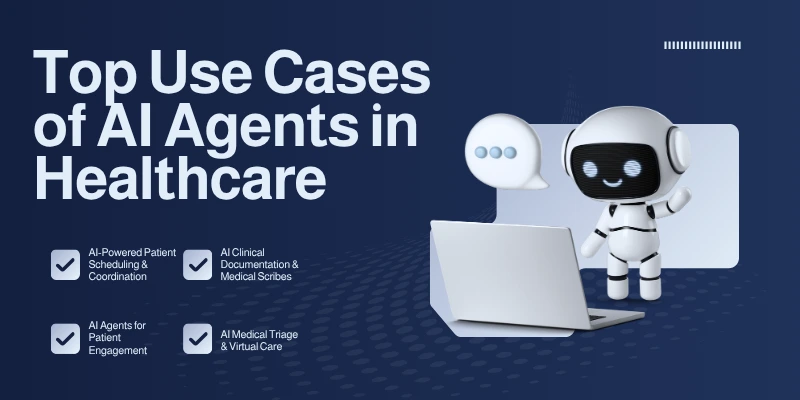
The biggest impact of ai agents in healthcare is happening through intelligent workflow automation, operational optimization, and real-time clinical assistance. Healthcare organizations across the United States are increasingly deploying AI-powered systems to reduce inefficiencies, improve patient experiences, and support healthcare professionals in delivering better care.
Patient scheduling has traditionally been one of the most time-consuming administrative functions in healthcare. Smart AI agents are transforming this process by automating appointment booking, patient routing, reminders, and rescheduling workflows.
AI agents can analyze provider availability, patient preferences, urgency levels, and clinical requirements to schedule appointments more efficiently. These systems also send automated reminders through SMS, email, or voice notifications, helping reduce missed appointments and improving patient engagement.
In large healthcare systems, AI-driven scheduling coordination helps optimize resource utilization while improving patient flow across departments. By reducing manual scheduling burdens, healthcare providers can focus more on patient care while improving operational efficiency and patient satisfaction simultaneously.
Clinical documentation is one of the leading causes of physician burnout in the United States. Doctors often spend hours updating electronic health records after patient consultations, reducing the amount of time available for direct patient interaction.
AI-powered medical scribes and ambient clinical intelligence systems are helping solve this challenge. These AI agents can listen to patient-provider conversations, convert speech into structured medical documentation, summarize consultations, and automatically update EHR systems in real time.
Voice-to-EHR automation is rapidly becoming one of the fastest-growing healthcare AI segments because it significantly reduces documentation workload while improving accuracy and efficiency. By automating repetitive administrative tasks, AI agents allow healthcare professionals to spend more time focusing on patient outcomes rather than paperwork.
Modern patients expect continuous communication and personalized healthcare experiences. AI agents are helping healthcare providers deliver 24/7 patient engagement through intelligent virtual assistants and automated communication systems.
These AI-powered systems support:
An advanced ai health chatbot can also answer patient queries instantly, improve healthcare accessibility, and reduce response delays for non-emergency support requests. This creates stronger patient relationships while reducing pressure on administrative teams.
AI agents are playing an increasingly important role in virtual healthcare delivery and digital triage systems. These systems can assess patient symptoms, evaluate risk levels, prioritize emergency cases, and guide patients toward appropriate care pathways.
For telehealth providers, AI-powered triage systems improve efficiency by helping clinicians focus on high-priority cases first. AI agents can also assist with virtual consultations, symptom analysis, and preliminary patient assessments before provider interaction.
As demand for digital healthcare continues to grow, telemedicine app development in USA is increasingly integrating AI-driven triage and virtual care capabilities to improve scalability and patient access.
Revenue cycle management remains one of the most complex operational areas in healthcare. AI agents are now helping automate critical financial and administrative workflows, including:
These intelligent systems reduce manual errors, accelerate payment cycles, and improve operational efficiency across healthcare finance departments. Administrative AI is rapidly becoming a top investment priority for U.S. healthcare organizations looking to reduce operational costs while improving financial performance.
AI-powered remote monitoring systems are transforming preventive healthcare delivery across the United States. By combining wearables, connected medical devices, and intelligent analytics, AI agents can continuously monitor patient health in real time.
These systems help healthcare providers track:
AI agents can generate real-time alerts when abnormalities are detected, enabling faster interventions and proactive care management. This approach is especially valuable for elderly patients, chronic disease management, and post-discharge monitoring programs.
As healthcare organizations continue investing in ai Improves Remote Patient Care strategies, advanced Healthcare Analytics Tools are becoming essential for delivering scalable, data-driven, and preventive healthcare solutions.
Patient expectations in the United States healthcare system are changing rapidly. Modern patients want faster access to care, personalized communication, shorter waiting times, and seamless digital healthcare experiences similar to what they receive from other industries. This growing demand is one of the main reasons healthcare providers are increasingly adopting ai agents in healthcare to improve patient engagement and care delivery.
Smart AI agents are helping healthcare organizations reduce appointment delays, automate patient communication, and provide 24/7 virtual assistance across multiple digital channels. Patients no longer need to wait hours or days for basic support requests, appointment confirmations, medication reminders, or follow-up information. AI-powered systems can instantly respond to patient inquiries while maintaining continuous communication throughout the care journey.
Another major advantage of ai agents for healthcare is personalization. AI systems can analyze patient preferences, medical history, behavioral patterns, and previous interactions to deliver customized healthcare experiences. This improves patient satisfaction while helping providers offer more proactive and patient-centered care.
Multilingual support is also becoming increasingly important in the diverse U.S. healthcare landscape. Voice AI agents and conversational healthcare systems can now support multiple languages, improving accessibility for patients from different backgrounds and reducing communication barriers during care delivery.
AI agents are also helping rural and underserved communities gain better access to healthcare services. Virtual AI assistants, remote patient support systems, and telehealth integrations allow patients in remote areas to receive timely guidance and ongoing care without frequent hospital visits.
As digital healthcare adoption continues to grow, voice AI agents are expanding healthcare accessibility while helping providers deliver faster, smarter, and more connected patient experiences.
Beyond patient care, AI agents are transforming the operational backbone of modern healthcare organizations. Hospitals across the United States are increasingly investing in intelligent automation to improve efficiency, reduce costs, and optimize resource management across complex healthcare environments.
Traditional healthcare automation focuses mainly on isolated repetitive tasks. Autonomous orchestration, however, allows AI agents to coordinate multiple systems, departments, and workflows simultaneously while adapting to real-time operational conditions. This is a major shift from simple automation to intelligent operational management.
AI agents are now being used for:
For example, an AI system can automatically analyze emergency room capacity, patient inflow, staffing levels, and bed availability to optimize hospital operations in real time. These intelligent systems help healthcare organizations improve response times while reducing operational bottlenecks.
Hospital administrators are also using AI agents to improve workforce efficiency. Staffing shortages remain a major challenge in the U.S. healthcare industry, and AI-powered scheduling systems can help balance workloads, reduce burnout, and improve shift planning based on patient demand patterns.
Inventory management is another area seeing rapid transformation. AI agents can monitor medical supply levels, predict future demand, automate procurement workflows, and reduce waste across healthcare facilities.
Healthcare organizations are increasingly prioritizing operational AI because of its measurable return on investment. By improving efficiency, reducing administrative costs, and optimizing hospital operations, AI agents are helping healthcare enterprises build smarter, more scalable healthcare systems capable of handling growing patient demands.
One of the most transformative applications of AI in healthcare is predictive intelligence. Modern AI agents are helping healthcare providers move from reactive treatment models to proactive and preventive care strategies powered by advanced data analysis and real-time clinical insights.
Predictive AI agents can analyze enormous volumes of healthcare data to identify disease risks, detect abnormalities early, and support more personalized treatment decisions. These systems are becoming increasingly valuable for improving patient outcomes while helping healthcare providers make faster and more informed clinical decisions.
Today’s AI-powered healthcare systems can process:
By combining these data sources, AI agents can identify hidden patterns that may not be immediately visible through traditional clinical analysis. This allows healthcare providers to detect potential health risks earlier and intervene before conditions become more severe.
For example, predictive healthcare analytics can help identify patients at high risk of chronic diseases, cardiovascular complications, diabetes progression, or hospital readmissions. AI-assisted diagnostics can also support radiologists and clinicians by improving imaging analysis accuracy and accelerating diagnosis workflows.
Another major advancement is personalized medicine. AI agents can recommend individualized treatment strategies based on a patient’s genetics, medical history, health conditions, and lifestyle behaviors. This shift toward Predictive Analytics in Personalized Healthcare is helping providers deliver more targeted and effective care plans.
As predictive AI technologies continue moving into production healthcare systems, healthcare organizations are increasingly adopting intelligent diagnostic tools to improve clinical outcomes, optimize preventive care, and create more data-driven healthcare ecosystems across the United States.
While AI agents are transforming healthcare operations and patient care, their adoption also brings significant challenges that healthcare organizations must carefully address. Building trust in AI-driven healthcare systems requires balancing innovation with safety, compliance, transparency, and ethical responsibility.
One of the biggest concerns surrounding AI adoption is data privacy and security. Healthcare systems manage highly sensitive patient information, including protected health information (PHI), medical histories, and financial records. Any vulnerability in AI infrastructure could expose healthcare organizations to serious cybersecurity risks and compliance violations.
HIPAA compliance remains a critical priority when deploying AI systems in clinical environments. Healthcare organizations must ensure that AI agents securely process, store, and manage patient data while maintaining strict regulatory compliance standards.
Another challenge involves AI hallucinations and inaccurate outputs. Generative AI systems may occasionally generate incorrect recommendations, incomplete clinical summaries, or misleading responses if not properly monitored. In healthcare environments, even small errors can have serious consequences for patient safety.
Bias in AI models is also a growing concern. If AI systems are trained on incomplete or biased datasets, they may produce unfair or inaccurate outcomes for certain patient populations. This raises ethical concerns around equitable healthcare delivery and algorithmic transparency.
Integration complexity presents another obstacle. Many hospitals still operate on legacy healthcare systems, making it difficult to integrate advanced AI technologies seamlessly across departments and workflows.
Despite these advancements, healthcare AI still requires strong human oversight. Human-in-the-loop systems are essential because they allow healthcare professionals to validate AI recommendations, monitor decision-making processes, and intervene when necessary.
As agentic AI adoption accelerates, governance, transparency, safety, and responsible implementation are becoming top priorities for healthcare organizations seeking long-term and trustworthy AI transformation.
As AI adoption expands across the healthcare industry, organizations are placing greater emphasis on compliance, governance, and responsible AI deployment. In the United States, healthcare providers must ensure that AI systems meet strict regulatory and security standards while protecting sensitive patient information at every stage of the care journey.
HIPAA compliance remains one of the most important requirements for any healthcare AI system. AI agents handling patient records, clinical workflows, or communication systems must securely process protected health information while maintaining privacy, confidentiality, and regulatory compliance.
Modern healthcare organizations are also investing heavily in secure AI infrastructure that includes:
Production-grade AI governance is becoming a critical operational discipline as healthcare enterprises move toward large-scale AI deployment. Organizations now require transparent AI systems capable of explaining how recommendations, predictions, and clinical decisions are generated.
Explainable AI is especially important in healthcare because providers must understand the reasoning behind AI-driven insights before making medical decisions. This improves accountability, reduces risk, and strengthens trust between clinicians and AI systems.
Healthcare leaders are also closely monitoring FDA considerations and emerging healthcare AI regulations as intelligent systems become more deeply integrated into clinical workflows.
Strong Healthcare and AI Integration strategies now require not only technological innovation but also enterprise-level governance frameworks that prioritize patient safety, ethical AI usage, transparency, and long-term compliance management.
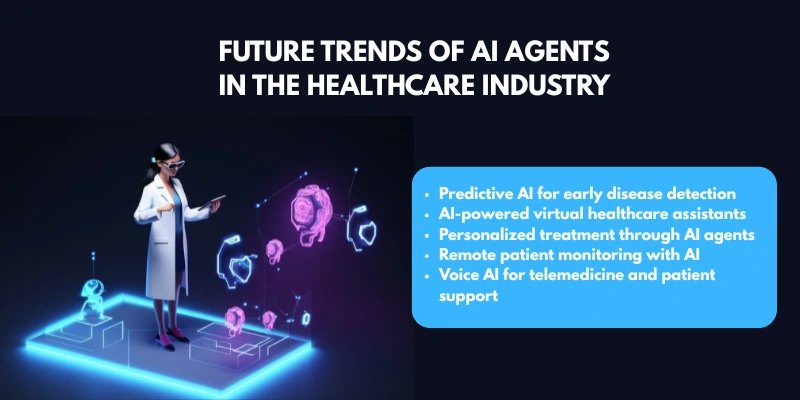
The future of healthcare AI is moving far beyond simple automation. Across the United States, healthcare organizations are entering a new era of intelligent decision orchestration powered by advanced agentic AI ecosystems. These next-generation systems will not only automate tasks but also coordinate complex healthcare operations, assist clinicians in real time, and continuously optimize patient care delivery.
One of the biggest emerging trends is the rise of AI copilots for doctors and healthcare staff. These intelligent assistants can help clinicians with documentation, diagnostics, treatment recommendations, administrative coordination, and patient communication while reducing cognitive workload and physician burnout.
Autonomous hospital operations are also becoming a major focus for healthcare enterprises. Future AI agents will manage staffing coordination, emergency response optimization, patient flow management, inventory allocation, and operational forecasting simultaneously across entire healthcare systems.
Voice AI healthcare assistants are expected to play a larger role in improving healthcare accessibility and patient engagement. Patients will increasingly interact with healthcare providers through conversational voice interfaces capable of scheduling appointments, monitoring symptoms, delivering medication reminders, and supporting virtual care experiences.
Another major advancement involves multi-agent healthcare systems, where multiple AI agents collaborate together across hospitals, laboratories, insurance systems, pharmacies, and telehealth platforms. This interconnected ecosystem will create more seamless and intelligent healthcare operations.
Healthcare organizations are also investing in AI-powered virtual hospitals, hyper-personalized medicine, and self-learning healthcare systems capable of continuously improving through real-time data analysis and patient interactions.
Importantly, AI will support healthcare professionals, not replace them. The future of healthcare depends on collaboration between human expertise and intelligent AI systems that enhance clinical decision-making rather than eliminate human involvement.
Experts predict that agentic AI will become deeply embedded across healthcare systems over the next few years, making ai trend matters now one of the most important discussions shaping the future of healthcare innovation.
Successfully implementing AI agents in healthcare requires a strategic and carefully planned approach. While the potential benefits are significant, healthcare organizations must focus on scalability, compliance, operational readiness, and measurable outcomes to ensure long-term success.
The most effective strategy is to start with high-impact workflows that generate immediate operational value. Many healthcare providers begin by implementing AI agents for appointment scheduling, patient engagement, clinical documentation, or revenue cycle management before expanding into more advanced use cases.
HIPAA compliance and data security should remain a top priority throughout the implementation process. Organizations must ensure that AI systems are deployed within secure and compliant environments capable of protecting patient data and maintaining regulatory standards.
Healthcare providers should also invest in scalable AI infrastructure that can integrate seamlessly with existing EHR systems, hospital management platforms, and clinical workflows. Strong interoperability is essential for maximizing efficiency and avoiding fragmented healthcare operations.
Another important factor is measurable ROI. Healthcare organizations should track operational improvements such as reduced administrative workload, faster response times, improved patient engagement, lower costs, and enhanced care delivery outcomes.
Staff training and human oversight are equally critical. AI systems should support healthcare professionals rather than disrupt clinical workflows. Training employees to work alongside intelligent systems helps improve adoption and long-term operational success.
Partnering with experienced providers offering ai agent development services, skilled healthcare application developers, and trusted ai software development companies in USA can significantly improve implementation quality, scalability, and compliance readiness for enterprise healthcare AI transformation.
Smart AI agents are rapidly transforming the healthcare industry across the United States by improving operational efficiency, enhancing patient experiences, and supporting healthcare professionals in delivering higher-quality care. From intelligent patient engagement and predictive diagnostics to hospital automation and remote monitoring, AI-powered systems are helping healthcare organizations address some of the industry’s biggest challenges.
Unlike traditional automation tools, modern AI agents can analyze data, coordinate workflows, make contextual decisions, and continuously improve healthcare operations in real time. These capabilities are enabling providers to reduce administrative burdens, improve clinical decision-making, optimize resource management, and deliver more personalized patient care at scale.
At the same time, healthcare organizations are becoming more focused on responsible AI adoption, emphasizing HIPAA compliance, transparency, governance, and human oversight to ensure safe and ethical implementation.
As healthcare systems continue evolving, AI agents will play an even larger role in shaping intelligent healthcare ecosystems that are more connected, predictive, accessible, and patient-centered. Organizations that strategically adopt AI today will be better positioned to improve patient outcomes, reduce inefficiencies, and lead the future of digital healthcare innovation.
As a trusted AI healthcare development expert, we help healthcare organizations build secure, scalable, and HIPAA-compliant AI solutions designed to improve patient care, automate operations, and accelerate digital transformation. From intelligent virtual assistants and predictive analytics to enterprise-grade ai agents in healthcare, our team delivers customized solutions that align with the evolving needs of modern healthcare providers across the United States. Partner with us to transform healthcare workflows through innovative, future-ready AI technologies built for long-term growth and operational excellence.


Start Build Your
Next Digital Solution?
Let’s build scalable, future-ready digital solutions tailored to your business goals. Connect with our experienced technology consultants to discuss your vision, strategy, and growth opportunities — with zero obligation and complete transparency.
Get a free consultation and cost estimate for your digital solution
Our expert will contact you within 24 hours. Check your email for confirmation.
Partner with SISGAIN experts to build secure, scalable AI-powered IT Solutions that transform your business operations.









DUQE FREEZONE Quarter Deck, Queen Elizabeth 2, Mina Rashid, Dubai, UAE

100 Consilium Pl Suite 200, Scarborough, ON M1H 3E3, Canada

C-109, Sector 2, Noida, Uttar Pradesh 201301 India
Project quotes, partnerships, implementation
Open roles, referrals, campus hiring