
 +1 844-445-5767
 +971 56-848-5757
 +91 921-208-0630
For Business & Service Inquiries
Sales Team
Project quotes, partnerships, implementation
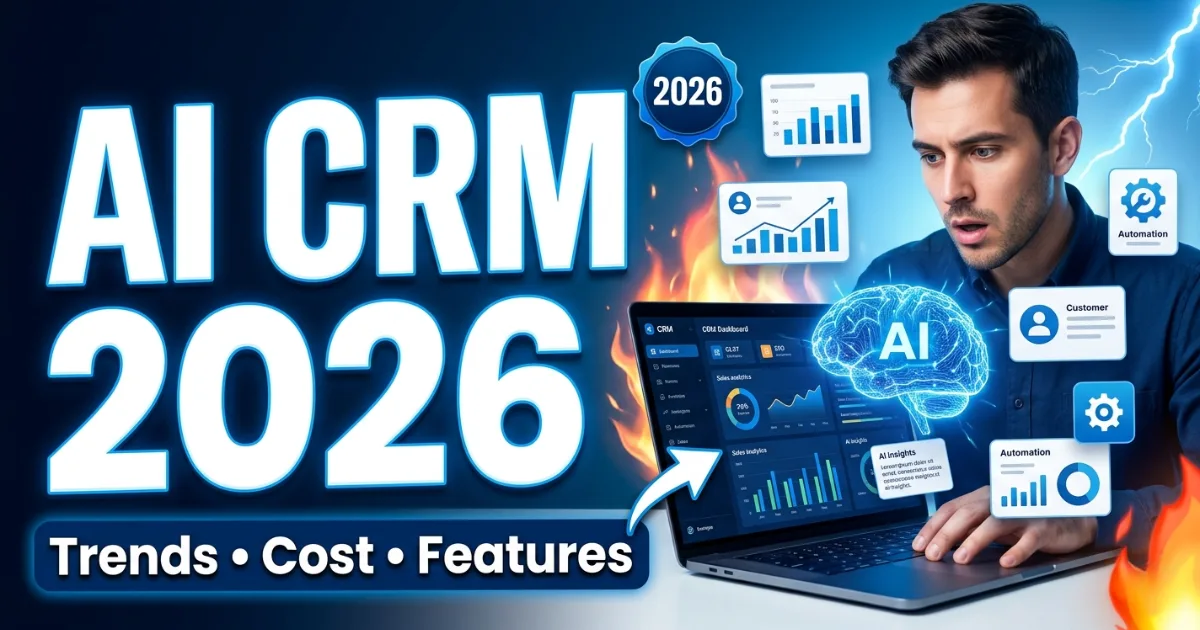
Businesses in 2026 face intense competition for customer attention. AI-powered CRM software development transforms how companies manage relationships, predict behaviors, and drive revenue. Unlike traditional systems that store data reactively, modern AI CRM platforms analyze patterns in real time, automate workflows, and deliver proactive insights.
If you're a business owner, startup founder, or enterprise leader seeking custom CRM development services, this guide covers everything: market trends, must-have features, industry use cases, development process, and realistic AI CRM development cost estimates.
SISGAIN, a trusted CRM software development company, specializes in building scalable, intelligent CRM solutions tailored to your needs. Whether you want cloud-based CRM solutions, mobile CRM app development, or full enterprise CRM development, partnering with experts ensures faster ROI and competitive edge.
AI CRM stands for Artificial Intelligence-powered Customer Relationship Management. It is the next-generation version of traditional CRM systems, enhanced with advanced AI technologies.
At its core, AI CRM combines machine learning (ML), natural language processing (NLP), predictive analytics, and generative AI. These tools help businesses automatically handle routine tasks, accurately forecast future outcomes, and deliver highly personalized experiences to customers at scale.
In simple terms: Traditional CRM systems mainly record what has already happened — such as past interactions, deals closed, or support tickets.
AI in CRM goes much further: it analyzes data in real time to predict what is likely to happen next and recommends the smartest actions to take. This turns your CRM from a passive database into a proactive intelligence partner that guides your team toward better decisions.
For example, instead of manually scoring leads or guessing the best follow-up email, an AI-powered CRM can automatically identify high-potential prospects, suggest personalized messages, and even flag customers who might churn soon — giving your sales, marketing, and service teams a clear advantage.
Real-world impact: Businesses using AI in their CRM are 83% more likely to exceed their sales goals compared to those that don’t. Moreover, adoption of AI and big data technologies in CRM is expected to surge by 97% between 2025 and 2030, showing how quickly this shift is happening across industries.
This evolution makes AI-powered CRM software development especially valuable for companies that want to move beyond basic data storage and unlock smarter, faster, and more profitable customer relationships.
The global CRM market is experiencing massive growth. In 2025, it was valued at approximately $90–113 billion, with projections showing continued strong expansion through the 2030s at a CAGR of around 12–14%. The AI in CRM segment alone reached about $11 billion in 2025 and is growing rapidly at a much higher pace.
This surge is not surprising. Businesses today generate enormous amounts of customer data from multiple channels — websites, mobile apps, social media, emails, phone calls, and in-store interactions. Managing this data effectively has become a major competitive advantage.
Several powerful factors are pushing companies toward smarter CRM solutions:
Integrating AI in CRM delivers tangible advantages that directly impact your bottom line:
In short: AI-powered CRM software development transforms your customer relationship system from a simple record-keeping tool into a strategic growth engine. It helps businesses achieve higher conversion rates, reduce customer churn, shorten sales cycles, and empower teams to work more efficiently.
Companies that invest in modern custom CRM development services today are positioning themselves to outperform competitors who continue using outdated, manual systems.
Also Read - AI Lead Scoring & Churn Prevention in Custom CRM
2026 marks the year AI moves from experimental to operational in CRM. Here are the top CRM development trends 2026:
Cloud-based CRM solutions dominate due to lower upfront costs, automatic updates, and scalability—87%+ of companies now prefer them.
Mini Summary: 2026 CRM systems evolve from record-keeping tools into intelligent operating systems for customer-centric growth.
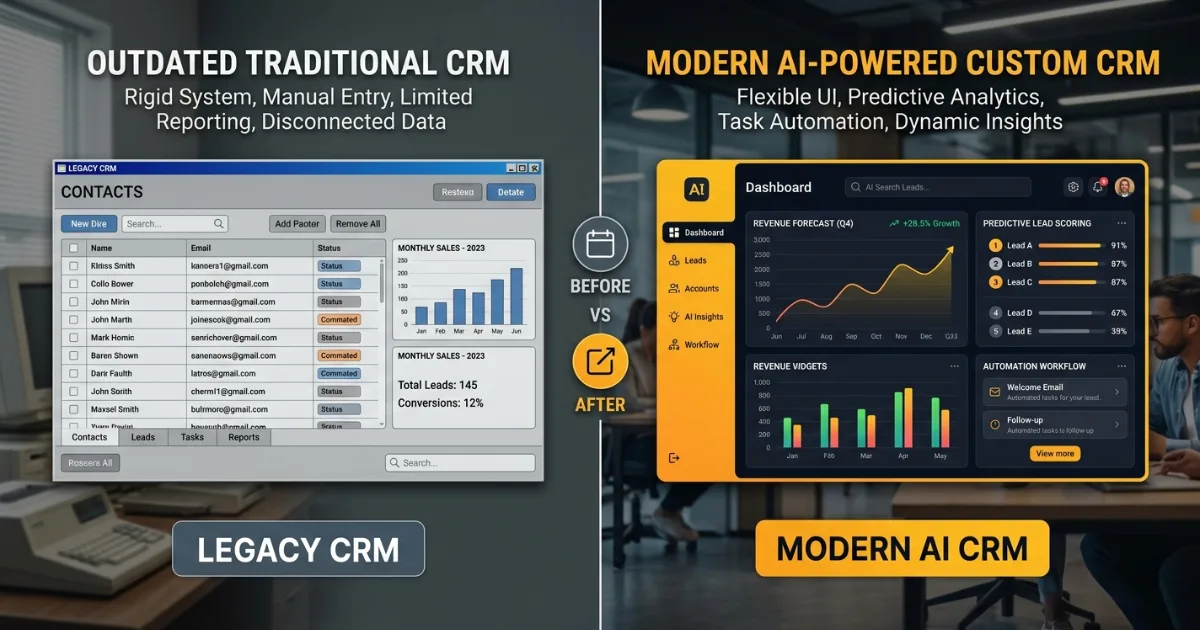
Choosing the right CRM can make a huge difference to your business performance. Understanding how AI-powered CRM differs from traditional CRM helps you see why investing in custom CRM development is often worth it in 2026.
Traditional CRM systems mainly act as digital filing cabinets — they store customer information and past interactions.
AI-powered CRM, on the other hand, works like an intelligent assistant. It not only stores data but also analyzes it in real time, predicts future outcomes, and automatically suggests the best next steps.
Here’s a side-by-side comparison to make the differences crystal clear:
| Aspect | Traditional CRM | AI-Powered CRM | Business Impact |
|---|---|---|---|
| Data Handling | Manual data entry and static records | Automatic capture, data enrichment, and real-time analysis | 50–70% less admin time for your team |
| Lead Scoring | Manual or simple rule-based scoring | Predictive machine learning models (often 89%+ accuracy) | Better lead prioritization and higher conversion rates |
| Forecasting | Based on historical averages and gut feeling | Dynamic ML predictions (up to 91% accuracy) | More reliable sales and revenue planning |
| Personalization | Basic customer segmentation | 1:1 hyper-personalized customer journeys at scale | 5–15% revenue uplift |
| Customer Service | Reactive (respond only when customer complains) | Proactive issue detection and automated resolution | Lower customer churn and higher satisfaction |
| Automation | Limited to simple rules | Intelligent workflows and autonomous AI agents | 25–40% productivity gains |
| Reporting | Historical dashboards only | Predictive insights + actionable recommendations | Truly actionable intelligence |
| Deployment & Cost | Often on-premise with high maintenance | Cloud/SaaS-based, highly scalable, AI features add 10–30% cost but deliver faster ROI | Quicker time-to-value (usually 3–6 months) |
| ROI Example | Solid but limited returns | 245–421% ROI depending on business size | Significantly higher long-term returns |
Key Insight: Traditional CRM is a system of record — it tells you what has already happened.
AI CRM is a system of intelligence — it tells you what is likely to happen next and recommends the smartest actions to take.
Businesses that continue using outdated legacy CRM systems risk falling behind. Their competitors who adopt AI in CRM gain a clear edge through smarter sales enablement, better customer experiences, faster decision-making, and stronger overall growth.
Bottom Line: If your business wants to stay competitive in 2026 and beyond, moving from a traditional CRM to an intelligent AI-powered CRM is no longer optional — it’s becoming essential for sustainable success.
When you invest in AI-powered CRM software development, choosing the right features is crucial for long-term success. Modern AI CRMs go far beyond basic contact management — they act as intelligent platforms that automate tasks, predict outcomes, and deliver personalized customer experiences.
Here are the most important features every business should look for in 2026:
Additional Boost for Sales Teams: Many modern CRMs also include sales enablement software features such as AI coaching for sales reps, smart content recommendations, and real-time buyer signal tracking. These tools help sales teams perform better and close deals faster.
For Enterprise Needs: If you are building or buying an enterprise CRM development solution, you should also consider advanced capabilities like multi-tenancy (supporting multiple departments or companies securely), sophisticated governance tools, high system availability (99.99% uptime), and the ability to train custom AI models on your own data.
Quick Tip: Prioritize features based on your business size, industry, and current pain points. A good CRM software development company can help you select and customize the right mix of features for maximum ROI.
A reliable CRM software development company follows a structured CRM system development process:
Mobile CRM app development requires extra focus on responsive design, security, and offline capabilities.
Timeline: MVP in 3–6 months; full enterprise solution 9–18 months.
Custom CRM development shines when tailored to verticals. Here are real-world examples:
Healthcare:
Retail:
BFSI (Banking, Financial Services, Insurance):
Other sectors like manufacturing (supply chain CRM), real estate (lead nurturing), and professional services (project-based client management) also benefit hugely from CRM integration services.
Example: A retail chain using AI CRM saw 40% sales uplift through hyper-personalized recommendations. A bank reduced fraud losses and improved customer satisfaction via conversational AI.
Cloud-based CRM solutions lead in 2026 for most businesses:
On-premise suits highly regulated industries needing full data control, but maintenance costs are higher.
Hybrid models are rising for enterprises balancing control and agility.
In 2026, mobile CRM app development is non-negotiable. Features include:
Development often uses cross-platform frameworks like React Native or Flutter for cost efficiency and faster updates.
One of the most common questions business owners ask is: “How much does it cost to develop a CRM in 2026?”
The answer depends on several factors — such as the features you need, whether you want a simple MVP or a full enterprise solution, the complexity of AI integration, and where your development team is located.
Below is a clear breakdown of AI CRM development cost based on realistic 2026 market estimates.
| Project Type | Key Features Included | Timeline | Estimated Cost (USD) |
|---|---|---|---|
| Basic Custom CRM (MVP) | Core contact management, deals pipeline, basic automation | 3–5 months | $30,000 – $80,000 |
| AI-Enhanced Mid-Tier CRM | Predictive lead scoring, chatbots, mobile app, key integrations | 5–9 months | $80,000 – $150,000 |
| Advanced AI CRM | Generative AI, advanced analytics, omnichannel support, custom ML models | 6–12 months | $150,000 – $300,000 |
| Enterprise CRM Development | Full feature suite, complex integrations, high-level security, multi-tenancy | 9–18 months | $200,000 – $500,000+ |
Several factors can increase or decrease the final price:
Important Note: These are average ranges. The exact AI CRM development cost for your project will be determined after a detailed requirements analysis.
Yes — when done right, it is a smart business investment rather than just an expense.
Many companies recover their investment within 6 to 12 months through:
Pro Tip: Don’t try to build everything at once. Start with a Minimum Viable Product (MVP) to test the solution with real users, gather feedback, and then scale it gradually. A reliable CRM software development company will provide transparent scoping, clear milestones, and phased delivery to help you manage costs and risks effectively.
SISGAIN stands out as a leading CRM software development company with deep expertise in AI software development services, custom CRM development, mobile CRM app development, and enterprise CRM solutions development.
With years of experience delivering healthcare, retail, BFSI, and other industry-specific solutions, SISGAIN combines technical excellence with business acumen. Clients praise their flexible platforms, post-launch support, and ability to build secure, scalable systems.
Key Advantages:
Whether you need a startup-friendly SaaS CRM or complex enterprise CRM development, SISGAIN tailors solutions to drive real business outcomes.
Starting your AI-powered CRM software development journey doesn’t have to be complicated. By following a simple, step-by-step approach, you can move from idea to a powerful, results-driven CRM system with minimal risk.
Here’s a clear 5-step guide to help you get started smoothly:
Ready to Transform Your Customer Relationships?
Don’t let outdated systems hold your business back.
Book a free consultation with SISGAIN today or get a demo of how an intelligent AI-powered CRM can work for your specific business.
Our expert team will carefully assess your needs, provide a clear customized roadmap, and give you a transparent cost estimate — all at no obligation.
Take the first step toward smarter sales, stronger customer loyalty, and higher revenue.
AI-powered CRM software development in 2026 is no longer a luxury—it’s a strategic necessity for businesses aiming to thrive amid rising customer expectations and data complexity.
By investing in custom CRM development services from a proven CRM software development company like SISGAIN, you gain intelligent automation, predictive power, and personalized engagement that drive sustainable growth.
Don’t let outdated systems hold you back. Book a demo or get a free consultation today to explore how tailored cloud-based CRM solutions, AI features, and mobile CRM app development can transform your operations.


Start Build Your
Next Digital Solution?
Let’s build scalable, future-ready digital solutions tailored to your business goals. Connect with our experienced technology consultants to discuss your vision, strategy, and growth opportunities — with zero obligation and complete transparency.
Get a free consultation and cost estimate for your digital solution
Our expert will contact you within 24 hours. Check your email for confirmation.
Partner with SISGAIN experts to build secure, scalable AI-powered IT Solutions that transform your business operations.









DUQE FREEZONE Quarter Deck, Queen Elizabeth 2, Mina Rashid, Dubai, UAE

100 Consilium Pl Suite 200, Scarborough, ON M1H 3E3, Canada

C-109, Sector 2, Noida, Uttar Pradesh 201301 India
Project quotes, partnerships, implementation
Open roles, referrals, campus hiring