
 +1 844-445-5767
 +971 56-848-5757
 +91 921-208-0630
For Business & Service Inquiries
Sales Team
Project quotes, partnerships, implementation

For years, businesses relied on generic marketing strategies to reach customers. Email campaigns were sent to thousands of users with identical messaging, CRM databases stored static customer records, and marketing teams relied on broad segmentation to target audiences. While these approaches once worked, today’s digital customers expect far more than generic interactions.
Modern consumers are constantly exposed to highly personalized digital experiences. From product recommendations on e-commerce platforms to curated content on streaming services, personalization has become the standard rather than the exception. As a result, businesses that still rely on traditional CRM workflows are rapidly losing customer attention, engagement, and loyalty.
This shift has led to the rise of the hyper personalized customer experience, where every interaction is tailored based on individual customer behavior, preferences, real-time actions, and predictive insights. Instead of sending one campaign to thousands of customers, companies now deliver unique experiences to every individual user across websites, mobile apps, emails, and digital platforms.
Traditional CRM systems were never designed for this level of intelligence. Most legacy CRM tools focus on storing customer information rather than actively analyzing behavior. They track contacts, deals, and communications but struggle to understand deeper customer intent or predict future actions. In a world where customers expect instant relevance, these outdated systems often fall short.
This is where the concept of hyper personalization CRM is transforming customer relationship management. Modern CRM platforms are no longer passive databases. They are intelligent ecosystems powered by artificial intelligence, behavioral analytics, and real-time data processing. These platforms continuously analyze customer interactions across multiple touchpoints and generate actionable insights that help businesses deliver highly relevant experiences.
The rapid growth of digital channels has also created a massive explosion of customer data. Every click, search query, product view, and transaction generates valuable behavioral signals. However, raw data alone does not create meaningful customer experiences. Businesses need advanced technologies capable of interpreting this data instantly and translating it into personalized actions.
This growing demand has accelerated the adoption of AI driven personalization CRM platforms. Artificial intelligence can process enormous datasets, identify patterns in customer behavior, and predict what users are likely to do next. By combining machine learning algorithms with CRM data, businesses can automatically trigger personalized recommendations, targeted offers, and contextual messaging that resonate with individual customers.
For example, an AI-powered CRM platform can detect when a customer repeatedly views a specific product category, predict purchase intent, and automatically deliver personalized offers or content recommendations. These insights allow businesses to engage customers at the exact moment when they are most likely to convert.
Another major shift shaping modern CRM strategies is the need for real-time decision making. In the digital economy, customer preferences change rapidly. A user browsing your website today may not be interested in the same product tomorrow. Businesses therefore need CRM systems capable of analyzing customer signals instantly and adjusting experiences dynamically.
Real-time personalization is now becoming a core competitive advantage. Companies that understand customer intent at the right moment can dramatically increase engagement, conversions, and retention. Those relying on delayed analytics or manual campaign strategies risk losing customers to more agile competitors.
To keep pace with these evolving expectations, organizations are increasingly investing in advanced customer personalization software. These platforms combine artificial intelligence, predictive analytics, and behavioral tracking to deliver truly individualized customer journeys.
However, implementing such systems often requires significant technical expertise. Many organizations are turning to specialized partners for CRM development and AI-driven solutions that can be customized to their business processes. Working with a custom ai development company allows enterprises to build intelligent CRM platforms tailored to their specific data infrastructure, customer journeys, and marketing strategies.
As businesses move toward more intelligent customer engagement strategies, one thing is becoming increasingly clear: generic customer interactions are no longer sustainable. Companies that want to remain competitive must adopt CRM systems capable of delivering real-time insights, predictive recommendations, and highly personalized engagement.
In today’s competitive digital landscape, organizations that invest in a crm system with personalization features are not simply upgrading their technology stack—they are redefining how they build relationships with customers.
To understand the value of modern CRM innovation, it is important to first clarify what hyper-personalization actually means. While many organizations claim to offer personalized experiences, most traditional systems only provide basic personalization. Hyper-personalization takes this concept significantly further.
Basic personalization typically relies on simple data points such as a customer’s name, location, or purchase history. For example, a marketing email may greet a customer by name or recommend products based on past purchases. While this approach can improve engagement slightly, it lacks the depth needed to truly understand individual customer behavior.
CRM hyper personalization, on the other hand, uses artificial intelligence, machine learning, and advanced analytics to analyze large volumes of customer data in real time. Instead of relying solely on historical information, hyper-personalized systems continuously monitor behavioral signals and adapt interactions dynamically.
This means that customer experiences are no longer based on static segments but on continuously evolving insights. Every click, page view, interaction, and behavioral pattern becomes part of a larger data ecosystem that allows businesses to predict customer needs with remarkable accuracy.
At the core of this transformation is the use of advanced AI customer insights platforms. These platforms analyze complex behavioral datasets and generate actionable intelligence about customer preferences, interests, and intent. By understanding these patterns, businesses can deliver targeted recommendations and personalized experiences that feel intuitive and relevant.
One of the most important technologies enabling hyper-personalized CRM systems is predictive personalization software. Predictive analytics algorithms analyze past behavior to forecast future actions. For instance, they can determine when a customer is most likely to make a purchase, churn, or engage with specific content.
Predictive models also allow CRM platforms to identify high-value customers and prioritize engagement strategies accordingly. This level of intelligence helps businesses allocate marketing resources more effectively and focus on opportunities with the highest conversion potential.
Another key component of hyper-personalized CRM systems is behavioral tracking. Advanced platforms use customer behavior analytics CRM technologies to monitor how users interact with digital platforms. This includes tracking website navigation patterns, product views, search behavior, engagement with marketing campaigns, and more.
When these behavioral signals are analyzed collectively, businesses gain a comprehensive understanding of each customer's journey. Instead of treating users as anonymous website visitors, companies can recognize intent signals and respond with highly relevant interactions.
Equally important is the role of customer journey mapping software. Hyper-personalization requires businesses to understand every stage of the customer lifecycle—from initial awareness to post-purchase engagement. Journey mapping tools help organizations visualize how customers move through various touchpoints and identify opportunities for personalized engagement.
For example, a CRM system may detect when a user repeatedly visits a pricing page but has not completed a purchase. Based on this insight, the system can trigger personalized incentives, targeted content, or direct sales outreach to move the customer toward conversion.
Hyper-personalized CRM platforms also integrate intelligent recommendation engines. These systems analyze behavioral data and automatically suggest products, services, or content that align with a customer’s interests. Similar technologies are widely used by leading digital companies such as e-commerce platforms and streaming services to deliver highly engaging experiences.
Another defining feature of hyper-personalization is automation. AI-powered CRM systems can trigger personalized actions automatically based on real-time customer behavior. These triggers might include personalized emails, targeted push notifications, customized landing pages, or dynamic website content.
Automation ensures that personalized experiences can be delivered at scale without overwhelming marketing teams. Instead of manually managing campaigns, businesses can rely on intelligent systems that continuously optimize customer engagement strategies.
Ultimately, hyper-personalization transforms CRM from a passive customer database into an intelligent decision-making engine. It enables businesses to understand customers on a deeper level, anticipate their needs, and deliver experiences that feel genuinely relevant.
As customer expectations continue to evolve, organizations that adopt hyper-personalized CRM strategies will be far better positioned to build meaningful relationships, increase customer loyalty, and drive long-term growth.
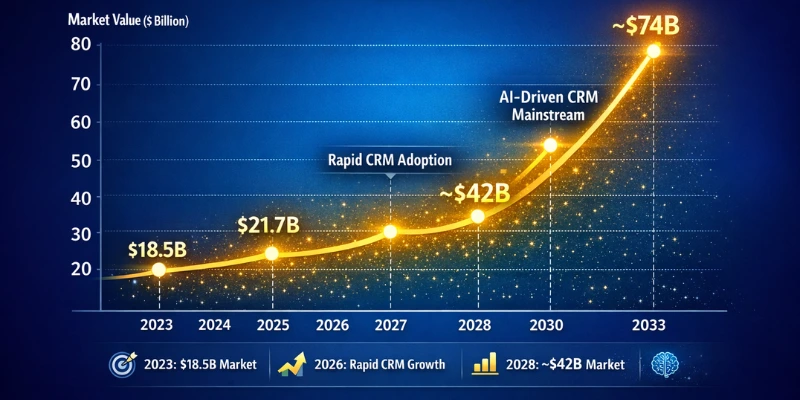
Digital markets have become intensely competitive over the last decade. Businesses are no longer competing only on price or product quality—they are competing on customer experience. In a world where customers can switch brands with a single click, companies that fail to deliver meaningful and relevant interactions risk losing their audience to competitors that understand them better.
This shift in market dynamics is one of the main reasons why organizations are rapidly adopting hyper-personalized CRM strategies.
Modern customers expect brands to understand their needs, preferences, and behavior. They want recommendations that feel relevant, communication that respects their interests, and experiences that adapt to their actions in real time. Generic marketing campaigns and static CRM records cannot meet these expectations.
Hyper-personalization bridges this gap by transforming CRM systems into intelligent platforms capable of delivering individualized experiences across the entire customer lifecycle. Instead of relying on broad segments such as “new customers” or “returning users,” businesses can create highly tailored interactions for each individual.
At the center of this transformation is personalized marketing automation. AI-powered CRM systems can analyze large datasets and automatically trigger personalized marketing actions based on behavioral signals. For example, if a customer abandons a shopping cart, the system can send a customized follow-up message with relevant product suggestions. If a user frequently browses a specific category, the CRM platform can recommend similar products or content that matches their interests.
This level of automation significantly improves marketing efficiency. Campaigns no longer rely on guesswork; instead, they are driven by real-time insights and predictive intelligence.
Another major driver behind hyper-personalized CRM adoption is the growing importance of data-driven customer journeys. Businesses today interact with customers across multiple channels including websites, mobile applications, social media platforms, email campaigns, and customer support systems. Managing these interactions manually is nearly impossible.
This is where hyper personalized customer journey software becomes essential. These systems continuously track how customers move through different touchpoints and identify patterns that reveal their intent. By understanding the complete journey, businesses can design experiences that feel seamless and highly relevant.
For example, a customer who first discovers a brand through social media may later visit the website, browse product pages, and eventually subscribe to email updates. A hyper-personalized CRM platform can connect all these interactions and respond with tailored messaging that aligns with the customer’s stage in the buying process.
A strong customer data personalization platform also allows organizations to unify information from multiple sources. CRM systems can integrate data from marketing tools, sales platforms, analytics software, and customer service applications. When all these data streams are connected, businesses gain a much clearer understanding of customer behavior.
The business impact of hyper-personalization is significant. Organizations that successfully implement personalized CRM strategies often report measurable improvements in performance metrics.
Companies using advanced personalization techniques frequently experience higher conversion rates because customers receive offers and recommendations that align closely with their interests. Instead of broadcasting generic campaigns, businesses deliver targeted experiences that motivate users to take action.
Retention rates also improve dramatically. When customers feel understood and valued, they are far more likely to remain loyal to a brand. Personalized interactions create a sense of relevance and connection that encourages long-term engagement.
Another critical benefit is the increase in customer lifetime value. By continuously delivering relevant experiences, businesses can encourage repeat purchases, cross-selling opportunities, and deeper customer relationships over time.
As digital competition continues to intensify, hyper-personalization is quickly evolving from a competitive advantage into a business necessity. Companies that invest in intelligent CRM technologies today will be better positioned to build stronger relationships with customers and maintain a sustainable advantage in increasingly crowded markets.
The effectiveness of hyper-personalization largely depends on the ability to process and interpret massive volumes of customer data. Modern organizations generate enormous datasets from website activity, mobile applications, social media interactions, customer support conversations, and transactional systems.
Without advanced technologies, transforming this data into meaningful customer insights would be extremely difficult. Artificial intelligence has therefore become the foundation of modern hyper-personalized CRM platforms.
AI enables CRM systems to analyze behavioral patterns, predict customer intent, and automatically deliver personalized experiences at scale. Through machine learning algorithms and intelligent automation, CRM platforms can evolve from simple record-keeping tools into powerful decision-making engines.
Below are the core AI technologies that power hyper-personalized CRM systems.
One of the most important components of a modern CRM platform is the AI customer insights platform. These engines analyze vast datasets to uncover patterns in customer behavior that would otherwise remain hidden.
Traditional analytics tools typically rely on historical reports. AI-powered systems, however, continuously process real-time data and adapt to new information as it becomes available.
For example, AI algorithms can track how customers interact with websites, which products they explore, how long they stay on specific pages, and what type of content they engage with most frequently. These behavioral signals provide valuable clues about customer preferences and purchase intent.
Advanced customer behavior tracking CRM software takes this analysis further by identifying micro-patterns in user activity. AI models can recognize subtle shifts in behavior that indicate increased buying interest, declining engagement, or potential churn risk.
Once these patterns are identified, CRM systems can automatically trigger relevant marketing or sales actions. This might include personalized content recommendations, targeted promotions, or proactive customer support outreach.
By continuously learning from new data, AI insights engines become more accurate over time, allowing businesses to refine their customer engagement strategies and improve decision-making.
Another powerful capability of AI-powered CRM platforms is predictive personalization. Instead of reacting to customer behavior after it occurs, predictive models anticipate future actions and enable businesses to respond proactively.
Using predictive personalization software, CRM systems analyze historical behavior, demographic information, and interaction patterns to forecast what customers are likely to do next. These predictions can include purchase probability, product preferences, engagement likelihood, or even potential churn.
For instance, if a customer regularly purchases products within a specific category every few weeks, predictive algorithms can estimate when they are most likely to buy again. The CRM platform can then send personalized recommendations or special offers at precisely the right moment.
Another important feature is the integration of a CRM software with AI recommendation engine. These systems automatically suggest products, services, or content that align with individual customer interests.
Recommendation engines are widely used by leading digital platforms because they significantly increase engagement and sales opportunities. When integrated into CRM systems, they enable businesses to deliver highly targeted suggestions across websites, email campaigns, mobile applications, and digital advertising platforms.
Predictive personalization allows companies to shift from reactive marketing to proactive engagement, ensuring that customer interactions are timely, relevant, and highly effective.
While predictive analytics is powerful, modern customer engagement strategies also require immediate responsiveness. Customers interact with brands in real time, and businesses must respond just as quickly.
This is where CRM with real time personalization features becomes essential. Real-time personalization technologies analyze customer behavior as it happens and instantly adapt the user experience.
For example, when a visitor browses a website, the CRM system can dynamically adjust product recommendations, promotional banners, or content suggestions based on the user’s browsing behavior. If the system detects a high purchase intent signal, it can immediately present a personalized offer or discount.
These capabilities are powered by advanced real time customer engagement software that processes customer signals within milliseconds. Instead of waiting for scheduled marketing campaigns, businesses can respond to customer actions at the exact moment they occur.
Real-time personalization is particularly valuable in industries where customer decisions are influenced by immediate context, such as e-commerce, travel bookings, and digital services.
By combining predictive analytics with real-time decision making, AI-powered CRM systems create highly adaptive customer experiences that feel intuitive and responsive.
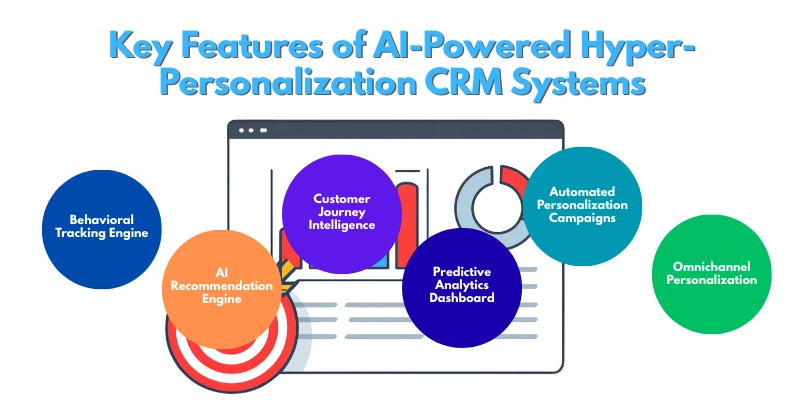
To successfully deliver hyper-personalized experiences, modern CRM platforms incorporate several advanced features that transform how businesses interact with customers.
Below are some of the most important capabilities that define an AI-powered hyper-personalization CRM system.
At the core of personalization lies the ability to understand customer behavior. Advanced customer behavior tracking CRM software monitors how users interact with digital platforms, including page visits, search queries, product exploration, and content engagement.
These insights help businesses identify patterns that reveal customer interests and purchase intent.
A powerful CRM software with AI recommendation engine enables businesses to automatically suggest relevant products, services, or content based on individual user behavior.
Recommendation engines analyze past interactions and continuously refine suggestions to maximize engagement and conversion potential.
Understanding the entire customer lifecycle is essential for effective personalization. Customer journey mapping software allows businesses to visualize how customers move through different stages of the buying process.
By identifying key touchpoints and behavioral signals, organizations can design highly targeted engagement strategies that guide customers toward conversion.
A predictive analytics dashboard powered by predictive personalization software provides real-time insights into customer trends and future behaviors.
These dashboards allow marketing and sales teams to identify high-value opportunities, forecast customer actions, and optimize engagement strategies.
Modern CRM systems support CRM for personalized marketing automation, allowing businesses to create dynamic campaigns triggered by specific customer actions.
These campaigns can automatically send personalized emails, product recommendations, promotional offers, or content updates without manual intervention.
Customers interact with brands through multiple channels, including websites, mobile apps, social media, and customer support platforms. A comprehensive customer experience personalization platform ensures that personalization remains consistent across all these touchpoints.
Omnichannel personalization allows businesses to maintain a unified customer experience regardless of how or where users engage with the brand.
Adopting hyper-personalized CRM technologies provides organizations with a wide range of strategic advantages. These benefits go beyond simple marketing improvements and can significantly impact overall business performance.
A hyper personalized customer experience increases the likelihood that customers will respond positively to marketing messages. When users receive recommendations or offers that match their interests, they are far more likely to complete a purchase or take the desired action.
Customer loyalty is strongly influenced by relevance and convenience. CRM platforms that support CRM hyper personalization allow businesses to deliver experiences that feel meaningful and valuable, encouraging customers to remain engaged over the long term.
With AI powered CRM personalization, businesses can target marketing campaigns with much greater precision. Automated personalization ensures that marketing resources are focused on customers who are most likely to respond, improving overall campaign efficiency.
AI-driven analytics tools provide detailed insights into customer behavior, preferences, and purchasing patterns. These insights help organizations refine their strategies and continuously improve the quality of customer interactions.
Companies that adopt advanced personalization strategies gain a significant advantage in crowded digital markets. By delivering exceptional customer experiences, businesses can differentiate themselves and build stronger relationships with their audiences.
Hyper-personalization is not limited to a single industry. Organizations across multiple sectors are adopting advanced CRM technologies to deliver more engaging and relevant customer experiences.
Online retailers rely heavily on AI based customer personalization software to recommend products, personalize website content, and optimize marketing campaigns. Personalized product recommendations have become one of the most powerful drivers of online sales.
Healthcare providers are increasingly using personalization technologies to improve patient engagement. By leveraging customer experience personalization platforms, healthcare organizations can deliver tailored communication, appointment reminders, and treatment recommendations.
Financial institutions use AI-powered CRM systems to analyze customer behavior and offer personalized financial products. These insights help banks and fintech companies improve customer satisfaction while increasing cross-selling opportunities.
Software companies use hyper-personalized CRM strategies to guide users through onboarding processes, recommend features, and optimize customer journeys. This approach helps improve product adoption and reduce churn.
Travel platforms and hospitality businesses rely on personalization to recommend destinations, customize travel packages, and deliver tailored promotional offers. Personalized experiences help these companies increase bookings and improve customer loyalty.
As more industries recognize the value of personalization, hyper-personalized CRM systems are quickly becoming a central component of modern digital business strategies.
Many businesses recognize the value of personalization but struggle with execution. Implementing a hyper personalization CRM strategy requires more than simply adding automation tools. It involves building a data-driven ecosystem where customer insights, artificial intelligence, and marketing automation work together to deliver individualized experiences.
Organizations searching for how to implement hyper personalization in CRM must follow a structured approach that aligns technology with customer engagement strategies. Below is a practical step-by-step framework that businesses can follow.
The foundation of any personalization strategy is data. Businesses must first gather customer information from multiple touchpoints to create a unified profile of each user.
Data sources typically include:
When these datasets are unified into a centralized system, businesses gain a 360-degree view of customer behavior. This allows companies to understand how users interact with their brand across the entire digital ecosystem.
Modern customer data personalization platforms help integrate data streams from different systems so that insights are not isolated across departments. Instead, marketing, sales, and support teams can access the same behavioral intelligence.
Without centralized data, personalization becomes fragmented and inconsistent.
Once data is collected, the next step is to transform raw information into actionable insights. Artificial intelligence plays a critical role in this stage.
AI algorithms analyze large volumes of behavioral data and identify patterns that reveal customer intent, interests, and engagement preferences.
Businesses often deploy behavioral analysis tools that can:
These capabilities allow companies to understand how customers interact with their brand and what motivates their decisions.
Advanced AI customer insights platforms continuously analyze new data and refine predictions over time. This allows CRM systems to evolve and become more accurate in identifying opportunities for personalized engagement.
Traditional CRM segmentation often relies on basic categories such as location, age group, or purchase history. However, hyper-personalization requires much deeper segmentation.
Businesses must create micro-segments based on behavioral patterns, preferences, and engagement signals. For example:
These micro-segments enable businesses to tailor messaging and recommendations much more precisely.
Instead of sending the same campaign to thousands of users, companies can deliver customized experiences to highly specific audience groups.
Once behavioral insights and micro-segments are established, businesses can begin automating personalized interactions.
Modern CRM platforms support CRM for personalized marketing automation, allowing organizations to trigger personalized campaigns based on customer behavior.
Examples of automation triggers include:
These campaigns can run continuously without manual intervention. AI algorithms monitor behavioral signals and trigger personalized responses automatically.
This level of automation ensures that businesses can scale personalization efforts across thousands or even millions of users.
The final step in hyper-personalization is continuous optimization. AI-powered CRM systems use predictive analytics to refine customer journeys and improve engagement strategies over time.
Predictive models can forecast:
With these insights, businesses can adjust messaging, timing, and recommendations to maximize engagement and conversions.
Companies that follow this structured implementation approach can transform their CRM systems into intelligent platforms capable of delivering truly personalized customer experiences.
While many CRM platforms offer basic personalization features, most off-the-shelf systems are not designed to support advanced hyper-personalization strategies.
Businesses implementing AI-driven personalization often encounter limitations with standard CRM tools, particularly when dealing with complex customer journeys, large datasets, or enterprise-level integrations.
As a result, many organizations invest in custom CRM personalization solutions tailored to their specific business requirements.
Custom CRM systems allow companies to design personalization frameworks that align with their industry, customer behavior patterns, and operational workflows.
Pre-built CRM software is typically designed for general use cases. While these tools offer useful features, they often lack the flexibility needed for advanced personalization strategies.
Common limitations include:
These restrictions can prevent businesses from implementing deep personalization strategies that rely on real-time data processing and advanced analytics.
Organizations investing in hyper personalization CRM development gain several strategic advantages.
Tailored Business Workflows
Custom CRM systems can be designed around specific business processes. Instead of forcing teams to adapt to rigid software structures, companies can create workflows that match their operational requirements.
Advanced AI Integration
Custom solutions allow organizations to integrate advanced machine learning models, recommendation engines, and behavioral analytics platforms. This makes CRM personalization software development significantly more powerful than standard CRM tools.
Enterprise Scalability
Large organizations require CRM systems capable of handling millions of customer interactions and data points. Custom platforms are built with scalability in mind, allowing businesses to grow without performance limitations.
Data Ownership and Control
Many businesses prefer to maintain full ownership of their customer data rather than relying on third-party platforms. Custom CRM architectures provide greater control over data storage, security, and governance.
Security and Compliance
Enterprises operating in regulated industries often require strict compliance with data protection standards. Custom CRM systems can be designed to meet these security requirements while supporting personalization strategies.
Companies seeking advanced CRM capabilities often work with a specialized crm software development company that understands enterprise architecture and AI integration.
Additionally, partnering with a custom ai development company allows businesses to build intelligent algorithms tailored to their specific customer engagement goals.
Through personalized CRM software development, organizations can create powerful platforms that deliver highly relevant customer experiences at scale.
As hyper-personalization becomes a strategic priority, many organizations are searching for the best CRM for personalized customer experience.
However, selecting the right platform requires careful evaluation of several critical factors.
The most important feature of a modern CRM platform is its ability to leverage artificial intelligence. Businesses should look for systems capable of behavioral analysis, predictive analytics, and automated recommendations.
AI-powered systems enable deeper insights and more accurate personalization strategies.
A modern CRM system with personalization features must be capable of responding instantly to customer behavior.
Real-time personalization allows businesses to adapt website experiences, marketing campaigns, and recommendations based on live user interactions.
Effective personalization requires unified customer data. CRM platforms must be able to integrate information from multiple sources, including marketing tools, analytics systems, e-commerce platforms, and customer service software.
Strong data integration ensures that personalization efforts remain consistent across all channels.
Automation plays a crucial role in scaling personalization strategies. CRM systems should support advanced automation workflows capable of triggering personalized campaigns based on customer behavior.
This includes automated email sequences, targeted messaging, and dynamic content delivery.
Businesses should choose CRM solutions that can scale with their growth. Enterprise-level systems must support large datasets, complex customer journeys, and high interaction volumes.
Organizations often work with an enterprise CRM development company to ensure their CRM infrastructure can support future expansion.
Customer data protection is essential for maintaining trust and meeting regulatory requirements. CRM platforms must provide robust security features including encryption, access control, and compliance with global data protection standards.
Selecting the right CRM platform ensures that businesses can deliver personalized experiences while maintaining operational reliability and security.
The next generation of CRM platforms will be far more intelligent than today's systems. Advances in artificial intelligence are rapidly transforming how businesses manage customer relationships.
One of the most exciting developments is the rise of Agentic AI powered CRM in 2026. Agentic AI refers to autonomous systems capable of making decisions and executing tasks without constant human intervention.
In CRM environments, autonomous AI agents will be able to analyze customer behavior, initiate conversations, deliver recommendations, and manage engagement strategies automatically.
These systems will move beyond simple automation toward fully intelligent customer relationship management.
Another emerging trend is Emotion AI. This technology analyzes voice tone, facial expressions, and text sentiment to understand customer emotions.
By detecting emotional signals, CRM platforms can adjust communication strategies to create more empathetic and meaningful interactions.
Voice-based personalization is also becoming increasingly important. As voice assistants and conversational AI continue to grow, businesses will need CRM systems capable of delivering personalized voice interactions.
Predictive customer journey mapping will further enhance personalization capabilities. AI will be able to forecast entire customer journeys and recommend optimal engagement strategies at each stage.
Ultimately, the future of AI CRM software development lies in creating systems capable of delivering highly adaptive and intelligent experiences across every touchpoint.
The evolution of hyper personalized customer journey software will redefine how businesses interact with customers, moving from reactive communication toward proactive engagement.
Implementing AI-powered CRM personalization strategies is technically complex. Enterprise systems must integrate multiple technologies including artificial intelligence, machine learning, behavioral analytics, automation tools, and large-scale data infrastructure.
As a result, many organizations choose to partner with specialized CRM development providers.
A professional CRM development company USA can design advanced CRM architectures tailored to enterprise requirements. These companies have experience building scalable platforms capable of handling high volumes of customer interactions.
Enterprises often require complex integrations between CRM systems, marketing platforms, data warehouses, and third-party software tools. Development partners ensure these integrations function seamlessly.
Additionally, a specialized enterprise CRM development company can implement advanced personalization features such as predictive analytics, behavioral tracking engines, and AI recommendation systems.
Companies investing in CRM development for personalized marketing gain access to custom-built platforms that align perfectly with their customer engagement strategies.
Working with experienced CRM developers allows businesses to accelerate implementation timelines while ensuring technical reliability and long-term scalability.
Customer expectations are evolving rapidly, and businesses can no longer rely on generic marketing strategies or traditional CRM platforms.
The rise of hyper personalization CRM systems is transforming how organizations understand and engage with their customers. By leveraging artificial intelligence, predictive analytics, and real-time behavioral insights, businesses can create highly relevant experiences that resonate with individual users.
AI technologies now enable AI powered CRM personalization that can anticipate customer needs, automate personalized interactions, and optimize engagement strategies across multiple channels.
Organizations that invest in advanced customer personalization software gain a significant competitive advantage. They can increase conversion rates, improve customer retention, and build stronger long-term relationships with their audiences.
As digital ecosystems continue to evolve, personalized CRM platforms will become the foundation of modern customer engagement strategies.
Businesses that adopt AI-driven CRM personalization today will be far better positioned to succeed in the increasingly competitive digital economy.



Start Build Your
Next Digital Solution?
Let’s build scalable, future-ready digital solutions tailored to your business goals. Connect with our experienced technology consultants to discuss your vision, strategy, and growth opportunities — with zero obligation and complete transparency.
Get a free consultation and cost estimate for your digital solution
Our expert will contact you within 24 hours. Check your email for confirmation.
Partner with SISGAIN experts to build secure, scalable AI-powered IT Solutions that transform your business operations.









DUQE FREEZONE Quarter Deck, Queen Elizabeth 2, Mina Rashid, Dubai, UAE

100 Consilium Pl Suite 200, Scarborough, ON M1H 3E3, Canada

C-109, Sector 2, Noida, Uttar Pradesh 201301 India
Project quotes, partnerships, implementation
Open roles, referrals, campus hiring