
 +1 844-445-5767
 +971 56-848-5757
 +91 921-208-0630
For Business & Service Inquiries
Sales Team
Project quotes, partnerships, implementation

In 2026, businesses that truly understand their customers will always stay ahead of the competition. With digital interactions increasing across every touchpoint, CRM development services have become the foundation of sustainable growth, smarter decision-making, and long-term customer loyalty.
For modern enterprises—especially those adopting CRM software for IT company ecosystems or partnering with experienced CRM development companies—a CRM is no longer just a tool for managing contacts. It is a centralized growth engine that connects sales, marketing, customer support, and leadership into one intelligent system.
Drawing from more than a decade of experience writing for CRM vendors, SaaS firms, and service-based enterprises, this blog explores 10 powerful CRM use cases every growing business needs in 2026, explained in a practical, user-friendly way with real-world relevance.
Customer expectations have evolved rapidly. Today’s buyers demand quick responses, personalized communication, and consistent service across channels. Businesses that fail to deliver this experience risk losing customers to more agile competitors.
A modern customer relationship management system helps businesses unify customer data, streamline internal workflows, and deliver meaningful interactions at scale. Instead of switching between disconnected tools, teams can collaborate from a single source of truth. This shift is especially important for organizations aiming to become the best CRM for service business models, where trust and responsiveness directly impact revenue.
As businesses grow, managing leads manually becomes inefficient and error-prone. CRM platforms simplify lead capture, qualification, and tracking by bringing every inquiry into one organized system.
With automated sales pipelines, teams gain complete visibility into where each prospect stands. Sales managers can identify bottlenecks, forecast revenue more accurately, and guide their teams with real-time insights. For IT firms, a well-implemented CRM software for IT company setup ensures seamless coordination between sales, technical consultants, and delivery teams.
Key Benefits
Personalization is no longer optional—it is expected. CRM systems store detailed customer histories, preferences, and interaction records, allowing businesses to engage customers in a more relevant and timely manner.
Instead of sending generic messages, companies can tailor communication based on customer behavior and lifecycle stage. This approach strengthens long-term relationships and reinforces the core goal of customer relationship management—building trust through meaningful interactions. For service-driven organizations, this capability plays a key role in becoming the best CRM for service based business.
Use Case Examples
Customer experience is a major differentiator in 2026, particularly for service-oriented businesses. A dedicated service industry CRM enables organizations to manage customer inquiries, complaints, and service requests efficiently.
By integrating customer service platforms within the CRM, support teams can track issues from first contact to resolution without losing context. This leads to faster response times, better accountability, and improved customer satisfaction. Over time, businesses build stronger relationships by consistently delivering reliable support.
CRM in Customer Service Platforms
Growing businesses need clarity, not guesswork. CRM platforms provide real-time dashboards and analytics that help leadership teams understand sales performance and predict future outcomes.
Through intelligent reporting, decision-makers can identify trends, evaluate team productivity, and plan resources more effectively. When supported by customized CRM development, these insights align closely with business goals, making forecasting more accurate and actionable.
Why This Matters
One of the most powerful CRM use cases in 2026 is the alignment of marketing and sales through automation. CRM systems track how leads interact with campaigns, websites, and emails, ensuring no opportunity is overlooked.
Marketing teams can nurture leads with personalized journeys, while sales teams receive better-qualified prospects. With the right CRM software services, businesses can measure campaign performance and continuously optimize their customer acquisition strategy.
Features Include
The healthcare sector requires a highly specialized approach to CRM. With increasing focus on patient experience and data security, healthcare CRM software development services help organizations manage relationships while maintaining compliance.
Hospitals, clinics, and healthcare startups use CRM systems to streamline appointment management, follow-ups, and patient communication. This not only improves operational efficiency but also enhances trust between patients and providers—an essential factor in modern healthcare delivery.
Healthcare CRM Use Cases
Real estate businesses handle multiple properties, agents, and clients simultaneously. Generic CRM tools often fail to address these complexities. That’s where custom real estate CRM software development becomes invaluable.
A tailored CRM allows real estate firms to manage listings, track buyer preferences, and automate follow-ups throughout long sales cycles. Agents stay organized, clients receive timely updates, and deals move forward with greater transparency and efficiency.
Key Capabilities
Beyond customer-facing activities, CRM platforms significantly improve internal operations. Workflow automation reduces manual tasks such as approvals, reminders, and task assignments.
By automating routine processes, teams focus more on strategic work rather than administration. This capability highlights the broader impact of advanced CRM development services, turning CRM into a productivity and efficiency platform rather than just a sales tool.
Business Impact
Customer acquisition costs continue to rise, making retention more important than ever. CRM systems help businesses identify at-risk customers, track satisfaction levels, and engage proactively.
Through structured follow-ups and feedback tracking, companies strengthen loyalty and encourage repeat business. For organizations aiming to be recognized as the best CRM for service business, retention-focused CRM strategies are essential for sustainable growth.
CRM-Driven Retention
As businesses expand, their CRM must scale effortlessly. Modern CRM platforms integrate with ERP systems, accounting tools, project management software, and emerging AI technologies.
Experienced CRM development companies design flexible architectures that support future growth without performance issues. This ensures businesses can adapt quickly to market changes while maintaining data integrity and system reliability.
Integration Use Cases
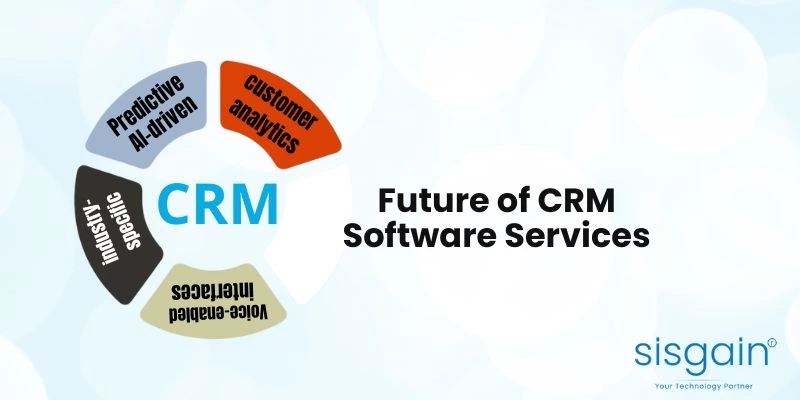
The future of CRM is intelligent, industry-specific, and deeply integrated. In 2026, CRM software services are increasingly focused on AI-driven personalization, predictive analytics, and automation that feels natural rather than complex.
Instead of overwhelming users with dashboards and features, modern CRM systems prioritize simplicity, usability, and real business outcomes. This user-first approach ensures higher adoption rates and better ROI across teams.
When businesses look for a reliable CRM software development company, they need more than just technical expertise—they need a partner that understands growth, scalability, and customer-centric strategy. SISGAIN stands out by delivering CRM solutions that are tailored, intuitive, and aligned with real business goals rather than generic software templates.
With a strong focus on customization and performance, SISGAIN offers end-to-end CRM software services that help organizations streamline sales processes, enhance customer engagement, and improve service delivery. Their approach combines deep industry knowledge with modern technologies, ensuring that each CRM solution adapts seamlessly to evolving business needs.
What truly differentiates SISGAIN is its ability to design CRM platforms that grow alongside businesses. From integrating advanced analytics to enabling automation across departments, SISGAIN empowers companies to transform customer data into actionable insights—driving smarter decisions, stronger relationships, and long-term success in competitive markets.

CRM has evolved into a strategic growth platform that supports every stage of the customer journey. From sales and marketing to customer support and retention, the right CRM use cases empower businesses to scale with confidence.
Organizations that invest in robust CRM development services gain the flexibility to adapt, personalize, and innovate as customer expectations evolve. By partnering with an experienced brand like SISGAIN, businesses can also leverage reliable CRM software services that ensure long-term performance, security, and scalability.
Ready to future-proof your customer relationships? Connect with SISGAIN today and transform your CRM into a true business asset—not just another system.



Start Build Your
Next Digital Solution?
Let’s build scalable, future-ready digital solutions tailored to your business goals. Connect with our experienced technology consultants to discuss your vision, strategy, and growth opportunities — with zero obligation and complete transparency.
Get a free consultation and cost estimate for your digital solution
Our expert will contact you within 24 hours. Check your email for confirmation.
Partner with SISGAIN experts to build secure, scalable AI-powered IT Solutions that transform your business operations.









DUQE FREEZONE Quarter Deck, Queen Elizabeth 2, Mina Rashid, Dubai, UAE

100 Consilium Pl Suite 200, Scarborough, ON M1H 3E3, Canada

C-109, Sector 2, Noida, Uttar Pradesh 201301 India
Project quotes, partnerships, implementation
Open roles, referrals, campus hiring