
 +1 844-445-5767
 +971 56-848-5757
 +91 921-208-0630
For Business & Service Inquiries
Sales Team
Project quotes, partnerships, implementation

In today's fast-paced business landscape, CRM systems are often bogged down by manual tasks that drain productivity. According to a 2025 Gartner report, sales teams spend up to 60% of their time on administrative work, leading to inefficiencies and missed opportunities. Meanwhile, McKinsey's 2026 AI adoption survey reveals that 78% of US enterprises are demanding advanced automation to handle growing customer data volumes. Enter agentic AI in CRM—a revolutionary approach that empowers autonomous CRM systems to handle complex decisions independently, automating up to 70% of workflows like lead qualification, follow-ups, and customer support.
This guide dives deep into agentic AI CRM development, exploring how it evolves beyond traditional automation to create self-driving CRM platforms. You'll learn the core concepts, technical architecture, a step-by-step developer roadmap, real-world case studies, and actionable strategies for implementation. Whether you're a startup founder seeking sales automation or an enterprise CTO building custom AI agents for CRM automation, this article provides the insights needed to leverage agentic AI for competitive advantage. By the end, you'll understand why agentic AI CRM is essential for 2026 and how to start building your own autonomous CRM systems.
Agentic AI in CRM refers to the integration of autonomous AI agents into customer relationship management systems, enabling them to act independently on goals without constant human intervention. Unlike traditional CRM tools that rely on predefined rules, agentic AI uses large language models (LLMs) and machine learning to reason, plan, and execute tasks dynamically. These AI agents can interpret customer data, make decisions, and adapt workflows in real-time, turning a static CRM into a self-driving platform.
To clarify, traditional CRM automation is rule-based think if-then scripts in tools like Salesforce or HubSpot that trigger emails based on fixed conditions. In contrast, agentic AI CRM systems employ intelligent agents that learn from interactions, predict outcomes, and optimize processes autonomously. This shift allows for more nuanced handling of customer journeys, such as prioritizing leads based on behavioral patterns rather than simple demographics, which aligns closely with the concept of AI-powered hyper-personalization in CRM, where AI analyzes deep customer insights to deliver highly tailored experiences.
Here's a comparison table to illustrate the differences:
| Aspect | Rule-Based CRM Automation | Agentic AI CRM Systems |
|---|---|---|
| Decision-Making | Static rules (e.g., if lead score > 50, send email) | Dynamic reasoning (e.g., analyze conversation sentiment and predict next best action) |
| Adaptability | Limited to predefined scenarios | Self-optimizing based on real-time data and feedback |
| Complexity Handling | Handles simple, repetitive tasks | Manages complex, multi-step workflows like personalized sales negotiations |
| Human Involvement | High for setup and adjustments | Minimal; agents act autonomously with oversight |
| Scalability | Scales linearly with rules added | Scales exponentially through learning and multi-agent collaboration |
| Examples | Automated email drips in Marketo | AI sales assistants in custom-built systems using LangChain for orchestration |
The CRM landscape in 2026 is being reshaped by agentic AI due to several converging trends. First, the explosion of customer data—Forrester predicts that US companies will manage 2.5 times more data by 2027 than in 2023—demands smarter systems to process it without overwhelming teams. Agentic AI CRM addresses this by automating data analysis and insights generation.
Second, the need for sales automation is acute amid economic pressures. A 2026 Salesforce State of Sales report shows that 65% of US sales reps struggle with productivity, pushing enterprises toward autonomous CRM systems that handle routine tasks. Third, the rise of AI-native SaaS platforms, like those from OpenAI and Anthropic, enables seamless integration of LLMs into CRM, fostering self-driving CRM platforms that evolve with business needs.
Finally, competitive pressures to improve sales productivity are intensifying. Deloitte's 2026 AI in Enterprise survey indicates that companies adopting agentic AI see a 25% uplift in sales efficiency. For US startups and SaaS companies, this means agentic AI CRM development isn't optional—it's a pathway to outpacing rivals in customer engagement and revenue growth.
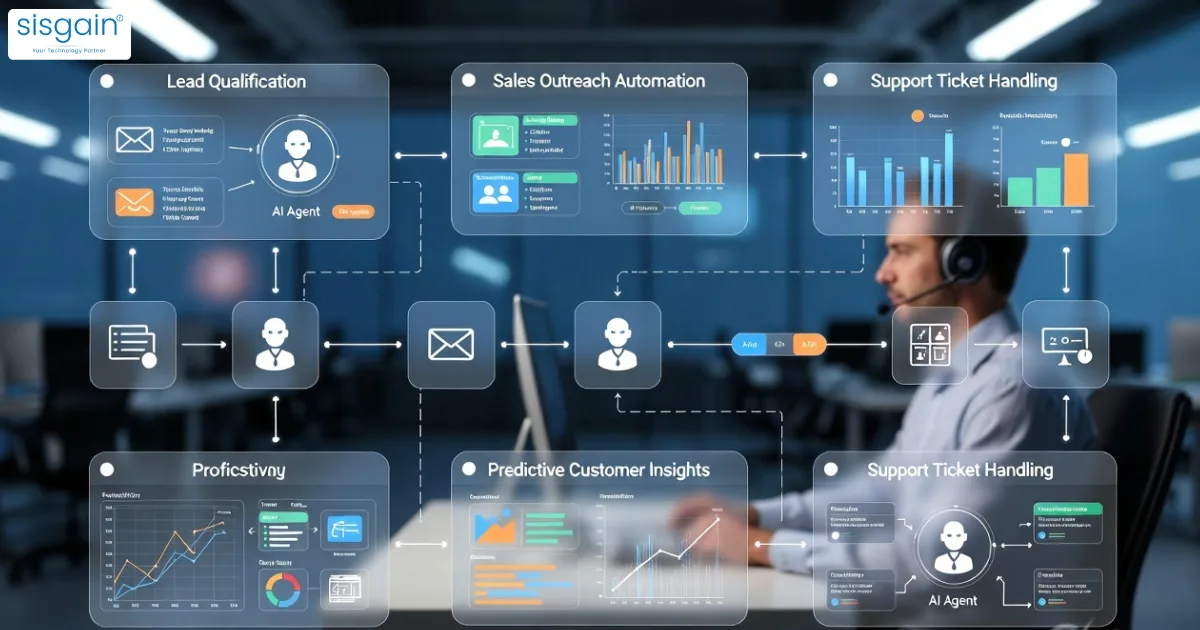
Agentic AI CRM systems offer transformative features that directly impact business outcomes. Below is a table outlining key capabilities, their business impacts, and development approaches:
| Capability | Business Impact | Development Approach |
|---|---|---|
| Autonomous Lead Qualification | Reduces manual screening time by 50%, boosting conversion rates by 30% (per HubSpot data) | Use LLMs like GPT-4o with tools like CrewAI to build agents that score leads via natural language processing on emails and interactions |
| Predictive Customer Insights | Improves retention by 25% through proactive recommendations | Integrate machine learning models (e.g., via Scikit-learn) with CRM data lakes for pattern recognition and forecasting |
| AI Sales Assistants | Increases deal closure speed by 40% by automating outreach and negotiations | Develop using AutoGen for multi-agent systems that simulate sales conversations and integrate with APIs like Salesforce Einstein |
| Self-Optimizing Workflows | Cuts operational costs by 35% through continuous improvement | Employ reinforcement learning frameworks like Stable Baselines, orchestrated with n8n for workflow automation |
| AI Customer Support Agents | Handles 70% of inquiries autonomously, reducing support tickets by 60% | Build with LangChain for chaining LLM prompts and integrating voice APIs for real-time responses |
Agentic AI excels in automating real-world CRM workflows, turning manual processes into autonomous operations. For lead qualification, an AI agent can analyze incoming inquiries from web forms or emails, scoring them based on intent signals like keyword usage or browsing history. For instance, in a SaaS company, the agent might qualify a lead as "hot" if it detects phrases like "pricing for enterprise" and automatically schedule a demo.
Automated follow-ups are another prime area. Traditional systems send generic emails, but agentic AI CRM can craft personalized messages based on past interactions. Imagine an agent reviewing a prospect's abandoned cart and sending a tailored discount offer, increasing response rates by 45% as seen in Shopify case studies.
In predictive support, agents monitor customer behavior to anticipate issues. For example, if usage data shows a drop in logins, the agent could proactively send troubleshooting guides or escalate to human support, reducing churn by 20% according to Zendesk benchmarks.
Marketing optimization involves A/B testing campaigns autonomously. An AI agent could adjust email subject lines in real-time based on open rates, optimizing for higher engagement. Pipeline management benefits too: agents forecast deal probabilities and recommend actions, like nudging stalled opportunities with custom content.
These examples demonstrate how agentic AI CRM development can create self-driving CRM platforms that handle end-to-end automation, freeing teams for strategic work.
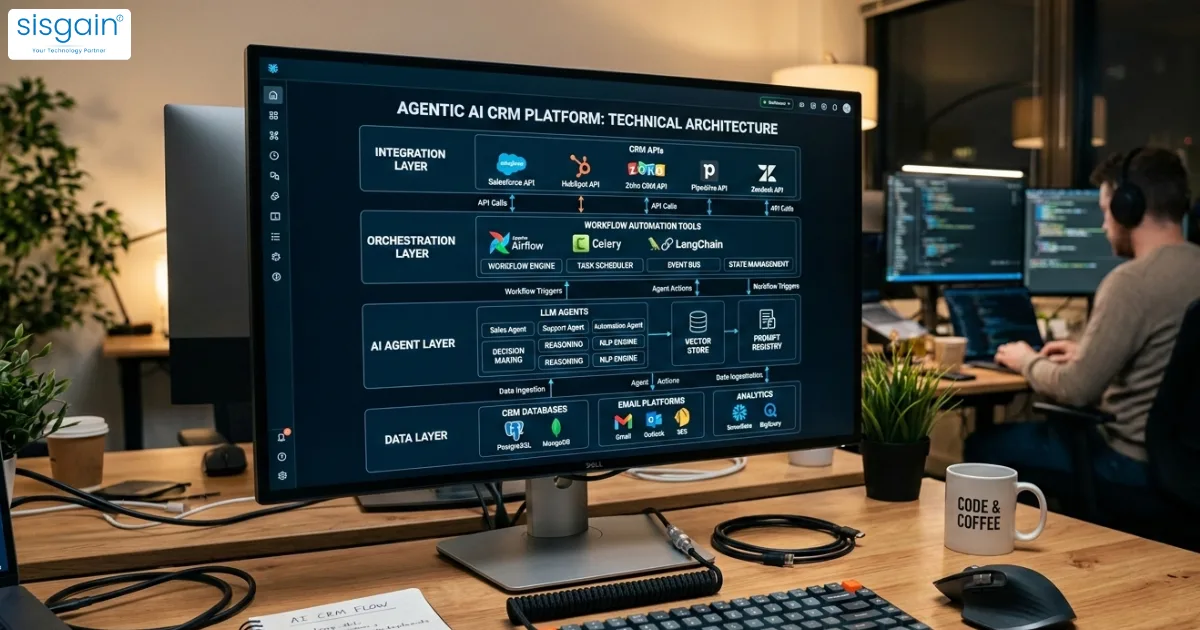
Building an agentic AI CRM system requires a layered architecture to ensure scalability and reliability. Let's break it down.
This foundation aggregates customer data from sources like databases, APIs, and real-time streams. Technologies like Snowflake or MongoDB store structured and unstructured data, while tools like Apache Kafka handle ingestion. In agentic AI CRM, this layer uses vector databases (e.g., Pinecone) for embedding customer interactions, enabling fast retrieval for AI agents.
Here, autonomous agents are built using frameworks like LangChain for prompt chaining or CrewAI for collaborative multi-agent setups. Agents leverage LLMs (e.g., Claude or GPT series) to reason and act. For example, a sales agent might query the data layer for lead history, decide on an action, and execute it via tools.
This coordinates agents and workflows. Tools like AutoGen manage multi-agent interactions, while n8n or Temporal handle sequencing and retries. Orchestration ensures agents don't conflict, such as prioritizing a support agent over a sales one during high-priority issues.
This connects the system to external CRM platforms via APIs (e.g., HubSpot API, Salesforce REST). It also integrates with third-party services like email (SendGrid) or calendars (Google Calendar). Security protocols like OAuth ensure compliant data flow.
These layers interact seamlessly: Data feeds agents, agents request orchestration for complex tasks, and integrations execute actions in the real world. This architecture supports AI-powered CRM workflow automation, making agentic AI CRM development robust for enterprise use.
Developing agentic AI CRM systems follows a structured roadmap. Here's a step-by-step guide for developers and architects.
Start by mapping CRM pain points. Conduct stakeholder interviews to identify workflows like lead nurturing or support ticketing. Set measurable KPIs, such as reducing response time from 24 hours to 2 hours. Use tools like Miro for diagramming goals, ensuring alignment with business objectives in agentic AI CRM development.
Select an LLM provider like OpenAI or Anthropic based on cost, latency, and capabilities. For US enterprises, consider compliance with GDPR or CCPA. Set up infrastructure using AWS Bedrock or Azure AI for hosting. Test models on sample data to ensure accuracy in tasks like sentiment analysis.
Use frameworks like CrewAI to create agents. For a lead qualification agent, define its tools (e.g., CRM API access) and prompts (e.g., "Analyze this email for purchase intent"). Implement multi-agent systems with AutoGen for collaboration, such as a researcher agent feeding data to a decision-maker agent. Code example in Python:
from crewai import Agent, Task, Crew

researcher = Agent(
    role='Lead Researcher',
    goal='Gather lead data',
    backstory='Expert in CRM data analysis',
    tools=[crm_api_tool]
)

qualifier = Agent(
    role='Lead Qualifier',
    goal='Score and qualify leads',
    backstory='Sales automation specialist',
    tools=[llm_scoring_tool]
)

task1 = Task(description='Fetch lead details', agent=researcher)
task2 = Task(description='Qualify based on data', agent=qualifier)

crew = Crew(agents=[researcher, qualifier], tasks=[task1, task2])
result = crew.kickoff()Connect agents to CRM systems using SDKs. For Salesforce, use the REST API to read/write records. Implement webhooks for real-time triggers, ensuring error handling with retries via Temporal. Test integrations in a staging environment to avoid disrupting live data.
Incorporate monitoring with tools like LangSmith for tracing agent actions. Address hallucinations by grounding agents with retrieval-augmented generation (RAG). Ensure security through role-based access and data encryption. For US businesses, comply with SOC 2 standards, auditing agents for bias.
Following this roadmap, developers can create autonomous CRM systems that scale.

Consider TechFlow, a US-based SaaS company specializing in project management tools. Facing slow lead conversion (average 45 days), they partnered with a CRM automation development company to build an agentic AI CRM system.
The implementation used LangChain for agent orchestration and integrated with HubSpot APIs. Key agents included a lead qualifier that analyzed inbound emails and a follow-up agent that generated personalized sequences.
Post-launch, TechFlow saw a 35% increase in conversion rates, with lead response times dropping from 12 hours to under 1 hour. Manual workflow hours reduced by 60%, freeing sales teams for high-value deals. Quantifiable results: Pipeline velocity improved by 28%, and annual revenue grew by $1.2M from automated upsells. This case underscores the ROI of agentic AI in CRM for SaaS firms.
Despite benefits, agentic AI CRM development faces hurdles.
Poor data quality can lead to inaccurate decisions. Solution: Implement data cleansing pipelines using Pandas or Talend before feeding into agents.
AI hallucinations—where agents generate false info—pose risks. Mitigate with RAG techniques, pulling verified data from CRM sources.
Security and compliance are critical, especially with sensitive customer data. Use encrypted APIs and regular audits; tools like Vault for secrets management help.
System integration complexity arises from disparate tools. Address by adopting microservices architecture and testing with Postman.
These solutions ensure reliable autonomous CRM systems.
Looking ahead, agentic AI CRM will evolve into autonomous sales pipelines that predict and close deals end-to-end. Voice-driven CRM systems, powered by models like Whisper, will enable hands-free interactions. Multi-agent AI ecosystems will see agents collaborating across departments, while predictive revenue systems forecast with 90% accuracy using advanced ML.
By 2028, IDC predicts 50% of US enterprises will adopt these, driving agentic AI CRM development further.
To adopt agentic AI CRM, begin with a pilot project—automate one workflow like lead scoring. Assess your tech stack for compatibility with tools like CrewAI. Partner with a CRM automation development company for expertise. Train teams on oversight, and measure success with metrics like automation coverage. Budget for LLM costs, starting small to scale.
Agentic AI in CRM represents the future of customer management, enabling self-driving systems that automate workflows and drive growth. By embracing this technology, businesses can achieve unprecedented efficiency.
Ready to build your agentic AI CRM? Book a free consultation with our expert team for custom AI and CRM development services tailored to your needs.



Start Build Your
Next Digital Solution?
Let’s build scalable, future-ready digital solutions tailored to your business goals. Connect with our experienced technology consultants to discuss your vision, strategy, and growth opportunities — with zero obligation and complete transparency.
Get a free consultation and cost estimate for your digital solution
Our expert will contact you within 24 hours. Check your email for confirmation.
Partner with SISGAIN experts to build secure, scalable AI-powered IT Solutions that transform your business operations.









DUQE FREEZONE Quarter Deck, Queen Elizabeth 2, Mina Rashid, Dubai, UAE

100 Consilium Pl Suite 200, Scarborough, ON M1H 3E3, Canada

C-109, Sector 2, Noida, Uttar Pradesh 201301 India
Project quotes, partnerships, implementation
Open roles, referrals, campus hiring