
 +1 844-445-5767
 +971 56-848-5757
 +91 921-208-0630
For Business & Service Inquiries
Sales Team
Project quotes, partnerships, implementation
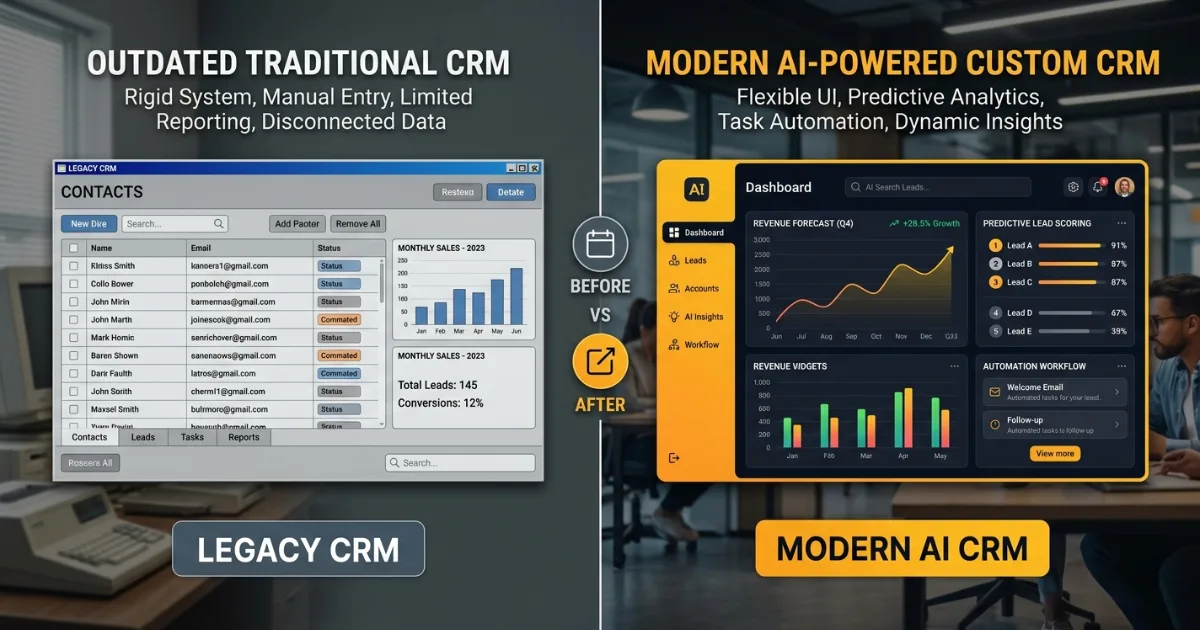
In today’s hyper-competitive market, businesses lose millions every year to unqualified leads that never convert and loyal customers who quietly churn. Only 27% of marketing-qualified leads handed to sales teams are actually ready to buy, while industries like telecom and e-commerce see average churn rates hovering between 22-25%.
Yet companies using AI predictive lead scoring and churn prediction CRM systems report 20-30% higher conversion rates, up to 30% lower churn, and 300-400% first-year ROI on lead-generation efforts.
This 2026 guide dives deep into how AI-powered predictive analytics transforms custom CRM development. You’ll learn exactly how these systems work, why off-the-shelf CRMs fall short, must-have features, real-world use cases, implementation steps, challenges, future trends, and more. Whether you’re a startup founder scaling sales or an enterprise leader optimizing retention, this guide equips decision-makers with actionable insights to build smarter, future-proof customer relationship platforms.
AI-powered predictive lead scoring uses machine learning to analyze behavioral, demographic, and historical data to rank leads by conversion probability. Churn prediction CRM models forecast which customers are at risk of leaving, enabling proactive retention. Integrated into custom CRM development, these tools boost conversions by 20-30%, reduce churn by up to 30%, and deliver 138% higher ROI on lead generation compared to traditional methods.
AI-powered predictive lead scoring is a smart, automated system that ranks every lead from 0 to 100 based on how likely it is to become a paying customer.
Think of it like a GPS for your sales team. Traditional methods rely on fixed rules you create manually — for example, “add 10 points if someone downloads a whitepaper.” These rules stay the same and often miss important signals.
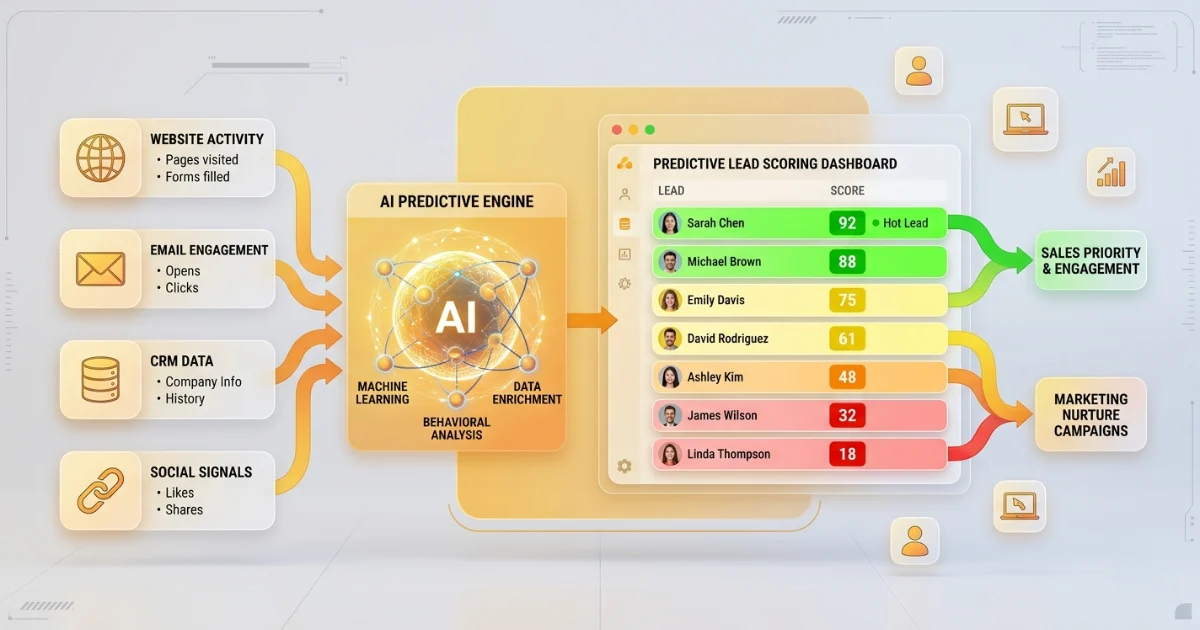
AI changes everything. It continuously studies thousands of data points from your CRM, marketing automation tools, website behavior, email replies, call notes, and even external buyer-intent signals. The system learns what actually leads to sales and updates scores in real time.
Here’s the entire process explained in four straightforward steps:
The result? Your sales team spends time only on the hottest leads, while mid-tier prospects get smart automated nurturing — all without any manual tweaking.
To make the difference easy to understand, here’s a clear comparison between the old-school rule-based method and modern AI-powered predictive scoring.
| Aspect | Traditional (Rule-Based) | AI-Powered Predictive Scoring |
|---|---|---|
| Scoring Method | Manual points system created by humans | Machine learning trained on real historical outcomes |
| Accuracy | Usually only 15-25% effective | 40-60%+ (often delivers up to 75% higher conversions) |
| Adaptability | Static – rules never change unless you update them manually | Dynamic – automatically updates and improves with new data |
| Data Used | Limited to basic info (job title, company size, simple actions like form fills) | Hundreds of signals (behavior, website activity, email engagement, buyer intent, and more) |
| Time to Value | Takes weeks to set up and maintain the rules | Ready in days; gets smarter and more accurate every day |
| ROI | Basic / baseline results | 300-400% return in the first year |
Bottom line: AI scoring completely removes guesswork and human bias. Your sales team can instantly focus on the hottest prospects while the system automatically nurtures mid-tier leads — saving time and dramatically boosting results.
Churn prediction is a smart AI system that looks at your customer data and predicts which customers are likely to leave, cancel their subscription, or stop using your product — often weeks or even months before it actually happens.
In simple terms, “churn” means a customer walking away. Instead of waiting until they cancel, the AI spots early warning signs and raises a red flag.
A churn prediction CRM then automatically sends alerts to your team, launches personalized retention offers, or triggers helpful outreach — all before the customer decides to leave.
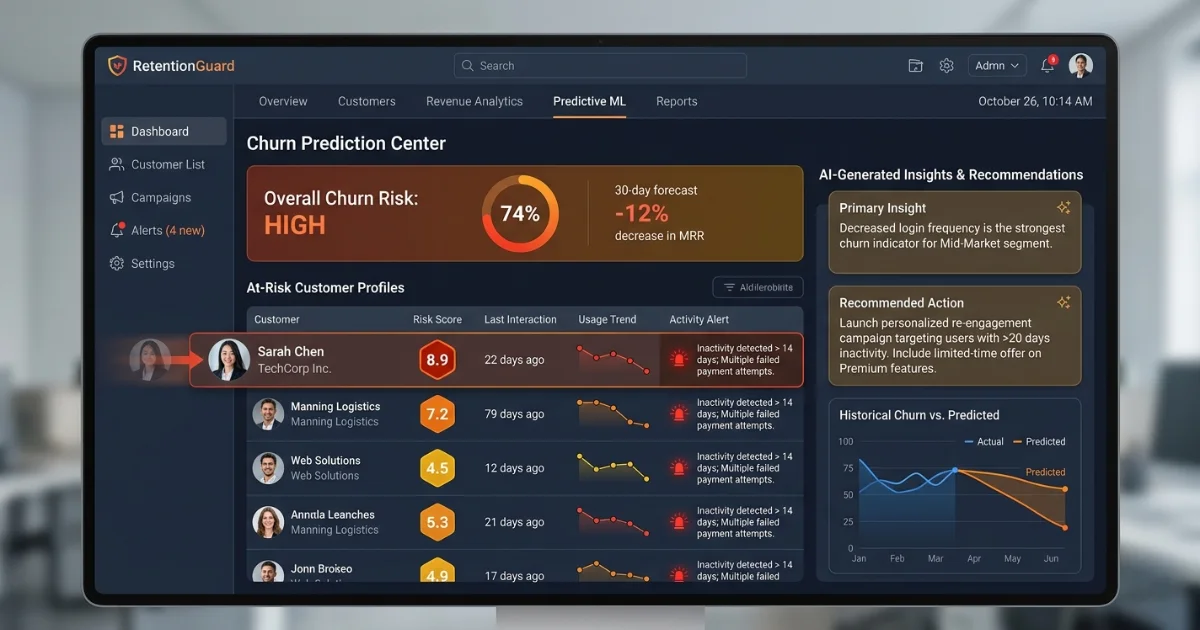
Keeping existing customers is far easier and cheaper than finding new ones. Here’s why this matters:
By predicting churn early, your business can take action fast, save money, protect revenue, and build stronger, longer-lasting customer relationships.
AI churn prediction works by constantly watching your customer data for early “red flags” — small changes that often show a customer is thinking about leaving.
Here are the six most common warning signs the system looks for:
The real advantage of AI? It can spot these patterns across thousands of customers at the same time — something that would be impossible for any human team to track manually. This early detection gives your business time to step in and fix issues before customers actually leave.
AI doesn’t replace your sales or customer success team — it makes them smarter and more effective by delivering precise predictions.
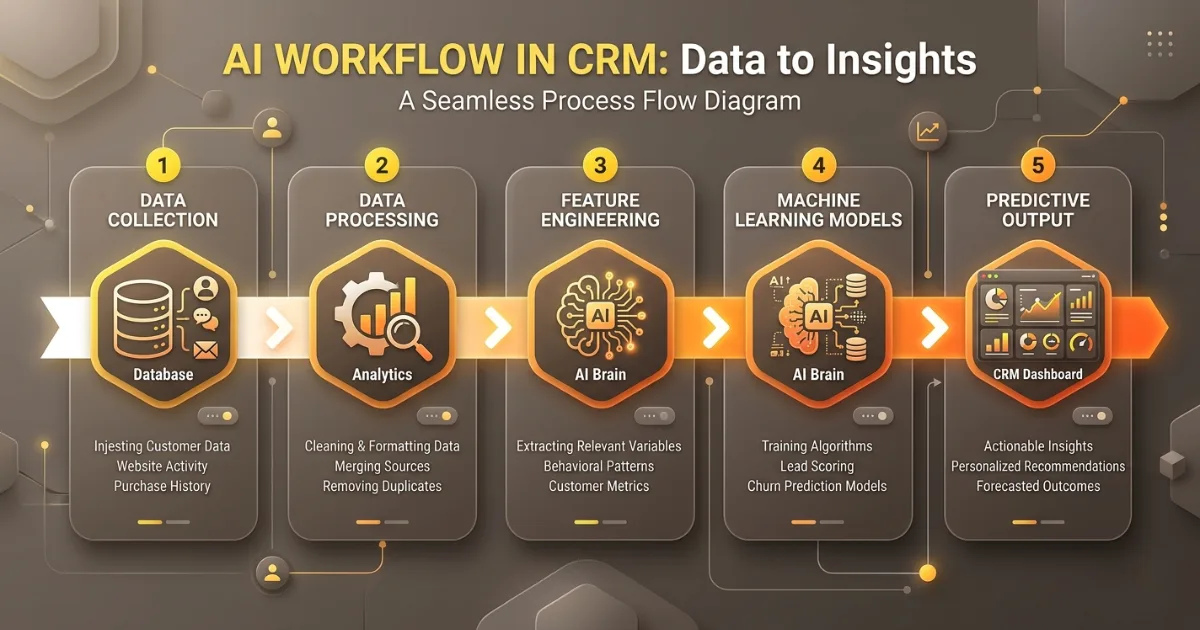
Here’s a simple, step-by-step explanation of how AI powers both lead scoring and churn prediction:
AI starts by gathering large amounts of information from multiple sources.
For lead scoring, it collects:
For churn prediction, it also looks at:
The more complete the data, the better the AI can make accurate predictions.
Raw data is often messy. In this step, the AI:
It also handles a common challenge called “class imbalance” — especially in churn prediction, where only 5–15% of customers actually leave. The system learns how to work well even when churn cases are rare.
This is where AI gets really smart. It creates new, meaningful variables (called “features”) from the raw data.
Examples include:
These engineered features help the AI discover hidden patterns that directly influence whether a lead will convert or a customer will churn.
The cleaned and enriched data is then fed into machine learning models. Different models are used depending on the need:
These models are trained using historical data — for example, “this lead eventually became a customer in 45 days” or “this customer churned after 6 months.”
Performance is measured using metrics like AUC-ROC (a score above 0.85 is considered very good) and precision-recall curves.
Final Output: The AI delivers real-time scores and risk probabilities (e.g., “This lead has an 87% chance of converting” or “This customer has a 42% risk of churning in the next 30 days”). These insights appear directly on your CRM dashboard, so your team can take immediate action.
Also Read - Agentic AI in CRM: Automate 70% of Customer Workflows
Off-the-shelf CRM platforms like Salesforce or HubSpot are good starting points, but they come with a big limitation — they force your unique business processes into their fixed templates.
Custom CRM development solves this problem by building a system specifically designed for your business. It gives you complete control over how the software works, looks, and grows with you.
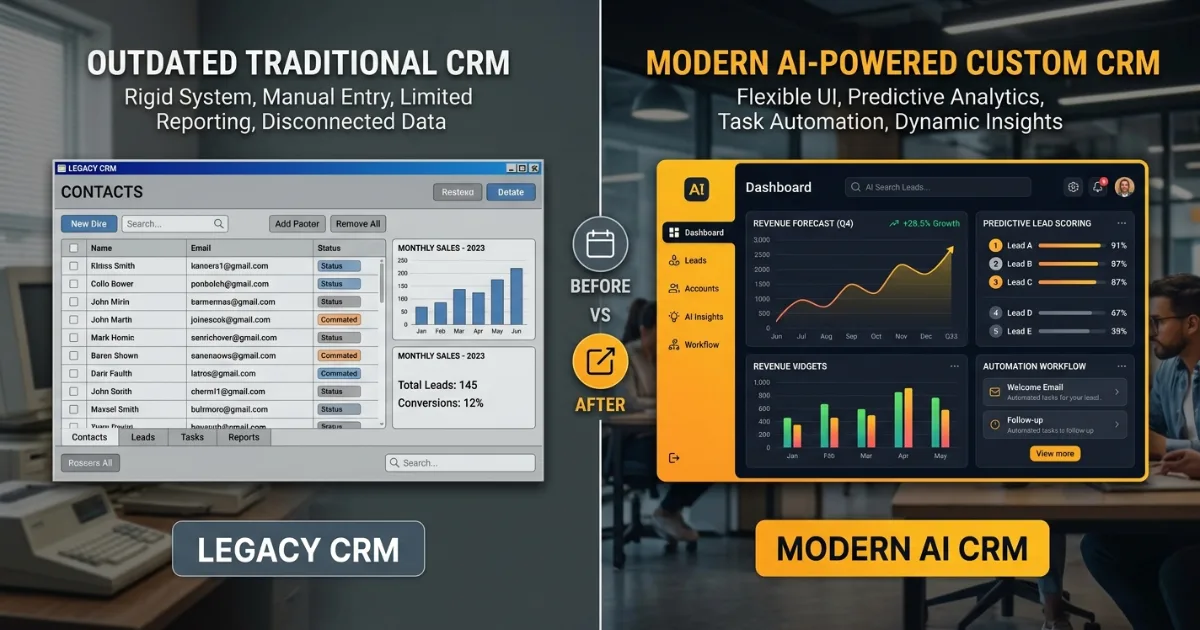
Here are the main reasons companies prefer building a custom CRM:
Leading custom CRM development companies like SISGAIN specialize in creating AI-native platforms. They build predictive lead scoring and churn prevention features right from day one. Their solutions are tailored to match your exact workflows, can scale globally, and deliver clear improvements in sales performance and customer retention — all without locking you into a generic platform’s limitations.
Integrating AI into your CRM delivers powerful, measurable advantages that directly impact your revenue and growth. Here are the top 7 benefits explained in simple terms:
These benefits work together to create a smarter, more efficient, and highly profitable customer relationship system.
Also Read - Why Businesses Are Investing in AI-Powered Hyper-Personalization CRM Systems
Seeing how AI-powered predictive lead scoring and churn prevention work in actual businesses makes the value crystal clear. Here are four practical examples from different industries:
A growing SaaS company built AI churn prediction into its custom CRM. The system automatically flagged accounts showing warning signs — such as customers using key features less often and giving lower NPS scores.
The company quickly launched personalized “win-back” campaigns and smart product recommendations. Results: Churn dropped by 25%, gross retention improved by 3 percentage points in just 6 months, and they saved hundreds of thousands of dollars in annual recurring revenue (ARR).
A telehealth platform integrated predictive analytics into its custom CRM to spot patients who might miss follow-up appointments or switch to another provider.
The AI carefully analyzed appointment history, patient portal activity, and the tone of support conversations. When risk was detected, the system triggered proactive steps like personalized reminders and direct calls from care coordinators.
Results: Patient retention increased by 23%, and appointment no-show rates decreased significantly.
An online retailer added predictive lead scoring to its custom CRM, especially for shoppers who abandoned their carts and for high-value repeat buyers.
The system automatically sent dynamic discount offers and loyalty rewards based on each customer’s score. Results: Churn among the most valuable customers fell by 22%, and the conversion rate from scored leads jumped by 30%.
A fast-growing lending startup used AI-powered lead scoring across credit applications, digital behavior patterns, and alternative data sources.
The custom CRM helped qualify leads more accurately and also monitored approved borrowers for early signs of repayment difficulty. When risks appeared, the team could step in with timely support. Results: Qualified leads increased by an impressive 215%, sales team efficiency improved by 30%, and churn among borrowers decreased noticeably.
These real examples show that whether you run a SaaS product, healthcare service, e-commerce store, or fintech business, integrating AI into a custom CRM can deliver fast, measurable improvements in both customer acquisition and retention.
When building or upgrading your CRM in 2026, certain AI-powered features are essential. These features turn your CRM from a simple contact database into a smart, proactive growth engine.
Here are the must-have features every modern AI CRM should include:
Live, visual dashboards that show real-time lead scores and customer churn risk. You can instantly see color-coded heatmaps — green for hot leads or safe customers, red for high-risk ones — helping your team prioritize efforts at a glance.
The system sends instant notifications to your team via Slack, Microsoft Teams, or email whenever a customer shows signs of churning. Each alert comes with clear recommended actions, so your customer success team can respond quickly and effectively.
AI automatically groups your customers and leads into smart segments based on their behavior, engagement level, and predicted lifetime value. This makes it easy to run targeted marketing campaigns and personalized sales strategies without manual work.
AI triggers automatic actions based on scores and predictions. For example, it can send personalized emails, SMS messages, or schedule follow-up calls the moment a lead’s score changes or a customer’s risk level rises.
The system acts like a smart assistant by suggesting the best next steps. Example: “Offer a 20% discount to this at-risk customer” or “Call this high-scoring lead today — they are very likely to convert.”
One of the most important features for trust and adoption. Instead of a mysterious black-box score, the AI clearly explains why a lead received a high score or why a customer is flagged as high-risk. You can see the top factors influencing each prediction, making it easier for your team to understand and act confidently.
These features work together to make your CRM intelligent, automated, and highly actionable — helping you win more deals and retain more customers in 2026 and beyond.
Implementation tip: Start with Scikit-learn for MVP, then scale to XGBoost in production for the best balance of speed and performance.
Implementing AI-powered predictive lead scoring and churn prevention in a custom CRM is highly rewarding, but it also comes with some common challenges. The good news is that each challenge has practical, proven solutions.
Here’s a clear breakdown of the major challenges businesses face and how to overcome them:
| Challenge | Description | Solution |
|---|---|---|
| Data Quality | Customer data is often incomplete, outdated, or scattered across different systems (siloed). | Implement strong data governance policies and use automated data cleansing pipelines to keep information clean and reliable. |
| Integration Complexity | Connecting the new AI CRM with existing legacy systems and tools can be difficult and time-consuming. | Use low-code iPaaS platforms (integration Platform as a Service) and modern microservices architecture to simplify and speed up integrations. |
| Cost & Expertise | High upfront investment and shortage of skilled AI talent make it hard for many companies to get started. | Partner with experienced custom CRM providers like SISGAIN for a complete turnkey solution. You can also begin with affordable cloud-based managed services to reduce costs and complexity. |
| Model Bias & Explainability | AI decisions sometimes appear as a “black box,” making teams hesitant to trust the predictions. | Adopt explainable AI techniques (such as SHAP values) so you can clearly see why the AI made a particular prediction. Conduct regular model audits to ensure fairness and build team confidence. |
The world of CRM is evolving rapidly. By 2026 and beyond, AI will transform CRM systems from simple databases into intelligent, proactive assistants that anticipate customer needs before they even arise.
Here are the most important future trends shaping AI CRM development:
Generative AI will automatically create personalized content for your team. It can write custom sales emails, business proposals, renewal offers, and retention messages tailored to each customer’s behavior and preferences — saving hours of manual work while improving response rates.
Thanks to edge computing, AI will deliver predictions in less than a second. Instead of waiting for daily or hourly reports, your team will see live updates on lead scores, churn risks, and customer behavior as they happen, enabling instant decision-making.
Advanced AI agents will analyze multiple types of data — text, voice, video, and browsing behavior — to deliver truly personalized experiences. Every customer touchpoint (emails, app notifications, website messages, or calls) will feel individually crafted, significantly boosting engagement and loyalty.
Future chatbots and AI agents will go far beyond answering questions. They will proactively engage customers, negotiate contract renewals, suggest upsells, and even handle entire retention conversations with natural, human-like dialogue.
With stricter data privacy laws, new techniques like federated learning and on-device AI models will become standard. These methods allow AI to learn from customer data without storing or sharing sensitive information, helping businesses stay compliant while still delivering powerful insights.
AI-powered predictive lead scoring and churn prevention are no longer nice-to-haves they’re competitive necessities in 2026. By embedding these capabilities into a custom CRM, businesses gain precision targeting, proactive retention, and explosive ROI that generic platforms simply cannot match.
The winners will be those who act now: build intelligent systems that learn, adapt, and deliver personalized experiences at scale.
Ready to transform your customer relationships? Partner with SISGAIN, a trusted custom CRM development provider, to design and deploy an AI-native platform tailored to your exact business needs. Their expert team delivers scalable, secure, and future-proof solutions that drive measurable growth in conversions, retention, and revenue.

Start Build Your
Next Digital Solution?
Let’s build scalable, future-ready digital solutions tailored to your business goals. Connect with our experienced technology consultants to discuss your vision, strategy, and growth opportunities — with zero obligation and complete transparency.
Get a free consultation and cost estimate for your digital solution
Our expert will contact you within 24 hours. Check your email for confirmation.
Partner with SISGAIN experts to build secure, scalable AI-powered IT Solutions that transform your business operations.









DUQE FREEZONE Quarter Deck, Queen Elizabeth 2, Mina Rashid, Dubai, UAE

100 Consilium Pl Suite 200, Scarborough, ON M1H 3E3, Canada

C-109, Sector 2, Noida, Uttar Pradesh 201301 India
Project quotes, partnerships, implementation
Open roles, referrals, campus hiring