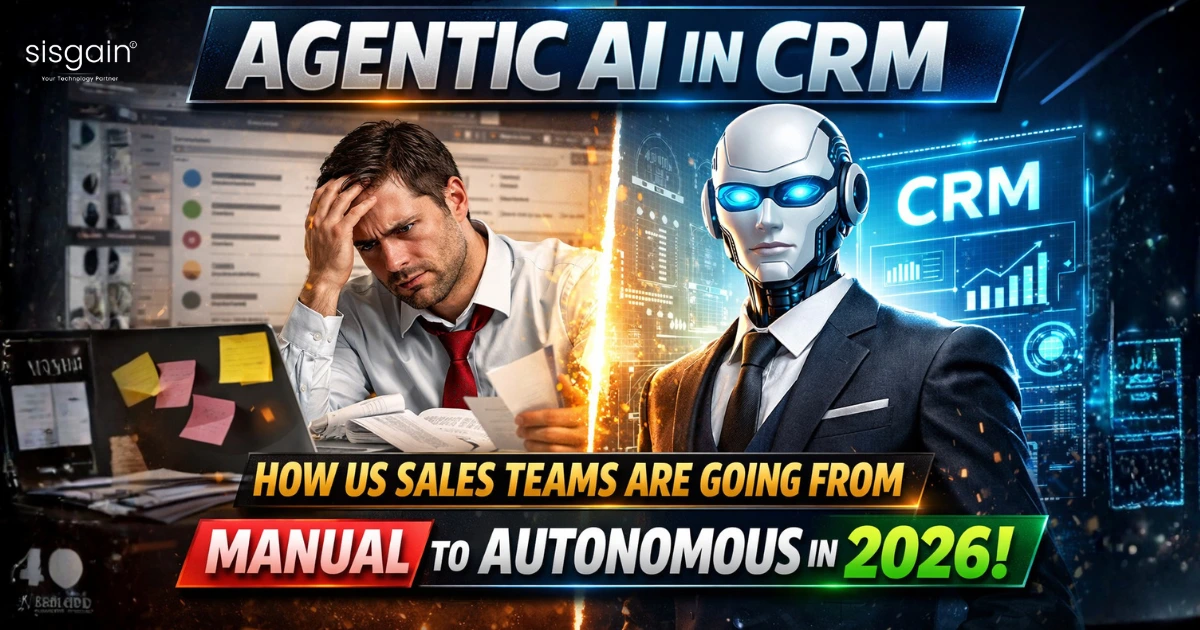
In 2026, customer relationship management is no longer about storing data or triggering reminders. It is about building systems that think, decide, and act autonomously to drive revenue, reduce churn, and deliver hyper-personalized experiences at scale.
Agentic AI represents the defining shift in enterprise software this year. These are autonomous AI systems that plan multi-step workflows, interact with tools and data sources, collaborate with other agents, and execute tasks toward defined business goals — all with minimal human intervention.
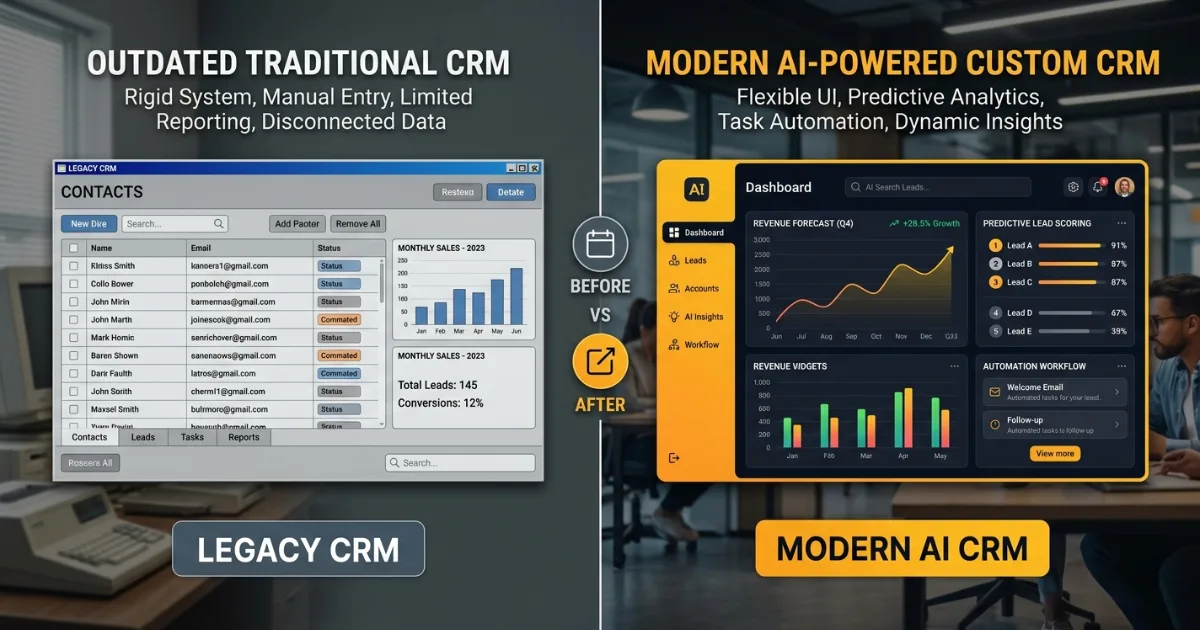
Traditional CRMs are reactive: a sales rep logs a call, the system updates a record, and alerts fire only when rules are met. An agentic AI-powered CRM is proactive. It detects a high-value lead entering the pipeline, qualifies it against 17 behavioral signals, drafts personalized outreach, books meetings, updates forecasts, and escalates only when confidence drops below a threshold.
Gartner predicts that by the end of 2026, 40% of enterprise applications will embed task-specific AI agents — up from less than 5% in 2025. Organizations that treat CRM as a passive database will fall behind those treating it as an autonomous revenue engine.
This guide is written for CTOs, founders, product managers, and enterprise technology leaders who want to move beyond off-the-shelf AI features and build (or deeply customize) an intelligent CRM system that delivers measurable competitive advantage. You will receive a complete, production-ready blueprint — from business alignment to architecture, implementation, security, and ROI modeling.
What Is an Agentic AI-Powered CRM?
An agentic AI CRM is a customer data platform augmented with autonomous AI agents that own outcomes across the customer lifecycle. These agents use large language models (LLMs), reasoning engines, memory systems, and tool-calling capabilities to plan, execute, and adapt workflows in real time.
Key Differences
Aspect | Traditional CRM | AI-Enabled CRM (2023–2025) | Agentic AI CRM (2026+) |
Core Behavior | Data storage + manual workflows | Predictive insights + recommendations | Autonomous planning, execution, and adaptation |
Decision Making | Rule-based | Probabilistic scoring | Goal-directed multi-step reasoning |
Automation Scope | Trigger → Action | Suggestion → Human approval | End-to-end workflow ownership |
Human Role | Primary executor | Supervisor of suggestions | High-level strategist and exception handler |
Example | “Lead score > 70 → notify rep” | “Lead score 82, here’s why” | “New inbound lead → qualify → research → outreach → book meeting → update forecast” |
Core capabilities of agentic AI CRM systems in 2026 include:
- Autonomous task execution — Agents complete full workflows (e.g., lead-to-opportunity conversion) without human prompts.
- Predictive sales forecasting at the deal, territory, and company level, updated in real time.
- AI-driven customer segmentation that evolves hourly based on behavioral signals.
- Self-optimizing workflows — Agents monitor their own performance and adjust strategies (e.g., A/B testing email sequences automatically).
- Multi-agent collaboration — A “Sales Orchestrator” agent coordinates with “Research,” “Compliance,” “Finance,” and “Support” agents.
For businesses still evaluating platforms before committing to custom development, refer to this foundational resource on how to choose the right CRM in 2026.
Step 1: Define Business Objectives Before Development
Never start with technology. Begin with outcomes.
Key questions to answer in a cross-functional workshop (sales, marketing, customer success, finance, IT):
- What are the top three revenue or retention goals for the next 18 months?
- Where are the biggest customer lifecycle friction points (lead response time, handoff delays, churn signals, support resolution time)?
- Which processes consume the most manual effort (lead qualification, follow-up sequencing, ticket routing, forecasting)?
- What systems must the CRM integrate with (ERP, marketing automation, billing, support desk, data warehouse)?
Recommended framework: Outcome Mapping Canvas
- Goal → e.g., “Increase win rate from 28% to 42%”
- Current bottlenecks → List with data (average response time, manual hours per week)
- Agent ownership → Which agent(s) will own the outcome?
- Success metrics → Primary (win rate) + guardrail (customer satisfaction score)
- Human oversight points — Where must a human remain in the loop?
Document these in a living Notion or Confluence page that becomes the source of truth for every agent prompt and evaluation metric.
Step 2: Identify High-Impact CRM Use Cases for AI Agents
Focus on use cases where autonomy delivers disproportionate ROI and risk is manageable.
High-ROI agent use cases in 2026:
- Automated lead qualification — Agent pulls firmographic data, enriches via APIs, analyzes website behavior and intent signals, scores, and routes or nurtures.
- AI sales assistants — Multi-agent teams that research accounts, draft sequences, book meetings, and update CRM records.
- Intelligent follow-up sequencing — Agents choose channel, timing, and messaging based on real-time engagement and predicted response probability.
- Churn prediction and intervention — Detects early signals (usage drop, sentiment shift) and autonomously triggers retention plays (discounts, check-in calls, feature recommendations).
- Smart ticket routing and resolution — Agents classify, gather context from history and knowledge base, attempt self-resolution, escalate only when necessary.
Explore detailed real-world CRM use cases that drive measurable business growth.
Prioritize 2–3 use cases for the MVP. Measure baseline metrics, then agent performance against them.
Step 3: Design the Agent Architecture
1. Core Components
- Data Layer — Unified Customer 360 (transactional + behavioral + external signals). Use a modern CDP or data mesh architecture.
- AI Model Layer — Mixture of frontier LLMs (GPT-5 class, Claude 4, Grok-3, or open models via Bedrock/Azure) + specialized predictive models (XGBoost/LightGBM for scoring, time-series for forecasting).
- Agent Orchestration Layer — Multi-agent framework handling planning, tool use, memory, and inter-agent communication.
- Integration APIs — Real-time bidirectional connectors (webhooks, event-driven architecture via Kafka or Azure Event Grid).
- Security & Compliance Layer — Zero-trust, audit logging, human-in-the-loop gates, and explainability.
2. Technology Stack (2026 Production-Ready)
Backend options:
- Python (FastAPI) — preferred for AI-heavy workloads
- Node.js/TypeScript — for high-throughput event systems
- Java/Spring Boot — for regulated industries needing strong typing
Agent frameworks (choose based on needs):
- CrewAI — Best for role-based, hierarchical multi-agent teams (sales team analogy works perfectly).
- LangGraph (LangChain ecosystem) — Most mature for complex stateful workflows and human-in-the-loop.
- AutoGen / AutoGen Studio — Strong for dynamic agent creation and research-heavy tasks.
- Microsoft Semantic Kernel or Salesforce Agentforce Builder — If staying within the ecosystem.
Vector databases:
- Pinecone, Weaviate, or Qdrant for long-term customer memory and RAG.
- Knowledge graphs (Neo4j) for relationship mapping.
Cloud platforms:
- AWS (Bedrock + SageMaker + Lambda)
- Azure (OpenAI + Azure AI Agent Service + Power Platform)
- GCP (Vertex AI + Agent Builder)
Event-driven backbone — Kafka or Pulsar for real-time triggers. Use temporal.io or Camunda for durable execution of long-running agent workflows.
Design for modularity: Each agent should be independently deployable, versioned, and observable.
Step 4: Data Strategy & Model Training
Poor data quality kills agentic systems faster than weak models.
Essential steps:
- Data cleaning & normalization — Deduplicate contacts, standardize formats, resolve identities across systems.
- Build a real Customer 360 — Merge CRM records, support tickets, billing, product usage, marketing interactions, and external signals (LinkedIn, web visits, intent data).
- Behavioral pattern detection — Store raw events and derive features (engagement velocity, sentiment trends, buying signals).
- Fine-tuning and RAG — Use domain-specific data to fine-tune smaller models or build high-quality retrieval corpora. Implement guardrails (constitutional AI, output validation, human review queues) to control hallucinations.
- Memory architecture — Short-term (conversation context), medium-term (recent interactions), long-term (vector + graph store).
Key Principle for AI-Agent Readiness The data strategy must create a single source of truth that agents can query in natural language with high precision and low latency. Implement retrieval-augmented generation (RAG) with hybrid search (vector + keyword + graph) and automatic citation of sources for explainability.
Step 5: Build Intelligent CRM Automation Workflows
Break automation into three pillars:
- Sales automation — Lead qualification agent → Research agent → Outreach agent → Meeting Booker → Forecast Updater.
- Marketing automation — Campaign agents that adapt content, timing, and channels based on performance; nurture sequences that self-optimize.
- Support automation — Ticket classifier → Knowledge retriever → Resolution agent → Satisfaction surveyor; escalation only when confidence < 85%.
Cross-functional collaboration — The “Revenue Orchestrator” agent can coordinate across sales, marketing, and success agents when a high-value customer shows mixed signals.
Modern CRM development for growth is no longer optional — it’s essential for scaling intelligent operations.
Step 6: Security, Compliance & Ethical AI
Enterprise requirements in 2026 are non-negotiable:
- GDPR, CCPA, and regional compliance — Data residency controls, consent management, right-to-be-forgotten automation.
- Encryption at rest and in transit — Plus field-level encryption for PII.
- Role-based access control (RBAC) + attribute-based — Agents inherit permissions from human owners.
- AI decision transparency — Every agent action must log reasoning chain, data sources used, and confidence score.
- Audit logs — Immutable, tamper-proof logs of every tool call and decision (use blockchain-style ledgers or Azure Immutable Storage).
- Human oversight gates — Configurable approval workflows for high-risk actions (contract changes, large discounts, data deletion).
Implement “agent identity” systems so each agent has its own credentials, audit trail, and performance scorecard.
Step 7: Testing, Deployment & Continuous Optimization
Testing strategies:
- Unit tests for tools — Mock external APIs.
- Agent behavior testing — Simulation environments (Salesforce eVerse-style) with synthetic customer journeys.
- A/B testing of agent strategies — Run parallel agent versions on live traffic subsets.
- Red teaming — Adversarial testing for safety, bias, and jailbreak resistance.
Deployment:
- Start with shadow mode (agents observe and recommend but do not act).
- Move to supervised autonomy.
- Then full autonomy with human escalation paths.
Continuous optimization:
- Feedback loops from human overrides.
- Reinforcement learning from human feedback (RLHF) or direct preference optimization.
- Monitor KPIs: automation rate, resolution time, win rate lift, cost per interaction, agent utilization.
Use observability platforms (LangSmith, Phoenix, or Salesforce Agentforce Command Center) to replay agent decisions and debug reasoning failures.
Cost of Building an Agentic AI CRM in 2026
Custom development cost ranges (mid-market to enterprise):
- MVP (2–3 agents, core CRM modules) — $120,000 – $250,000 (4–7 months)
- Full-featured agentic CRM (multi-agent, 360 data, full integrations) — $350,000 – $750,000 (8–14 months)
- Large enterprise (global, heavy compliance, custom models) — $800,000 – $2M+
AI infrastructure costs (annual, after launch):
- LLM inference — $40,000 – $150,000 (depends on volume; use cheaper models for routine tasks)
- Vector DB + storage — $15,000 – $40,000
- Compute (orchestration, monitoring) — $20,000 – $60,000
- Total first-year infra — $80,000 – $250,000
Custom vs. SaaS:
- Extend Salesforce Agentforce or Dynamics 365 Copilot — faster to value, but limited by platform constraints and higher per-user costs.
- Full custom — higher upfront, maximum differentiation and data control.
Long-term ROI (typical observed in 2026 deployments):
- 35–60% reduction in manual sales/support workload
- 15–30% lift in win rates and retention
- 3–9 month payback period for most mid-market implementations
For companies planning full-scale CRM development, custom AI integration ensures long-term scalability and competitive advantage.
Benefits of Agentic AI-Powered CRM
- Higher conversion rates through hyper-personalized, timely engagement
- Reduced manual workload — sales teams focus on relationship-building, not data entry
- Faster decision-making — real-time forecasts and recommendations
- Improved customer retention via proactive churn intervention
- Predictive revenue forecasting with unprecedented accuracy
- Scalable personalization at enterprise volume without proportional headcount growth
Common Mistakes to Avoid
- Over-automation without clear strategy — agents amplify bad processes
- Poor data quality — garbage in, autonomous garbage out
- Ignoring human-AI collaboration — removing humans entirely leads to trust erosion and errors
- No governance framework — uncontrolled agents create compliance nightmares
- Underestimating infrastructure scaling — LLM costs and latency can explode without proper routing and caching
Future of Agentic AI in CRM Beyond 2026
By 2027–2028, we will see fully orchestrated multi-agent CRM ecosystems where a single “Revenue CEO” agent coordinates dozens of specialized agents across sales, marketing, success, finance, and even partner ecosystems.
- AI-native enterprises will treat agents as digital employees with onboarding, performance reviews, and career paths (via prompt evolution and fine-tuning).
- Autonomous revenue engines will negotiate contracts, manage renewals, and optimize pricing dynamically.
- Predictive CX systems will anticipate needs before customers articulate them, creating delight at scale.
Organizations that master agent-native architecture, data foundations, and human-digital workforce design today will lead the AI-driven economy of the 2030s.
Conclusion: Building Intelligent CRM Systems That Think and Act
Agentic AI is not another CRM feature — it is the next evolution of how businesses manage customer relationships. Traditional systems store history. Intelligent systems create the future.
The difference between leaders and laggards in 2026–2030 will not be who adopted AI first, but who built agentic systems that are trustworthy, observable, aligned with business goals, and deeply integrated into their operating model.
Start with clear objectives. Choose high-impact use cases. Design modular, observable architecture. Prioritize data quality and governance from day one. Measure relentlessly.
Organizations investing in intelligent CRM development today will lead tomorrow’s AI-driven economy.