
 +1 844-445-5767
 +971 56-848-5757
 +91 921-208-0630
For Business & Service Inquiries
Sales Team
Project quotes, partnerships, implementation
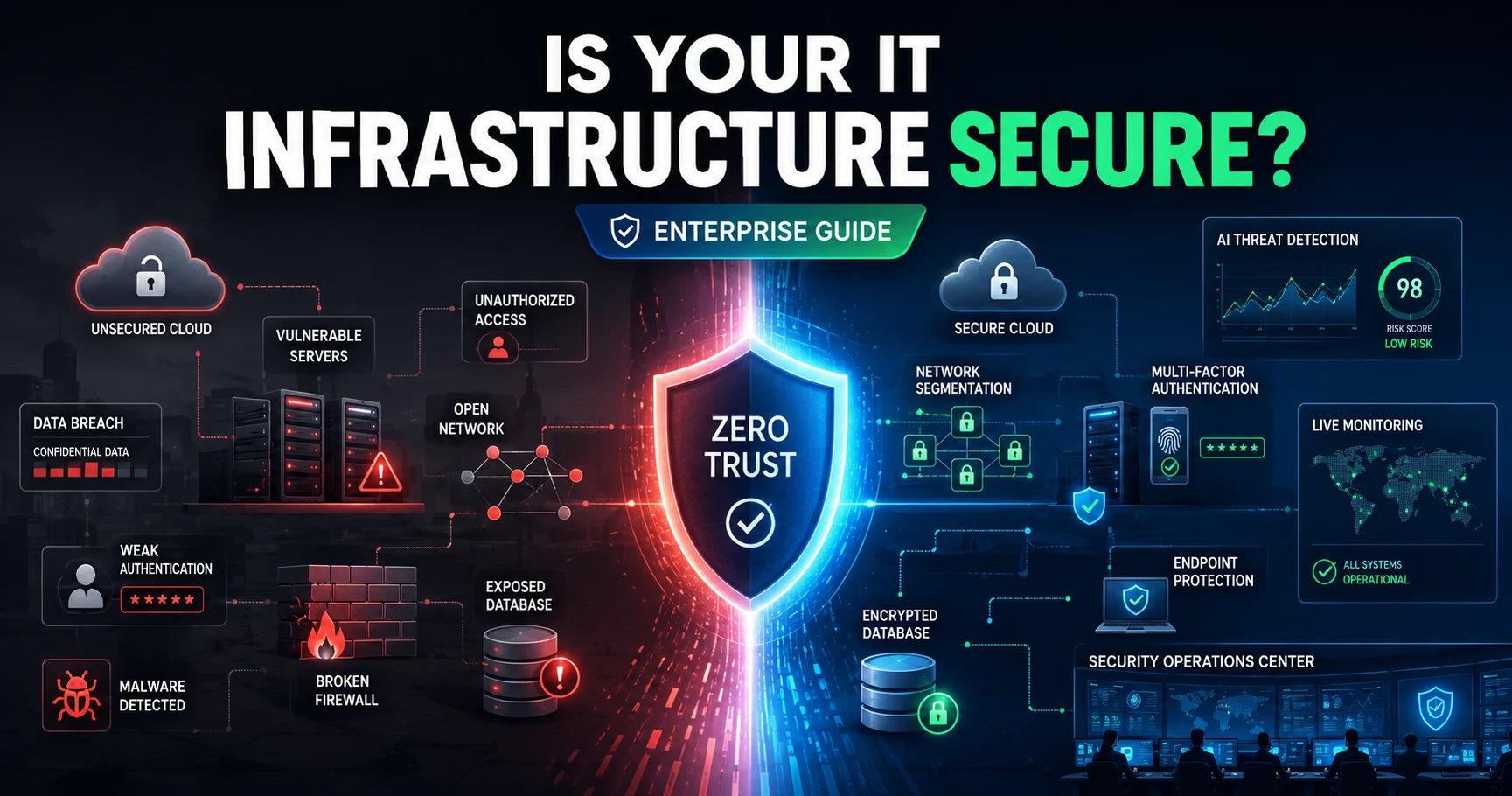
Quick answer: Infrastructure security management is the systematic process of protecting an organization's IT systems, networks, servers, endpoints, and data from cyber threats. It covers everything from network security and access controls to cloud protection and disaster recovery. A strong strategy combines prevention, detection, response, and continuous improvement to keep business operations running securely.
Ransomware attacks against critical industries surged 34% in 2025, according to research from KELA. The average global data breach still costs organizations USD 4.44 million, even after the first decline in five years (IBM, 2025 Cost of a Data Breach Report). For businesses running complex hybrid environments—spanning on-premises servers, cloud platforms, remote endpoints, and third-party vendors—the stakes have never been higher.
IT infrastructure security is no longer a background IT function. It is a core business priority that directly affects operational continuity, regulatory compliance, customer trust, and bottom-line financial health. One misconfigured cloud bucket, one unpatched vulnerability, one phishing email—any of these can set off a chain of events that costs millions and takes years to fully recover from.
This guide is written for IT leaders, CISOs, operations managers, and enterprise decision-makers who need a clear, practical framework for strengthening infrastructure security management across their organizations. You will find definitions, current threat data, actionable best practices, technology recommendations, policy frameworks, and a look at where this discipline is headed next.
Infrastructure security management is the practice of identifying, assessing, and mitigating risks across an organization's entire IT environment. This includes physical assets (data centers, servers, networking hardware), digital assets (operating systems, applications, cloud platforms), and the processes, policies, and people who interact with them.
The scope is broad by design. Unlike point-in-time security audits, infrastructure security management is a continuous, lifecycle-based process. It applies equally to on-premises environments, hybrid cloud setups, and fully cloud-native architectures.
A critical distinction worth making early: infrastructure security management does not replace cybersecurity—it is the operational foundation on which cybersecurity controls are built and sustained. Without a well-managed infrastructure, even the most sophisticated security tools deliver inconsistent protection.
Organizations seeking to formalize this function often begin with a review of their existing infrastructure management services to identify gaps in governance, visibility, and control. This baseline assessment is typically the most valuable first step a security team can take before deploying new technologies or frameworks.
The business case for robust IT infrastructure security has never been clearer—or more urgent. Several converging forces have raised the risk profile of enterprise IT environments dramatically over the past three years.
Digital transformation has expanded the attack surface. Organizations that have migrated workloads to the cloud, adopted SaaS platforms, or deployed IoT devices now manage far more entry points than they did five years ago. More than 51% of enterprise IT spending was projected to shift to the cloud by 2025 (Splashtop, 2025), and that expansion brings new configuration and access management challenges.
Hybrid and remote work means the network perimeter no longer exists in a meaningful sense. Employees connect from home networks, personal devices, and public Wi-Fi—environments that IT teams cannot fully control. This dramatically increases the risk of credential theft and endpoint compromise.
Regulatory pressure continues to intensify. GDPR, HIPAA, PCI-DSS, SOC 2, ISO 27001, and emerging AI governance frameworks all require documented IT infrastructure policies and procedures, continuous monitoring capabilities, and demonstrable incident response protocols. Failure to comply results in fines, audits, and reputational damage.
Financial exposure is substantial and growing. The average global data breach cost was USD 4.44 million in 2025 (IBM). That figure includes detection costs, regulatory fines, customer notification expenses, lost business, and remediation work. For small and mid-sized businesses, a single major incident can be existential.
Customer and partner trust is also at stake. Organizations that suffer a publicized breach lose business relationships, see customer churn increase, and often spend years rebuilding brand credibility. Infrastructure security management is, in this context, also a competitive differentiator.
These two terms are often used interchangeably, but they describe different—though overlapping—disciplines.
|
Dimension |
IT Infrastructure Security |
Cybersecurity |
|---|---|---|
|
Scope |
Physical and digital IT assets |
Digital assets, data, and software systems |
|
Focus |
Protecting hardware, networks, systems, and services |
Preventing, detecting, and responding to cyber attacks |
|
Approach |
Lifecycle management, governance, continuous operations |
Threat-based, control-based, incident response |
|
Key Stakeholders |
IT Operations, Infrastructure Teams, CIO |
Security Operations, CISO, Risk Management |
|
Examples |
Server hardening, network segmentation, patch management |
Threat hunting, SOC operations, malware analysis |
|
Relationship |
Provides the foundation for cybersecurity controls |
Operates within and on top of IT infrastructure |
Think of it this way: cybersecurity defines what needs to be protected and from what. IT infrastructure security determines how the underlying systems are built, managed, and maintained to support those protections.
Understanding the threat landscape is a prerequisite for building effective defenses. These are the eight most significant threats facing enterprise IT infrastructure today.
Ransomware remains the most operationally disruptive threat. Global ransomware attacks against critical industries surged 34% in 2025, with 4,701 incidents recorded in the first three quarters of the year (KELA, 2025). Manufacturing attacks alone increased 61%. Ransomware encrypts critical systems and data, demanding payment for decryption keys—with no guarantee of recovery even when payment is made.
Malicious insiders, negligent employees, and compromised privileged accounts are responsible for a significant share of IT infrastructure breaches. According to SpyCloud's 2025 Insider Threat Pulse Report, 56% of organizations experienced an insider threat incident in the past year. Insiders already have authenticated access—making detection far more difficult than stopping external attackers.
Phishing emails and social engineering attacks remain the most common initial access vector. Attackers use stolen credentials to authenticate to VPNs, cloud platforms, and remote access tools—bypassing perimeter defenses entirely. Strong multi-factor authentication (MFA) is the single most effective countermeasure.
Distributed Denial-of-Service attacks flood infrastructure with traffic, rendering services unavailable. For businesses that depend on uptime for revenue or customer service, even a brief DDoS event can cause meaningful financial damage and reputational harm.
More than 31% of cloud breaches occur due to misconfiguration and manual errors (SentinelOne, 2025). Misconfigured storage buckets, overly permissive IAM roles, and unencrypted data in transit are all common findings in cloud security assessments. As cloud infrastructure grows more complex, misconfiguration risk scales with it.
Zero-day exploits target software flaws that the vendor is unaware of—or for which no patch yet exists. These attacks are difficult to detect and defend against because traditional signature-based tools have no reference point. Behavioral detection and network segmentation are the most reliable compensating controls.
Attackers increasingly compromise software vendors, managed service providers, and third-party tools to gain access to multiple downstream targets simultaneously. The SolarWinds attack demonstrated how a single supplier compromise can affect thousands of organizations. Third-party vendor risk management is now a core requirement of IT infrastructure security.
Unpatched vulnerabilities in operating systems, applications, and firmware remain one of the most exploited weaknesses in enterprise environments. Many breaches involve vulnerabilities that have had patches available for months or years. Automated patch management significantly reduces this exposure.
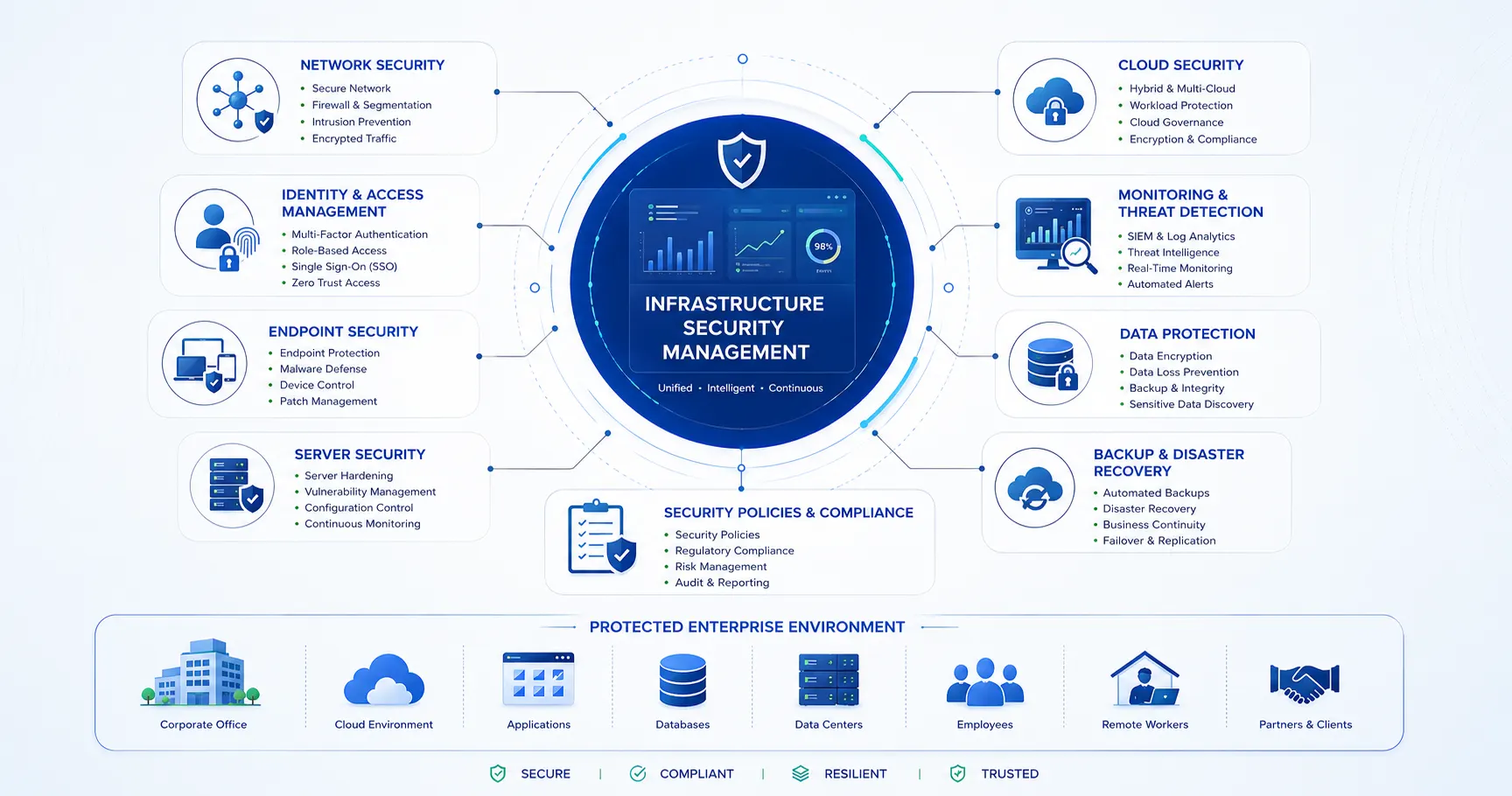
A mature infrastructure security management program is built on eight foundational components. Each addresses a distinct risk domain.
Network security encompasses firewalls, intrusion detection and prevention systems (IDS/IPS), network segmentation, and secure access controls. The goal is to restrict unauthorized lateral movement and limit the blast radius of any breach that does occur.
Every laptop, desktop, server, mobile device, and IoT sensor is a potential entry point. Endpoint protection platforms (EPP), endpoint detection and response (EDR), and device management policies are all required to maintain a secure IT infrastructure at the device level.
Cloud security involves securing data, workloads, and configurations across IaaS, PaaS, and SaaS environments. This includes cloud security posture management (CSPM), workload protection, and access governance. Cloud security is rapidly becoming the central focus of infrastructure security management given the pace of cloud adoption.
IAM controls who can access what—and under what conditions. Strong IAM includes role-based access controls (RBAC), privileged access management (PAM), single sign-on (SSO), and multi-factor authentication. Identity is the new perimeter in modern IT environments.
Data protection covers encryption at rest and in transit, data loss prevention (DLP) tools, data classification frameworks, and backup policies. With regulatory requirements tightening globally, data protection is as much a compliance function as a security one.
Server hardening involves disabling unnecessary services, applying configuration baselines, managing administrative access, and regularly auditing server states. Both physical and virtual servers require dedicated security controls.
Real-time visibility across the entire IT environment is non-negotiable. Security Information and Event Management (SIEM) platforms, Security Operations Centers (SOC), and AI-powered analytics tools provide the telemetry required to detect anomalies before they escalate. Organizations looking to formalize this capability should explore dedicated infrastructure monitoring solutions that offer end-to-end visibility across hybrid environments.
Resilient backup and disaster recovery capabilities ensure that organizations can restore critical systems and data within defined recovery time objectives (RTO) and recovery point objectives (RPO). Backups should be tested regularly—an untested backup is not a reliable backup.
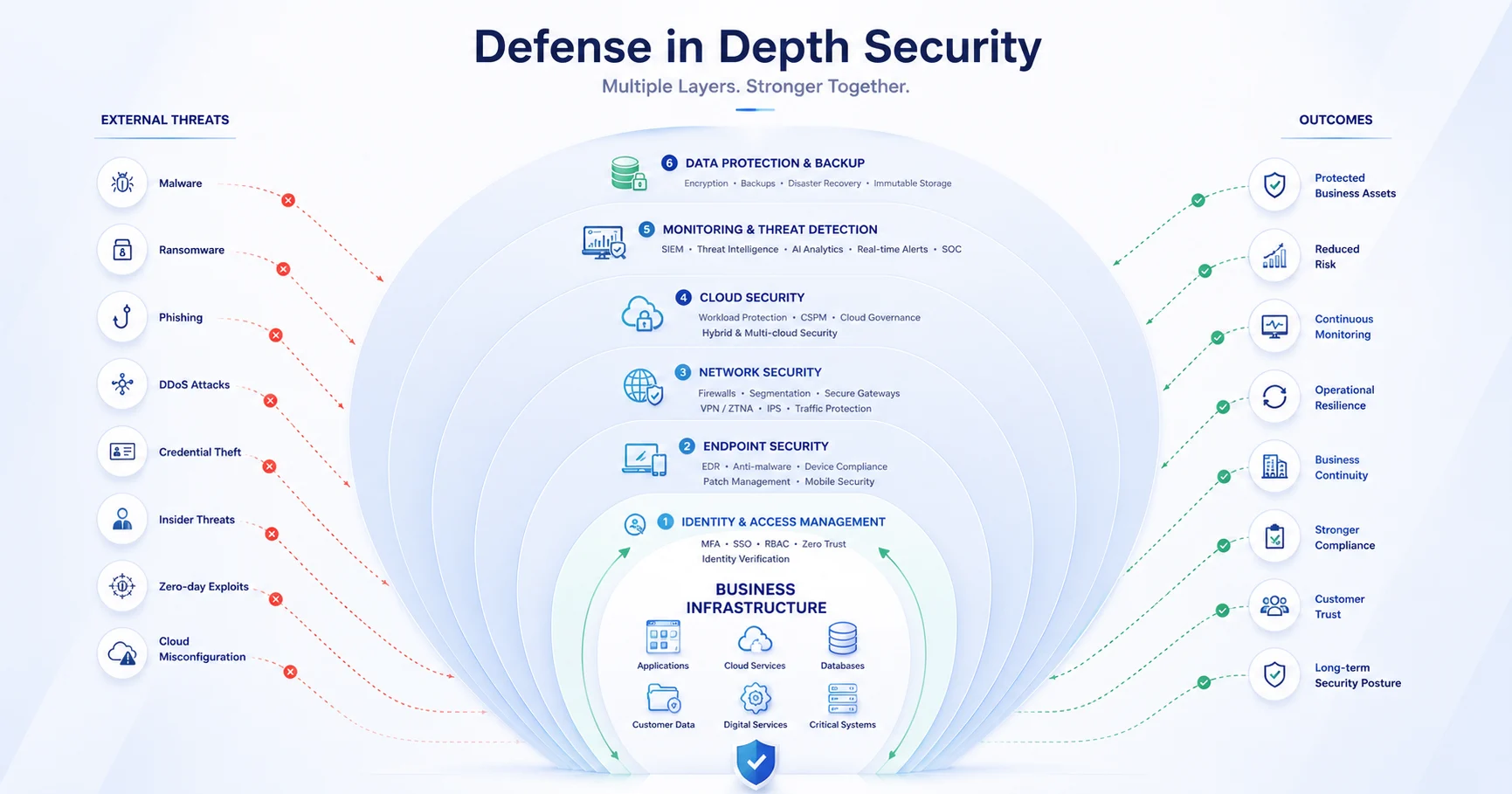
Effective infrastructure security management is not a single project—it is an ongoing operational framework. The most widely adopted structure organizes this work around five pillars.
1. Prevention — Implementing controls that stop threats before they materialize. This includes access management, patch management, network segmentation, and security configuration.
2. Detection — Building the visibility required to identify threats that bypass preventive controls. Continuous monitoring, behavioral analytics, and threat intelligence feeds all contribute to detection capability.
3. Response — Containing and remediating incidents quickly. This requires documented incident response plans, trained response teams, and clear escalation procedures. IBM's 2025 report found the average breach containment time was 241 days—organizations with mature response capabilities close that gap significantly.
4. Recovery — Restoring normal operations after an incident. Backup validation, failover testing, and business continuity planning all fall under this pillar.
5. Continuous Improvement — Treating security as a living program rather than a one-time configuration. This includes post-incident reviews, red team exercises, security metrics tracking, and regular policy updates.
Zero Trust operates on the principle of "never trust, always verify." No user, device, or network segment receives implicit trust—every access request is authenticated, authorized, and continuously validated. Zero Trust is the most effective architectural approach for protecting hybrid and multi-cloud environments.
MFA is the single highest-impact control for preventing unauthorized access. Require MFA for all user accounts, with particular emphasis on administrative accounts, remote access tools, and cloud platforms. Avoid SMS-based MFA in favor of authenticator apps or hardware tokens.
Users and systems should have access only to the resources required for their specific role—nothing more. Regularly audit access rights and remove permissions that are no longer needed. Overprivileged accounts are a primary vector for lateral movement after initial compromise.
Unpatched vulnerabilities remain one of the most exploited weaknesses in enterprise IT infrastructure. Establish a defined patching cadence (monthly for routine updates, immediate for critical vulnerabilities), and use automated patch management tools to ensure coverage at scale.
Encryption renders stolen data unusable. Apply encryption to all sensitive data stored on servers, in cloud storage, and on endpoint devices. Use TLS 1.3 or higher for data in transit, and manage encryption keys through dedicated key management systems.
Network segmentation limits lateral movement by dividing the network into isolated zones. If an attacker gains a foothold in one segment, segmentation prevents them from freely moving through the rest of the environment. Apply this principle to both on-premises and cloud network architectures.
Real-time monitoring provides the visibility required to detect threats early. A SIEM platform aggregates log data from across the IT environment and correlates events to surface suspicious activity. Pair SIEM with a dedicated SOC—whether in-house or managed—for 24/7 coverage.
Manual processes do not scale. Automated patch management and configuration compliance tools ensure that every system in the environment stays current and correctly configured without depending on individual human actions.
EDR tools provide deep visibility into endpoint behavior, enabling security teams to detect, investigate, and contain threats on individual devices. EDR is now a standard requirement for any organization running more than a small number of endpoints.
Scheduled vulnerability scans identify known weaknesses before attackers can exploit them. Penetration testing goes further, using real-world attack techniques to find vulnerabilities that automated scanners miss. Organizations should perform internal assessments quarterly and external penetration tests at least annually.
Technology alone cannot protect an organization if employees click on phishing links or use weak passwords. Regular, scenario-based security awareness training reduces the success rate of social engineering attacks. Simulated phishing campaigns provide measurable data on employee readiness.
Cloud environments require dedicated governance. Implement Cloud Security Posture Management (CSPM) tools to continuously assess configurations, enforce policies, and detect drift. Given that 31% of cloud breaches stem from misconfiguration, proactive posture management is essential. Organizations managing complex cloud environments should review their cloud infrastructure management practices to ensure security governance keeps pace with cloud adoption.
An incident response plan that has never been tested is not a plan—it is a document. Conduct tabletop exercises at least twice per year, simulating realistic attack scenarios. Use the results to identify gaps and improve response playbooks.
Backups are only valuable if they can be restored reliably and quickly. Schedule regular restore tests to validate backup integrity and measure actual RTO and RPO against defined targets. Ransomware frequently targets backup systems—ensure backups are air-gapped or stored in immutable storage.
IT infrastructure policies and procedures must evolve alongside the threat landscape and technology environment. Conduct a comprehensive policy review annually, and trigger ad hoc reviews whenever significant technology changes, incidents, or regulatory updates occur.
|
Best Practice |
Priority |
Primary Benefit |
|---|---|---|
|
Zero Trust Architecture |
Critical |
Limits unauthorized access and lateral movement |
|
Multi-Factor Authentication |
Critical |
Prevents credential-based attacks |
|
Least Privilege Access |
High |
Reduces attack surface and insider risk |
|
Patch Management |
Critical |
Closes known vulnerability windows |
|
Data Encryption |
High |
Protects data confidentiality at rest and in transit |
|
Network Segmentation |
High |
Contains breach blast radius |
|
Continuous Monitoring / SIEM |
Critical |
Enables early threat detection |
|
Automated Configuration Management |
High |
Maintains consistent security baselines |
|
Endpoint Detection & Response (EDR) |
High |
Detects and contains endpoint threats |
|
Vulnerability Assessments |
High |
Identifies weaknesses before attackers do |
|
Security Awareness Training |
High |
Reduces human-factor risk |
|
Cloud Security Posture Management |
Critical |
Prevents cloud misconfiguration breaches |
|
Incident Response Testing |
High |
Validates and improves response readiness |
|
Backup & DR Validation |
Critical |
Ensures recovery capability after ransomware |
|
Policy Review Cycles |
Medium |
Maintains governance alignment |
Well-documented IT infrastructure policies and procedures are the governance backbone of any security program. Without them, controls are inconsistently applied, compliance is difficult to demonstrate, and incident response becomes improvised.
Every enterprise should maintain documented policies covering the following areas:
Access Control Policy — Defines how user accounts are provisioned, managed, and deprovisioned. Specifies MFA requirements, password complexity, and privileged access procedures.
Password and Credential Management Policy — Sets standards for password length, complexity, rotation, and the use of password managers. Addresses both human and non-human identities (service accounts, API keys).
Patch Management Policy — Establishes patching cadences by severity level, defines ownership for patch approval and deployment, and specifies acceptable vulnerability remediation windows.
Backup and Data Retention Policy — Documents backup frequency, retention periods, storage locations, encryption requirements, and restore testing schedules.
Disaster Recovery Policy — Defines RTO and RPO targets, assigns recovery responsibilities, and outlines the steps required to restore critical systems after a major incident.
Vendor and Third-Party Risk Management Policy — Establishes security requirements for external vendors, defines assessment cadences, and specifies contractual security obligations.
Remote Work and BYOD Security Policy — Sets security requirements for employees working from home or using personal devices, including VPN usage, endpoint security, and acceptable use rules.
Incident Response Policy — Defines what constitutes a security incident, escalation procedures, communication protocols, and post-incident review requirements.
Change Management Policy — Governs how changes to IT infrastructure are proposed, tested, approved, and documented to prevent unauthorized or poorly tested modifications.
Compliance Documentation Policy — Specifies which regulatory frameworks apply, assigns compliance ownership, and defines evidence collection and audit preparation procedures.
IT infrastructure policies and procedures should be reviewed annually at a minimum, approved by executive leadership, and communicated clearly to all employees with access to IT systems.
Selecting the right technology stack is a critical enabler of infrastructure security management. These are the core tools that enterprise security teams should evaluate.
Next-Generation Firewalls (NGFW) — Provide deep packet inspection, application awareness, and integrated intrusion prevention. Essential for controlling traffic at network perimeters and between internal segments.
Security Information and Event Management (SIEM) — Aggregates and correlates log data from across the environment to detect anomalies and support incident investigation. Modern SIEM platforms incorporate user and entity behavior analytics (UEBA).
Extended Detection and Response (XDR) — Provides unified threat detection and response across endpoints, networks, cloud workloads, and email. XDR reduces detection time by correlating telemetry that siloed tools would process separately.
Endpoint Detection and Response (EDR) — Monitors endpoint behavior in real time, enabling detection of fileless malware, living-off-the-land attacks, and other advanced techniques that signature-based tools miss.
Identity and Access Management (IAM) / Privileged Access Management (PAM) — Centralized platforms for managing identities, enforcing access policies, and governing privileged account usage. Critical for both security and compliance.
VPN and Zero Trust Network Access (ZTNA) — ZTNA is replacing traditional VPN in many organizations, providing identity-verified, least-privilege remote access without exposing the full network.
Cloud Access Security Broker (CASB) — Provides visibility and control over cloud application usage, data movement, and access policies across both sanctioned and unsanctioned SaaS platforms.
Security Orchestration, Automation, and Response (SOAR) — Automates repetitive incident response tasks, reducing mean time to respond (MTTR) and enabling security teams to handle higher alert volumes without additional headcount.
AI-Powered Threat Detection — Machine learning models analyze behavioral patterns across large data sets to identify threats that rule-based systems miss. IBM's 2025 report highlighted that AI-powered defenses were a key driver of reduced breach containment times.
Cloud Security Posture Management (CSPM) — Continuously assesses cloud configurations, identifies policy violations, and provides remediation guidance for misconfigurations that could lead to data exposure.
|
Mistake |
Business Impact |
Recommended Solution |
|---|---|---|
|
Treating patching as a low-priority task |
Exploitation of known, preventable vulnerabilities |
Automate patching and enforce remediation SLAs by severity |
|
Using single-factor authentication for admin accounts |
Credential theft leading to full environment compromise |
Enforce MFA on all privileged and remote access accounts |
|
Over-permissioned cloud IAM roles |
Data exposure from compromised cloud credentials |
Apply least privilege; audit IAM roles quarterly |
|
No network segmentation |
Ransomware spreads freely across the environment |
Implement VLANs and micro-segmentation |
|
Untested backups |
Inability to recover after ransomware attack |
Schedule and document monthly restore tests |
|
Shadow AI and unauthorized cloud tools |
Data leakage and expanded attack surface |
Enforce CASB controls; publish approved tool lists |
|
Inadequate third-party vendor assessment |
Supply chain compromise affecting downstream systems |
Require security assessments for all vendors with system access |
|
No formal incident response plan |
Slow, disorganized response that amplifies damage |
Develop, document, and test IR playbooks annually |
|
Ignoring insider threat indicators |
Data theft or sabotage goes undetected |
Deploy UEBA and establish insider threat program |
|
Skipping security awareness training |
High phishing click rates and credential exposure |
Conduct quarterly training and monthly simulated phishing |
Use this checklist to evaluate the current state of your IT infrastructure security program.
Access and Identity
Network Security
Endpoint Security
Cloud Security
Data Protection
Monitoring and Response
Governance and Compliance
A mature infrastructure security management program delivers measurable value across multiple business dimensions.
Reduced Financial Exposure — Organizations with strong security controls and AI-powered defenses have demonstrably lower breach costs. IBM's 2025 report found that faster breach containment—enabled by better detection tools—significantly reduced total incident costs.
Operational Continuity — Security incidents cause downtime. A well-protected and resilient IT infrastructure minimizes the frequency and duration of disruptions, protecting revenue and productivity.
Regulatory Compliance — Documented IT infrastructure policies and procedures, access controls, and monitoring capabilities directly satisfy the requirements of GDPR, HIPAA, PCI-DSS, and other frameworks. Compliance gaps lead to fines and audit findings.
Competitive Differentiation — Enterprise customers and partners increasingly require evidence of security controls before signing agreements. A strong security posture becomes a business enabler and procurement advantage.
Reduced Cyber Insurance Premiums — Insurers are applying stricter underwriting standards. Organizations with documented controls, tested incident response plans, and active monitoring programs access better coverage at lower premiums.
Improved Employee Productivity — Security incidents are disruptive and demoralizing. A stable, well-protected IT environment allows employees to work without interruption and with confidence.
Stronger Stakeholder Trust — Boards, investors, and customers want assurance that IT infrastructure security is taken seriously at the executive level. A mature program supports transparent reporting and demonstrates responsible stewardship of business and customer data.
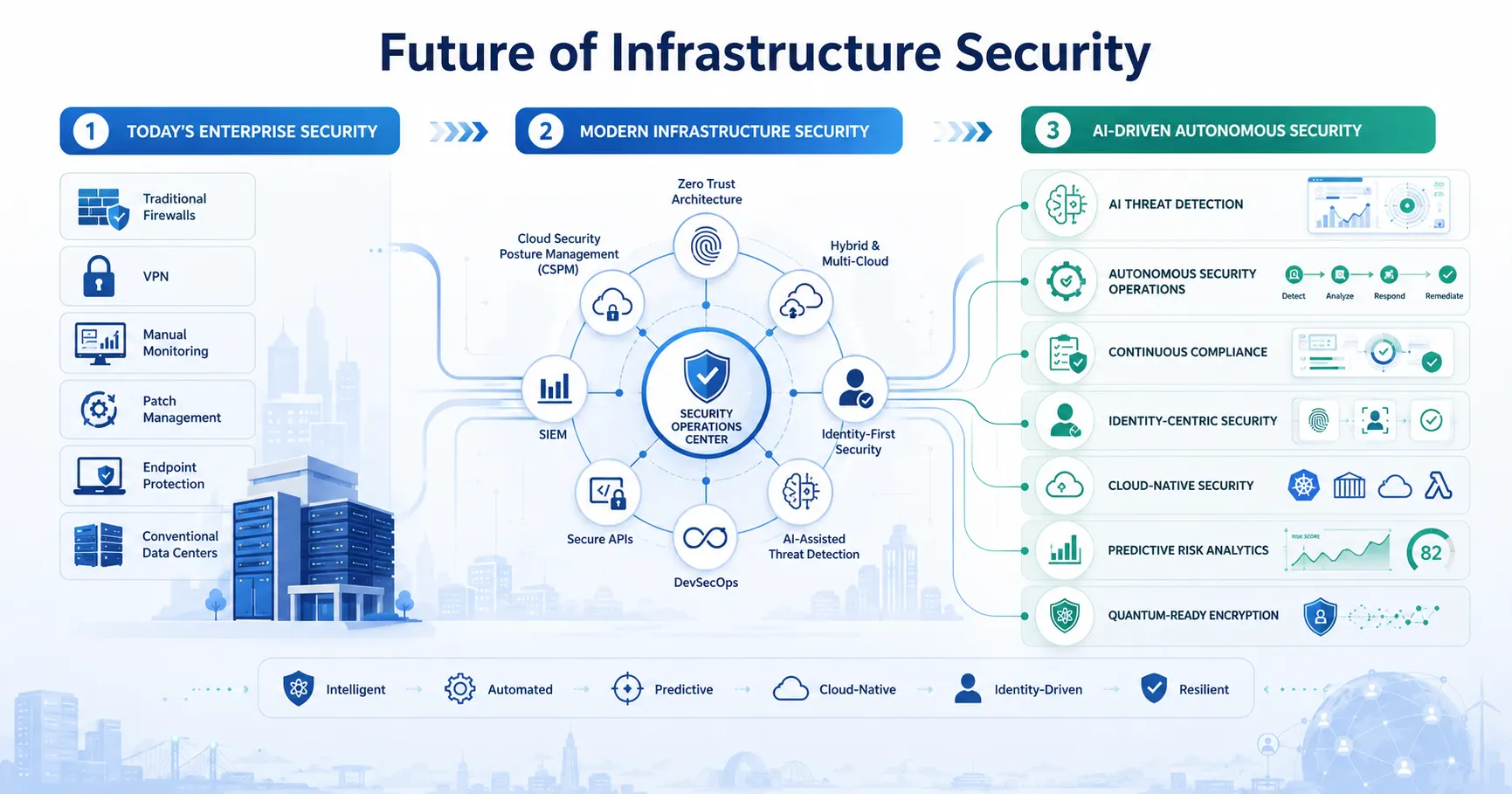
The discipline of infrastructure security management is evolving rapidly. These ten trends will define the next generation of enterprise security programs.
1. AI-Powered Threat Detection — Machine learning models are becoming the primary mechanism for detecting novel attack patterns. Expect AI to handle more of the detection and triage workload, freeing human analysts for higher-order investigation tasks.
2. Autonomous Security Operations — AI-driven SOAR platforms are beginning to autonomously contain threats, isolate compromised endpoints, and revoke suspicious access without human intervention—dramatically reducing response times.
3. Zero Trust Maturity — Zero Trust will move from architectural principle to operational standard. Organizations will expand Zero Trust controls to cover all application access, API interactions, and machine-to-machine communications.
4. Identity-First Security — As network perimeters continue to dissolve, identity becomes the primary security boundary. Expect continued investment in IAM, PAM, and continuous identity verification capabilities.
5. Cloud-Native Security — Security controls will increasingly be embedded in cloud-native development pipelines (DevSecOps), shifting protection left into the build and deployment process rather than applying it as an afterthought.
6. Secure Access Service Edge (SASE) — SASE converges network security and WAN capabilities into a single cloud-delivered service. Adoption will accelerate as organizations seek to simplify security architecture for distributed workforces.
7. Security Automation at Scale — Manual security operations will give way to automated workflows for vulnerability management, compliance monitoring, access reviews, and threat response—reducing human error and scaling coverage.
8. Continuous Compliance Monitoring — Point-in-time audits will be supplemented—or replaced—by real-time compliance monitoring tools that provide continuous evidence of control effectiveness.
9. Predictive Analytics and Risk Quantification — Security teams will increasingly use predictive models to forecast likely attack vectors and quantify financial risk exposure, enabling better-informed investment decisions.
10. Quantum-Resistant Encryption — As quantum computing advances, organizations will need to migrate to post-quantum cryptographic algorithms to protect sensitive data from future decryption attacks. Planning for this transition should begin now.
IT infrastructure security is not a destination—it is a continuous discipline. The threat landscape evolves constantly. Attack techniques grow more sophisticated. Cloud environments expand in complexity. Regulatory requirements tighten. The only effective response is a structured, ongoing program built on clear governance, proven best practices, and the right technology tools.
The 15 best practices outlined in this guide provide a practical roadmap. Begin with the highest-impact controls—Zero Trust, MFA, patch management, and continuous monitoring—then build out the rest of the framework systematically. Document your IT infrastructure policies and procedures before deploying new tools. Test your incident response and disaster recovery capabilities before you need them.
The organizations that invest in infrastructure security management today are the ones that will absorb future attacks, recover faster, and maintain the trust of their customers and partners. That is not just a security outcome—it is a business one.


Start Build Your
Next Digital Solution?
Let’s build scalable, future-ready digital solutions tailored to your business goals. Connect with our experienced technology consultants to discuss your vision, strategy, and growth opportunities — with zero obligation and complete transparency.
Get a free consultation and cost estimate for your digital solution
Our expert will contact you within 24 hours. Check your email for confirmation.
Partner with SISGAIN experts to build secure, scalable AI-powered IT Solutions that transform your business operations.









DUQE FREEZONE Quarter Deck, Queen Elizabeth 2, Mina Rashid, Dubai, UAE

100 Consilium Pl Suite 200, Scarborough, ON M1H 3E3, Canada

C-109, Sector 2, Noida, Uttar Pradesh 201301 India
Project quotes, partnerships, implementation
Open roles, referrals, campus hiring