
 +1 844-445-5767
 +971 56-848-5757
 +91 921-208-0630
For Business & Service Inquiries
Sales Team
Project quotes, partnerships, implementation
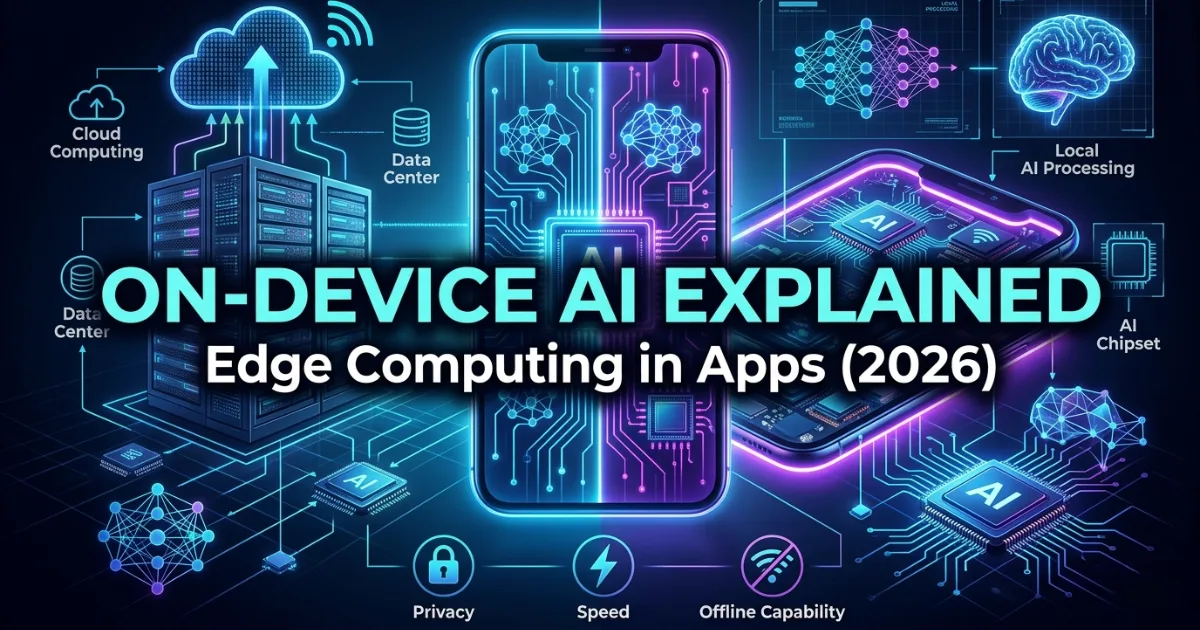
In 2026, users expect mobile apps to respond instantly, protect sensitive data, and work flawlessly—even offline. Traditional cloud-dependent AI often falls short: it introduces latency, raises privacy concerns, and racks up massive server costs. Enter on-device AI in mobile apps and edge computing in mobile apps—the technologies powering the next generation of intelligent, private, and efficient applications.
Business owners, CTOs, and startups are shifting to AI that runs directly on smartphones, tablets, and wearables. Organizations investing in AI-powered experiences increasingly rely on custom mobile app development to deliver intelligent, privacy-first applications that perform consistently across Android and iOS devices. Industry analysts predict that 90% of new mobile applications will incorporate AI capabilities by 2026, with a significant portion processing data locally. This shift isn’t hype—it delivers measurable ROI through lower costs (up to 73% cloud savings in some cases), sub-50ms response times, and full GDPR/HIPAA compliance without data leaving the device.
As a leading AI software development company, SISGAIN has helped enterprises across healthcare, finance, retail, and logistics build these next-generation apps. In this comprehensive guide, we break down exactly what on-device AI and edge computing mean, how they work, their real-world impact, and why your business should invest now.
On-device AI refers to artificial intelligence models that run inference (making predictions or decisions) entirely on the user’s smartphone or tablet using its own hardware—CPU, GPU, or dedicated Neural Processing Units (NPUs). No data is sent to the cloud for processing.
This differs from cloud AI, where every request travels to remote servers. On-device AI leverages lightweight, optimized models (often called Small Language Models or SLMs) that deliver powerful results while respecting device constraints like battery life and memory.
Snippet-ready definition for search engines and voice assistants: On-device AI in mobile apps processes data locally on the user’s device using specialized chips like NPUs. It enables real-time intelligence, offline functionality, enhanced privacy, and reduced latency—without relying on internet connectivity or cloud servers. In 2026, it powers everything from live translation to fraud detection directly on your phone.
Key enablers in 2026 include Apple’s Neural Engine (in A18-series chips), Google’s Tensor G4/G5, and Qualcomm’s Snapdragon 8 Elite series with advanced AI engines. These chips make sophisticated tasks—like running 7–13 billion parameter models—feasible on consumer devices.
Edge computing in mobile apps extends on-device AI by processing data at the “edge” of the network—on the device itself or on nearby edge servers—rather than routing everything to centralized cloud data centers.
In practice, your app might:
This hybrid approach powers real-time applications in AR/VR, gaming, telehealth, and IoT-connected apps. Gartner previously forecasted that 75% of enterprise data would be processed at the edge by 2025, and that trend has accelerated. The global edge AI market is booming, with projections showing continued double-digit growth driven by 5G/6G and AI-optimized hardware.
Edge computing reduces bandwidth usage, cuts costs, and improves reliability in low-connectivity environments—critical for field workers, travelers, or users in emerging markets.
Understanding how on-device AI operates helps CTOs and development teams design smarter, more efficient mobile architectures. Unlike cloud AI, where every request travels to remote servers, on-device AI processes data directly on the user's smartphone or tablet using its built-in hardware.
Here is the complete pipeline in simple, sequential steps:
The process begins with the device's sensors—camera, microphone, accelerometer, GPS, or touchscreen—capturing raw input in real time.
On-device preprocessing cleans and prepares this data locally. For example:
This step happens entirely on the device, ensuring speed and privacy from the very first moment. No data leaves the phone at this stage.
Developers start with a trained AI model (often created in the cloud) and optimize it for mobile constraints like limited memory, battery, and processing power.
Popular frameworks in 2026 include:
Optimization techniques make large models practical on phones:
These steps ensure the model runs efficiently even on mid-range devices in 2026.
Once loaded, the optimized model performs inference—the actual task of making predictions or generating outputs.
Modern smartphones use dedicated Neural Processing Units (NPUs) alongside the CPU and GPU. Examples in 2026 include:
These specialized chips handle the heavy matrix multiplications and neural network operations at high speed and low power. Complex tasks like real-time object detection, live language translation, or image enhancement now complete in under 50 milliseconds on flagship phones.
The AI delivers instant results to the user—such as highlighting objects in the camera view, suggesting smart replies, or summarizing a notification.
Many apps include a local feedback loop: the model subtly improves over time based on user interactions and patterns, all without sending any personal data to the cloud. This creates personalized experiences that feel natural and responsive.
When the device connects to the internet, the app can optionally send anonymized insights or request fleet-wide model updates from the cloud. This keeps individual user data private while allowing the overall system to improve continuously.
This entire pipeline is what makes modern AI-powered mobile apps feel instantly smart, work offline, and protect user privacy. It turns the smartphone into a powerful, self-contained AI device rather than a thin client constantly calling home to the cloud. Achieving this level of performance requires robust application building practices, optimized AI architectures, and deep expertise in cross-platform mobile engineering.
Practical insight for decision-makers: Most successful implementations in 2026 use a hybrid approach—handling 70-90% of interactions on-device for speed and privacy, while reserving the cloud for initial training or occasional heavy computations.
Businesses adopting on-device AI see immediate advantages:
For enterprises, these translate directly to higher engagement, lower churn, and stronger competitive positioning.
Ready to build smarter apps? Contact the AI solutions provider at SISGAIN for a free consultation on integrating on-device AI into your mobile strategy.
Choosing the right AI architecture is one of the most important decisions when building a modern mobile app. Should you process everything on the user’s phone (on-device), send all requests to the cloud, or use a smart combination of both?
Here’s a clear, side-by-side comparison to help business owners, CTOs, and product teams make informed decisions:
| Aspect | On-Device AI (Edge Computing) | Cloud AI | Hybrid Approach (Recommended for Most Apps) |
|---|---|---|---|
| Latency (Speed) | Very fast – under 50 milliseconds (feels instant) | Slower – 200 to 500+ ms due to round trips | Best of both: instant for most tasks, cloud when needed |
| Privacy & Security | Excellent – all data stays on the user’s device | Moderate – data is sent to external servers | Strong – sensitive data processed locally, non-sensitive in cloud |
| Offline Functionality | Works fully without internet | Does not work without internet | Seamless – automatically switches to on-device when offline |
| Cost | Low ongoing costs (uses user’s phone hardware) | High – every request costs money in API calls & servers | Highly optimized – can reduce cloud costs by up to 73% |
| Model Power | Limited to optimized smaller models (SLMs) | Unlimited – can use very large, powerful LLMs | Flexible – uses small models locally and large ones in cloud when required |
| Scalability | Highly scalable – every user’s phone becomes a compute node | Expensive to scale – requires more servers | Infinite scalability by leveraging millions of user devices |
| Battery & Power Use | Very efficient thanks to dedicated NPUs | Higher power use due to constant internet usage | Balanced and efficient |
| Best For | Real-time features, private data, offline scenarios | Complex analysis, heavy training, massive datasets | Most real-world enterprise and consumer apps |
In 2026, relying only on cloud AI is rarely the best choice. Pure on-device AI also has limitations in handling extremely complex tasks.
The winning strategy for most businesses is a Hybrid AI approach:
This combination delivers the fastest user experience, strongest data protection, lowest operating costs, and maximum flexibility.
Businesses that adopt hybrid on-device + cloud AI architectures consistently see higher user satisfaction, lower churn, better compliance, and significantly reduced infrastructure expenses.
On-device AI is no longer just a technical concept — it is actively transforming how people use mobile apps across industries. By processing data directly on the smartphone or tablet, these apps deliver instant responses, work without internet, and keep sensitive information private.
Below are practical, real-world examples from key sectors that demonstrate the power of on-device AI in mobile apps and edge computing in mobile apps.
Doctors, patients, and caregivers are benefiting greatly from on-device AI:
Real Example: Telemedicine apps powered by on-device AI enable instant patient triage while fully complying with HIPAA regulations, making healthcare more accessible and secure.
Banks and fintech companies are using on-device AI to make financial services faster, safer, and more personalized:
Shopping experiences are becoming smarter and more interactive with on-device AI:
Modern vehicles and mobility apps are becoming significantly safer and more intelligent:
These practical examples clearly show why AI-powered mobile apps have become essential in 2026. Companies that ignore on-device AI risk falling behind in user experience, data privacy, and operational efficiency.
Looking for custom implementation? Partner with a trusted mobile app development company that specializes in AI-powered applications. SISGAIN helps businesses design, develop, and scale intelligent mobile experiences with on-device AI, edge computing, and cloud-native architectures.
While on-device AI in mobile apps offers powerful benefits, it is not without its challenges. Understanding these limitations helps businesses and development teams plan better and set realistic expectations.
Here are the main hurdles companies face when implementing on-device AI in 2026:
How to Overcome These Challenges Most successful companies today do not rely on pure on-device AI. Instead, they use a hybrid approach — running the majority of tasks locally for speed and privacy, while using the cloud for complex computations and regular model improvements. Continuous testing, optimization, and careful device targeting also help minimize these limitations.
By understanding these challenges early, businesses can make smarter architectural decisions and build more reliable, high-performing AI-powered mobile apps.
The field of on-device AI in mobile apps is evolving rapidly. By 2026 and in the coming years, several exciting developments will make AI on smartphones even smarter, faster, and more efficient. Here’s what businesses and CTOs should watch for:
Large AI models like GPT are powerful but too big to run on phones. In 2026 and beyond, Small Language Models (SLMs) specially designed for mobile devices will take center stage.
These compact models will deliver 80–90% of the performance of big cloud models while running smoothly on smartphones. Tasks like real-time translation, smart replies, summarization, and personalized recommendations will become faster and more accurate — all without needing an internet connection.
Future on-device AI won’t just respond to commands. It will become agentic — meaning it can think, plan, and act on its own.
These intelligent agents will anticipate user needs, make decisions locally, and complete tasks automatically. For example, your phone might silently organize your schedule, book a cab when it detects you’re running late, or prepare a meeting summary — all while keeping your data private on the device.
The arrival of 6G networks will dramatically improve edge computing. With ultra-low latency and higher speeds, your phone will seamlessly collaborate with nearby edge servers.
This will enable real-time applications like high-quality AR experiences, instant multi-player gaming, and advanced remote surgeries — with almost no delay, even in crowded areas.
New “brain-like” chips called neuromorphic processors are being developed. These chips mimic how the human brain works, consuming far less power while delivering higher efficiency.
In the near future, smartphones equipped with neuromorphic hardware will run complex AI tasks using minimal battery, making all-day on-device AI a reality.
By 2027, more than 90% of AI-powered mobile apps will use a hybrid approach. Most everyday tasks will run locally on the device for speed and privacy, while the cloud will be used only for heavy training or very complex calculations. This combination will offer the best balance of performance, cost, and user experience. As these technologies mature, demand for advanced mobile application development solutions will continue to rise across healthcare, finance, logistics, and retail sectors.
The on-device AI market is growing at an impressive pace. It is projected to expand at a 24.8% Compound Annual Growth Rate (CAGR), reaching over $156 billion by 2033. This rapid growth reflects how quickly businesses and consumers are adopting edge AI technologies.
Bottom Line: By 2027–2030, on-device AI will become as common and essential in mobile apps as touchscreens are today. Companies that start adopting these technologies now will gain a significant competitive advantage in user experience, privacy, and operational efficiency.
The benefits of on-device AI in mobile apps are no longer theoretical — they deliver measurable business value in 2026. Companies that adopt this technology today are seeing faster performance, lower costs, better user experiences, and stronger data protection.
Here’s why smart businesses are investing in on-device AI right now:
Who Benefits the Most?
Bottom Line: Investing in on-device AI today is not just about staying current — it is about building a stronger, more efficient, and future-ready mobile strategy. Companies that act now will save money, delight users, and stay ahead of the competition for years to come.
At SISGAIN, we don’t just build apps—we engineer intelligent, edge-native experiences that drive real business outcomes. As a premier AI software development company offering mobile app development services, custom AI engineering, and enterprise-grade deployment expertise, we combine deep expertise in TensorFlow Lite, Core ML, and custom NPU optimization with proven delivery across healthcare, finance, retail, and enterprise sectors.
Businesses looking to build AI-powered applications should evaluate whether their existing mobile architecture can support modern on-device intelligence, offline functionality, and scalable mobile app development solutions.
Our clients benefit from:
Whether you need a proof-of-concept or full-scale rollout, our software development experts deliver results.
Get a free consultation today and discover how on-device AI can transform your mobile strategy.
On-device AI and edge computing are no longer emerging trends—they define competitive mobile experiences in 2026 and beyond. By embracing these technologies, businesses unlock faster performance, unbreakable privacy, lower costs, and delighted users.
Don’t let your competitors lead the way. Build intelligent, future-ready mobile apps that work everywhere, protect everything, and scale effortlessly.




Start Build Your
Next Digital Solution?
Let’s build scalable, future-ready digital solutions tailored to your business goals. Connect with our experienced technology consultants to discuss your vision, strategy, and growth opportunities — with zero obligation and complete transparency.
Get a free consultation and cost estimate for your digital solution
Our expert will contact you within 24 hours. Check your email for confirmation.
Partner with SISGAIN experts to build secure, scalable AI-powered IT Solutions that transform your business operations.









DUQE FREEZONE Quarter Deck, Queen Elizabeth 2, Mina Rashid, Dubai, UAE

100 Consilium Pl Suite 200, Scarborough, ON M1H 3E3, Canada

C-109, Sector 2, Noida, Uttar Pradesh 201301 India
Project quotes, partnerships, implementation
Open roles, referrals, campus hiring