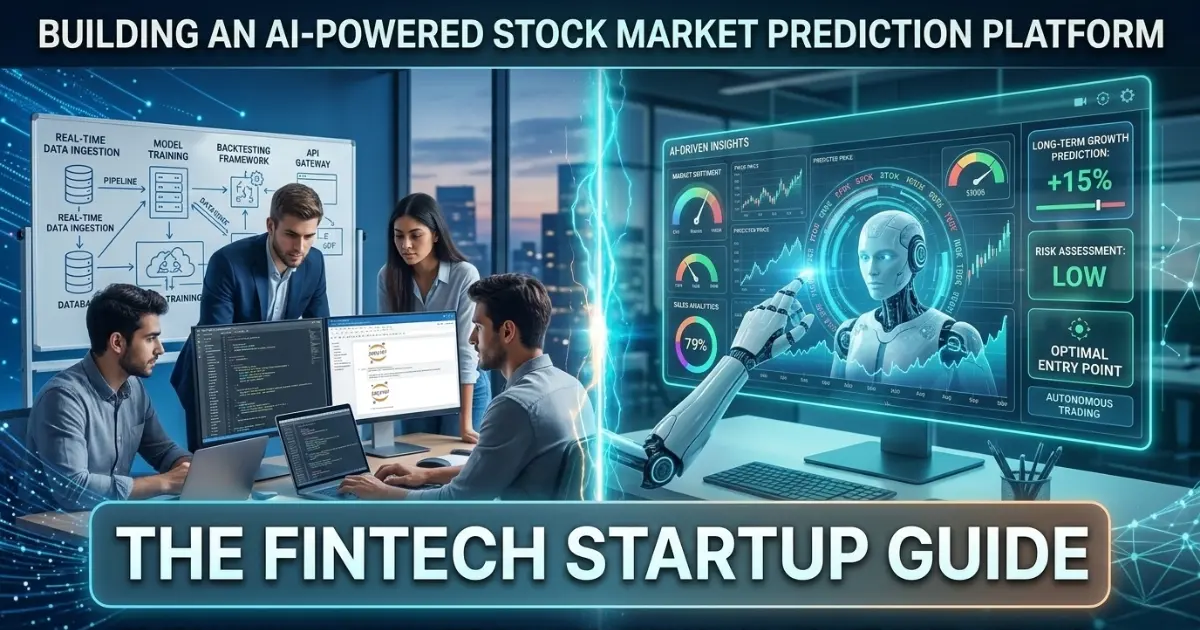
The AI Revolution Is Rewriting How Markets Are Analyzed — and Traded
The stock market has always been a battlefield of information. Whoever processes more data, faster, and more accurately tends to win. For decades, that advantage belonged exclusively to hedge funds and investment banks that could afford armies of quantitative analysts. Today, artificial intelligence is democratizing that edge — and fintech startups are at the forefront of this shift.
Across global financial markets, AI-driven strategies are no longer a novelty. They are rapidly becoming the baseline. From algorithmic trading desks on Wall Street to retail investment apps in Southeast Asia, AI stock market prediction platforms are transforming how billions of dollars move every single day.
"We are witnessing the largest technological shift in the history of capital markets. AI is not augmenting traders — in many asset classes, it is replacing them entirely."
— Former Managing Director, Goldman Sachs Equities Division
For fintech founders, product managers, and startup investors, the question is no longer whether to invest in AI-powered trading technology. The question is how to build it correctly, efficiently, and compliantly. This guide answers that question with depth and precision.
Whether you are building a retail investment assistant, a professional-grade algorithmic trading terminal, or a B2B stock analytics API — this is the most comprehensive fintech AI platform development guide you will find. By the end, you will understand the architecture, the AI models, the regulatory landscape, the realistic costs, and the strategies that separate platforms that scale from those that stall.
What Is an AI-Powered Stock Market Prediction Platform?
An AI stock market prediction platform is a software system that uses artificial intelligence, machine learning, and big data analytics to forecast the future price movements, trends, and behavior of financial assets — and to generate actionable signals for trading or investment decisions.
Unlike traditional stock screeners or basic charting tools, these platforms do not merely display historical data. They learn from it. They identify hidden patterns across thousands of variables simultaneously — price history, earnings reports, macroeconomic indicators, social media sentiment, options flow, geopolitical news, and more — and translate those patterns into probabilistic predictions.
How These Platforms Actually Work
At a high level, an AI stock market prediction platform similar to how you might build a fintech application operates in four interconnected layers:
- Data Ingestion Layer: Continuously pulls structured and unstructured data from financial APIs, news feeds, social media, SEC filings, and alternative data sources (satellite imagery, credit card spending, web traffic data).
- AI Processing Layer: Applies machine learning models — including deep learning, natural language processing, and time-series forecasting — to analyze the incoming data and generate predictions.
- Signal Generation Layer: Translates model outputs into human-readable or machine-executable trading signals, alerts, and recommendations with defined confidence levels.
- Execution & Monitoring Layer: Connects predictions to brokerage APIs for automated trade execution and provides dashboards to monitor portfolio performance in real time.
Core Use Cases
Price Direction Prediction
Forecasting whether a stock will go up, down, or sideways over a defined time horizon.
Intraday Trading Signals
Real-time buy/sell signals for day traders based on momentum, volume, and pattern recognition.
Portfolio Optimization
AI-driven rebalancing and asset allocation recommendations based on risk tolerance and market conditions.
Sentiment Analysis
Quantifying market mood from news headlines, earnings calls, and social media in real time.
Risk Assessment
Identifying concentration risk, tail risk scenarios, and portfolio drawdown probabilities.
Automated Trading
Executing trades autonomously based on predefined AI strategies without human intervention.
A stock market prediction platform is not just an algorithmic trading system. It is an intelligence layer that can serve retail investors, institutional traders, financial advisors, hedge funds, and even corporate treasury teams — each with very different interfaces but sharing the same underlying AI engine.
The Market Opportunity Is Massive — and Still Early
The convergence of several powerful trends makes right now one of the best moments in history to build an AI trading platform. Here is why the opportunity is extraordinary — and why waiting even two years could mean entering a far more crowded market.
Growth of AI in Fintech
The global AI in fintech market was valued at approximately $9.6 billion in 2023 and is projected to reach $49.4 billion by 2028, growing at a compound annual growth rate (CAGR) of 38.5%. Within that market, trading and investment analytics represent the largest and fastest-growing segment.
What is driving this growth? Three primary forces:
- Data proliferation: Financial markets now generate more data in a single trading day than existed in the entire history of markets just two decades ago. Traditional analytical tools cannot process it. AI can.
- Cloud infrastructure maturity: AWS, Google Cloud, and Azure have made enterprise-grade compute infrastructure accessible to startups at a fraction of the historical cost. Training a sophisticated deep learning model on three years of market data no longer requires a private data center.
- Retail investor democratization: The explosion of zero-commission trading apps has brought 150+ million new retail investors into global markets since 2020. Most of them want intelligent tools to compete with institutional players. They represent an enormous addressable market that remains largely underserved by truly sophisticated AI.
Where the Startup Opportunity Lives
Large incumbent players (Bloomberg, FactSet, Refinitiv) have the data advantage but move slowly and charge prohibitively for access. Retail trading apps (Robinhood, eToro, Zerodha) have the user base but lack serious analytical depth. The gap between those two extremes is where fintech startups can build highly differentiated and defensible businesses.
Specific high-opportunity niches include:
- AI-powered stock analytics for independent retail investors at a consumer price point ($15–$50/month)
- Institutional-grade AI signal APIs sold to hedge funds, family offices, and prop trading firms
- White-label AI investment platforms sold to banks, brokerages, and wealth management firms
- Sector-specific AI platforms focused on crypto, commodities, emerging market equities, or fixed income
"The next unicorn in fintech will not be a payment app. It will be the company that builds the most accurate and actionable AI-driven investment intelligence layer."
— Partner at a leading Silicon Valley fintech VC firm
Core Features of an AI Stock Market Prediction Platform
The features you build define your market positioning. A platform targeting day traders needs different capabilities than one targeting long-term investors or institutional quant desks. That said, there is a set of foundational features that every serious AI investment platform must include — and a set of advanced AI features that create genuine competitive differentiation.
Foundational Features
1. Real-Time Market Data Integration
Your platform lives and dies by data quality and latency. You need to integrate multiple data feeds — real-time tick data, Level 2 order book data, historical OHLCV data, options chain data, and fundamental financial data. Providers include Polygon.io, Alpha Vantage, Quandl, IEX Cloud, and Bloomberg API (for institutional tiers). Data normalization pipelines are critical, as different sources return data in different formats and timestamps.
2. AI-Based Price Prediction Models
This is the platform's core intellectual property. Prediction models should output directional forecasts (up/down/neutral), magnitude estimates (expected % move), time horizon specificity (1-day, 1-week, 1-month outlook), and confidence scores with probability distributions. Models must be continuously retrained as market regimes change — a model trained only on 2019 data will perform poorly in a 2022-style bear market.
3. Portfolio Management Dashboard
Users need a clean, intuitive interface that shows their current holdings, AI-generated performance attribution, risk metrics (beta, Sharpe ratio, maximum drawdown), and scenario analysis. The best platforms make complex portfolio analytics feel simple. This is a user experience challenge as much as it is a technical one.
4. Trading Alerts and Signals
Actionable, timely notifications sent via in-app, email, SMS, or webhook. Each alert should include the signal direction, the supporting rationale (why is the AI flagging this?), the suggested entry and exit points, a stop-loss recommendation, and the confidence level. Transparency in signal generation builds user trust and retention.
5. Sentiment Analysis Dashboard
Real-time analysis of news sentiment, social media chatter (Reddit WallStreetBets, Twitter/X, StockTwits), earnings call transcripts, and analyst report tone. Sentiment scores should be presented as a time series overlaid on price charts so users can see the correlation between sentiment shifts and price movements historically.
Advanced AI Features That Drive Differentiation
Automated Trading Bots
AI agents that execute trades autonomously based on strategy parameters set by the user. Supports limit orders, market orders, trailing stops, and options strategies.
AI Investment Assistant
A conversational AI (powered by LLMs) that answers natural-language questions about portfolio performance, explains AI predictions, and suggests rebalancing actions.
Alternative Data Integration
Incorporating satellite imagery, web scraping data, app download trends, credit card transaction aggregates, and shipping data to surface insights invisible to traditional analysts.
Backtesting Engine
Lets users and quants test AI strategies against historical data with realistic execution assumptions (slippage, commission, liquidity constraints).
Risk Management AI
Proactively identifies when a portfolio is approaching dangerous concentration levels or when macro signals suggest a defensive repositioning is warranted.
Earnings Prediction Engine
Forecasts whether a company will beat or miss analyst consensus earnings estimates, with options positioning suggestions for each scenario.
AI Technologies That Power Stock Market Prediction
Understanding which AI technologies to deploy — and when — is one of the most critical architectural decisions a fintech startup will make. Different prediction tasks require different modeling approaches, and the most powerful platforms use an ensemble of complementary techniques.
Machine Learning Algorithms
Machine learning stock prediction starts with classical algorithms that remain highly effective for structured financial data. Gradient Boosting models (XGBoost, LightGBM, CatBoost) are particularly powerful for tabular financial data because they handle mixed feature types well, are resistant to overfitting with proper regularization, and are interpretable enough for regulatory compliance. Random Forest models are used for feature importance analysis, helping identify which signals most strongly predict price movements for each security.
Support Vector Machines (SVMs) remain relevant for binary classification tasks (will this stock outperform or underperform over the next month?). Logistic regression with engineered features is often used as a baseline model for comparison and interpretability.
Deep Learning Models
For more complex pattern recognition tasks, deep learning architectures provide superior performance:
- LSTM (Long Short-Term Memory) Networks: The most widely used deep learning architecture for stock prediction. LSTMs are a type of recurrent neural network (RNN) specifically designed to learn patterns across long time sequences — making them ideal for price history data. They can capture the "memory" of how a stock behaved during previous similar market conditions.
- Transformer Models: Originally developed for NLP, Transformers have proven highly effective for time-series prediction through architectures like Temporal Fusion Transformers (TFT). They use attention mechanisms to identify which historical time points are most relevant to predicting future prices, outperforming LSTMs on many financial forecasting benchmarks.
- Convolutional Neural Networks (CNNs): Applied to candlestick chart pattern recognition, turning visual chart patterns into machine-detectable features. CNNs excel at identifying complex, multi-bar patterns that human chartists look for manually.
- Graph Neural Networks (GNNs): An emerging architecture that models the relationships between companies (supply chain relationships, sector correlations, shared institutional ownership) to improve prediction accuracy by incorporating cross-asset dependencies.
Natural Language Processing
NLP is what allows your platform to understand and quantify the qualitative world — news, earnings calls, social media, analyst reports, central bank minutes. Modern NLP for finance involves:
- FinBERT and Financial LLMs: Fine-tuned versions of BERT and GPT-style models trained specifically on financial text, providing dramatically better sentiment classification accuracy than general-purpose models.
- Named Entity Recognition (NER): Automatically identifying companies, people, financial instruments, and events mentioned in unstructured text.
- Event Detection: Flagging material events (mergers, FDA approvals, executive departures, regulatory actions) in real time from news streams before they fully propagate to market prices.
- Earnings Call Analysis: Transcribing and analyzing management tone, keyword frequency changes, and forward guidance language to predict post-earnings price reactions.
Time-Series Forecasting
Financial data is inherently sequential, and time-series specific techniques are essential. ARIMA (AutoRegressive Integrated Moving Average) and its variants (SARIMA, ARIMAX) provide strong statistical baselines for volatility and price forecasting. Facebook's Prophet model handles seasonality and regime changes well for longer-horizon forecasts. GARCH models specifically model volatility clustering — the well-documented tendency of volatile periods to cluster together — which is critical for options pricing and risk management.
The most accurate production prediction systems use ensemble methods that combine outputs from multiple model types — a classic ML model, an LSTM, a Transformer, and a sentiment model — and weight them dynamically based on recent performance in the current market regime. No single model dominates all market conditions.
Reinforcement Learning for Trading
Reinforcement learning (RL) represents the frontier of autonomous trading system design. RL agents learn optimal trading strategies by simulating thousands of market interactions and receiving reward signals based on profitability and risk metrics. Unlike supervised learning models that simply predict price direction, RL agents learn when to enter and exit positions, how much capital to allocate, and how to manage drawdowns in a holistic, sequential decision-making framework. Libraries like Stable-Baselines3 and RLlib are commonly used.
Tech Stack for Building an AI Stock Market Prediction Platform
Choosing the right technology stack is as much a business decision as a technical one. Your stack needs to handle high-frequency data ingestion, low-latency model inference, complex UI rendering, and enterprise-grade security — all simultaneously. Here is the recommended stack architecture:
Frontend
The user interface must handle real-time data rendering — charts updating multiple times per second — without performance degradation.
React with Next.js provides the performance and SEO capabilities needed. The TradingView Charting Library is the gold standard for financial charting and significantly accelerates development versus building custom charting from scratch. WebSockets are essential for real-time data streaming to the client.
Backend
Python dominates the AI/ML layer due to its ecosystem. FastAPI provides high-performance REST and WebSocket endpoints. TimescaleDB (a PostgreSQL extension) is purpose-built for time-series financial data and provides dramatically better query performance than standard databases for OHLCV queries. Apache Kafka handles the real-time event streaming pipeline from market data sources. Redis provides the ultra-low-latency caching layer for frequently accessed signals.
AI/ML Frameworks
PyTorch is the preferred framework for deep learning model development in financial AI due to its flexibility and dynamic computation graph, which allows rapid experimentation. In the context of enterprise AI software development, MLflow provides model versioning, experiment tracking, and production deployment management essential for maintaining a reproducible AI pipeline as your models evolve.
Financial Data APIs
Cloud Infrastructure
GPU instances are essential for model training. NVIDIA A100 GPUs on AWS (P4d instances) or GCP reduce LSTM training time from days to hours. Kubernetes ensures the platform scales horizontally during market open when data volumes and user concurrency peak. Managed ML platforms like SageMaker simplify model deployment and A/B testing of prediction models in production.
| Layer | Primary Choice | Alternative | Purpose |
|---|---|---|---|
| Frontend | React + Next.js | Vue.js + Nuxt | Real-time UI & charting |
| API Layer | FastAPI (Python) | Express (Node) | REST & WebSocket endpoints |
| ML Engine | PyTorch | TensorFlow | Model training & inference |
| Streaming | Apache Kafka | AWS Kinesis | Real-time data pipeline |
| Time-Series DB | TimescaleDB | InfluxDB | Market data storage |
| Cache | Redis | Memcached | Low-latency signal serving |
| ML Ops | MLflow | Weights & Biases | Experiment tracking |
| Cloud | AWS | GCP | Infrastructure & GPU compute |
| Orchestration | Kubernetes | AWS ECS | Container management |
| NLP | Hugging Face | OpenAI API | Sentiment & text analysis |
Step-by-Step Development Process for an AI Trading Platform
Building an AI trading platform is a multi-phase, iterative process. Rushing to market with an undertested AI model is one of the most dangerous mistakes a fintech startup can make — particularly given the financial consequences for users. Here is the structured development roadmap that serious teams follow.
-
Phase 1: Market Research & Product Definition (Weeks 1–4)
Begin with deep market research to identify your specific niche, target user persona, and competitive differentiation. Conduct 30–50 user interviews with potential customers. Map competitor feature sets. Define your MVP scope ruthlessly — it is far better to do three features exceptionally well than ten features mediocrely. Engage a legal advisor early to understand the regulatory requirements for your intended user jurisdiction and product type (especially around providing investment advice).
-
Phase 2: Data Infrastructure & Collection (Weeks 4–10)
Set up your data pipeline infrastructure before writing a single line of model code. Select and integrate your primary and backup market data APIs. Build data normalization and cleaning pipelines. Establish your time-series database schema. Begin collecting and archiving historical data (minimum 5–10 years for meaningful model training). Set up real-time streaming infrastructure for market hours data ingestion. Data quality at this stage determines everything downstream.
-
Phase 3: AI Model Development & Training (Weeks 8–20)
This phase runs partially in parallel with infrastructure work. Start with baseline models (ARIMA, logistic regression, XGBoost) to establish performance benchmarks. Progress to more complex deep learning architectures (LSTM, Transformer). Implement a rigorous backtesting framework with realistic execution assumptions. Train models on out-of-sample data using walk-forward validation — never standard cross-validation, which leads to dangerously optimistic performance estimates in financial models. Document model performance across different market regimes.
-
Phase 4: Backend Architecture Development (Weeks 10–20)
Build your microservices-based backend with dedicated services for data ingestion, model inference, user authentication, portfolio management, alert delivery, and brokerage integration. Implement a model serving layer (using FastAPI + TorchServe or TensorFlow Serving) that can handle sub-100ms inference requests. Set up the message queuing system for asynchronous signal generation. Design the database schema for user data, portfolios, trade history, and model predictions. Implement comprehensive API rate limiting and circuit breakers.
-
Phase 5: UI/UX Design & Frontend Development (Weeks 12–22)
Financial platforms live or die by their UX. Professional traders demand information density and speed. Retail investors demand clarity and simplicity. Design for your specific user. Implement the real-time charting layer with your chosen charting library. Build the portfolio dashboard, signal feed, alert management interface, and account management screens. Conduct UX testing sessions with real target users, not internal team members. Optimize rendering performance for real-time data updates.
-
Phase 6: Security Implementation & Compliance Review (Weeks 18–26)
Security cannot be bolted on at the end — but this phase is when formal security audits happen. Engage a specialized fintech security firm for penetration testing. Implement end-to-end encryption, SOC 2 compliance controls, and financial data protection measures. Complete your regulatory compliance review with legal counsel. If you are providing investment advice, this is when you confirm RIA registration requirements and implement appropriate disclaimers and guardrails in the AI signal presentation.
-
Phase 7: Testing, Optimization & Beta Launch (Weeks 22–30)
Run comprehensive load testing simulating market open conditions — this is when your system faces maximum concurrent user requests and data throughput simultaneously. Paper trade the AI signals for a minimum of 60 days before any live capital execution features go live. Beta launch to a controlled group of 200–500 users under close monitoring. Measure model performance in live market conditions versus backtested expectations. Iterate rapidly based on user feedback and live performance data.
-
Phase 8: Production Launch, MLOps & Continuous Improvement (Week 30+)
Full production launch with comprehensive monitoring dashboards (model performance metrics, system health, user engagement). Implement automated model drift detection — when model performance degrades below defined thresholds, the system should alert the ML team and potentially fall back to simpler, more robust models. Set up a continuous retraining pipeline that incorporates the most recent market data on a regular schedule. Establish a product feedback loop to identify the features users value most.
Challenges Every Fintech AI Startup Must Confront
Building an AI stock market prediction platform is not for the faint of heart. The challenges are real, significant, and have destroyed well-funded startups that underestimated them. Understanding them clearly is the first step to navigating them successfully.
Market Volatility and Model Fragility
Financial markets are non-stationary systems — the underlying statistical properties of asset prices change over time as market participants adapt, regulations change, and macroeconomic regimes shift. A model trained on a bull market will frequently fail catastrophically during a bear market or a volatility spike like March 2020 or August 2024. This is called concept drift, and managing it is an ongoing operational challenge, not a one-time engineering problem. Solutions include ensemble models, regime detection layers, and frequent retraining cycles — but there is no perfect solution.
Data Quality and Survivorship Bias
Financial data is notoriously messy. Corporate actions (stock splits, dividend adjustments, ticker changes), exchange outages, erroneous prints, and reporting delays all introduce noise that can corrupt model training data. More insidiously, survivorship bias — building models on only the stocks that exist today, ignoring the hundreds that went bankrupt — leads to dramatically overstated backtested performance. Rigorous point-in-time data is expensive (Bloomberg and Refinitiv charge a premium for it) but essential for credible backtesting.
Overfitting and the Curse of Backtesting
The financial AI space is littered with models that looked brilliant in backtest and failed immediately in live trading. With enough feature engineering and model tuning, it is trivially easy to create a model that perfectly explains historical price movements — but has zero predictive power going forward. This is overfitting, and the standard machine learning safeguards (train/test splits, cross-validation) are insufficient for financial time-series data without walk-forward validation and strict discipline around out-of-sample testing.
Regulatory Compliance Complexity
The regulatory landscape for AI-powered investment platforms is evolving rapidly and varies significantly by geography. In the US, providing personalized investment advice typically requires SEC registration as a Registered Investment Advisor (RIA). In the EU, MiFID II regulations impose strict requirements on algorithmic trading systems, including kill switch mandates and pre-trade risk controls. The SEC has also begun issuing guidance on AI use in financial services, particularly around explainability requirements and conflicts of interest. Non-compliance can result in forced shutdown, substantial fines, and reputational damage that is impossible to recover from in financial services.
AI Model Bias and Fairness
AI models trained on historical financial data can inherit and amplify existing market biases. For example, models may systematically undervalue certain sectors or geographies due to historical data imbalances, or may exhibit higher prediction error for smaller-cap stocks with thinner data histories. Rigorous bias analysis across asset classes, market cap tiers, and time periods must be part of every model evaluation framework.
Explainability and User Trust
Users — particularly professional traders and institutional clients — want to understand why the AI is generating a particular signal. A black-box system that simply says "buy" with 78% confidence is not sufficient for sophisticated users, and increasingly, not for regulators either. Implementing SHAP (SHapley Additive exPlanations) values and attention visualization for Transformer models to provide interpretable signal rationale is becoming a competitive necessity.
AI Trading Platform Development Cost: What to Actually Expect
One of the most common questions from fintech founders is: how much does it cost to build an AI stock market prediction platform? The honest answer is that cost varies enormously based on your feature scope, team composition, data requirements, and target market. Here is a realistic breakdown.
| Development Component | MVP Estimate | Full-Scale Platform | Notes |
|---|---|---|---|
| UI/UX Design | $15,000 – $30,000 | $50,000 – $120,000 | Research, wireframes, prototypes, design system |
| Frontend Development | $25,000 – $50,000 | $80,000 – $180,000 | Real-time charting adds significant complexity |
| Backend Development | $30,000 – $60,000 | $100,000 – $250,000 | Microservices, API integrations, streaming pipeline |
| AI/ML Model Development | $40,000 – $80,000 | $150,000 – $400,000 | The highest-cost and highest-value component |
| Data Infrastructure | $10,000 – $25,000 | $40,000 – $100,000 | Database setup, pipeline engineering, ETL |
| Security & Compliance | $15,000 – $30,000 | $60,000 – $150,000 | Pen testing, SOC 2, legal review |
| QA & Testing | $10,000 – $20,000 | $40,000 – $80,000 | Load testing critical for market-open scenarios |
| DevOps & Cloud Setup | $8,000 – $15,000 | $30,000 – $70,000 | Kubernetes, CI/CD, monitoring stack |
| Data API Subscriptions (Annual) | $6,000 – $24,000 | $50,000 – $500,000+ | Bloomberg API alone can cost $24K+/year per user |
| Cloud Infrastructure (Annual) | $12,000 – $36,000 | $60,000 – $300,000+ | GPU costs for training add significantly |
Total Investment Ranges
Key Cost Factors
- Team composition: In-house US engineers cost 2–3× more than equivalent offshore talent. A hybrid model (US tech lead + offshore execution team) often delivers the best cost-to-quality ratio.
- Data quality ambition: Premium point-in-time historical data from Bloomberg or Refinitiv can cost $50,000–$200,000/year. Budget data from free APIs severely limits model quality.
- Target market: Building for institutional clients requires dramatically more investment in compliance, audit trails, and enterprise security than building a retail consumer app.
- AI model sophistication: The step from a basic ML model to a production-grade ensemble with alternative data integration can easily double or triple your ML development costs.
The biggest cost mistake most AI fintech startups make is underinvesting in data infrastructure and overinvesting in UI in the early stages. A beautiful interface on top of mediocre AI predictions will not retain users. Excellent predictions delivered through a basic interface will. Build the intelligence layer first.
Security and Regulatory Compliance for Fintech AI Platforms
Financial services is one of the most heavily regulated industries on earth — for good reason. Users are trusting your platform with their financial futures. A single data breach or compliance violation can end your company overnight. Building security and compliance into your architecture from day one is not optional; it is existential.
Essential Security Features
- End-to-end encryption (TLS 1.3): All data in transit between client and server must be encrypted. No exceptions.
- Encryption at rest (AES-256): All stored user data, portfolio information, and trading history must be encrypted in your database.
- Multi-factor authentication (MFA): Mandatory for all user accounts, especially for accounts with brokerage execution capabilities.
- OAuth 2.0 / JWT authentication: Stateless, secure authentication for API access with short-lived token expiry.
- Role-based access control (RBAC): Granular permission controls, especially critical for multi-user enterprise accounts.
- API rate limiting and DDoS protection: Financial platforms are high-value targets for denial-of-service attacks, particularly around market events.
- Audit logging: Immutable logs of all data access, model prediction generation, and trade execution events for regulatory compliance and forensic analysis.
- Kill switches for automated trading: Mandatory circuit breakers that can halt all automated trading activity immediately — required by MiFID II and recommended universally.
- Penetration testing: Minimum annual penetration testing by a qualified third-party security firm, with more frequent testing after major releases.
Regulatory Framework Essentials
| Regulation | Jurisdiction | Key Requirements |
|---|---|---|
| SEC / RIA | United States | Required for personalized investment advice. Fiduciary duty, disclosure requirements, record-keeping mandates. |
| FINRA Rules | United States | Governs communications with the public about investment products. AI signal presentations must meet communication standards. |
| MiFID II | European Union | Algorithmic trading registration, kill switch mandates, pre-trade risk controls, extensive reporting obligations. |
| GDPR | European Union | Data minimization, consent management, right to deletion, data processing agreements with vendors. |
| FCA Authorization | United Kingdom | Required for investment-related activities. Consumer Duty rules require AI recommendations to be explainable and in users' best interests. |
| SOC 2 Type II | Global standard | Security, availability, and confidentiality controls audit. Increasingly required by enterprise clients and institutional partners. |
| PCI-DSS | Global standard | Required if handling payment card information for subscription payments. |
Regulatory compliance is not just about avoiding fines. It is a trust signal to institutional customers and a moat against new entrants who underestimate the compliance burden. Building it properly the first time costs far less than retroactively remediating a non-compliant system — or recovering from an enforcement action.
Future Trends in AI Stock Prediction Platforms
The field is evolving at extraordinary speed. The platforms being built today will look dramatically different in just three to five years. Startups that build with architectural flexibility and an eye toward these emerging trends will be dramatically better positioned for the next wave of innovation.
Generative AI and Large Language Models in Finance
The integration of large language models (LLMs) like GPT-4, Claude, and specialized financial LLMs is moving from experimental to production. The most immediate application is conversational AI investment assistants that can answer natural-language questions about portfolio performance, explain complex AI predictions in plain English, and simulate "what if" scenarios. More sophisticated applications include generating earnings analysis reports, synthesizing conflicting analyst views, and producing personalized market commentary tailored to each user's holdings and investment objectives.
AI Robo-Advisors 2.0
The first generation of robo-advisors (Betterment, Wealthfront) used relatively simple rule-based allocation algorithms dressed up in modern UI. The next generation will use genuine deep learning for dynamic asset allocation that adapts in real time to changing market conditions, individual risk capacity signals (including behavioral patterns), and macroeconomic regime detection. These platforms will be able to manage complex, multi-asset portfolios including alternatives, private credit, and international assets in ways that were previously only accessible to ultra-high-net-worth investors.
Autonomous Multi-Agent Trading Systems
Multi-agent reinforcement learning systems — where multiple AI agents with different investment mandates and time horizons interact and compete within a simulated market — are emerging from academic research labs into early commercial applications. These systems can discover non-obvious portfolio construction strategies and arbitrage opportunities that neither humans nor single-model systems would identify. Hedge funds are already deploying early versions of these systems.
Alternative Data Proliferation
The alternative data market — which includes satellite imagery of retail parking lots, credit card transaction data, app download metrics, social media activity data, and IoT sensor feeds — is growing at over 40% annually. AI platforms that can effectively integrate and extract alpha from alternative data sources will have increasingly meaningful edges over those relying solely on traditional financial data. The cost of alternative data is declining rapidly as the market matures.
Quantum Machine Learning
While still largely in the research phase, quantum computing promises to dramatically accelerate certain machine learning computations relevant to financial modeling — particularly portfolio optimization problems and certain Monte Carlo simulations. Companies including IBM, Google, and IonQ have active fintech quantum computing research programs, and the first commercially relevant quantum ML applications in finance are expected to emerge within the next 5–7 years. Forward-thinking fintech architects are designing their AI pipeline with eventual quantum integration in mind.
Decentralized AI and On-Chain Analytics
The convergence of blockchain analytics and AI is creating a new category of platforms that provide AI-powered predictions specifically for crypto markets, incorporating on-chain transaction flow data (whale wallet movements, liquidity pool dynamics, smart contract interaction patterns) as first-class predictive features. As DeFi matures, these platforms will bridge traditional and crypto market analytics.
Explainable AI Becomes Regulatory Standard
Regulatory pressure for explainable AI (XAI) is accelerating globally. The EU AI Act, SEC guidance on algorithmic accountability, and FCA Consumer Duty rules are all pushing in the same direction: AI systems making financial recommendations must be able to explain their reasoning in terms humans can understand and regulators can audit. Platforms that build genuine explainability into their core AI layer — not as an afterthought — will have a significant competitive and regulatory advantage.
The Future of Trading Is Intelligent — Build Your Share of It
We are at a genuine inflection point in the history of financial markets. AI is not approaching the center of investment decision-making — it has already arrived. The question for fintech founders is not whether AI-powered stock prediction platforms will define the next decade of financial technology. They will. The question is whether your startup will be the one building the platform that millions of investors rely on.
Building a serious AI stock market prediction platform requires deep technical expertise, genuine intellectual honesty about what AI can and cannot reliably predict in financial markets, respect for the regulatory environment, and an unwavering commitment to user trust. It is not a project for shortcuts.
The startups that will succeed in this space share several characteristics: they invest properly in data quality before model quality, they build modular architectures that can evolve with AI capabilities, they treat compliance as a feature not a friction, they are transparent with users about the limitations and confidence levels of their AI predictions, and they build around specific, underserved user problems rather than trying to build a general-purpose platform from day one.
The rewards for getting it right are extraordinary. AI-powered fintech platforms that achieve product-market fit in this space command premium valuations, high net retention rates, and defensible moats built on proprietary data, trained models, and embedded user workflows. In a market where financial decisions have direct and immediate consequences for people's financial wellbeing, platforms that consistently deliver genuine predictive value build a depth of user loyalty that few other software categories can match.
The intelligent financial platform of 2030 is being architected and built right now. Every week of delay is a week of data collection, model training, user feedback, and market learning that your competitors are accumulating. The opportunity is real. The technology is available. The market is enormous.
The only question left is whether you will build it.






 +1 844-445-5767
 +971 56-848-5757
 +91 921-208-0630