
 +1 844-445-5767
 +971 56-848-5757
 +91 921-208-0630
For Business & Service Inquiries
Sales Team
Project quotes, partnerships, implementation

The real estate world is no longer driven only by location, intuition, and spreadsheets. Today, the most successful portfolios are powered by data—millions of records flowing from listing platforms, satellite imagery, IoT sensors, tenant systems, financial models, and demographic databases. Human teams alone cannot analyze this volume at speed.
That is why AI in real estate has moved from experimentation to strategic necessity.
Across commercial and residential markets, artificial intelligence in real estate is helping executives price assets more accurately, automate leasing, reduce fraud, forecast demand, and uncover investment opportunities before competitors do. From REITs and developers to brokerage networks and property managers, organizations that deploy AI effectively are gaining a structural advantage.
This in-depth guide is written for decision-makers—founders, CTOs, CIOs, asset managers, and investors—who want to understand:
How AI is reshaping the ai in real estate industry
Which use cases deliver the highest ROI
Where automation truly moves the needle
How AI for real estate investors improves returns
What it takes to build and deploy enterprise-grade platforms
How how AI is changing real estate in USA markets right now
Let’s explore what separates early adopters from industry leaders.
When people hear “AI,” they often imagine robots replacing agents. In reality, today’s systems are decision-augmentation engines—software that amplifies human judgment by analyzing far more information than any team could process manually.
In the ai in real estate industry, core technologies include:
Machine Learning (ML): Models that forecast prices, demand, vacancy, and risk.
Natural Language Processing (NLP): Systems that read leases, contracts, emails, and listings.
Computer Vision: Algorithms that analyze photos, drone footage, and satellite imagery.
Predictive Analytics: Forecasting future conditions based on historical and live data.
Generative AI: Creating marketing copy, reports, feasibility studies, and investor updates.
Together, these tools enable ai automation real estate tasks across acquisition, development, leasing, operations, compliance, and portfolio strategy.
Instead of replacing professionals, AI frees them from repetitive analysis so they can focus on negotiation, relationships, and strategic growth.

Nowhere is adoption moving faster than in North America. Institutional investors, brokerage networks, and PropTech platforms are rapidly embedding AI into their core workflows.
In the US market, we are seeing:
AI-driven underwriting replacing manual spreadsheets.
Automated valuation models guiding acquisition teams.
Smart lead-scoring engines for brokerages.
Predictive maintenance platforms for multifamily and office portfolios.
Climate-risk modeling influencing insurance and pricing.
Large operators increasingly partner with specialized AI development companies in USA to build proprietary platforms rather than rely only on off-the-shelf tools.
For capital-intensive portfolios, the stakes are high: faster insight means better entry prices, earlier exits, and superior risk control. That is why AI for real estate investors has become a competitive differentiator rather than an optional upgrade.
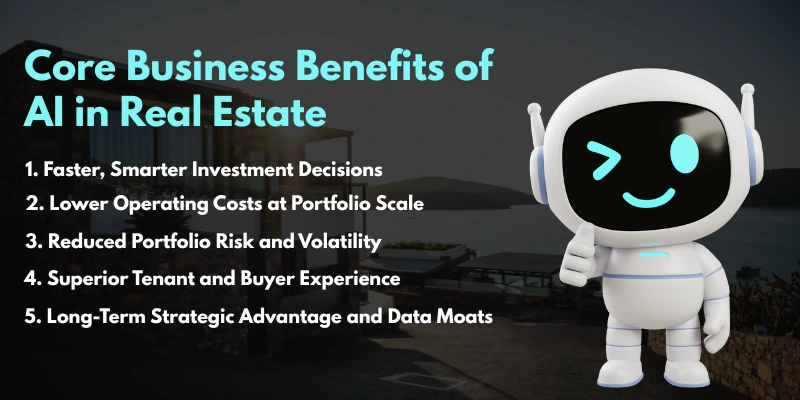
Executives invest in technology for measurable results—not experimentation. When deployed strategically, AI in real estate becomes a profit engine rather than a cost center. The real benefits of AI in real estate appear across five enterprise-critical dimensions: capital efficiency, operational excellence, risk management, customer experience, and long-term competitive positioning.
Acquisition teams traditionally rely on broker packages, spreadsheets, site visits, and manual comparable analysis. This process can take weeks—often causing firms to miss attractive opportunities.
With artificial intelligence in real estate, investment committees gain:
Real-time underwriting models that simulate multiple pricing scenarios.
Automated comparable selection across entire metro areas.
Zoning and entitlement risk scoring based on historical approvals.
Demand forecasting using migration, employment, and infrastructure data.
Climate-risk modeling for flood, wildfire, or heat exposure.
AI engines continuously ingest new transaction data and market signals, allowing pricing models to adjust daily instead of quarterly. For AI for real estate investors, this speed translates into earlier bids, sharper entry points, and higher internal rates of return.
In large portfolios, even small inefficiencies compound into millions of dollars annually. AI-driven automation targets the most expensive friction points across leasing, accounting, facilities, and marketing.
Organizations use ai automation real estate tasks to:
Extract lease clauses automatically rather than employing legal review teams.
Schedule maintenance proactively instead of reacting to failures.
Automate invoice reconciliation and CAM charge audits.
Optimize energy usage through smart-building systems.
Generate marketing assets and investor reports with generative models.
Over time, these efficiencies compress operating expense ratios and free internal teams to focus on asset strategy rather than administrative workload—one of the most tangible benefits of AI in real estate at scale.
Risk management is where AI often delivers its highest strategic value.
Traditional risk analysis relies heavily on static reports and quarterly reviews. In contrast, AI systems monitor portfolios continuously, flagging emerging issues long before they appear in financial statements.
Advanced platforms provide:
Early-warning systems for tenant distress based on payment patterns.
Market overheating indicators derived from price acceleration and inventory shifts.
Vacancy probability forecasts for each asset.
Insurance and climate exposure analytics.
Construction delay risk modeling tied to supply-chain signals.
For boards and institutional stakeholders, this capability transforms portfolio oversight from reactive to predictive—strengthening capital preservation while improving long-term yield stability.
Modern buyers and tenants expect instant responses, transparent pricing, and personalized recommendations. AI allows real estate organizations to deliver consumer-grade digital experiences without ballooning headcount.
Using AI in the real estate industry, firms deploy:
Virtual assistants answering property questions 24/7.
Personalized property recommendations across channels.
Dynamic pricing and incentives based on demand.
Automated tour scheduling.
Real-time service-ticket resolution predictions.
These tools shorten transaction cycles, improve lead conversion, and raise retention—directly impacting top-line revenue while enhancing brand reputation in competitive markets.
Perhaps the most underestimated benefit of AI is compounding intelligence.
Every transaction, maintenance event, leasing cycle, and marketing campaign feeds back into machine-learning models, making future predictions more accurate. Over time, organizations develop proprietary datasets and valuation engines that competitors cannot replicate easily.
Firms that embed AI in real estate development and portfolio planning gain:
Institutional knowledge preserved in algorithms.
Scenario models for downturns and expansion phases.
Faster geographic expansion.
Stronger negotiating positions with capital partners.
Increased asset liquidity through superior pricing confidence.
This creates a strategic “data moat”—turning technology into a durable competitive advantage rather than a short-term efficiency play.
The most valuable deployments focus on ai automation real estate tasks that were previously slow, manual, expensive, or vulnerable to human error. When properly integrated into enterprise systems, artificial intelligence in real estate moves beyond dashboards and experiments—it becomes embedded in daily operations, from underwriting to asset management and marketing execution.
Leading organizations concentrate their AI investments on functions that directly influence revenue, risk, and operating margins.
Property valuation has traditionally relied on broker judgment and backward-looking comparable analysis. AI replaces static models with continuously learning systems that adjust prices in near real time.
Modern valuation engines ingest:
Historical transaction records and rent rolls
MLS and off-market listings
Infrastructure projects and zoning updates
Crime statistics and school rankings
Economic growth indicators
Satellite and street-view imagery
Environmental and climate-risk data
Advanced ensembles of machine-learning models—such as gradient boosting and deep neural networks—run thousands of simulations to estimate fair market value, downside risk, and upside potential under different economic scenarios.
For acquisitions teams, this means faster underwriting and sharper bids. For asset managers, it enables quarterly—or even weekly—revaluation across entire portfolios. For lenders and REITs, it strengthens refinancing decisions and stress testing.
These capabilities sit at the heart of AI for real estate investors, where timing, pricing precision, and risk visibility directly determine returns.
Consumer-grade recommendation engines are now reshaping property discovery.
Instead of relying solely on filters like price and location, AI platforms analyze:
Search patterns and click behavior
Saved listings and tour history
Budget flexibility
Commute preferences
Family size and lifestyle indicators
Past transaction data
Using collaborative filtering and similarity modeling, systems predict which properties a buyer is most likely to engage with—then reorder listings dynamically across websites, mobile apps, and CRM platforms.
For brokerages and marketplaces, this results in:
Higher lead-to-tour conversion
Shorter sales cycles
Reduced marketing spend
More qualified buyer pipelines
This is a practical example of how AI in the real estate industry improves revenue efficiency without increasing agent headcount.
Lease review is one of the most expensive and error-prone processes in commercial property management. Manual abstraction can take hours per document—and enterprise portfolios often manage tens of thousands of leases.
NLP-driven systems now extract critical clauses automatically, including:
Rent escalations and step-ups
Renewal and termination options
Expense-recovery provisions
CAM charges
Exclusivity clauses
Regulatory obligations
Jurisdiction-specific disclosures
Beyond extraction, advanced platforms flag inconsistencies across portfolios, identify unusual terms, and monitor compliance deadlines.
This level of ai automation real estate tasks allows legal teams and asset managers to shift from document review to portfolio strategy—often delivering seven-figure annual savings for large operators while lowering litigation risk.
Maintenance has historically been reactive: equipment breaks, tenants complain, costs spike.
AI-enabled smart-building platforms change that dynamic entirely.
IoT sensors embedded in HVAC units, elevators, lighting systems, water lines, and energy meters stream real-time performance data into predictive models. These systems learn what “normal” operation looks like—and trigger alerts when subtle deviations signal future failure.
Benefits include:
Reduced emergency repair costs
Extended equipment lifespan
Fewer tenant disruptions
Lower energy consumption
Optimized capital-expenditure planning
For multi-site portfolios, predictive maintenance alone can transform NOI by systematically reducing operating expenses—one of the most tangible operational wins delivered by artificial intelligence in real estate.
As digital listings dominate transactions, fraud risk has grown: manipulated photos, misleading descriptions, fake listings, and non-compliant language expose firms to regulatory penalties and reputational damage.
AI combats this through:
Computer vision models that detect edited or AI-generated imagery.
Metadata analysis to uncover tampering.
Text classifiers that flag discriminatory or misleading language.
Contract-review systems that spot unusual clauses or inconsistencies.
For MLS platforms, brokerages, and enterprise landlords, these safeguards provide scalable governance—reducing legal exposure while maintaining trust with buyers, tenants, and regulators.
Also Read - How Artificial Intelligence Is Advancing Financial Fraud Detection
Marketing is another area where automation delivers immediate ROI.
Generative AI systems now produce:
Property descriptions
Email campaigns
Social media creatives
Investor updates
Market-trend reports
Feasibility-study summaries
At the same time, predictive models score inbound leads based on behavior patterns, response speed, budget alignment, and historical close rates.
Agents receive prioritized prospect lists instead of inbox overload—allowing them to focus on negotiations rather than qualification.
For large brokerage networks, this combination of content generation and scoring dramatically improves sales productivity while keeping marketing costs under control.
Together, these deployments show how artificial intelligence in real estate becomes embedded into the operating fabric of modern firms.
Rather than isolated pilots, they form an automation layer across:
Acquisition
Leasing
Operations
Risk management
Marketing
Compliance
This is where digital transformation turns into structural advantage—and why leaders across the ai in real estate industry are investing aggressively in scalable automation platforms rather than fragmented tools.
Beyond buying and selling, ai in real estate development is transforming how projects are conceived and executed.
Developers now apply AI to:
Site selection and land feasibility studies
Zoning and regulatory risk modeling
Construction cost forecasting
Supply-chain disruption prediction
Sustainability and energy-efficiency simulations
Demand forecasting for new submarkets
Digital-twin platforms—virtual replicas of physical projects—allow teams to simulate traffic flow, energy usage, tenant behavior, and long-term operating costs before ground is broken.
For capital-heavy developments, these insights reduce uncertainty and protect margins.
Winning implementations are not single tools—they are integrated ecosystems.
A modern AI in real estate platform typically includes:
MLS feeds
Property management systems
GIS and satellite imagery
IoT sensors
Financial systems
Market research feeds
ETL workflows clean, normalize, and enrich raw data.
Valuation engines
Forecasting models
Recommendation systems
Risk classifiers
Monitoring model accuracy, bias detection, retraining schedules, and audit logs.
Connecting AI services to CRMs, ERPs, accounting tools, and dashboards.
Dashboards, analytics portals, mobile apps, and reporting systems built with modern real estate software tools.
Organizations often collaborate with an experienced AI application development company to design these architectures around their proprietary data and workflows.
Executives face a crucial decision: purchase SaaS platforms, build custom systems, or adopt a hybrid approach.
Best for: quick wins, marketing automation, basic analytics.
Pros: fast deployment, lower upfront cost.
Cons: limited differentiation, data locked into vendors.
Best for: institutional portfolios, proprietary models, competitive advantage.
Pros: full ownership, tailored workflows, strategic moat.
Cons: higher initial investment.
Using SaaS for commodity functions while developing proprietary valuation or portfolio engines with a specialized real estate software development company.
For firms pursuing long-term leadership, owning core AI models often becomes a strategic imperative.
Deploying artificial intelligence in real estate without governance creates serious risk.
Key considerations include:
Fair Housing compliance: avoiding discriminatory outcomes.
Explainable AI: models must justify valuations and recommendations.
Data privacy: GDPR, state-level US regulations, tenant protections.
Cybersecurity: protecting high-value property and financial data.
Bias monitoring: ensuring training data does not reinforce historic inequities.
High-performing organizations embed legal review, audit trails, and ethics boards directly into their AI programs from day one.
What does it take to roll out AI successfully?
Pilot module (valuation, leasing, forecasting): $40k–$120k
Department-wide platform: $150k–$400k
Enterprise portfolio system: $300k–$1M+
Data audit & readiness assessment
MVP deployment
KPI definition (IRR uplift, vacancy reduction, cost savings)
Pilot portfolio rollout
Model refinement
Enterprise scaling
Measured correctly, the benefits of AI in real estate—from improved acquisition timing to reduced operating costs—often deliver payback within 6–18 months for large portfolios.
Over the next decade, we will see:
Autonomous underwriting engines
AI-driven negotiation assistants
Market-wide digital twins
Climate-risk forecasting baked into valuations
Real-time portfolio optimization
Smart-city integration with municipal systems
As these technologies mature, ai in real estate industry leaders will increasingly resemble financial-technology firms—running data platforms as sophisticated as those used in capital markets.
The competitive gap between AI-enabled firms and traditional operators is widening rapidly.
Organizations that adopt AI in real estate today gain faster insight, lower costs, smarter portfolios, and resilience in volatile markets. Those who wait risk falling behind data-driven competitors who move with algorithmic speed.
Whether you are exploring automation pilots, portfolio analytics, or full-scale transformation, partnering with the right technology experts—and building systems aligned with your strategic goals—will define success in the next era of property markets.








Start Build Your
Next Digital Solution?
Let’s build scalable, future-ready digital solutions tailored to your business goals. Connect with our experienced technology consultants to discuss your vision, strategy, and growth opportunities — with zero obligation and complete transparency.
Get a free consultation and cost estimate for your digital solution
Our expert will contact you within 24 hours. Check your email for confirmation.
Partner with SISGAIN experts to build secure, scalable AI-powered IT Solutions that transform your business operations.









DUQE FREEZONE Quarter Deck, Queen Elizabeth 2, Mina Rashid, Dubai, UAE

100 Consilium Pl Suite 200, Scarborough, ON M1H 3E3, Canada

C-109, Sector 2, Noida, Uttar Pradesh 201301 India
Project quotes, partnerships, implementation
Open roles, referrals, campus hiring